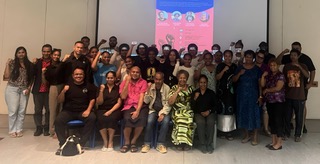
West Papuan journalists call for Pacific solidarity  

August 20, 2025 _  Ema Ganivatu

IN exile but unbroken, three West Papuan journalists are in Fiji calling on the Pacific to stand with them against Indonesia’s ongoing media blackout and human rights abuses.

Their visit is part of a broader effort to forge solidarity with Pacific neighbours, through media partnerships, university collaborations, and joint advocacy for human rights and self-determination.

Speaking after the screening of their latest documentary film “Pepera 1969: A Democratic Integration” at the University of the South Pacific, the team including Victor Mambor, co-founder of Jubi Media Papua, Yuliana Lantipo, senior journalist and editor, and Dandhy Laksono, Jakarta-based investigative filmmaker shared their personal experiences of reporting from inside one of the most heavily militarised and censored regions in the Pacific.

“We are here to build bridges with our brothers and sisters in the Pacific,” said Mambor.

“There is no hope from the Asian side,” added Laksono. “That’s why we are here, to reach out to the Pacific. We need new audiences, new support, and new understanding.”

The team urged Pacific people to push for greater awareness of the West Papuan situation and to challenge the dominant narratives propagated by the Indonesian government.

“Don’t just listen to what Jakarta says,” said Mambor. “Speak to Papuans. Listen to our stories. Raise our voices.”

“We want to bring West Papua back to the Pacific — not just geographically, but politically, culturally, and emotionally.”

Mambor described the continued targeting of Jubi Media staff, including attacks on their office and vehicles, as part of an escalating crackdown under Indonesia’s new President.

“Two of our operational cars were destroyed. Our journalists are constantly intimidated. Yet we continue to report the truth.”

The situation for press freedom in West Papua is dire. Foreign journalists are barred entry, internet access is often restricted during periods of unrest, and local reporters — especially Indigenous one’s risk arrest or violence for covering politically sensitive stories.

“If you report on deforestation or culture, maybe it’s allowed. But if you report on human rights or the military, there is no tolerance,” said Laksono.

Laksono, who is not Papuan himself but has long worked to expose injustices in the region, added:
“Much of Indonesia has been indoctrinated through school textbooks and media into believing a false history. Our film tries to change that by offering the truth, especially about the so-called Act of Free Choicein 1969, which was neither free nor a genuine act of self-determination.”

Journalist Yuliana Lantipo spoke of the daily trauma faced by communities caught between the Indonesian military and the West Papua National Liberation Army.

“Every day we receive reports: killings, displacement, families fleeing villages, children out of school, no access to health care. Women and children are the most affected,” she said.

As one of the few Indigenous female journalists reporting from conflict zones, Lantipo also highlighted how her identity both enables and complicates her work.

“Sometimes, as a woman, I can access conflict areas more easily, especially when traveling with elders or family members. But Indigenous male journalists, especially those with dreadlocks or visible Papuan identity, are often turned away or arrested.”

Despite the personal risks, Lantipo and her colleagues remain committed to their role.

“People need us to speak the truth. That is our responsibility. That is our profession.”

Jubi Media Papua

Founded in 2001 by West Papuan civil society, Jubi Media has become one of the most trusted and independent sources of information from the territory. With more than 30 reporters and 50 staff, the media house has built a reputation for fearless journalism.

Jubi means ‘to speak the truth’,” said Mambor. “We created a special section just to tell Pacific stories — to remind our people that we are not alone, and to reconnect West Papua with our Pacific identity.”

Amnesty International Indonesia documented 104 attacks against human rights defenders in the first half of 2025

Human Rights News / Indonesia / 1 August 2025 

Amnesty International Indonesia released a troubling report on 14 July 2025, documenting attacks against at least 104 human rights defenders across 54 separate cases during the first six months of the year. The peak of violence occurred in May 2025, when 35 human rights defenders became victims of attacks, highlighting what Amnesty International Indonesia Executive Director, Mr Usman Hamid, described as “the government’s failure to respect efforts to protect human rights in Indonesia.

The report reveals that more than half of the attacks targeted indigenous community members fighting for land rights and journalists covering sensitive issues, with 36 indigenous community members and 31 journalists among the victims. Other affected groups included community leaders, fishers, human rights activists, student activists, environmental advocates, academics, farmers, and anti-corruption campaigners. Law enforcement officers emerged as the primary perpetrators, with police suspected in 20 of the 53 documented cases. This figure was significantly higher than attacks committed by private companies, government employees, military personnel, or public order agencies.

Amnesty International identified five distinct forms of persecution: police reporting, arrests, criminalization, intimidation, physical violence, and attacks on human rights institutions. The civil society organisation attributes this surge in violence to the rise in authoritarian practices and policies, as well as the militarisation of civilian space, calling for immediate government action. Neither Human Rights Minister Natalius Pigai nor National Police spokesperson Inspector General Sandi Nugroho responded to requests for comment regarding the report’s findings.

Amnesty International Indonesia documented 104 attacks against human rights defenders in the first half of 2025

Human Rights News / Indonesia / 1 August 2025 

Amnesty International Indonesia released a troubling report on 14 July 2025, documenting attacks against at least 104 human rights defenders across 54 separate cases during the first six months of the year. The peak of violence occurred in May 2025, when 35 human rights defenders became victims of attacks, highlighting what Amnesty International Indonesia Executive Director, Mr Usman Hamid, described as “the government’s failure to respect efforts to protect human rights in Indonesia.

The report reveals that more than half of the attacks targeted indigenous community members fighting for land rights and journalists covering sensitive issues, with 36 indigenous community members and 31 journalists among the victims. Other affected groups included community leaders, fishers, human rights activists, student activists, environmental advocates, academics, farmers, and anti-corruption campaigners. Law enforcement officers emerged as the primary perpetrators, with police suspected in 20 of the 53 documented cases. This figure was significantly higher than attacks committed by private companies, government employees, military personnel, or public order agencies.

Amnesty International identified five distinct forms of persecution: police reporting, arrests, criminalization, intimidation, physical violence, and attacks on human rights institutions. The civil society organisation attributes this surge in violence to the rise in authoritarian practices and policies, as well as the militarisation of civilian space, calling for immediate government action. Neither Human Rights Minister Natalius Pigai nor National Police spokesperson Inspector General Sandi Nugroho responded to requests for comment regarding the report’s findings.

New interactive mapping platform exposes accelerating environmental destruction in West Papua

Human Rights News / IndonesiaWest Papua / 30 July 2025 

Groundbreaking satellite data analysis and interactive mapping tools have revealed the unprecedented scale of deforestation and ecosystem destruction across West Papua, with the National Strategic Projects driving 24% of the forest loss in 2024. A comprehensive new study published by Nusantara Atlas has unveiled a detailed analysis of land clearing trends across West Papua, revealing alarming acceleration in environmental destruction driven by government mega-projects and corporate expansion. The research introduces powerful new data visualization tools that allow interactive monitoring of ecological changes across one of the world’s last intact tropical wilderness areas.

The research methodology combines multiple data sources, including satellite imagery analysis, land-use planning documents obtained through information requests, and ground-based verification, to create a comprehensive picture of environmental change across West Papua. The publication’s combination of scientific analysis and accessible data visualisation tools marks a new era in environmental monitoring, providing the evidence base necessary for urgent policy intervention to protect one of Earth’s most biodiverse regions.

The Nusantara Atlas publication represents a breakthrough in environmental transparency by opening public access to civil society organisations, researchers, and policymakers with sophisticated tools previously available only to government agencies and large corporations. The interactive mapping platform allows public access to environmental monitoring data, enabling real-time tracking of ecological destruction and corporate accountability.

New data platform transforms environmental monitoring

The publication introduces “Papua Watch,” an interactive story map that provides unprecedented access to satellite-based monitoring of land clearing activities across 13 key locations in West Papua. The platform combines high-resolution satellite imagery, land-use planning data, and comparative analysis tools to track the ongoing expansion of food estates, oil palm plantations, mining operations, and infrastructure development in the region.

The mapping application’s most significant innovation lies in its ability to provide comparative satellite imagery analysis, allowing users to observe environmental changes over time with precision previously unavailable to the public. Users can visualize the exact locations where deforestation occurred, identify which ecosystems were affected, and track the companies responsible for the destruction.

Key data visualisation features include:

  • Time-series satellite imagery comparison showing before-and-after environmental changes
  • Detailed mapping of forest loss by driver and geographic location
  • Interactive overlay of protected areas, indigenous territories, and development projects
  • Real-time tracking of road construction and infrastructure expansion
  • Ecosystem-specific analysis distinguishing between primary forest, swamp forest, savanna, and grassland conversion

Alarming acceleration of environmental destruction

The research reveals that primary forest loss in West Papua rose 10% from 2023 to 2024, reaching 25,300 hectares, with preliminary 2025 data indicating the pace is accelerating further. Most significantly, the Merauke National Strategic Project (PSN) emerged as the top driver of deforestation in 2024, resulting in the loss of 5,936 hectares of primary forest. This figure equals 24% of all recorded forest destruction.

The satellite data shows that from January 2024 to June 2025, the Merauke PSN cleared 22,272 hectares of natural ecosystems, including primary forest (9,835 ha), Melaleuca swamp forest, natural savanna, and grassland. This represents only a fraction of the project’s ultimate target of converting up to 3 million hectares for rice fields and sugarcane plantations.

Interactive tools reveal corporate networks behind destruction

The mapping platform’s corporate tracking capabilities expose the key players driving environmental destruction in West Papua. The analysis identifies the Jhonlin, Fangiono, and Salim groups as the three primary actors. The interactive data allows users to trace specific concessions to their corporate owners and track their clearing activities over time.

Major findings through the mapping analysis revealed that PT Global Papua Abadi (linked to the Fangiono family) cleared 11,751 hectares between January 2024 and June 2025. Land clearings associated with the oil palm expansion in the first half of 2025 are already equal to those of all of 2024, indicating an accelerating pressure on land and resources. According to the satellite imagery analysis on the infrastructure development, 40 km of a planned 135 km access road have been completed, opening new areas for exploitation that have previously been inaccessible.

Mining threats exposed through island-specific analysis

The research platform also provides a detailed analysis of mining impacts on West Papua’s ecologically sensitive small islands, particularly in Raja Ampat. The mapping reveals that PT Gag Nikel cleared 35 hectares between January 2024 and June 2025, while PT Kawei Sejahtera Mining cleared an additional 35 hectares on Kawe Island.

The platform’s ecosystem-specific analysis demonstrates why island mining poses exceptional risks. Smaller islands are home to globally significant biodiversity, which cannot regenerate once damaged by industrial operations due to their geographical limitation and their exposure to various forms of erosion.

Infrastructure development catalyses environmental destruction

The mapping shows that completion of planned infrastructure will inevitably increase accessibility to protected areas, including Danau Bian and Bupul Nature Reserves, facilitate speculative land clearing as road access increases land values, and enable expansion of transmigration sites with associated population pressure.

The platform’s road network analysis reveals the strategic nature of current development. The new PSN road, when completed, will connect to the existing Trans-Papua Highway and MIFEE road networks, creating a continuous corridor across southern Papua’s wilderness. The mapping illustrates that this corridor ends less than 1 km from the Danau Bian Nature Reserve, putting this protected ecosystem at immediate risk.

The comparative satellite imagery supports the observation that road construction acts as a catalyst for broader environmental destruction, with clearing expanding along transport corridors and facilitating industrial access to previously protected areas.

Scientific validation of environmental concerns

The research validates concerns about the environmental suitability of current projects through detailed ecosystem analysis. The mapping reveals that much of the targeted area consists of acidic peat soils and seasonally flooded wetlands, conditions that have caused similar food estate projects to fail elsewhere in Indonesia.

The platform’s soil and climate data integration shows that Merauke’s tropical wet-dry savanna climate, combined with naturally occurring annual wildfires and highly acidic soils, creates conditions “far from ideal for rice cultivation.” The research notes that while the Indonesian government claims a successful first rice harvest on a 4-hectare plot in May 2025, initial yields often succeed due to residual soil nutrients before productivity typically declines as tropical soils become increasingly acidic and nutrient-poor.

International implications and conservation priorities

The research platform positions West Papua’s environmental crisis within global conservation priorities, noting that the region represents one of the world’s last intact tropical wilderness areas. The mapping demonstrates that without urgent intervention, such as Indigenous land rights recognition, science-based land use planning, and a permanent halt to the Merauke Strategic National Project, West Papua is at high risk of losing irreplaceable ecosystems.

Interestingly, the study warns that continued destruction could jeopardize Indonesia’s 2030 net-zero emissions target, as the clearing of carbon-rich peat forests and wetlands releases significant greenhouse gases into the atmosphere.

Urgent call for policy response

The research concludes with specific policy recommendations based on the mapping analysis. Recommendations include implementing a moratorium on forest conversion to oil palm, banning mining on small islands, recognizing Indigenous land rights, and adopting science-based land use planning. The interactive platform provides policymakers with the precise geographic and temporal data needed to implement targeted conservation measures.

Military members accused of fatally torturing Papuan youth in Intan Jaya for wearing a t-shirt with Morning Star

CasesHuman Rights News / IndonesiaWest Papua / 25 July 2025 

On the evening of 17 July 2025, members of the Indonesian National Armed Forces (TNI) reportedly tortured and executed Mr Obert Mirip, an 18-year-old student, inside the Titigi Military Post, Sugapa District, Intan Jaya Regency, Papua Tengah Province (see photo on top, source: Jubi). The incident occurred after Obert was accused of being a member of the West Papua National Liberation Army (TPNPB) for wearing a shirt displaying the Morning Star Flag and the Papua New Guinea flag. Multiple reports affirm that Mr Mirip was not affiliated with any armed group but was summarily executed in military custody. His body was later returned to his village by order of the local TNI commander, without formal investigation or due process.

According to reports from multiple independent sources, TNI personnel deployed drone surveillance over Ndugusiga Village on 17 July 2025, at approximately 7:00 pm. After identifying Mr Obert Mirip based on his clothing, TNI soldiers reportedly descended from their post, forcibly arrested him at his home, and escorted him to the Titigi military post. That same night, he was allegedly tortured and eventually succumbed to the injuries he sustained as a result of torture. The next day, TNI soldiers informed nearby villagers that a TPNPB member had been shot and demanded that the body be collected for burial. Upon verification, community members confirmed that the deceased was Mr Obert Mirip.

The TPNPB Central Headquarters released a statement according to which Obert Mirip was not associated with the TPNPB and condemned the killing as a deliberate act of intimidation aimed at suppressing civilians. Local civil society actors denounced the TNI’s narrative as disinformation and accused state authorities of violating the civil and political rights of the indigenous population. The dissemination of false claims labeling Mr Obert Mirip as a TPNPB member was widely criticised as a defamatory tactic aimed at justifying unlawful violence against civilians.

Relatives and civil society representatives have called upon Indonesian authorities to conduct an independent, impartial, and transparent investigation into the killing of Mr Obert Mirip and to ensure that all perpetrators, including those with command responsibility, are held accountable. The Indonesian National Human Rights Commission (Komnas HAM) should monitor the situation in Intan Jaya and other conflict areas and timely investigate allegations of grave human rights violations in West Papua.

Background

The killing of Obert Mirip underscores the urgent need for the Indonesian state to demilitarise West Papua and to guarantee the right to freedom of expression, cultural identity, and political opinion without fear of retaliation or violence. The Titigi area already became an area of conflict in April 2023, as Indonesian security forces conducted raids on four villages in the Intan Jaya Regency of West Papua, covering an area of 2.7 square kilometres. The raids destroyed at least 28 houses. Security forces reportedly killed four civilians and injured three others, including two minors. More than 3,000 indigenous Papuans were internally displaced   as a result of these operations, facing dire living conditions without access to adequate food, healthcare, or education

Legal analysis

This incident constitutes a grave violation of international humanitarian and human rights law, notably the right to life, the prohibition of torture, and the protection of civilians under the Fourth Geneva Convention. The summary execution of an unarmed civilian without judicial process is a potential crime against humanity under Article 7 of the Rome Statute of the International Criminal Court (ICC), especially in the context of a widespread and systematic attack against the civilian population.

Photo of Mr Obert Mirip’s body taken on 18 July 2025, after being tortured by TNI members in Titigi, Intan Jaya

Joint security forces torture and arbitrarily arrest four KNPB activists in Dekai, Yahukimo

CasesHuman Rights News / IndonesiaWest Papua / 17 July 2025 

On the night of 12 July 2025, joint security forces consisting of Navy’s Marine Corps, Police Mobile Brigade (Brimob), and the local police raided the secretariat of the West Papua National Committee (KNPB) in Dekai, Yahukimo Regency, Papua Pegunungan Province, and arbitrarily arrested the four KNPB members, Mr Sinduk Enggalim, Mr Deko Kobak, Mr Hulu Amosoho, and Mr Ronal Kobak. The four activists were subjected to severe physical abuse during and after their arrest, amounting to torture. They were released two days later, on 14 July 2025, in a physically injured state and without charges filed against them.

On 12 July 2025, at 10:35 pm, police forces arrived at the KNPB office in a patrol vehicle and remained parked on the main road for approximately 20 minutes. At 10:55 pm, joint security forces entered the KNPB office compound. Three police officers approached two activists sitting on the veranda, followed by dozens of Brimob and military personnel. Security forces entered the building and started searching the office while devastating the interior. Witnesses reported hearing cries of pain from inside the secretariat.

The four activists were then apprehended, their hands bound behind their backs, their eyes blindfolded with duct tape, and loaded onto a military vehicle. The activists testified they were severely beaten while en route to the Koramil military post, causing two of them to urinate involuntarily. Upon arrival, they were thrown onto the ground and subjected to a six-hour torture session that included burning of skin, electrocutions, beatings with hard objects to the head and body, and being submerged in drums filled with water, in an attempt to force confessions regarding alleged affiliations with the West Papua National Liberation Army (TPNPB). Mr Hulu Amosoho was separated from the group and tortured in isolation.

On 13 July 2025, around 06:00 am, they were transferred to the Yahukimo Police Station, where the torture continued. Police officers reportedly burned their hair and beards. Despite a subsequent visit to the hospital, only minimal treatment was provided following instructions from military personnel. All four were released on 14 July 2025, at 3:00 pm, due to the lack of incriminating evidence.

Legal and human rights analysis

The arrest and detention of the four activists constitute grave violations of international human rights law, including the prohibition of torture under the Convention Against Torture (CAT), to which Indonesia is a party. The arrest was carried out without a warrant, at night, and in the absence of any visible or declared legal basis, violating Article 18 of Indonesia’s own Criminal Procedure Code (KUHAP), which mandates due process safeguards.

Moreover, the involvement of military personnel in civilian law enforcement, particularly in the arbitrary arrest and inhumane treatment of political activists, further constitutes a breach of the principle of civilian supremacy and violates Article 9 of the International Covenant on Civil and Political Rights (ICCPR), which guarantees the right to liberty and security of person.

The prolonged incommunicado detention, denial of access to legal counsel and family members, and the lack of judicial oversight strongly suggest the presence of enforced disappearance-like practices during the initial hours of detention.

The Indonesian government is obliged under international human rights law to launch an independent investigation into acts of torture and arbitrary arrest committed by state agents, ensuring that those responsible will face criminal prosecution. The Indonesian Government should refrain from the use of military personnel in civilian law enforcement roles, particularly against political actors. All victims of arbitrary arrest and torture must receive comprehensive medical treatment, psychosocial support, and reparations, including compensation and rehabilitation in accordance with international standards.

Table of KNPB activists arrested and tortured during police detention in Dekai on 12 July 2025

NoNameAgeAffiliationAdditional information
1Sinduk Enggalim28Chairman, KNPB YahukimoBeaten, could not sit or stand for extended periods
2Deko Kobak25Activist, KNPB YahukimoChin laceration requiring stitches, unable to eat; he was beaten with a blunt object to the face, sustained a cut above the left eye
3Hulu Amosoho23Activist, KNPB YahukimoHead and facial injuries required stitches
4Ronal Hiben Ris Kobak23Activist, KNPB YahukimoBeaten, suffered from inability to sit or stand for long

Photos showing the physical condition of four KNPB activists after being tortured in Yahukimo

Video testimony by four KNPB activists after being released on 14 July’25

Trial begins in Tobias Silak Murder Case amid transparency concerns

Human Rights News / IndonesiaWest Papua / 2 July 2025 

Nearly 11 months after the fatal shooting of Mr Tobias Silak in the Yahukimo Regency, Papua Pegunungan Province, criminal proceedings have commenced at the Wamena District Court against the four police officers, Muh. Kurniawan Kudu (Chief Police Brigadier, Bripka), Fernando Alexander Aufa, Ferdi Moses Koromath, and Jatmiko (see photo on top, source: WPCC). The case files were transferred to the Public Prosecutor in Wamena on 28 May 2025, with the first hearing held on 24 June 2025. The court session focused on the reading of indictments. However, the scheduled 30 June hearing for defendant objections was postponed due to the defence team’s lack of preparedness, raising early concerns about the pace of the proceedings.

The trial process has sparked significant transparency concerns, as the victim’s family and their legal counsel were not notified of the first hearing. Mr Kawer criticized the prosecutor’s failure to inform key stakeholders, questioning whether the prosecution truly represents victim interests or public interest as claimed. Additionally, legal representatives have expressed dissatisfaction with the charges brought against the defendants, primarily Article 338 (murder) and Article 395 (negligence causing death) of the Criminal Code KUHP. They argue that the more serious charge of premeditated murder under Article 340 would better reflect the gravity of the shooting that killed both Mr Tobias Silak and Mr Naro Dapla on 20 August 2024.

In response to these procedural concerns, the Indonesian Judicial Commission in Papua announced in late June’25 that it would monitor the trial proceedings following a request from the victim’s family’s legal team. The Commission is currently awaiting authorization from the headquarters to begin formal oversight. Meanwhile, civil society groups, including the Tobias Silak Justice Front, continue to demand maximum penalties, including dismissal from the police force for the accused officers, while planning consolidation efforts across multiple cities to maintain public pressure throughout the trial process (see photos below, source: FJTS).

The case represents a critical test of Indonesia’s commitment to accountability for alleged security force violations in West Papua, with at least eight hearings expected before a verdict is reached. The outcome will be closely watched as an indicator of whether Indonesia’s justice system can break the pattern of impunity that has characterized similar cases in the region.

The Tobias Silak Justice Front held a peaceful protest in front of the Prosecutor’s Office in Wamena on 10 June 2025

Civil society condemns government denial and calls for international intervention

Human Rights News / IndonesiaUN on West PapuaWest Papua / 2 July 2025 

In the past months, the situation surrounding the National Strategic Project (PSN) in Merauke, Papua Selatan Province, has further escalated. In the Soa Village, Tanah Miring District, indigenous women from 75 families have collectively opposed the land encroachment by PT. Global Papua Abadi, which received a government concession for an energy project without the community’s free, prior, and informed consent (FPIC). This project threatens to destroy their natural sources of livelihood and violates their rights to land and self-determination. Similarly, on 23 June 2025, indigenous land belonging to the Kwipalo clan in Kakyo Village, Semangga District, was reportedly seized by the military for the construction of a post without consent or legal process, constituting a grave act of militarisation and forced dispossession.

Investigations by the National Commission on Human Rights (Komnas HAM) in May and June 2025 revealed widespread violations across multiple districts in Merauke. These include forced evictions, destruction of sacred sites, and the complete disregard for FPIC principles. Indigenous communities, religious leaders, and civil society groups have united in protest, calling the PSN an instrument of structural injustice and ecocide. On 17 June 2025, the Indonesian Fellowship of Churches (PGI) condemned the PSN for violating indigenous rights, destroying ecosystems, and exacerbating the climate crisis.

In addition to public mobilisation and advocacy, a coalition of Indonesian civil society organisations (CSOs) issued a formal response to the joint communication of nine UN Special Rapporteurs dated 7 March 2025. The CSOs strongly criticised the Government of Indonesia’s reply of 6 May 2025 for denying ongoing and well-documented human rights and environmental violations related to the National Strategic Project (PSN) in Merauke. They noted that the government’s response ignored empirical evidence and failed to address the substantive issues raised by the UN experts, including land dispossession, militarisation, food insecurity, ecological destruction, and the lack of respect for FPIC principles

According to the CSOs, the government’s reply reflected a broader institutional reluctance to engage meaningfully with international human rights norms. They pointed out that the Indonesian state has failed to comply with recommendations made by Komnas HAM, as well as with constitutional and international legal standards safeguarding indigenous peoples’ rights. Furthermore, they underscored that permits and business licences had been granted to companies in areas with customary land claims, without community consent or proper consultation. The coalition urged the UN Special Rapporteurs to conduct direct monitoring in Merauke and called for the immediate suspension of PSN implementation to prevent the continued expansion of human rights and environmental violations.

The PSN’s implementation in Merauke reflects a deeper failure of democratic governance and environmental responsibility. It undermines constitutional protections and international legal obligations, particularly under the UN Declaration on the Rights of Indigenous Peoples. The Indonesian government’s response to concerns raised by UN Special Rapporteurs has been criticised as evasive and dishonest. Indigenous leaders and civil society continue to demand the immediate suspension of all PSN activities, restoration of customary lands, adequate reparations, and a UN-led investigation. Without urgent corrective action, the PSN will inevitably destroy the ecological, cultural, and spiritual fabric of West Papua’s indigenous communities.

The military seized land belonging to the Kwipalo Clan in the Kakyo Village, Semangga District, without consent or legal process

 Planetary urbanisation: Why Indonesia destroys its green islands to ‘green’ cities elsewhere 

Sediment is clearly visible close to nickel mining operations on Kawe Island, Raja Ampat, discolouring the water in one of Indonesia’s most biodiverse marine areas. The concession covers an area of 5,922 hectares and is located within the mega-biodiversity region of Raja Ampat, West Papua.

BY DWIYANTI KUSUMANINGRUM

26 JUNE 2025

This article is reproduced courtesy of University of Melbourne’s unit Indonesia at Melbourne

The controversy over nickel mining in Raja Ampat, Papua, is a telling example of how capitalist-driven planetary urbanisation is reshaping the world we live in.

Today, urbanisation occurs on a global scale. It is taking place not only within cities and urban areas but even in many non-city zones that serve as ‘operational landscapes’ for supplying cities’ demands. This concept of ‘planetary urbanisation’ explains how non-urban realms in the Global South have played a strategic role as operational landscapes supporting cities in the Global North.

Environmentally destructive nickel mining activities within the Raja Ampat UNESCO Global Geopark, a global tourism site widely known for its idyllic scenery and marine biodiversity, is a case in point. It shows how the current global demand for urban environmental sustainability has incentivised policymakers in the Global South to provide the materials needed for the cities in the North to be more sustainable.

It also tells the disturbing story of how Indonesia, in a nutshell, is willing to destroy its invaluable green islands for the sake of ‘greening’ cities in China and Europe.

Colonial origin of planetary urbanisation

Indonesia’s rich natural resources have been a source of vital global commodities since the colonial era. In the 15th century, high demand for commodities from Europe encouraged exploration in tropical countries, paving the way for colonialism. 

Resource exploitation by colonial powers played a critical role in the growth of cities in Indonesia and Europe, since the extraction from Indonesia funded the growth of the Netherlands and its cities. This is one of the first examples of planetary urbanisation — where the South was squeezed to provide for the North.

During colonial times, most Indonesian cities were basically just ‘operational landscapes’ of Dutch cities. By the late 18th century, for example, Makassar and Ternate were important cities in the global spice route and became hubs for the ‘local government’ of the VOC (Vereenigde Oost-Indische Compagnie, the Dutch East India Company). A similar trajectory also happened to Pangkalpinang, with its tin mining on Bangka Island, and Padang, a port city that supplied gold powder from the Minang kingdom.

The locations of Indonesia’s new ‘cities’ later expanded beyond those determined by geographical localities (resources sites). In the inland of Java, cities grew organically around train stations as a result of the expansion of transportation networks and the extensive exploitation of plantations in many different locations.

This process of planetary urbanisation continues today, as nickel becomes the latest commodity sought after by major cities in the northern hemisphere.

Nickel boom and resource nationalism

The global demand for renewables such as wind turbines, solar panels and EV batteries has fuelled excessive extraction of nickels in many countries including Indonesia, where more than half the world’s nickel supply is located. According to US Geological Survey, Indonesia has as many as 55.000.000 metric tons of nickel reserve.

Under former president Joko “Jokowi” Widodo, Indonesia introduced a series of policies aimed at downstreaming its nickel mining industry. These included banning  nickel ore export  and promoting domestic nickel processing industry.

However, this seemingly nationalistic policy is not necessarily beneficial for the Indonesian people. Scholars have argued that “resource nationalism” is in fact a pseudo-nationalism, because it is plagued by rent-seeking practices. A revealing Watchdoc investigative documentary has shown that the nickel industry in Indonesia largely benefits just a few mining oligarchs. To make matters worse, more than 90% of nickel processing infrastructure is owned by Chinese companies.

Nickel mining and environmental degradation 

Nickel mining activities in the eastern part of Indonesia are embodiments of ‘operational landscapes’ in ‘planetary urbanisation’. This is indicated by the spatial and social concentration of capital in the forms of infrastructural facilities and the influx of migrant workers, some of whom are from China, in the region.

Look at the private airports in the Indonesia Morowali Industrial Park (IMIP) and on Gag Island, Raja Ampat. At IMIP alone, there are 91,581 Indonesian workers and 11,615 foreign workers working in the industry. Or look at Teluk Weda’s smelters and port, which serves as a hub for vessels carrying nickels from small islands in the eastern part of Indonesia.

It remains to be seen, however, if these new ‘operational landscapes’ will eventually lead to the creation of new local cities as it was the case during colonial times, or if they will only destroy the environment in Indonesia to support cities in other countries.

The reality is that nickel mining sites are believed to have caused anthropogenic disasters (floods and landslides), and environmental degradation (air, land, and water pollutions), adversely affecting the local communities.

Floods in Morowali, for example, are attributed by many observers to IMIP industrial zones replacing local forest that previously served as a catchment area. In Teluk Weda, for example, Forest Watch Indonesia has found that the expansion of nickel industry encroaching into nearby forested areas has increased the flood risk in the surrounding areas.

In Obi Island, North Maluku, local media reported that mining activities had directly dumped their waste into the ocean. In Teluk Weda, nickel mining allegedly polluted  the river and groundwater, affecting the lives of the locals in Halmahera.

The Watchdoc documentary also emphasises the impact of the mining industry on Teluk Weda’s public health. Levels of the heavy metal arsenic have been detected in blood samples taken from residents, mining workers, and fishermen in the area. This demonstrates how the nickel mining industry can have fatal consequences.

Sustainable for whom? 

Capitalism can be cruel. Yet, there is no denying that capitalist-driven Dutch colonialism, which heavily relied on plantations, played a role in the making of major cities in Indonesia with less severe environmental degradation. The ongoing process of mining activities in eastern part of Indonesia seems much more ominous.

We need to ask who really benefits from the global campaign for’ sustainable development’. Of course Indonesia should tap this economic opportunity, but we cannot let it happen at the expense of our own natural habitat and our society’s wellbeing.

Indigenous Moi Tribe rejects massive palm oil project threatening last remaining forests in West Papua

Human Rights News / IndonesiaWest Papua / 26 June 2025 

The Indonesian government’s plan to implement a National Strategic Project (PSN) worth 24 trillion rupiah in the Papua Barat Daya Province has sparked resistance from indigenous communities. They understand the massive palm oil development as an existential threat to their ancestral lands and way of life. PT Fajar Surya Persada Group’s proposal, submitted to the Governor on 27 May 2025, seeks to establish an integrated palm oil-based food industry across 98,824.97 hectares covering key districts in Sorong and Tambrauw regencies. The project involves a consortium of five companies that would control vast swaths of traditional Moi territory, including PT Inti Kebun Sawit (18,425.78 hectares), PT Inti Kebun Sejahtera (307.91 hectares), PT Sorong Global Lestari (12,115.43 hectares), PT Omni Makmur Subur (40,000 hectares), and PT Graha Agrindo Nusantara (13,799.51 hectares).

The indigenous Moi Tribe has voiced resistance against what they describe as systematic land grabbing disguised as development. On 21 June 2025, Moi communities from 13 affected districts held traditional consultation meetings in the Klaso District, culminating in sacred oath-taking ceremonies (see photo on top, source: Suara Papua) and the planting of “Tui” bamboo poles, traditional symbols of prohibition and spiritual protection. Traditional leader, Dance Ulimpa declared that the Moi people “can live without palm oil, but cannot live without our customary forests,” emphasizing that these represent their last remaining forest territories. The communities have threatened to paralyze government offices in the provincial capital and the Sorong Regency if authorities accept the company’s application.

Evidence from existing palm oil operations in the region reveals devastating environmental and social impacts that fuel indigenous resistance. According to community testimonies, palm oil companies already operating in Sorong District have caused severe ecological damage, including pollution of the once-pristine Malalis and Klasof rivers where PT Hendrison Inti Persada and PT Inti Kebun Sejahtera operate. Traditional representative Desi Karongsan reported that the Klasof River now runs yellow and oily during rainy seasons, killing fish and causing skin rashes among children. Despite promises of economic benefits, only one Moi person reportedly works for the palm oil companies, while customary land is leased at exploitative rates of just 100,000 rupiah (approximately € 6.00) per hectare per month. The economic marginalization is so severe that some indigenous land is leased at only 6,000 rupiah per hectare, highlighting the gross inequality in benefit distribution.

Political resistance is building at multiple levels, with the West Papua Regional Parliament (DPRP) committing to draft regional regulations protecting indigenous rights and imposing a moratorium on palm oil expansion. A coalition of 18 organizations, including the Moi Great Tribe Council, Indigenous Peoples Alliance of the Archipelago (AMAN), Greenpeace Indonesia, and various human rights groups, has formally rejected the PSN, arguing that despite Papua’s Special Autonomy Law intended to protect indigenous rights, communities continue facing poverty, displacement, and human rights violations. The coalition demands an immediate halt to all PSN activities that deprive indigenous communities of their ancestral land. The coalition calls for development policies that prioritize indigenous participation and environmental protection over corporate interests in what they describe as West Papua’s transformation into “a testing ground for greedy and reckless development.”

Is Marles the right fit for defence?

Indonesia’s President-elect Prabowo Subianto, Deputy Prime Minister Richard Marles and Prime Minister Anthony Albanese at a joint statement at Parliament House in Canberra, Tuesday, August 20, 2024. Indonesian Defence Minister and President-elect Prabowo Subianto is visiting Australia from 19 to 20 August 2024

June 16, 2025               

P&I readers don’t need to be told that Defence Minister Richard Marles is floundering when trying to make security links with Indonesia seem as though they’ve “never been in better shape”.

Relationships could be basking on the sunny side in the interests of regional harmony, though the enthusiasm is partisan. As Professor Tim Lindsey reminded in this newsletter:

“To put it bluntly, Australia struggles to get Indonesia’s attention. It is an uncomfortable truth that… Australia’s leverage and importance is limited. Jakarta sees Canberra as the junior partner in the relationship.”

Readers can measure Lindsey’s academic appraisal against Marles’ bushy-tailed approach when viewing this short clip of his media conference in Jakarta earlier this month.

It appears that little of substance was achieved in the meeting with his Duntroon-trained counterpart, Sjafrie Sjamsoeddin.

The Australian’s job is to persuade the Indonesians to settle disputes through wearing out words before loading weapons. It can be a long and boring process but diplomacy can save lives.

The task will be tough because Marles, 57, is not from the warrior class. He was a lawyer and union official before entering Parliament.

Apart from titles, the two men have nothing in common – they can’t even talk cricket (an alien game in the Archipelago) or swill beer together as Muslim Sjafrie is a teetotaller. His ignorance of Australian values was made clear with the gauche gift of an Indonesian 9mm Pindad combat pistol.

Septuagenarian Sjafrie was a career soldier who served in the Kopassus Special Forces unit which has a reputation for ruthlessness. He became a lieutenant-general, a close mate since training days with President Prabowo Subianto who supplied his present job.

In the Indonesian political system, ministers can be hand-picked by the president from outside Parliament.

Prabowo is now replacing civilian functionaries with military men, raising comparisons to the last century doctrine of dwifungsi(dual function) “that allowed the armed forces to crush dissent and dominate public life”.

(Second President Soeharto, a former general and autocrat who ruled Indonesia for 32 years, was Prabowo’s model – and former father-in-law.)

The Indonesian media favours “retired” when referencing Sjafrie’s exit from his 36-year career. However, his Wikipedia entry claims he was “dismissed” from the military over allegations he was involved in the disappearance of 13 Jakarta student democracy activists – a charge he rejects.

His boss, Prabowo, was cashiered for the same 1998 offence and fled to exile in Jordan.

This month the Marles’ message to his homeland stressed geography and strategy to underline our neighbour’s importance; the first is elementary and the second an on-the-fly concept poorly articulated:

“You just need to look at the map to understand how strategically important Indonesia is to Australia, but how strategically important Australia can be to Indonesia. We really can help provide Indonesia with strategic depth.

“We have a security anxiety in relation to China that’s principally driven by the very significant conventional military build-up that China is engaging in… It does shape how we think about the strategic landscape.”

How Indonesia thinks wasn’t addressed. “We” must have referred to Oz and not the Marles-Sjafrie meeting and its unspecified “optimistic and ambitious bilateral agenda”.

Sjafrie was absent from the Marles’ media stand-up, probably fearing he might encounter a probing journo should he venture too close to a mike.

Not to explain the 20 honour ribbons layered down his uniform, including the Star of Peace Veteran awarded this year, but his behaviours while an ambitious young soldier putting down dissidents.

He was in East Timor during the 1991 Santa Cruz Cemetery massacre when at least 280 protesters against Indonesian occupation were shot and hundreds went missing. Sjafrie also served in Aceh and West Papua, fighting Indonesian citizens demanding independence.

When his army ties ended, he became the defence ministry secretary-general. In 2009 he was scheduled to accompany then president Susilo Bambang Yudhoyono on a trip to Pittsburgh for the G-20 summit.

In those days, the US took a moral stand on VIP visitors with suspect histories. It refused Sjafrie a visa, apparently because of alleged links to past atrocities in East Timor and Jakarta which he denies. He’s never faced a court

Marles has no similar reservations, so he has invited Sjafrie to Australia. He also wants Indonesian troops to train in Australia – though no dates have been set.

Whether this would attract Australian protesters concerned about human rights in Indonesia is doubtful. The lobby is overwhelmed with issues from Israel.

It’s small when compared with Aotearoa NZ where former politicians, Pacific Island NGOs, church leaders and academics regularly report alleged atrocities in the Republic – particularly the closed province of West Papua.

However much they may dislike members of other governments for their policies, personalities and actions, most diplomats tend to swallow hard in their dealings with unpalatable foreign leaders.

That’s why the sanctioning of two members of the Israeli Government, Security Minister Itamar Ben-Gvir and Finance Minister Bezalel Smotrich, is unusual when both nations are allies and democratic.

The far-right politicians’ assets have been frozen and travel bans imposed for reportedly advocating violence. The US is angry, but Oz has support from Canada, the UK and other nations.

Prabowo and Sjafrie won’t get the same treatment — their alleged crimes occurred long ago — and the damage to Australian-Indonesian relations today would be too great for any outbreak of principles.

The days of civilian seventh president Joko “Jokowi” Widodo and Malcolm Turnbull’s jolly strolls around Sydney in 2017 are legendary.

In those times, relationships really were in better shape.

The views expressed in this article may or may not reflect those of Pearls and Irritations.

Duncan Graham

Duncan Graham has been a journalist for more than 40 years in print, radio and TV. He is the author of People Next Door (UWA Press). He is now writing for the English language media in Indonesia from within Indonesia. Duncan Graham has an MPhil degree, a Walkley Award, two Human Rights Commission awards and other prizes for his radio, TV and print journalism in Australia. He lives in East Java.

———————————————————