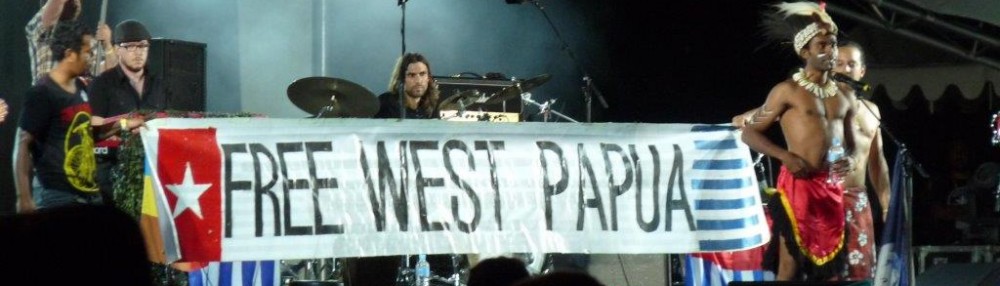
The AWPA Annual General Meeting will be held following the lunch around 2-15-2.30 p.m.
There will be reporting on the various projects around the continuing problem of Internally Displaced People in West Papua, the renewal of transmigration and the increased political role for the armed force in the Indonesian Government.
The TNI Headquarters stated that the TPNPB-OPM’s accusations were a way to discredit the TNI and seek world sympathy.
May 16, 2025 | 15.55 WIB
TEMPO.CO, Jakarta – The West Papua National Liberation Army of the Free Papua Movement (TPNPB OPM) accused the Indonesian military of planting a landmine bomb on the body of a TPNPB OPM soldier. Previously, the soldier was killed in a shootout between them and Indonesian military forces.
“The victim’s body was planted with a landmine bomb by the Indonesian government military, but the TPNPB troops did not know about it,” said TPNPB OPM spokesman Sebby Sambom in a written statement on Friday, May 16, 2025.
The mine bomb then exploded right when the evacuation of the bodies was carried out. As a result, two TPNPB OPM members who were helping to evacuate the victims were killed in the incident.
“During the evacuation, the mine bomb that was installed exploded and resulted in two TPNPB members being killed and two other members being injured,” said Sebby.
According to Sebby, the three TPNPB OPM soldiers who died were Gus Kogoya, Notopinus Lawiya, and Kanis Kogoya. Meanwhile, those who suffered minor injuries due to bomb fragments included Tinus Wonda and Dnu-Dnu Seperti.
“The injured are currently at the TPNPB headquarters to undergo medical treatment,” he said.
Previously, armed contact between the TPNPB OPM and the Indonesian military occurred since around 05.00 in the morning on Tuesday, May 13, 2025. Sebby claimed that the armed contact occurred after the Indonesian military launched an operation and shot civilians in Titigi Village, Ndugusiga Village, Jaindapa Village, Sugapa Lama Village, and Zanamba Village.
The Indonesian National Armed Forces Headquarters has dismissed allegations by the West Papua National Liberation Army-Free Papua Movement (TPNPB-OPM) regarding the use of explosives in an operation in Sugapa District, Intan Jaya Regency, Papua, last Wednesday, May 14, 2025.
Head of the TNI Headquarters Information Center, Major General Kristomei Sianturi, said that soldiers from the Habema Task Force did not use explosives or plant mines during the operation.
“That is OPM propaganda to discredit the TNI and seek world sympathy that the TNI is committing human rights violations in Papua,” said Kristomei when contacted on Friday, May 16, 2025. According to him, the TPNPB-OPM’s accusations and negative narratives against the TNI are nothing new. This is because this action is often carried out to attract world attention.
Tempo has tried to confirm this with the Head of the Cartenz 2025 Peace Operation Brigadier General Faizal Ramadhani and the Head of Information for the Cendrawasih XVII Military Command Lieutenant Colonel Candra Kurniawan. However, until this news was written, there had been no response.
Andi Adam Faturahman contributed to the writing of this article
Ancient Javanese mythology, often inherited from India and adapted to fit local culture, is rich with striking characters in the wayang kulit shadow puppet theatre. The fat-gut wise clown Semar is charged with maintaining stability.Shadow Puppet of Semar. Contributor: YA/BOT / Alamy Stock Photo Image ID: 2HWMM88
This mirrors Anthony Albanese’s zip-in-and-out visit to Jakarta. The prime minister came with the doctrine, made famous by Paul Keating in 1994, to tell President Prabowo Subianto that “there is no country more important to Australia than Indonesia”.
Keating may have thought it true – the electorate knows it’s not.
Albanese is being polite by meeting Prabowo and getting a hotel visit that was “warm”. Government PR has a limited temperature range for such events. There was much flag waving by the hire-a-parade service – but that’s a standard Jakarta welcome for VIPs.
Here’s the cold front that Albanese hasn’t addressed: In 2023 the Lowy Institute asked: Do Australians and Indonesians trust each other?
“Australian attitudes towards Indonesia have been — at best — lukewarm. And at worst, they betray a lurking suspicion.
“Only 12% of Australians nominated Indonesia as Australia’s ‘best friend in Asia’ – fewer than Japan, India and Singapore.”
If Albanese and the Department of Foreign Affairs and Trade have read the Lowy surveys, there’s little sign they’re clearing out the threadbare cliches for an Op Shop. Melbourne Uni Prof Tim Lindsey has written:
“Indonesia and Australia have almost nothing in common other than the accident of geographic proximity. This makes their relationship turbulent, volatile and often unpredictable.”
With this talkfest, all was predictable. Much of the reporting reads as though it’s been assembled using AI – such is the lack of mainstream media expertise in the region.
Security, trade and defence were the leads, though there were few proposals to effect change. The Indonesia-Australia Comprehensive Economic Partnership Agreement is a bipartisan deal signed in 2020 after 10 years of negotiation.
It was supposed to improve two-way trade. Apart from adding university outposts, it’s failed to meet diversity goals, remaining a dealer in bulk – mainly meat and grains, heading from us to them. Albanese urged Oz Biz to show greater ambition, but the big problem is in Indonesia.
Explained The Jakarta Post: “Indonesia’s ambition to attract world-class investment is being quietly sabotaged, not by interest rates or the threat of US trade tariffs, but by the familiar menace of thuggery and extortion.
“From street-level rackets to entrenched mafia control of parking, freight and food markets, criminal coercion continues to drain business confidence, inflate costs and corrode the very rule of law that investors depend on.”
Now add numbers – 11 of them to one of us. Stir in the Red Threat – phantom Russian bombers scouting for a base in West Papua leading to nuclear strikes on Kirribilli. This beat-up was refuelled at the leaders’ media conference, though the hollow story has long been trashed by Jakarta.
The chance to raise serious issues in the relationship was missed. That was wrong. Likewise, the whitewashing of Prabowo, 73. To be informed world citizens, Australians need to know more of the ruler next door.
He now gets benign labels like “retired general” or “former army general and defence minister”. The full story is that in 1998, he was cashiered, fled into exile in Jordan and banned from the US and Australia for alleged human rights abuses and war crimes.
He denies the charges, which come from putting down dissident movements in East Timor and West Papua, and the kidnapping and disappearance of Jakarta students protesting for democracy in 1998. The BBC described him as “tainted”.
Through his recorded statements, the man comes across as a bombastic autocrat and a bit loony. Like Trump, he inflates nonsense: “In other countries they have made studies where the Republic of Indonesia has been declared no more in 2030.”
The source turned out to be the US Sci Fi novel Ghost Fleet.
Leaders can’t select neighbours. Had Albanese washed his shaken hands, all diplomacy would have gone down the gurgler with the blood.
Our Catholic prime minister would have missed the kiddy flag wavers and dashed for Rome ahead of the inaugural Papal mass.
He reportedly plans to ask the new pontiff to visit Australia in 2028 – an invite not offered to the divorced Prabowo.
DFAT knows he wouldn’t be cheered like his predecessor Joko “Jokowi” Widodo. He and his wife Iriana were hosted by Malcolm Turnbull in 2017 and enjoyed jolly blusukan – impromptu public walkabouts.
People-to-people ties are a key – but there’s little chance of that until we stop discriminating against Indonesians.
Malaysians and Singaporeans get free Electronic Travel Authority visas online – a facility not available to Indonesians who have to pay $195 per person and lodge a printed form. That could be changed at the admin level, and be a useful present for Albanese to offer.
Another would be the so-called Backpacker (Working Holiday) Visas. There are almost 5000 available to Indonesians but the quota isn’t full, probably because the rules — which include having $5000, a big sum for many applicants — are onerous.
There are no caps on the numbers of British passport holders.
Making it easier for young Indonesians to travel and earn would help lift cultural knowledge – and could be done without recourse to Parliament or arousing the Murdoch media.
Only one politician’s comment moved the dial from discussion to detail. David Shoebridge raised the plight of Hazara refugees stuck in Indonesia when Kevin Rudd struck the 1 July 2013 cut-off date for asylum-seekers.
Said the Greens Senator: “Labor previously opposed this policy because of its unfairness, but did nothing about it during the last Parliament; now is the time.”
The Hazara are not economic refugees and few are failed boat people; they are escapees from Sunni Taliban persecution largely because they are Shi’a Muslims. Many helped Australian troops as interpreters and guides during our 2001-2021 involvement in the war against the Taliban.
Prabowo and most Muslims next door are Sunni. In loose detention, the Shi’a are barely tolerated and unwelcome.
There are about 42,000 Hazara in Australia and about 7600 stranded in Indonesia – a state that hasn’t signed the 1951 UN Refugee Convention.
In the wayang shadow theatre, Semar often takes a more realistic view of the world as opposed to the idealistic. Just the guy to help improve the talks of two leaders from cultures far apart.
Duncan Graham
Duncan Graham has been a journalist for more than 40 years in print, radio and TV. He is the author of People Next Door (UWA Press). He is now writing for the English language media in Indonesia from within Indonesia. Duncan Graham has an MPhil degree, a Walkley Award, two Human Rights Commission awards and other prizes for his radio, TV and print journalism in Australia. He lives in East Java. ————————————————————
The NGO Coalition on Human Rights in Fiji . . . campaigning also against colonisation and for justice in Kanaky, Palestine and West Papua. Image: FWCC/File
Prime Minister Sitiveni Rabuka and Fiji’s coalition government are “detached from the values that Fijians hold dear”, says the NGO Coalition on Human Rights in Fiji (NGOCHR).
The rights coalition has expressed deep concern over Rabuka’s ongoing engagements with Indonesia.
“History will judge how we respond as Fijians to this moment. We must not stay silent when Pacific people are being occupied and killed,” said NGOCHR chair Shamima Ali.
“Is Fiji’s continuing silence on West Papua yet another example of being muzzled by purse strings?”
“As members of the Melanesian and Pacific family, bound by shared ancestry and identity, the acceptance of financial and any other benefit from Indonesia—while remaining silent on the plight of West Papua—is a betrayal of our family member and of regional solidarity.”
“True leadership must be rooted in solidarity, justice, and accountability,” Ali said.
“It is imperative that Pacific leaders not only advocate for peace and cooperation in the region but also continue to hold Indonesia to account on ongoing human rights violations in West Papua.”
Audio 17 min.click on the ABC link above to hear the audio
Presented by Jacob McQuire Emily Nguyen-Hunt
In January 2006, 43 West Papuans arrived in Australia by boat seeking asylum.
Within months, all were granted protection visas and have lived in exile in Melbourne ever since.
At the time, their arrival sparked diplomatic tensions between Australia and Indonesia, drawing global attention to Australia’s position on human rights abuses in the Asia-Pacific region.
Years on, a community-led project called Kal Angam-Kal: Stories of West Papua – spearheaded by Cyndi Makabory, Yasbelle Kerkow, and Florence Tupuola, shows young West Papuans interviewing Elders from that group of 43. Some even hearing about their own parents’ journey for the first time.
Since first exhibiting in 2023, Kal Angam-Kal was recently a Commendation Recipient in the 2024 Victorian Community History Awards.
Nesia Daily spoke with Cyndi Makabory and project participant, Mariana Korwa about the power of intergenerational storytelling and what Kal Angam-Kal means to their community.
An Indonesian soldier gives a thumbs up as he crosses a rice field on a combine harvester in remote Papua, where a government food security mega-project has raised fears of mass deforestation.
Keen to end its reliance on rice imports, Indonesia wants to plant vast tracts of the crop, along with sugar canefor biofuel, in the restive eastern region.
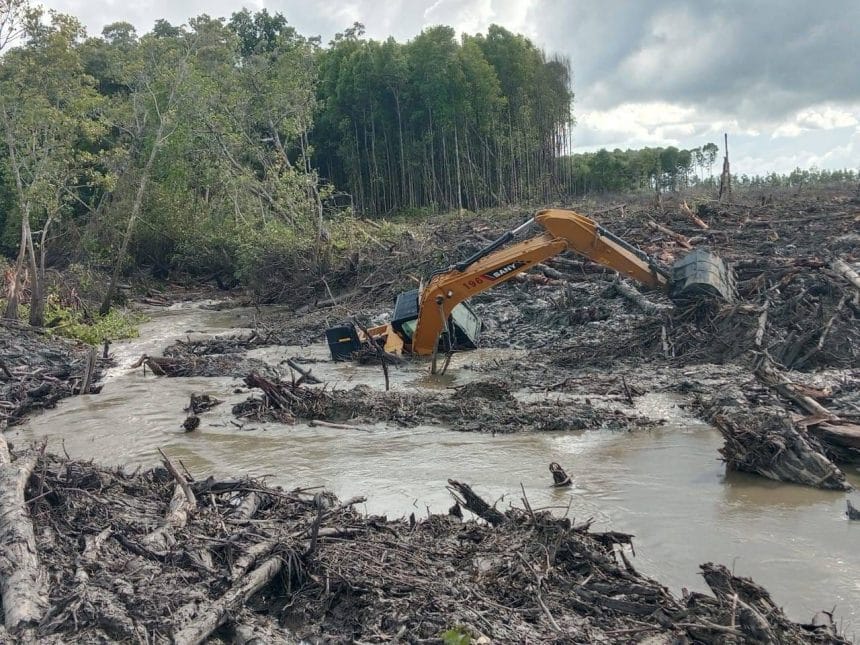
But environmentalists warn it could become the world’s largest deforestation project, threatening endangered species and Jakarta’s climate commitments.
And activists fear the scheme will fuel rights violations in a region long plagued by alleged military abuses as a separatist insurgency rumbles on.
The project’s true scale is hard to ascertain; even government statements vary.
At a minimum, however, it aims to plant several million hectares of rice and sugar cane across South Papua province’s Merauke. One million hectares is around the size of Lebanon.
Deforestation linked to the plan is already under way.
By late last year, more than 11,000 hectares had been cleared—an area larger than Paris—according to Franky Samperante of environmental and Indigenous rights NGO Yayasan Pusaka Bentala Rakyat.
That figure has only increased, according to analysis by campaign group Mighty Earth and conservation start-up The TreeMap.
Their work shows areas cleared include primary and secondary natural dryland and swamp forest, as well as secondary mangrove forest, savanna and bush.
“Usually, deforestation is a product of government not doing its job,” said Mighty Earth chief executive Glenn Hurowitz.
“But in this case, it’s actually the state saying we want to clear some of our last remaining forests, carbon-rich peatlands, habitat for rare animals,” he told AFP.
Indonesia’s government says the land targeted is degraded, already cultivated or in need of “optimization,” dismissing some areas as little more than swamps.
‘Tragedy’
Environmentalists argue that misunderstands the local ecosystem.
“In South Papua, the landscape and the ecosystem is lowland forest,” said Samperante.
“There are often misconceptions or even belittling” of these ecosystems, he added.
Mapping done by Mighty Earth shows the project threatens a broader ecosystem range—including peatlands and forests the group says should be protected by a government moratorium on clearing.
“The tragedy in this project,” said Hurowitz, “is that Indonesia has made so much progress in breaking the link between agricultural expansion and deforestation.”
“Unfortunately, this single project threatens to undermine all progress.”
Indonesia has some of the world’s highest deforestation rates and Papua retains some of the largest remaining untouched tracts.
Indonesian think-tank CELIOS says cutting down so much forest could derail Jakarta’s plan to reach net-zero by 2050.
For President Prabowo Subianto’s government, criticism of the project ignores Indonesia’s agricultural and economic realities.
He has made the scheme a priority, visiting soon after taking office.
In January, he said the country was on track to end rice imports by late 2025, and reiterated its energy independence needs.
The agriculture ministry did not respond to AFP’s request for comment.
In Papua, planting is in full swing. In the region’s Kaliki district, AFP saw farmers supported by soldiers tending rice paddies in recently-cleared land.
“This location used to be like the one on the right here. Non-productive and neglected land,” said Ahmad Rizal Ramdhani, a soldier serving as the agriculture ministry’s food resilience taskforce chief, at an event lauding the project.
That characterization is disputed by Mighty Earth’s satellite analysis, which found that at least two areas in the region cleared for rice overlap with government-designated peatland.
Indonesia’s military is heavily involved in the project.
Local farmer Yohanis Yandi Gebze told AFP soldiers gave him “tools, agricultural equipment and machinery” for rice cultivation.
Speaking not far from Ramdhani’s event, he praised the military.
“I see them cooperating with the people very well,” he said.
‘Cannot refuse’
Others say that is only part of the story.
Indonesia officially seized Papua, a former Dutch colony, in a widely criticized but UN-backed vote in 1969.
It has since been accused of abuses in a decades-long separatist conflict in the region.
“The community feels intimidated,” said Dewanto Talubun, executive director at Merauke-based environmental and rights group Perkumpulan Harmoni Alam Papuana.
“Not all members of the community agree with this project, and they cannot directly refuse,” he told AFP.
Samperante too reported local fears.
“Almost every day a human rights violation occurs,” he said.
The defense ministry told AFP the military had the resources and “high discipline” to accelerate the food project while securing “stability and security” in the region.
However, there are significant doubts about the project’s viability.
“Soils in Merauke are likely too acidic and the climate too extreme… to grow rice,” said David Gaveau, founder of The TreeMap.
He warned that draining Merauke’s wetlands for agriculture risks turning the area “into a tinder box”—a fate seen elsewhere in Indonesia.
Critics do not dispute Jakarta’s food security needs, but said crops should be grown elsewhere on abandoned agricultural land.
“It should be done in places that are capable of absorbing it,” said Hurowitz.
“Without destroying Indonesia’s gorgeous, beautiful natural heritage and community lands.”
Owing to its violent political history, West Papua’s vibrant human past has long been ignored.
Unlike its neighbour, the independent country of Papua New Guinea, West Papua’s cultural history is poorly understood. But now, for the first time, we have recorded this history in detail, shedding light on 50 millennia of untold stories of social change.
By examining the territory’s archaeology, anthropology and linguistics, our new book fits together the missing puzzle pieces in Australasia’s human history. The book is the first to celebrate West Papua’s deep past, involving authors from West Papua itself, as well as Indonesia, Australasia and beyond.
The new evidence shows West Papua is central to understanding how humans moved from Eurasia into the Australasian region, how they adapted to challenging new environments, independently developed agriculture, exchanged genes and languages, and traded exquisitely crafted objects.
Archaeological evidence shows that people migrating from Eurasia into the Australasian region came through West Papua. Dylan Gaffney, CC BY-SA
Early seafaring and adaptation
During the Pleistocene epoch (2.5 million to 12,000 years ago), West Papua was connected to Australia in a massive continent called Sahul.
Archaeological evidence from the limestone chamber of Mololo Cave shows some of the first people to settle Sahul arrived on the shores of present-day West Papua. There they quickly adapted to a host of new ecologies.
What do you need to know about this election?
The precise date of arrival of the first seafaring groups on Sahul is debated. However, a tree resin artefact from Mololo has been radiocarbon dated to show this happened more than 50,000 years ago.
Genetic analyses support this early arrival time to Sahul. Our work suggests these earliest seafarers crossed along the northern route, one of two passages through the Indonesian islands.
Human dispersal to West Papua during the Pleistocene epoch (about 50,000 years ago) and during the Lapita period (more than 3,000 years ago). Dylan Gaffney, CC BY-SA
Interestingly, the first migrants carried with them the genetic legacy of intermarriages between our species, Homo sapiens, and the Denisovans, a now extinct species of hominins that lived in eastern Asia. Geneticists currently dispute whether these encounters took place in Southeast Asia, along a northerly or southerly route to Sahul, or even in Sahul itself.
In the same way modern European populations retain about 2% of Neanderthal ancestry, many West Papuans retain about 3% of Denisovan heritage.
As the Earth warmed at the end of the Pleistocene, rising seas split Sahul apart. The large savannah plains that joined West Papua and Papua New Guinea to Australia were submerged around 8,000 years ago. Much of West Papua’s southern and western coastlines became islands.
Social transformations during the past 10,000 years
As environments changed, so did people’s cuisine and culture.
We know from sites in Papua New Guinea that people developed their own agricultural systems between 10,000 and 6,000 years ago, at a similar time to innovations in Asia and the Americas. However, agricultural systems were not universally adopted across the island.
New chemical evidence from human tooth enamel in West Papua shows people retained a wide variety of diets, from fish and shellfish to forest plants and marsupials.
One of the key unanswered questions in West Papua’s history is when cultivation emerged and how it spread into other regions, including Southeast Asia. Taro, bananas, yams and sago were all initially cultivated in New Guinea and have become important staple crops around the world.
Moses Dialom, an archaeological fieldwork collaborator from the Raja Ampat Islands, examines excavated artefacts at Mololo Cave. Tristan Russell, CC BY-SA
The arrival of pottery, some 3,000 years ago, represents movements of new people to the Pacific. These are best illustrated by iconic Lapita pottery, recorded by archaeologists from Papua New Guinea all the way to Samoa and Tonga.
Lapita pottery makers spoke Austronesian languages, which became the ancestors of today’s Polynesian languages, including Māori.
New pottery discoveries from Mololo Cave suggest the ancestors of Lapita pottery makers existed somewhere around West Papua. Finding the location of these ancestral Lapita settlements is a major priority for archaeological research in the territory.
Rock paintings provide evidence of social change in West Papua. Tristan Russell, CC BY-SA
Other evidence for social transformations includes rock paintings and even bronze axes. The latter were imported all the way from mainland Southeast Asia to West Papua around 2,000 years ago. Metal working was not practised in West Papua at this time and chemical analyses show some of these artefacts were made in northern Vietnam.
At all times in the past, people had a rich and complex material culture. But only a small fraction of these objects survive for archaeologists to study, especially in humid tropical conditions.
People settled diverse environments around West Papua, including montane cloud forests (upper left), lowland rainforests (upper right), mangrove swamps (lower left) and coastal beaches (lower right). Dylan Gaffney, CC BY-SA
Living traditions and the movement of objects
From the early 1800s, when West Papua was part of the Dutch East Indies, colonial administrators, scientists and explorers exported tonnes of West Papuan artefacts to European museums. Sometimes the objects were traded or gifted, other times stolen outright.
In the early 1900s, many objects were also burned by missionaries who saw Indigenous material culture as evidence of paganism. The West Papuan objects that now inhabit museums in Europe, America, Australia and New Zealand are connections between modern people and their ancestral traditions.
Sometimes these objects represent people’s direct ancestors. Major work is currently underway to connect West Papuans with these collections and to repatriate some of these objects to museums in West Papua. Unfortunately, funding remains a central issue for these museums.
Many West Papuans continue to produce and use wooden carvings, string bags and shell ornaments. Anthropologists have described how people are actively reconfiguring their material culture, especially given the presence of new synthetic materials and a cash economy.
A montage of images showing West Papuan archaeologists in the field. (A) Klementin Fairyo, left, is setting up a new excavation. (B) Martinus Tekege excavating pottery. (C) Sonya Kawer with wartime archaeology. (D) Abdul Razak Macap, right, sieving for archaeological artefacts at Mololo Cave. Klementin Fairyo, Martinus Tekege, Sonya Kawer, Abdul Razak Macap, CC BY-SA
Despite our new findings, West Papua remains an enigma for researchers. It has a land area twice the size of Aotearoa New Zealand, but there are fewer than ten known archaeological sites that have been radiocarbon dated.
By contrast, Aotearoa has thousands of dated sites. This means West Papua is the least well researched part of the Pacific and there is much more work to be done. Crucially, Papuan scholars need to be at the heart of this research.
A West Papuan doctoral candidate has warned that indigenous noken-weaving practices back in her homeland are under threat with the world’s biggest deforestation project.
About 60 people turned up for the opening of her “Noken/Men: String Bags of the Muyu Tribe of Southern West Papua” exhibition by Veronika T Kanem at Auckland University today and were treated to traditional songs and dances by a group of West Papuan students from Auckland and Hamilton.
The three-month exhibition focuses on the noken — known as “men” — of the Muyu tribe from southern West Papua and their weaving cultural practices.
It is based on Kanem’s research, which explores the socio-cultural significance of the noken/men among the Muyu people, her father’s tribe.
“Indigenous communities in southern Papua are facing the world’s biggest deforestation project underway in West Papua as Indonesia looks to establish 2 million hectares of sugarcane and palm oil plantations in the Papua region,” she said.
West Papua has the third-largest intact rainforest on earth and indigenous communities are being forced off their land by this project and by military.
The ancient traditions of noken-weaving are under threat.
Natural fibres, tree bark Noken — called bilum in neighbouring Papua New Guinea — are finely woven or knotted string bags made from various natural fibres of plants and tree bark.
“Noken contains social and cultural significance for West Papuans because this string bag is often used in cultural ceremonies, bride wealth payments, child initiation into adulthood, and gifts,” Kanem said.
“This string bag has different names depending on the region, language and dialect of local tribes. For the Muyu — my father’s tribe — in Southern West Papua, they call it ‘men’.
In West Papua, noken symbolises a woman’s womb or a source of life because this string bag is often used to load tubers, garden harvests, piglets, and babies.
“My research examines the Muyu people’s connection to their land, forest, and noken weaving,” said Kanem.
“Muyu women harvest the genemo (Gnetum gnemon) tree’s inner fibres to make noken, and gift-giving noken is a way to establish and maintain relationships from the Muyu to their family members, relatives and outsiders.
“Drawing on the Melanesian and Indigenous research approaches, this research formed noken weaving as a methodology, a research method, and a metaphor based on the Muyu tribe’s knowledge and ways of doing things.”
Hosting pride Welcoming the guests, Associate Professor Gordon Nanau, head of Pacific Studies, congratulated Kanem on the exhibition and said the university was proud to be hosting such excellent Melanesian research.
Professor Yvonne Underhill-Sem, Kanem’s primary supervisor, was also among the many speakers, including Kolokesa Māhina-Tuai of Lagi Maama, and Daren Kamali of Creative New
The exhibition provides insights into the refined artistry, craft and making of noken/men string bags, personal stories, and their functions.
An 11 minute documentary on the weaving process and examples of noken from Waropko, Upkim, Merauke, Asmat, Wamena, Nabire and Paniai was also screened, and a booklet is expected to be launched soon.
TEMPO.CO, Jakarta – The Masyarakat Adat, or indigenous people, of Yoboi village of Papua are adopting new ways to turn their native sago palms into high-value products, reducing processing time from several days to only five hours and opening doors to wider markets.
Papua has the second largest sago palm plantations in Indonesia, but customary sago processing remains largely manual and time-consuming, resulting in low-grade products that offer limited benefits to local livelihoods and food security.
Now, however, members of the Masyarakat Adat Yoboi can process sago into value-added products that meet food safety standards by using a small-scale sago processing unit, built through the support of a project jointly implemented by the Ministry of Agriculture and the Food and Agriculture Organization of the United Nations (FAO), and now owned by the community. FAO and Analisis Papua Strategis (APS) have trained 30 community members to sustainably operate the units and diversify sago-derivative products.
“With the sago processing machine unit, Yoboi people have become economically independent. It is the right solution for us in Yoboi, who have large sago forest areas in Jayapura,” said Sefanya Walli, Head of the Yoboi Adat Village, in a written statement released by the UN Indonesia.
Sago, a sacred staple for Masyarakat Adat, has been considered an alternative source of carbohydrates to help ensure food security and diversity.
However, efforts remain necessary for sago products to be accepted and consumed by the wider population, said Elvyrisma Nainggolan, Chair of the Plantation Products Marketing Group, Directorate General of Plantations, Ministry of Agriculture of the Republic of Indonesia.
“Sago-producing village groups play an important role, and they need to be empowered so they can process sago into flour, which can then be turned into sago-based cakes and even noodles, like in Yoboi. That way, it is hoped that Masyarakat Adat Yoboi’s sago derivatives could become more widespread in markets across the archipelago and even go global in the future,” said Elvyrisma.
community’s sago-based products and connect them with potential buyers, distributors, and market actors, FAO, Masyarakat Adat Yosiba (Yoboi, Simforo, and Babrongko), and Analisis Papua Strategis launched today the first Sago Festival in Yoboi, Jayapura.
During the festival, women and other members of the Masyarakat Adat Yoboi presented live demonstrations of their sago-based dishes, such as noodles and rice analogs, showcasing their market potential. A business networking session allowed community members, small and medium sago entrepreneurs, market actors, and cooperatives to be connected and leverage business potential and opportunities. Over 100 people participated in this festival, including members of Masyarakat Adat, business representatives, and the public of Jayapura.
Head of Papua Province Plantation and Livestock Agency, Matheus Philep Koibur, expressed his appreciation toward the Sago Festival for showcasing the high potential of sago commodities to meet food needs, environmental preservation, and economic improvement of the community.
“The Sago Festival has opened up a big room to promote our sago to industry players who can then turn them into high-value products. Moreover, it is hoped that people of other sago-producing districts are motivated to follow the footsteps of Masyarakat Adat Yoboi,” said Matheus.
As Indonesian President Prabowo Subianto steers his giant nation closer to China it’s worth recalling Paul Keating three decades ago: “No country is more important to Australia than Indonesia.”
His successors nod and offer warm words, but no longer hear their prophet. Caught up in domestic policies and trying to dodge the Trump Martian machine, we’re ignoring the neighbour.
We’re in Asia geographically, but not there culturally or politically. Their harbours are close; we want their shelter, but they’re indifferent. Updating the chart is urgent.
The US President trashes international alliances like Aussie bogans beat up Bali bars. We now fear Big Bro won’t rush to sort out bullies on a faraway playground with fewer folk than Texas.
An SOS might be triggered by real or imagined Beijing threats – like those this month involving the reported shooting of flares near an Australian surveillance jet over the South China Sea, and Chinese naval live-fire exercises in the east Indian Ocean.
The warships were 280 nautical miles from Tassie, but close enough to churn paranoia and a rush to check the ANZUS Treaty text.
The Cold War alliance “binds Australia, (NZ) and the US to consult on mutual threats, and, in accordance with our respective constitutional processes, to act to meet common dangers”.
It was signed when Trump was a pre-schooler. Now a septuagenarian, he’s showing no respect for last-century deals done for a different time and world.
In 1952, when ANZUS was born, Indonesia was run by the mercurial Sukarno dabbling with democracy, but settling for autocracy. Its population of 72 million was three years into formal independence after more than three centuries of Duch colonialism.
It threatened to go Communist; the three Western nations panicked and knocked-up ANZUS.
Since then, the Republic’s numbers have quadrupled; it’s the world’s fourth-largest state with more Muslims than anywhere else and is destroying democracy. Last year, its economic growth rate topped 5% against our 1.1%.
Although just next door, we can’t bother to learn their culture and language and understand their beliefs and values – all essential if we hope to get close.
It also has a new right-wing president. Prabowo Subianto, 73, a disgraced former general, is turning his nation into a military fantasy, parading his ministers in fatigues, forcing them to sleep under canvas. If this demeaning wasn’t real, it would be hilarious.
Prabowo is rubbishing ballots for wasting time and money; better select than elect. He’s told local journos to “prioritise the interests of the nation… a responsible press should know what constitutes the national interest”.
Opposition is stirring. Though so far poorly organised, the potential for mass strife is ever present, largely ignored by the Australian media though not by Pearls & Irritations. Water-cannons have already hosedIndonesia Gelap (Dark Indonesia) demos in Surabaya.
Prabowo’s popular policy of free lunches for schoolkids has funding and admin hassles. About 32,000 extra workers are needed to cook and deliver. They won’t be trained at the nation’s many hospitality colleges but at Universitas Pertahanan, the Defence University, where military staff can teach the loading of woks and the arming of trays.
The corruption curse terrifying investors still froths and bubbles. This month, seven suspects were arrested in an alleged $19 billion graft case at the government’s oil company, Pertamina.
Prabowo has said he wants to forgive convicted corruptors provided they secretly return the money – an idea that’s probably illegal.
Back to Keating last century; his bromance with Suharto was consummated with the Australia–Indonesia Agreement for Maintaining Securitylaid in 1995. The plan was fine, but Keating’s partner was already losing control after almost 30 years of despotic rule.
One report claimed Suharto was impressed by the PM, “telling his advisers he admired the Australian’s patriotism and praising his readiness to promote an Australia more engaged with its region”.
However, he was not engaged with the wong cilik – the ordinary folk whose multitudes can destroy the elite. Keating and his crew, high in their five-star hotels and embassy briefings, couldn’t sniff the winds of change billowing through the crowded kampongs far below.
Your correspondent and other Westerners were regularly cornered by intense youth and wrung dry for fresh news. The Oz motorcade howled through the intersections where masked students sold smudged photocopies of banned international magazines exposing Suharto’s kleptocracy and brutality.
Keating must have known the pact was one-sided, his counterpart rotten. Why did he ignore this villainy? He’s been contacted for comment, but hasn’t replied.
The document was shredded in 1999 after Suharto fell and Australia helped East Timor through the referendum. A shamed nation lost its pride; trust in Down Under has never recovered – and vicky-verky.
A 2021 Lowy Institute poll showed only 13% of Indonesians want Australia as a “preferred partner”. The figure for Japan, a brutal occupying force in the 1940s, was 46%.
Now Prabowo has put Indonesia into BRICS, “the China-backed bloc of emerging economies” – Brazil, Russia, India and South Africa plus Egypt, Ethiopia, Iran and the UAE.
It’s in opposition to the G7: France, the US, the UK, Germany, Japan, Italy and the EU.
Australia is in neither club though ranking as the 12th largest economy in the world, ahead of Canada which is in G7. We’re not even in ASEAN, the impotent 10-member Association of Southeast Asian Nations. Indonesian wags call it NATO – No Action Talk Only.
The latest paperwork is the Australia‑Indonesia Defence Co-operation Agreement driven and signed last August by Deputy PM Richard Marles who saw a happy marriage. Prabowo doused arousal with cold water saying Indonesia would not “be involved in any geopolitical or military alliances or groupings” begging the question: Why did he sign?
We also have the Indonesia-Australia Comprehensive Economic Partnership, a 2020 pact that promised much, but has delivered little in trade and less in influence. Its track to success has been potholed as predicted, with no one keen to repair it except with platitudes.
Some know our grains make noodles, our forests burn, koalas are cute and many shops close early. That’s about it. Korean pop is fun.
James Curran, professor of modern history at Sydney University, wrote that Keating “not only wanted to bury the old fears of Indonesia; he was looking ahead to the possibility of a new threat, in the form of a potentially more aggressive China”.
“He was doing what any prudent leader should do – thinking broadly about the nation’s geopolitical future and preparing for any worst-case scenario.”
That scenario is here and now – engineered by Trump. If Canberra has a Plan B, it’s secret.
Three years ago the Lowy Institute’s Dr Stephen Grenville — formerly with the International Monetary Fund in Jakarta — wrote:
“Indonesia is more important to us than we are to them, and this will become truer as their relative economic weight increases. It’s hard to imagine an Indonesian president reciprocating Keating’s ‘no country is more important to Australia than Indonesia’.”