West Papua: Where Transmigration Means Genocide, Ecocide and, in the End, Suicide

“By way of transmigration … the different ethnic groups will in the long run disappear because of integration…and there will be one kind of man.”

Martano, Indonesian Minister of Transmigration, March 1985

“Brigadier-General Ali Murtopo told us in 1969 that if we want to be independent we should write to the Americans and ask them if they would be good enough to find us a place on the moon.”

West Papua People’s Front

Article courtesy of Julie Wark, first published in Counterpunch 22/11/24

Indonesia’s new president, war criminal Prabowo Subianto, couldn’t even wait to be sworn in. He established a “strategic initiative” of five “Vulnerable Area Buffer Infantry Battalions” in the Keerom, Sarmi, Boven Digoel, Merauke, and Sorong Regencies of West Papua to “enhance security” with an additional 5,000 troops as backup for the 25,000 already there. According to the Armed Forces Chief, General Agus Subiyanto, “the main goal of the new battalions is to assist the government in accelerating development and improving the prosperity of the Papuan people”. He didn’t mention a possible future presence of militias, which is Prabowo’s way of dealing with populations that resist military-improved prosperity. On 21 October, just one day after Prabowo’s inauguration, Muhammad Iftitah Sulaiman Suryanagara, Minister for Transmigration, announced plans to resume the government’s transmigration programme in West Papua. It was needed, he said “for enhancing unity and providing locals with welfare”. Prabowo himself hotfooted it to West Papua on 3 November to check out a programme aiming to create three million hectares (an area about as big as Belgium) of food estates across the country. Reuters calls this a “self-sufficiency drive”. Forest, wetland, and savannah will be turned into rice farms (in which Indonesia’s military has a major stake), sugarcane plantations, and other infrastructure, which would include military installations to guard the sequestered land. This “key food programme” is actually ecocide. In net terms, it will add approximately 392 million tons of carbon to the atmosphere.

For the past six decades, Indonesia has been an occupying colonial power in West Papua. The United Nations is responsible for this and its atrocious consequences, as John Saltford meticulously details in his account of the 1969 UN-orchestrated handover of West Papua to Indonesia in a so-called Act of Free Choice, which was nothing more than “a ridiculous and overtly manipulated denial of West Papuan rights”. Ever since, overt manipulation of the reality of the West Papuan people has been the order of the day in the international arena. The murderous farce is officially blessed as Indonesia has been a member of the UN Human Rights Council since 2006. The UN has refrained from confronting Indonesia about its refusal to allow an official visit to West Papua, although more than a hundred countries have demanded it. After all, investigating crimes against humanity committed by one of its leading human rights “defenders” might be awkward. “Universal” human rights law turns out to be for some but not for others. And “some” can kill and otherwise destroy “others” with impunity.

The transmigration equation is actually this: moving people in = moving people out. Whether they want to move in or want to move out. Some people don’t have the right to decide these things. That transmigration in West Papua comes with so many troops, that it is so highly secretive, is enough to suggest that “enhancing unity” and “providing welfare” are not the agenda at all. In both origin and destination, transmigration is not voluntary but more due to deceit and brute force, respectively. In itself, it’s another form of militarisation because there are many former military personnel secreted among transmigrants, especially in border areas. As the Free Papua Movement (OPM) leader James Nyaro warned, “Don’t think of these settlers as ordinary civilians. They are trained military personnel disguised as civilian settlers”.

Since West Papua with its torture mode of governance isn’t open to independent observers it’s almost impossible to get accurate figures of the numbers in the equation but a recent estimate puts the total number of internally displaced people at about 80,000. This displacement means denial of the basic rights needed for survival: food, shelter, health, freedom from suffering, torture, inhuman treatment, danger, and from fear, freedom of movement, liberty, and security. Genocide Watch reports that some 500,000 West Papuans have been killed since the Indonesian occupation began and, in 2015, the Unrepresented Nations and Peoples Organization calculated that West Papua’s population was approximately 4.4 million, but only around two million were Indigenous West Papuans. The figures show that Indonesian settlers outnumber West Papuans by some 10% and that about 25% of the population has been murdered. In 2004, a Yale University study concluded that the evidence “… strongly suggests that the Indonesian government has committed proscribed acts with the intent to destroy the West Papuans as such, in violation of the 1948 Convention on the Prevention and Punishment of the Crime of Genocide and the customary international law prohibition this Convention embodies.” Twenty years later, the evidence of genocide is even more compelling but even more hushed up.

Why is this horrible case of genocide, ecocide and, in the end, human species suicide (“unwitting suicide, causing one’s own death while pursuing other ends”) being ignored? One explanation comes from Edward S. Herman. There are “good and bad genocidists”. In the “first fine careless rapture” of Indonesia’s New Order (military dictatorship), its genocidal project and mechanisms were lauded and assisted by the World Bank, “development aid” bodies like the IGGI (Inter-governmental Group on Indonesia), and funded by World Food Program, the EEC, Asian Development Bank, Islamic Development Bank, West Germany, France, the Netherlands, the United States, and the UNDP. After throwing West Papua to wolves in New Order clothing, the “international community” has, by omission and commission, embraced this as a “good” genocide, perpetrated by our genocidists and it has done nothing, absolutely nothing, to stop it. Underlying this fact is racism, murderous, systemic racism.

Transmigration comes with a lot of baggage. You only have to look at the history of transmigration in West Papua to understand how transmigration, European and settler colonial in origin, belongs to the “good” genocide package. It began in Dutch colonial times, in the early nineteenth century, when poor settlers sent to the outer islands were forced to provide plantation labour, with very high mortality rates. The standard—a very low bar for the rights of some—was set. After independence, Sukarno continued the programme, now planning to transport millions of people from the islands of Java, Madura, Bali, and Lombok to less densely populated settlement areas in Sumatra, Kalimantan, Sulawesi, and West Papua. His original plan, announced in 1949, was to move 48 million people over 35 years, thereby reducing Java’s population from 54 million to 31 million. However, the targets of this immense social engineering endeavour (the World Bank’s “most irresponsible project” in the words of Survival International) were never achieved. Between 1979 and 1984, the peak transmigration years during Suharto’s New Order military regime, 535,000 families (almost 2.5 million people) were moved.

The rights of transmigrants themselves, many of them poor peasants who are either tricked or coerced into leaving their homes, are also violated, as transmigration is a matter of “national security”. They are moved to state- or privately-owned estates, where the company concerned, often a military asset, cultivates twenty percent of the land while the transmigrants, now a de facto coolie labour force, must cultivate the rest and sell the crops to the company. They are promised eventual ownership of 1.5 hectares of cultivable land and 0.5 hectares for a house and garden but, when crops are eventually produced some years later, they must pay for the land by reimbursing some the bank credit used for the company’s initial investment. They live in compounds far from the land they’re allocated, and are also in danger from attacks from the West Papua National Liberation Army (TPNPB) or displaced local people.

For West Papuans, the arrival of transmigrants was preceded by forced displacement as the rule in transmigrant areas was one Papuan family to nine non-Papuan families. By 1984, about 700,000 hectares of land had been confiscated (about a third of the size of Belgium, to stay with the earlier comparison) without any compensation. In 1981, the counterinsurgency “Operation Clean Sweep” (suggesting that West Papuans were rubbish to be cleared away, like their rainforest) came with the slogan Biar tikus lari kehutan, asal ayam piara dikandang (Let the rats flee to the jungle so the chickens can breed in the coop), which also says a lot about the almost captive status of transmigrants.

It’s been known for more than forty years that transmigration is a fiasco within its own framework of the benign “development project”. Costing an average of US$7,000 per family in the mid-1980s, it was an economic disaster that gobbled up almost 40% of the economic development budget of the outer islands. Rather than alleviating poverty there, transmigration aggravated it and spread it more widely. Most transmigrants were worse off after moving. Population pressure in Java wasn’t relieved. The environmental calamity it caused was clear from the start. Yet, with World Bank and Asian Development Bank loans, plus bilateral financial aid, transmigration kept expanding so that, from 1980 to 1990, ten times more people were moved than in the previous seven decades. By 1991 forest loss was estimated at 1.2 million hectares per annum.

Transmigrasi has strategic and economic (cash crop) goals other than the mostly stated aim of reducing population pressure. In 1987, the Department of Transmigration was fairly honest for once: ‘‘the frontier regions of Kalimantan, Irian Jaya, East Timor have the priority for migrating military people for the purpose of Defense and Security’’. The idea was to seed active and retired military personnel into transmigration settlements and administration to create buffer zones in “trouble spots”. When he headed the Cendrawasih/ XVII Regional Command in West Papua, Brigadier-General Sembiring Meliala referred to ‘‘The Basic Pattern of Territorial Management Specific to Irian Jaya, Employing the Method of Community Development Centers.’’ By this he meant camps to which the Indigenous peoples of West Papua would be moved after being ejected from their traditional villages, where they were to be “Javanised” with special courses of ‘‘guidance and instruction.’’ In fact, transmigrasi is a depraved plan that aims to strengthen “national defence and security” (read: military benefits) by means of mass murder and at the price of global warming with all its planet-wide consequences: après moi le déluge.

Propaganda is another important aspect. Posters distributed by an organism whose name declares that West Papuans are aliens—Project for the Guidance of Alien Societies of the Directorate General for Social Guidance (Projekt Pembinaan Kemasyarakatan Suku-Suku Terasing)—and text books that were distributed in the early 1980s, by which time twenty-four major transmigration sites had been established on 700,000 hectares of appropriated land, show West Papuans as primitive, dirty and lazy and, depicted beside them, Javanese as neat, clean, civilised, and hardworking. The term Papuan was generally expunged, or Papua and Maluku were lumped together as one geographical, ethnic, and cultural entity. Information like the following was disseminated: “The inhabitants of Maluku and Irian both come from the same ethnic stock: Irianese. … [T]he countryside of Irian has not yet been cultivated because of the lack of people. Even their staple food, sago, just grows wild in the jungle.” The government still refers to transmigration in abandoned land.

This is all part of what settler colonialism scholar Patrick Wolfe calls the “logic of elimination”, whereby Indigenous populations are obliterated to gain control of land and resources. “The deployment of five new battalions in Merauke is best understood in terms of Wolfe’s logic of elimination.” In another word, genocide. But it’s not just a local genocide that the Indonesian military hopes to tuck away behind restricted access to West Papua and a sweeping press ban, because it’s also ecocide. And this affects the whole world.

So far, the results in Merauke, for example, are that Papuans number less than 40% of the population, life expectancy is 35 years for men and 38 for women, and HIV rates are extremely (and suspiciously) high. The Indonesian government, boasting about how it’s strengthening environmental standards, plans to take two million hectares of land in this region for a sugarcane project of five consortiums of Indonesian and foreign companies. Since this—“the world’s biggest deforestation project”—is designated a project of “strategic national importance”, Indonesian law allows the government to expel Indigenous communities from their land. President Prabowo Subianto’s first official visit to “West Papua” wasn’t to West Papua, but to the Merauke food estate, the National Strategic Project, to what, for him, was a part of Indonesia that needs the protection of heavily armed troops against the local Malind people who are protesting the seizure and destruction of their land, customary forests, and villages, without any prior warning, let alone consultation. Destruction of their very lives. West Papuans are fighting back, not only as an organised National Liberation Army but also as groups and individuals armed with bows and arrows or weapons acquired on the black market from low-ranking Indonesian soldiers whose welfare is neglected. Stripped of their identity as ancestral keepers of the land and forest by acts of capitalist violence, in which the agribusiness crops are in themselves part of the destructive machinery, Indigenous people become “terrorists” threatening Indonesia’s national security, and therefore exterminable.

Alien monocrops, affecting both natural forests and peatlands, significantly increase carbon emissions as well as the direct devastation they cause. Rainforests are often described as Earth’s oldest living ecosystems. Some have existed in their present form for at least 70 million years. For example, the Amazon rainforest probably appeared some 55 million years ago during the Eocene era. Rainforests cover only 6% of the Earth’s surface but contain more than half its plant and animal species, so they’re extraordinarily dense with all kinds of flora and fauna which, since they also help to regulate climate, are essential to human wellbeing. They are usually structured in four layers: emergent (top layer, up to 60 metres high); canopy (about five metres thick, forming a roof over the two remaining layers, creating a humid, dark environment below, and protecting topsoil); understory (dark, still, and damp); and forest floor (where decomposers like slugs, termites, worms, and fungi thrive, breaking decaying fallen organic matter into nutrients). Although each layer, with different levels of sunlight, water, and air circulation, has its own characteristics, they belong to an interdependent system. When a tree is cut down, at least four different whole ecosystems are destroyed. And every single species that disappears has knock-on effects on other species including, eventually, humans. In this sense, a single tree can represent the whole forest. The rainforest is many worlds that are unknown to the marauding species—the humans that come to cut them down—who see only cash crops where whole cosmologies have thrived since human time began.

It’s no coincidence that Prabowo has announced a new transmigration programme at the same time as his ecocidal deforestation regime intensifies. These conjoined twins of his agenda are the two sides of Indonesian colonialism in West Papua: exploitation and settlement by dispossession. Benny Wenda, Interim President of the United Liberation Movement for West Papua tells it from his people’s perspective: “Indonesia only wants West Papua’s resources; they do not want our people. The wealth of West Papua—gas from Bintuni Bay, copper and gold from the Grasberg mine, palm oil from Merauke—has been sucked out of our land for six decades, while our people are replaced with Javanese settlers loyal to Jakarta.”

Although Rafael Lemkin, who coined the term “genocide”, was greatly concerned about colonial genocides, he is generally and mistakenly seen as having a more limited understanding of the word, in “the wake of the Holocaust in order reflect its features as a state-organized and ideologically-driven program of mass murder”. Israel’s present, horrific genocide in Palestine, a moral wound inflicted on all humanity, has laid bare the deep colonial, racist roots of the Westphalian world order, supposedly of equal sovereign states. Rather, it is an order of “unequal subjects; sovereigns and colonized; and of states, empires, settlers, and colonies”. As such, it normalises mass shredding of defenceless people, especially children, and their debasement to unidentifiable body parts in plastic bags. The fact that its victims tend to be dark-skinned is part of an ongoing colonial legacy arising from the destructive forces of European capitalism. The results in terms of international law, including genocide law, are visible in the power of veto used by the United States to block proposals put before the UN Security Council ordering Israel to stop the genocide in Gaza. “The right to veto is not only a privilege of the victors in WW2; it is an advantage given to themselves by the same vanquishers that simultaneously happened to be at the time former and new empires.”

If the international legal system is dominated by old imperial powers and newer transnational companies, every aspect of exploitation, subjugation, and even genocide in former colonies will be ignored, disguised and, in some cases, encouraged. In West Papua, hiding behind innocuous terms like development, enhancing unity, welfare, and sustainability are the facts that directly affect the other people, the original peoples of West Papua.

1) The causes of political and social unrest in West Papua extend far beyond the question of self-determination; the people are not just “rebels” as they’re often depicted but are threatened with extermination.

2) They’re not a “primitive” lesser or alien species but wise human kin who know how to live in harmony with nature and who, protecting their environment (and hence that of everyone), are said to stand in the way of progress (read: destruction).

3) They have no rights as people or as individuals as the international legal order doesn’t protect them, but lets the genocide happen.

4) They’re frontline victims of the civilising lie which, now taking the form of global warming, is telling us what civilisation has done to this planet, humanity’s habitat.

5) West Papua rainforest custodians are subjected to an alien military mindset or, in practice, everyday brutality and devastation. In a detailed study, Yezid Sayigh spells out the scary reality of what military-managed “sustainability” means in Egypt, and the comparison with the Indonesian regime is relevant because the Indonesian military is also heavily involved in extractive sector business.

6) The West Papua people are clearly subject to the “logic of elimination” by occupying forces seeking to gain control of land and resources.

7) Not all genocides are highly organised, high-tech mass killing projects. Genocide can be achieved through gradual dispossession, destruction, and small-scale but constantly repeated killing, as is happening in West Papua, and also against many other Indigenous peoples.

8) As genocide scholar Kjell Anderson asks, if West Papuans “do not regard themselves as Indonesians and are not regarded as such by other Indonesians”, how can they survive as a people in the militarised, hegemonic state of Indonesia?

9) The UN is still dodging its responsibility for the genocide in West Papua even though its own human rights experts express “serious concerns about the deteriorating human rights situation … citing shocking abuses against indigenous Papuans, including child killings, disappearances, torture and mass displacement of people”.

Rafael Lemkin understood genocide as aiming at the annihilation of essential elements of a group’s conditions of life: political, social, cultural, economic, biological, physical, and moral. Whatever the group and wherever it was. All of these elements were assaulted in European colonial projects around the world, and are being destroyed by Indonesia’s colonial project in West Papua, most recently by the revival of transmigration and deliberate destruction of Indigenous cultures and ways of life. As philosopher Imge Oranlı observes, genocide denial “is a peculiar phenomenon that speaks to the ontology of evil. Here, the evilness of an evil event is not readily evident to the public because the evil in question was socially and politically produced by the same ideology that continues to shape the collective social imagination of that very public.” The western collective and social imagination is shaped by the deeds and ideology that enabled a good part of European “civilisation”. So, some genocides are more acceptable than others. Once again, think of Belgium: what if a European country of about the same size as the recent land appropriation in West Papua was subjected to the same genocidal project. Would the “international community” remain passive and silent?

“Good” or “bad” genocide, the issues are inescapably the same: genocide (humans kill others of their own nature)→ecocide (as part of this project, humans kill nature) and, in the end→suicide (humans kill themselves).

Papuan women’s mangrove forest in Indonesia is increasingly threatened by development and pollution

On the southeastern coast of Jayapura city lies a mangrove forest where only women are permitted to enter

By EDNA TARIGAN and FIRDIA LISNAWATI – Associated Press 8 hrs ago 

JAYAPURA, Indonesia (AP) — On the southeastern coast of the city of Jayapura, Petronela Merauje walked from house to house in her floating village inviting women to join her the next morning in the surrounding mangrove forests.

Merauje and the women of her village, Enggros, practice the tradition of Tonotwiyat, which literally means “working in the forest.” For six generations, women from the 700-strong Papuan population there have worked among the mangroves collecting clams, fishing and gathering firewood.

“The customs and culture of Papuans, especially those of us in Enggros village, is that women are not given space and place to speak in traditional meetings, so the tribal elders provide the mangrove forest as our land,” Merauje said. It’s “a place to find food, a place for women to tell stories, and women are active every day and earn a living every day.”

The forest is a short 13 kilometers (8 miles) away from downtown Jayapura, the capital city of Papua, Indonesia’s easternmost province. It’s been known as the women’s forest since 2016, when Enggros’ leader officially changed its name. Long before that, it had already been a space just for women. But as pollution, development and biodiversity loss shrink the forest and stunt plant and animal life, those in the village fear an important part of their traditions and livelihoods will be lost. Efforts to shield it from devastation have begun, but are still relatively small.

Women have their own space — but it’s shrinking

One early morning, Merauje and her 15-year-old daughter took a small motor boat toward the forest. Stepping off on Youtefa Bay, mangrove trees all around, they stood chest-deep in the water with buckets in hand, wiggling their feet in the mud to find bia noor, or soft-shell clams. The women collect these for food, along with other fish.

“The women’s forest is our kitchen,” said Berta Sanyi, another woman from Enggros village.

That morning, another woman joined the group looking for firewood, hauling dry logs onto her boat. And three other women joined on a rowboat.

Women from the next village, Tobati, also have a women’s forest nearby. The two Indigenous villages are only 2 kilometers (1.2 miles) apart, and they’re culturally similar, with Enggros growing out of Tobati’s population decades ago. In the safety of the forest, women of both villages talk about issues at home with one another and share grievances away from the ears of the rest of the village.


EDITOR’S NOTE: This is part of a series of on how tribes and Indigenous communities are coping with and combating climate change.

Alfred Drunyi, the leader of Drunyi tribe in Enggros, said that having dedicated spaces for women and men is a big part of the village’s culture. There are tribal fines if a man trespasses and enters the forest, and the amount is based on how guilty the community judges the person to be.

“They should pay it with our main treasure, the traditional beads, maybe with some money. But the fines should be given to the women,” Drunyi said.

But Sanyi, 65, who’s been working in the forest since she was just 17, notes that threats to the space come from elsewhere.

Development on the bay has turned acres of forest into large roads, including a 700-meter (2,300-foot) bridge into Jayapura that passes through Enggros’ pier. Jayapura’s population has exploded in recent decades, and around 400,000 people live in the city — the largest on the island.

In turn, the forest has shrunk. Nearly six decades ago, the mangrove forest in Youtefa Bay was about 514 hectares (1,270 acres). Estimates say it’s now less than half that.

“I am so sad when I see the current situation of the forest,” Sanyi said, “because this is where we live.” She said many residents, including her own children, are turning to work in Jayapura instead of maintaining traditions.

Pollution puts traditions and health at risk

Youtefa Bay, where the sea’s brackish water and five rivers in Papua meet, serves as the gathering bowl for the waste that runs through the rivers as they cross through Jayapura.

Plastic bottles, tarpaulin sheets and pieces of wood are seen stuck between the mangrove roots. The water around the mangrove forest is polluted and dark.

After dozens of years being able to feel the clams on the bay with her feet, Sanyi said she now often has to feel through trash first. And once she removes the trash and gets to the muddy ground where the clams live, there are many fewer than there used to be.

Paula Hamadi, 53, said that she never saw the mangrove forest as bad as it is now. For years, she’s been going to the forest almost every day during the low tide in the morning to search for clams.

“It used to be different,” Hamadi said. “From 8.00 a.m. to 8:30 in the morning, I could get one can. But now, I only get trash.”

The women used to be able to gather enough clams to sell some at the nearest village, but now their small hauls are reserved for eating with their families.

A study in 2020 found that high concentrations of lead from waste from homes and businesses were found at several points in the bay. Lead can be toxic to humans and aquatic organisms, and the study suggests its contaminated several species that are often consumed by the people of Youtefa Bay.

Other studies also showed that populations of shellfish and crab in the bay were declining, said John Dominggus Kalor, a lecturer on fisheries and marine sciences at Cenderawasih University.

“The threats related to heavy metal contamination, microplastics, and public health are high,” Kalor said. “In the future, it will have an impact on health.”

Some are trying to save the land

Some of the mangrove areas have been destroyed for development, leading to degradation throughout the forest.

Mangroves can absorb the shocks of extreme weather events, like tsunamis, and provide ecosystems with the needed environment to thrive. They also serve social and cultural functions for the women, whose work is mostly done between the mangroves.

“In the future people will say that there used to be a women’s forest here” that disappeared because of development and pollution, said Kalor.

Various efforts to preserve it have been made, including the residents of Enggros village themselves. Merauje and other women from Enggros are trying to start mangrove tree nurseries and, where possible, plant new mangrove trees in the forest area.

“We plant new trees, replace the dead ones, and we also clean up the trash around Youtefa Bay,” Merauje said. “I do that with my friends to conserve, to maintain this forest.”

Beyond efforts to reforest it, Kalor said there also needs to be guarantees that more of the forest won’t be flattened for development in the future.

There is no regional regulation to protect Youtefa Bay and specifically the women’s forests, but Kalor thinks it would help prevent deforestation in the future.

“That should no longer be done in our bay,” he said.


The Associated Press’ climate and environmental coverage receives financial support from multiple private foundations. AP is solely responsible for all content. Find AP’s standards for working with philanthropies, a list of supporters and funded coverage areas at AP.org.

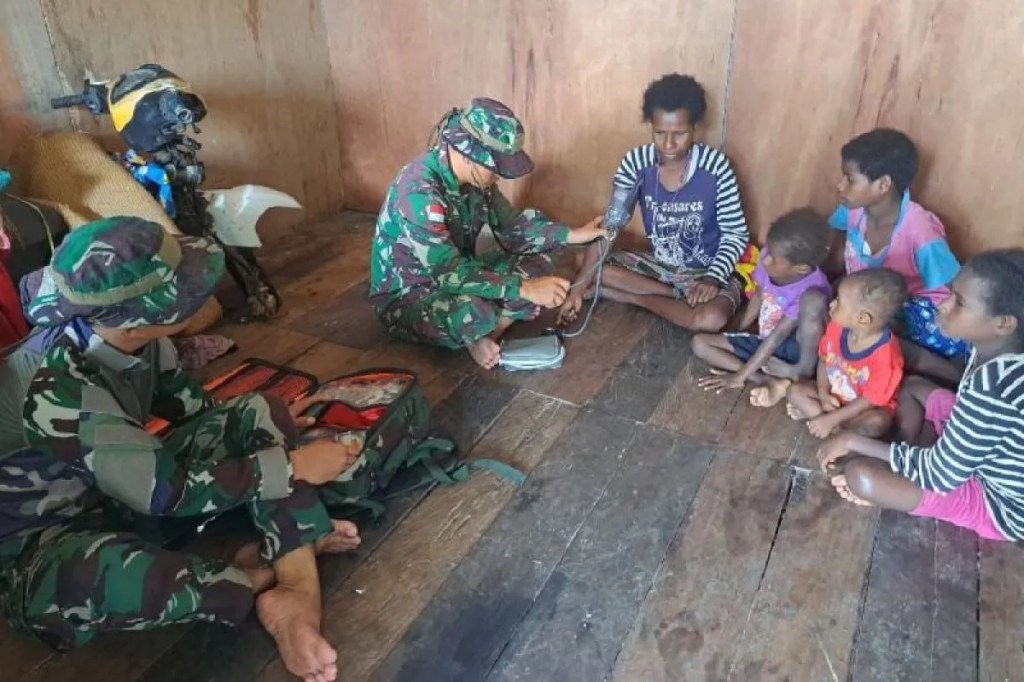
Army providing free healthcare services to native Papuans in Kimaam

Jayapura, Papua (ANTARA) – Indonesian soldiers from the 125/SMB Infantry Battalion Task Force provided free healthcare services to native Papuans in Kiworo Village, Kimaam Sub-district, Merauke District, South Papua Province.

Located on Yos Sudarso Island, some 129 kilometers away from Merauke, Kimaam Sub-district can only be reached by airplane or ship, Kimaam Post Commander Second Lieutenant Raden Andika stated.


During this community service, the army paramedics visited the households in need of healthcare services, he noted in a press statement that ANTARA received in Jayapura City on Wednesday.

Apart from providing healthcare services to the villagers, the army personnel also conducted a knowledge-sharing session on healthy lifestyle and clean environment, Andika remarked.

A Kiworo villager named Margaretha Muyak thanked the army personnel for the community service.


In addition to Kiworo, Kimaam Sub-district has several other villages, including Kimaam, Mambum, Woner, Deka, Komolom, Kumbis, Turiram, Webu, Umanderu, Kalilam, Purawander, Teri, and Sabudom.

ANTARA reported earlier that Indonesian soldiers stationed in Papua have demonstrated exemplary capability in maintaining peace and stability in the region for decades in their endeavors to safeguard the country’s territorial integrity.

The soldiers are chiefly tasked with securing peace and stability in the country’s easternmost region.

However, they are also living and mingling with members of local communities, which has provided them a glimpse of the challenges faced by native Papuans in their day-to-day lives.

Indonesia’s Jokowi does a Machiavelli 

By Warief Djajanto Basorie 

Nov 20, 2024

Power is the proverbial drug that leaders find hard to quit.

After ten years as Indonesia’s president, Joko “Jokowi” Widodo has passed the baton to Prabowo Subianto October 20.

However, Jokowi is no lame duck. He has made moves that can still allow his influence to be felt.

Jokowi’s stay-in-power thoughts and done deals could match the power precepts of Niccolo Machiavelli, a public official in 16th Century Florence, a major principality under the autocratic rule of Lorenzo de Medici. Machiavelli was imprisoned and tortured by de Medici.

A ruler can act unethically and immorally to hold on to power. He or she can exercise any means to that end.

This is a key postulate Machiavelli (1469-1527) underscored in his 1513 treatise, Il PrincipeThe Prince.

Another principle is “keep your friends close and your enemies closer”.

Machiavelli maintains that leaders should always mask their true intentions. For sure, Jokowi never stated outright his intentions. But his subtle steps were detectable.

Jokowi’s post-presidential influence is noted in Prabowo’s cabinet lineup the new president announced the night after his inauguration. Jokowi had 34 ministers. Prabowo announced 48 ministers and 56 deputy ministers.

Prabowo retained 18 ministers from Jokowi’s cabinet. They include respected finance minister Sri Mulyani Indrawati to calm world investors, state-owned enterprises minister Erick Thohir, home affairs minister Tito Karnavian, and energy and natural resources minister Bahlil Lahadalia.

Beginnings

Jokowi, 63, was a small furniture businessman who became mayor of his hometown, Solo, in 2005 and later as governor of Jakarta in 2012. In 2014 Jokowi successfully ran to be president as a common man candidate opposite strongman retired General Prabowo Subianto who hails from the political elite.

In his first five-year term, Jokowi scored high public approval ratings for building toll-roads, developing public transport and delivering social benefits like the costly but highly favoured BPJS program in universal health care.

In the start of his second and final five-year term in 2019, Jokowi announced what was to be his signature legacy, a new US$33 billion capital named Nusantara (Archipelago) in the Borneo jungle.

However, the world-wide onslaught of the Covid-19 pandemic impaired the construction of this planned carbon-neutral, environment-friendly, hi-tech cyber city.

Jokowi realised that by the end of his presidency he could not yet move the capital from flood-fraught, pollution and traffic-jam-prone Jakarta to Nusantara, 1260 km to Jakarta’s northeast in East Kalimantan province.

To finish incomplete programs, Jokowi quietly sought to amend the Constitution to allow him a third term but failed to get parliamentary traction.

Jokowi’s alternative course was how to exercise power indirectly after he leaves office.

House call

Jokowi won his first and second terms by trouncing Prabowo, a former special forces Army commander. Prabowo took defeat vindictively. Knowing this, Jokowi acted to assuage that spite.

Jokowi called on Prabowo’s residence. The incumbent caught Prabowo unaware by inviting him to join his Cabinet as defence minister. This is the victor respecting and reverting the loser to be his ally. Prabowo accepted this invite arguing it was for national unity.

In public statements, Prabowo would profusely praise Jokowi’s character and policies including the building of the new capital.

Meanwhile, Gibran Rakabuming Raka, Jokowi’s first son, has been elected mayor of Solo in 2021.

Jokowi’s thinking was to have Gibran stand for Central Java governor. Subnational elections for governors, mayors and regents are scheduled for Nov 27 this year.

However, in the year before the Feb 14 2024 presidential and legislative voting, Prabowo sought permission from Jokowi to have Gibran as his vice presidential running mate.

Prabowo, 73, has publicly stated Indonesia’s future is in the hands of young leaders. He declared he wanted to be the bridge to the next generation.

Given that Jokowi has enjoyed consistently high approval ratings, Prabowo judged that having Gibran on his ticket and his father’s endorsement would be a double benefit.

Age was a conditional issue. Under Indonesia’s election law, Indonesians running for president and vice president must be at least 40 years old. Gibran is 37.

Coercion

Jokowi’s brother-in-law who was then the chief justice of the Constitutional Court cut the Gordian knot for Gibran. The Constitutional Court ruled the 40-year-old age limit remains but younger candidates who already hold elected public office can also run.

A public outcry ensued. Academics and rights activists accuse Jokowi of building a political dynasty.

Prabowo was pitted against two other tickets: former Jakarta governor Anies Baswedan and former Central Java governor Ganjar Pranowo. Prabowo vanquished them, capturing 58.6% of the vote. A ballot distance of more than 30% to either of his opponents ruled out a second round of voting.

No manipulation in vote counting was reported in the Feb 14 election. However, in the campaign, pre-election coercion and intervention profited the Prabowo/Gibran ticket.

Jokowi deployed the military and police in the provinces to pressure grassroots leaders like village heads to get their population to vote for Prabowo-Gibran.

The president would also visit vote-rich districts in the central island of Java and distribute 10 kilo sacks of rice to low income residents as one form of social assistance. Java has 56% of Indonesia’s population of 280 million people.

Jokowi also commanded sway on eight of the nine political parties with seats in parliament. The lone out-of-the-ring party was the Islam-based PKS that rejected Jokowi’s new capital scheme.

Further, in August energy minister Bahlil Lahadalia got to become general chair of the influential Golkar party that has the second most seats in the newly elected parliament. Golkar was the political vehicle that kept authoritarian president Soeharto in power from 1966 to 1998.

Bahlil is a Jokowi loyalist who undertook the failed lobbying to get parliamentary approval for a third term for Jokowi.

Democracy in decline

In its July 29, 2024 edition on ten years as president, the Jakarta-based news weekly Tempo viewed in a strident editorial that Jokowi has “pulled back the progress of democracy”.

“Indonesia is now afflicted with the four characteristics of democratic reversal: a legal system that is not impartial, a bureaucracy that is not neutral, excessive executive power, and media that is not independent,” the editorial exclaimed.

The magazine reported Jokowi has committed 18 sins in his 10 years in power that turn back the 1998 reform drive after the 32-year rule of General Soeharto. Tempo detailed each sin in up to six pages.

These anti-democracy moves include political dynasty and oligarchy building, weakening of democratic institutions, and debilitating the erstwhile independent Corruption Eradication Commission, KPK, making its officers into government employees.

In his second term, Jokowi did not hide his pro-business drive. He pushed policies that allowed investors laxity of environment protection regulations and KPK scrutiny.

Tempo’s serious fault-finding, however, did not slacken favourable polling of Jokowi’s work performance. The nonpartisan daily Kompas gave Jokowi an approval rating of 75.6% in June 2024, up from 73.5% in December 2023.

More recently, pollster Indikator Politik Indonesia gave Jokowi a 75% favourable rating based on a Sept 22-29 survey with 1200 respondents in 11 of the most populated provinces.

The nation’s elite, however, may not share that poll-based sentiment. On October 1, newly elected and returned legislators of the 580-member House of Representatives were sworn in.

When the House Speaker acknowledged the presence of President Joko Widodo, the vast chamber fell silent. When the Speaker stated the name of president-elect Prabowo Subianto, House members gave rousing applause.

What are Jokowi’s sources of power? Australian National University’s annual Indonesia Update conference Sept 13-14 2024 notes three points: popularity, coercion, and power sharing with elites.

Delivery matters

Apparently voters are more into what a leader can deliver. They are indifferent to dynasty formation that is also found at the subnational level.

When Jokowi stepped down on October 20, one question is how he can influence matters of state.

Through Gibran, his son and even Prabowo, Jokowi can get access to cabinet deliberations. Jokowi also maintains links to the parties that endorse Prabowo, particularly Golkar.

It is Jokowi’s intent that his unfinished programs stay on track. This includes the Nusantara national capital where he has taken office in the capacious presidential palace the past month. Another is down streaming industries turning raw minerals like nickel and bauxite into manufactured goods. Also plantation crops like oil palm converted to biofuel.

But the key determinant would be the new president. Prabowo has his own signature programs. One is providing free nutritional lunches to Indonesian school kids. Another is to boost the annual economic growth rate to 8% from the present 5%. Prabowo has the closing call.

 Kiwi pilot kidnapping in West Papua leads to police raids in Australia

 By APR editor –  November 19, 2024

By Duncan Graham

An alleged plot involving firearms and threatening the life of New Zealand pilot Philip Mehrtenswhen held hostage in Papua this year is being investigated by the Australian Federal Police.

The case involves “advancing a political cause by the separation of West Papua from Indonesia . . . with the intention of coercing by intimidation the governments of New Zealand and Indonesia”.

Named in the AFP search warrant seen by MWM is research scholar Julian King, 63, who has studied and written extensively about West Papuan affairs.

He has told others his home in Coffs Harbour, Queensland, was raided violently earlier this month by police using a stun grenade and smashing a door.

During the search, the police seized phones, computers and documents about alleged contacts with the West Papua rebel group Organisasi Papua Merdeka, OPM (Free Papua Organisation) and a bid to seek weapons and ammunition.

However, no arrests are understood to have been made or charges laid.

King, a former geologist and now a PhD student at Wollongong University, has been studying Papuan reaction to the Indonesian takeover since 1963. He has written in a research paper titled “A soul divided: The UN’s misconduct over West Papua” that West Papuans:

‘LIVE UNDER A MILITARY DICTATORSHIP DESCRIBED BY LEGAL SCHOLARS AND HUMAN RIGHTS ADVOCATES AS SYSTEMIC TERROR AND ALLEGED GENOCIDE.’

Also named in the warrant alongside King is Amatus Dounemee Douw, confirmed by MWMcontacts to be Australian citizen Akouboo Amatus Douw, who chairs the West Papua Diplomatic and Foreign Affairs Council, an NGO that states it seeks to settle disputes peacefully.

Risk to Australia-Indonesia relations
The allegations threaten to fragment relations between Indonesia and Australia.

It is widely believed that human rights activists and church organisations are helping Papuan dissidents despite Canberra’s regular insistence that it officially backs Jakarta.

Earlier this year, Deputy PM Richard Marles publicly stressed: “We, Australia, fully recognise Indonesia’s territorial sovereignty. We do not endorse any independence movement.”

In August, Douw alleged Indonesian troops shot Kiwi Glen Conning on August 5 in Central Papua. The government version claims that the pilot was killed by “an armed criminal group” after landing his helicopter, ferrying local people who fled unharmed.

When seized by armed OPM pro-independence fighters in February last year, Mehrtens was flying a light plane for an Indonesian transport company.

He was released unharmed in September after being held for 593 days by the West Papua National Liberation Army (Tentara Pembebasan Nasional Papua Barat – TPNPB), the military wing of the OPM.

Designated ‘terrorist’ group, journalists banned
OPM is designated as a terrorist organisation in Indonesia but isn’t on the Australian list of proscribed groups. Jakarta bans foreign journalists from Papua, so little impartial information is reported.

After Mehrtens was freed, TPNPB spokesman Sebby Sambom alleged that a local politician had paid a bribe, a charge denied by the NZ government.

However, West Papua Action Aotearoa spokesperson Catherine Delahunty told Radio NZ the bribe was “an internal political situation that has nothing to do with our government’s negotiations.”

Sambom, who has spent time in Indonesian jails for taking part in demonstrations, now operates out of adjacent Papua New Guinea — a separate independent country.

Australia was largely absent from the talks to free Mehrtens that were handled by NZ diplomats and the Indonesian military. The AFP’s current involvement raises the worry that information garnered under the search warrants will show the Indonesian government where the Kiwi was hidden so that locations can be attacked from the air.

AT ONE STAGE DURING HIS CAPTIVITY, MEHRTENS APPEALED TO THE INDONESIAN MILITARY NOT TO BOMB VILLAGES.

It is believed Mehrtens was held in Nduga, a district with the lowest development index in the Republic, a measure of how citizens can access education, health, and income. Yet Papua is the richest province in the archipelago — the Grasberg mine is the world’s biggest deposit of gold and copper.

OPM was founded in December 1963 as a spiritual movement rejecting development while blending traditional and Christian beliefs. It then started working with international human rights agencies for support.

Indigenous Papuans are mainly Christian, while almost 90 percent of Indonesians follow Islam.

Chief independence lobbyist Benny Wenda lives in exile in Oxford. In 2003 he was given political asylum by the UK government after fleeing from an Indonesian jail.  He has addressed the UN and European and British Parliaments, but Jakarta has so far resisted international pressure to allow any form of self-determination.

Questions for new President Prabowo
Indonesian President Prabowo Subianto is in the UK this week, where Papuans have been drumming up opposition to the official visit. In a statement, Wenda said:

‘PRABOWO HAS ALSO RESTARTED THE TRANSMIGRATION SETTLEMENT PROGRAMME THAT HAS MADE US A MINORITY IN OUR OWN LAND.’

“For West Papuans, the ghost of (second president) Suharto has returned — (his) New Order regime still exists, it has just changed its clothes.”

Pleas for recognition of Papuan’s concerns get minimal backing in Indonesia; fears of balkanisation and Western nations taking over a splintered country are well entrenched in the 17,000-island archipelago of 1300 ethnic groups where “unity” is considered the Republic’s foundation stone.

Duncan Graham has a Walkley Award, two Human Rights Commission awards and other prizes for his radio, TV and print journalism in Australia. He now lives in Indonesia. He has been an occasional contributor to Asia Pacific Report and this article was first published by Michael West Media.

Health risk claims ‘a hoax’: Indonesian Ambassador

The Indonesian Ambassador to Vanuatu, Siswo Pramono, has dismissed recent claims of health risks associated with Indonesian medical services as baseless.

“This is not an allegation but a hoax,” he said. He defined a hoax as a “deliberate act meant to deceive or trick people into believing something false, often for personal gain, amusement, or to create confusion.”

Prior to the arrival of the Indonesian navy hospital ship, WSH-991, in Port Vila, the Special Envoy of West Papua in Vanuatu Morris Kaloran warned the people of health risks and urged them to stay away.

He also describes the vessel’s presence as a ‘slap in the face’ to the Melanesian people, particularly Vanuatu which has been a vocal advocate for the rights of west Papuans.

In his response, Ambassador Pramono emphasized the advances made in public health in Papua, Indonesia, citing statistics that demonstrate improved life expectancy among Papuans over the last five years under Indonesia’s public health services.

“In Indonesia, health services are pretty much standardized,” he said.

He drew a comparison between Port Vila, which has a population of around 50,000, and the Regency of Keerom in Papua, which has approximately 60,000 residents.

According to data from the Statistics of Papua Provinces in 2021, Keerom is served by 33 doctors, 234 nurses, 114 midwives, 30 pharmacists, and 29 nutritionists.

“This shows that the government of Papua’s provinces is committed to promoting public health, with significant support from Indonesia’s central government,” he said.

In alignment with Vanuatu’s public health goals, Pramono noted that, at Prime Minister Charlot Salwai’s request, Indonesia recently dispatched ten experienced nursing trainers to Port Vila to enhance the quality and capacity of nursing services.

“The mission is to help improve the quality and capacity of Port Vila’s nursing services, and we will continue this program into next year,” he said.

Ambassador Pramono, who is based in Australia, also highlighted Indonesia’s international reputation for public health development.

During the COVID-19 pandemic, Indonesia was entrusted by the United Nations to serve as a co-chair of the COVID-19 Vaccines Global Access (COVAX) Advance Market Commitment, ensuring equitable vaccine distribution among developing countries, including Vanuatu.

“According to Our World in Data, Indonesia was among the five countries with the highest COVID vaccination rates among developing nations,” he said.

He said that the Economist Intelligence Unit (EIU) recognized Indonesia’s effective governance during the pandemic by raising its Democracy Index from 6.3 in 2020 to 6.71 in 2021.

“This progress reflects the Indonesian government’s commitment to providing the basic human right of health,” he said.

In response to Vanuatu’s request for further healthcare support, the recent visit of the Indonesian Navy hospital ship to Port Vila is seen as an extension of Indonesia’s humanitarian cooperation with Vanuatu.

“This mission, like our support during COVID-19 through COVAX, illustrates our commitment to being a good partner,” said Mr. Pramono.

He said that Vanuatu’s government has expressed interest in expanding the program, with requests for the hospital ship to visit other islands.

“As the Indonesian Ambassador, I will recommend that the Indonesian government seriously consider this request,” he added.

glenda@dailypost.vu

West Papuan leader makes ‘raise our banned flag’ plea over new threat

By APR editor – 

November 14, 2024

Asia Pacific Report

An exiled West Papuan leader has called on supporters globally to show their support by raising the Morning Star flag — banned by Indonesia — on December 1.

“Whether in your house, your workplace, the beach, the mountains or anywhere else, please raise our flag and send us a picture,” said United Liberation Movement for West Papua (ULMWP) interim president Benny Wenda.

“By doing so, you give West Papuans strength and courage and show us we are not alone.”

The plea came in response to a dramatic step-up in military reinforcements for the Melanesian region by new President Prabowo Subianto, who was inaugurated last month, in an apparent signal for a new crackdown on colonised Papuans.

January 1 almost 63 years ago was when the Morning Star flag of independence was flown for the first time in the former Dutch colony. However, Indonesia took over in a so-called “Act of Free Choice” that has been widely condemned as a sham.

“The situation in occupied West Papua is on a knife edge,” said the UK-based Wenda in a statement on the ULMWP website.

He added that President Prabowo had announced the return of a “genocidal transmigration settlement policy”.

Indigenous people a minority
“From the 1970s, transmigration brought hundreds of thousands of Javanese settlers into West Papua, ultimately making the Indigenous people a minority in our own land,” Wenda said.

“At the same time, Prabowo [is sending] thousands of soldiers to Merauke to safeguard the destruction of our ancestral forest for a set of gigantic ecocidal developments.

“Five million hectares of Papuan forest are set to be ripped down for sugarcane and rice plantations.

“West Papuans are resisting Prabowo’s plan to wipe us out, but we need all our supporters to stand beside us as we battle this terrifying new threat.”

The Morning Star is illegal in West Papua and frequently protesters who have breached this law have faced heavy jail sentences.

“If we raise [the flag], paint it on our faces, draw it on a banner, or even wear its colours on a bracelet, we can face up to 15 or 20 years in prison.

“This is why we need people to fly the flag for us. As ever, we will be proudly flying the Morning Star above Oxford Town Hall. But we want to see our supporters hold flag raisings everywhere — on every continent.

‘Inhabiting our struggle’
“Whenever you raise the flag, you are inhabiting the spirit of our struggle.”

Wenda appealed to everyone in West Papua — “whether you are in the cities, the villages, or living as a refugee or fighter in the bush” — to make December 1 a day of prayer and reflection on the struggle.

“We remember our ancestors and those who have been killed by the Indonesian coloniser, and strengthen our resolve to carry on fighting for Merdeka — our independence.”

Wenda said the peaceful struggle was making “great strides forward” with a constitution, a cabinet operating on the ground, and a provisional government with a people’s mandate.

“We know that one day soon the Morning Star will fly freely in our West Papuan homeland,” he said.

“But for now, West Papuans risk arrest and imprisonment if we wave our national flag. We need our supporters around the world to fly it for us, as we look forward to a Free West Papua.”

——————————

  •  

Papuan indigenous peoples struggle has become much harder after court ruling: Walhi

Suara Papua – November 4, 2024

Jayapura – The struggle by Papuan indigenous people to save their customary forests from the invasion by corporations and the government has become harder after legal efforts reached a dead end with the Supreme Court’s (MA) rejection of the Awyu tribe’s appeal which challenged the environmental feasibility permit issued to the company PT Indo Asiana Lestari (IAL) by the Papua provincial government.

The court’s decision, as per Supreme Court document number 458 K/TUN/LH/2024, was taken at a deliberation meeting of the panel of judges on September 18. The full document was only able to be accessed on November 1.

Following the Supreme Court’s ruling, Hendrikus Franky Woro, an environmental activist from the Awyu tribe with the Coalition to Save Papua’s Customary Forests, expressed his deep disappointment because the Supreme Court appeal by the Awyu indigenous people, which was an effort to defend their customary forests from the expansion of palm oil corporations in Boven Digoel district, South Papua, now seemed to have been vain.

Woro and the Awyu tribe took their appeal to the Supreme Court after the Jayapura State Administrative Court (PTUN) and the Makassar State Administrative High Court (PTTUN) rejected their lawsuit and appeal.

The legal challenge was reasonable considering that the environmental feasibility permit issued by the provincial government for PT IAL was considered illegal and has a huge impact on the customary landowners and their future generations. This is because the palm oil company is operating on 36,094 hectares of land owned by the Woro clan, part of the Awyu tribe.

In a press release on Monday November 4, Indonesian Forum for the Environment (Walhi) Regional Executive Director Maikel Primus Peuki said that the verdict adds to the list of bad news for indigenous peoples and local communities who are fighting in courts against the threat of companies damaging the environment.

Woro’s disappointment, according to Peuki, was also felt by the Coalition to Save Papua’s Customary Forests. Peuki also felt the same because the court’s decision to reject the cassation appeal will make indigenous people’s struggle more difficult.

That is why Peuki regrets the Supreme Court’s ruling which seems to give false power to the company.

“The island of Papua is a customary land owned by more than 200 clans living in the land of Papua. This Supreme Court decision seems to give false power to the company. However, the Awyu indigenous people still have the right to their customary forests that have been with them for generations since they first lived in this customary area”, he said.

Walhi Papua hopes that the permit owned by the company will not eliminate the rights of indigenous peoples to their land, because it is clear that the owners of the customary rights have not relinquished their customary rights to anyone.

“We hope that the public will continue to support the struggle of the Awyu tribe and indigenous peoples throughout Papua who are fighting to defend their customary lands and forests”, said Peuki.

It turns out that one of the three judges who tried the case, Yodi Martono Wahyunadi, issued a dissenting opinion.

One of the important points in the dissenting opinion concerns the 90-day lawsuit deadline, which was previously used as a pretext by the Makassar PTTUN to reject Woro’s appeal. In his considerations, Judge Wahyunadi referred to Article 5 Paragraph (1) of Supreme Court Regulation Number 6/2018 which states that the calculation of the deadline only refers to working days. The deadline calculation should also have included local holidays in Papua province.

But considering substantive justice rather than formal justice, Judge Wahyunadi was of the opinion that the court needed to set aside the deadline provision by carrying out a practical invalidation.

Tigor Gemdita Hutapea, a member of the Save Papua’s Customary Forests advocacy team stated, “From the considerations in the dissenting opinion regarding this deadline, we consider the Supreme Court to be inconsistent in applying the rules they make. Even though the Supreme Court regulation is a guide used by the judiciary internally”.

“This Supreme Court’s ruling does not mean that the object of the lawsuit is correct because two judges did not examine the substance. But one [member of the] panel of judges in their dissenting opinion stated that the issuance the AMDAL [Environmental Impact Analysis] was proven not to have accommodated losses in areas where indigenous peoples live, which have been managed and utilised for generations”, said Hutapea.

In the dissenting opinion Wahyunadi said that the object of the lawsuit, the environmental permit for PT IAL, is clearly contrary the principles in Law Number 32/2009 on Environmental Protection and Management, so it must be annulled. Unfortunately, Judge Wahyunadi lost the vote.

[Translated by James Balowski. The original title of the article was “WALHI Papua Sebut Perjuangan Masyarakat Adat Kian Berat Pasca Putusan MA”.]

Source: https://suarapapua.com/2024/11/04/walhi-papua-sebut-perjuangan-masyarakat-adat-kian-berat-pasca-putusan-ma/

————————–

The population of Indonesian Papua opposes the new “Transmigrasi”

ASIA/INDONESIA – The population of Indonesian Papua opposes the new “Transmigrasi”

Information service of the Pontifical Mission Societies since 1927

Wednesday, 6 November 2024

Jayapura (Agenzia Fides) – The indigenous population of West Papua rejects the plan of the new Indonesian government to resume the program of internal migration of people from Indonesian islands (mainly Java) to Papua. The planned resettlement program (“Transmigrasi”) aims to encourage internal migration of people from densely populated regions to less densely populated regions of Indonesia. The program was conceived and initiated by the Dutch colonial government, but was taken up and continued again in the last century by the Indonesian government of Sukarno and then from the mid-1980s by the dictator Suharto, only to be suspended in early 2000. 


The Indonesian government of newly elected President Prabowo Subianto has now announced that it wants to “revitalize” ten areas in Papua with a new population “to strengthen unity and provide social support to the local population.” “We want Papua to be fully unified as part of Indonesia in terms of welfare, national unity and beyond,” said Minister of Transmigration Muhammad Iftitah Sulaiman Suryanagara. 


The announcement, meanwhile, sparked concern and protests from Papua’s indigenous inhabitants, who fear social and economic problems. West Papua, the western part of the large island of New Guinea, is Indonesian territory and a resource-rich region, but has long been a source of conflict: the indigenous population has denounced abuses and human rights violations by the military for decades. Indigenous groups and student associations in West Papua recall the negative impact of the program under dictator Suharto’s “New Order” in the 1960s: to make room for “settlers,” indigenous land was confiscated, forests were cut down, and cultural traditions were destroyed (so much so that several indigenous groups now speak the Javanese dialect better than their mother tongue). 

The government’s announcement has also raised doubts among local Christian communities, who have called on the government to focus on the needs of the people rather than on a new “colonization.” The Papuan Council of Churches, an ecumenical body that includes leaders of the various Christian denominations, has stressed that the people of Papua are “in dire need of services” and that they “can do without further ‘transmigration.'” “Papuans need education, health care, social welfare and development,” the Council stressed.

 Local religious leaders pointed out that the program perpetuates inequalities rather than promotes prosperity. The phenomenon exacerbates social problems, such as tensions arising from cultural and linguistic differences between the various groups: native Papuans suffer from marginalization and exclusion, and feel resentment towards “foreigners,” who are Indonesian citizens from other islands, as well as a “distance” from the central government in Jakarta. According to official statistics, between 1964 and 1999, 78,000 families moved to and settled in the Papua region thanks to the incentives offered by the government: the program was suspended to respect the principle of administrative autonomy of the various regions of the vast Indonesian archipelago. 

According to the Indonesian Central Bureau of Statistics, about 6.2 million people now live in the Indonesian region of West Papua. Persistent tensions that have never abated in Indonesian Papua have created an underlying state of crisis due to conflicts between the Indonesian army and armed separatist groups such as the Organisasi Papua Merdeka (OPM) or the Free Papua Movement (which emerged in the early 1960s): today there are still about 80,000 internally displaced Papuans in the conflict areas. The fighting groups claim injustices against the local population. (PA) (Agenzia Fides, 6/11/2024)

DR BUDI HERNAWAN – WEST PAPUA – “LET’S BULLDOZE AND OCCUPY THEM NOW!”

Live Encounters Magazine Volume One November-December 2024.

“Let’s bulldoze and occupy them now!”: dismantling the logic of outsourcing
in the National Strategic Project for Food Estate and Energy in West Papua 

– by Dr. Budi Hernawan

I was privileged to attend two important events in Jakarta on 16 and 18 October 2024 where representatives of the Malind and Ye tribes from the Southern Papua advocate for their rights to exist in their own land against the encroachment of the so-called Proyek Strategis Nasional Food Estate (the National Strategic Projects for Food Estate, hereafter PSN). The first event occurred in the Office of Indonesian Legal Aid Foundation (YLBHI) and the second in the office of the Indonesian Bishops’ Conference. I am not reporting the details of the events, but I will reflect on the testimonies presented by the indigenous Papuans during the meetings since their narratives encapsulate what the Cameroonian philosopher, Achille Mbembe, calls ‘indirect private governance’ of postcolony (Mbembe 2001: 80) or I would call it outsourcing of West Papua as postcolony.

Mbembe explains that indirect private governance entails “privatisation of state sovereignty performed by private operators for private ends” (Mbembe 2001: 78). The outsourcing of state sovereignty aims not only privatises the means of coercion but also resources and other utilities formerly concentrated in the state. In exercising the state’s coercion against the Papuans, the Indonesian state armed forces remain the main operator on the ground as we will learn from the testimonies below.

However, the absence of a presidential decree that governs a military operation for both combat and non-combat functions as stipulated by Law 34/2004 regarding the Indonesian Military (TNI) demonstrates the ways in which the state has outsourced its power to various units within the Indonesian military without the required legal and legitimate power of the state. As a result, these military units no longer act to protect the nations, the people and the country but the private enterprise.

On the other hand, the privatisation of state power over resources has been translated into encroaching extractive industry that has deeply changed the landscape of Papua and the indigenous Papuans. The state has outsourced its authority to both national and international corporation to dominate the Papuan landscape, body and psyche.

The outsourcing framework is effective to analyse the production of Papua as a postcolony, which Mbembe defines societies that [1] emerged from colonial past and violence. It is [2] chaotic but coherent, governed by [3] political improvisation, and [4] distinctive regime of violence (Mbembe 2001: 102). The postcolony of Papua, however, not only involves a binary opposition of Papua and Indonesia. Rather, it implants ‘the logic of conviviality’ to all Papuans and Indonesians whereby the state, the Papuans and the Indonesians co-exist and share space.

The testimonies

During the two separate meetings, the representatives of the Malind and Yei tribes explained the penetration of PSN to their lives, their land, their forest, their animals in a bitter tone.  They represent some 50,000 indigenous peoples affected by the project (Pusaka Bentala Rakyat 2024: 12). The number is only half size of the population of Setiabudi District, the smallest district in Jakarta[1] but their land that the project has been penetrating is about 10 times larger than Jakarta.

Mama Sinta, a woman elder from Ilwayap District, told the meetings, “We put sasi, coconut leaves, as a sign of blockade but Jhonlin Group [the corporation] doesn’t care. They keep bulldozing our land. We are helpless. We are scared. Jhonlin Group does not acknowledge us. We cannot do anything because the [Indonesian] military are there to protect them. They just shoot at deer randomly. We can only look at from a distance with tears. When we heard that the Regent of Merauke was going to visit us, we told him our rejection of the project.

We told him the destruction and impact that we suffered from the project. We already complained to him but he did nothing. So, we are appalled whom he protects? We reject the corporation, but they already bulldoze our forest, dig up our water fountain, drive away fish, deer, kangaroo, pigs and other animals. So, we came here to Jakarta to raise our concerns to the government ministries here.”

Vincent, another landowner from Jagegob District, continues, “In my area, they plan to grow sugarcane. My clan has already rejected the project. We are a bit better off than Mama Sinta’s situation because we did not deal with the [military] troops. We only deal with Bintara Pembina Desa (Babinsa, low ranking army officers) who go around door to door to tell off people to give up their land. This [action] has caused tension and rift within families. For some families, where brother agrees to receive compensation, his sister opposes or vice versa so they have family fight.”

Simon, the Coordinator of Forum Solidaritas Merauke (Solidarity Forum of Merauke), narrated his story. “Around June-July 2024, we saw a luxury cruise with five decks and helipad belongs to Haji Ihsam harboured in Mariana strait. Towards the end of July 2024, some 100 excavators arrived, and they are now clearing the forest aiming to construct 135 km road with 1 km wide straight from District Ilwayap in the West to District Muting in the East [see the long orange line in the middle of Figure 1]. The excavators are so cruel. They just killed deer by crushing them with their claws just like that. Meanwhile, the army are flying around with choppers and shoot dead at any deer they see are running away from the excavators. Then they collect and bring them to the camp to eat. They never ask for our permission.”Figure 1. Map of Food Estate National Strategic Project in Merauke Regency. Courtesy of Pusaka Bentala Rakyat, 2024.

“The road project is ridiculous. There are many parts on the way are very deep peatland. Boats can even sail through during the rainy season. How come they will build the road? Nonetheless, they already destroy our water. We drink from the swamp. There are lotus flowers and others who filter the water so we can drink it. Now, it’s gone. Other parts are our sacred ancestral ground where not everyone is allowed to enter. They have also been destroyed. So we oppose this project. We already raised this issue with Papua’s People Council (MRP) of South Papua Province but they told us that they know nothing. They confessed that they have never been consulted by the central government or the Regent of Merauke. So, we put sasi adat, symbolic blockade, in every village to tell the corporation that we oppose them.”

Affirming the previous testimonies, Franky Samperante, Director of Pusaka Bentala Rakyat Foundation, explains that the Food Estate project in Merauke is full of secrecy. “We already sent letters to the government of Merauke to request the site plan of the food estate project on the ground of freedom of information. But we only received a list of small companies operating in Merauke unrelated to the food estate projects. They do not comply with free prior informed consent as required. There is no AMDAL (Environmental Impact Analysis), KLHS (Strategic Environment Analysis) and permission of the feasibility of the environment documents”

He also questions the road project that Haji Isam is currently doing [see the long orange line in the middle of Figure 1]. “The road project doesn’t make sense. Where do you find in Indonesia a road with one-kilometre wide? We suspect it’s not only for road but for something else. But we don’t know, and we don’t have information from the government or the contractor because they do not want to tell us. It’s also questionable the role of the military troops with big guns in the field protecting the project”

The testimonies went around for almost 2 hours. At the end, the speakers expressed their gratitude to the audience who paid attention to them because no one in Merauke listened to them. They smile but they are also well aware of that their struggle is far from over.

What is the National Strategic Projects for Food Estate and Energy?

PSN was born in 2016 by Nawacita, the nine vision of the outgoing President Joko Widodo, who was determined to expedite economic development and economic equality in 3T (tertinggal, terdepan, terluar or the most undeveloped, the frontier and the outer) areas through massive infrastructure development (Rasunah et al. 2024: 1). The vision was implemented by various Presidential Decrees and Ministerial Regulations resulted in 341 PSN across 34 provinces in Indonesia during the period of 2016-2024.

The latest Ministerial Regulation No. 8 of 2023 regarding the Fourth Amendment of Ministerial Regulation No. 7 of 2021 regarding the Change of the List of PSN is the one that introduces 10 new mega projects in Papua. Five of them are infrastructure projects, such as Sorong Port, new airport of Nabire, new airport of Siboru and others. The food estate projects in the Regency of Merauke falls under the category of Kawasan Ekonomi Khusus (Special Economy Zone) aiming to produce sugar, bioethanol, and rice (Pusaka Bentala Rakyat 2024: 2).

The logic of the project is not novel. It is a continuation of 2.5 million-hectare MIFEE (Merauke Food and Energy Estate)[2]project introduced by Yudhoyono administration in 2010 but failed to meet its own ambition as initially had claimed. Officially, the government grabbed 1,282,833 hectares (see Figure 2) from the Malind tribe or 25 percent of the territory of Merauke Regency for the project but since it was outsourced to 38 corporations, the size of the occupied land became 1,588,651 hectares (almost ten times the size of London). Nevertheless, the destruction of the Malind’s life is more than real. Half size of MIFEE project was virgin rainforest, which belongs to the Malind tribe. It had been cleared but left abandoned.Figure 2. Map of Merauke Food and Energy Estate (MIFEE). Courtesy of Pusaka Bentala Rakyat, 2024.

A joint investigative report of TEMPO magazine, Pusaka Bentala Rakyat and Trend Asia, “Competing Food Estates in Merauke”, 23 September 2024[3], reveals that Jokowi refused to reuse MIFEE area because he did not want the Democrat Party, Yudhoyono’s political party, would have taken credit, should the project had gone well. Instead, Jokowi expedited the food estate project in Central Kalimantan aiming for food storage and grow casava.

Nonetheless, TEMPO noted that both projects withered away with no result and both Ombudsman and BPK’s audit found huge problems of the project starting from the planning until the implementation stage. The failure of Central Kalimantan projects, however, did not stop Jokowi’s administration. Instead, it prompted Jokowi to issue Presidential Decree No. 15/2024 set up a new task force to expedite self-sufficiency of sugar and bioethanol headed by Minister of Energy and Investment, Bahlil Lahadalia. It did not take too long for Bahlil Lahadalia to act.

He held meeting with various ministries and local government of South Papua and Merauke that outsourced 10 corporations to do the job which resulted in the first planting of sugarcane by Jokowi in Tanah Miring District on 27 July 2024 (Pusaka Bentala Rakyat 2024: 6-7).

But at the same time, then President-elect Prabowo felt that food estate was his idea since 2009 since as the Minister of Defence, he was appointed by President Jokowi as the head of task force of food security. He instructed his Ministry of Defence to find a tycoon who was willing to prefinance the project. They found coal mining entrepreneur Andi Syamsuddin Arsyad also known as Haji Isam, the owner of Jhonlin Group and the cousin of the former Minister of Agriculture Amra Sulaiman. He is the one on the ground now. He is tasked to clear 50,000 -100,000 hectares which costs Rp1 trillion (USD66 millions). Prabowo also revived PT Agra Industry Nasional (Agrinas) which previously failed in the food estate project in Gunung Mas, Central Kalimantan (Pusaka Bentala Rakyat 2024: 10).

In a broader picture of PSN, the recent report of Nalar Institute from Yogyakarta, “Proyek Strategis Nasional: KepentinganSi(apa)? Catatan Kritis Implementasi PSN 2016-2024” (Rasunah et al. 2024) is revealing. Although the report is framed in economic terms, it provides us with in-depth analysis of the inherent contradiction between the Nawacitapromise for economic development and equality and the reality on the ground. The Report argues that construction of infrastructure does not necessarily generate multiplier effects that lead to an increase of people’s welfare. On the contrary, the PSN policy has increased social conflict and environmental destruction. The report from Konsorsium Pembaruan Agraria (KPA/ the Agrarian Reform Consortium) explains that during 2020-2023 there are 115 agrarian conflicts eruption due to PSN, which continues to increase exponentially every year; down streaming process in the mining industry has increased poverty; and food estate project seriously damage the environment (Rasunah et al. 2024: 4).

Further the report explains two major detrimental impacts of PSN: social and environmental. In the social sphere, PSN has caused the decline of people’s economy, the rise of agrarian conflict and dispute over land compensation, disruption of daily life activity, threat of the life of indigenous community, and threat to public health and safety. For instance, the nickel project in Sulawesi Tenggara has impoverished the people from 11,17% (2021) to 11.43% (2023) instead of increasing their welfare whereas the similar nickel project in Obi Island in North Maluku has significantly caused air pollution which led to the increase of perspiration infection disease between 2021-2022 (Rasunah et al. 2024: xx).

Similarly, PSN has caused detrimental impacts on the environment. The report found that the most frequently impact of the infrastructure development is the damage of the green ecosystem. This includes destruction of forest and peatland, and reduction of green space. For instance, the construction of Morowali Industrial Park (IMIP) in Central Sulawesi has sacrificed 8,700 hectares of forest for mining operation and smelter. 90 hectares of forest was cleared to construct Tiu Suntuk dam in the Sumbawa Barat Regency and of course, 2,684,680.68 hectare of forest in the South Papua Province will be destroyed to develop food estate projects as explained above (Rasunah et al. 2024: 4).

If we scrutinise further, the PSN is flawed since its inception since it adopts the logic of outsourcing. The report clearly identifies the flaws in five stages of project design and implementation (Rasunah et al. 2024: 19-21). At the project design stage, PSN failed to meet its promise to redistribute resources. The fact is distribution of resources, and the project puts a heavy emphasis on procedures than substance, which is about people’s consent and participation. The second stage is the agenda setting which lacks legitimate representation of all stakeholders and does not comply fully with AMDAL and KLHS. The third stage, planning and policy formulation of PSN, does not include public consultation, proper dissemination of information to the public, and transparency of information about the project.

The fourth stage of implementation is full of intimidation, blockade from the affected community so the project is delayed which is supposed to be finalised in the beginning of the project. The fifth stage of monitoring indicates corruption of the project funds and there is no follow-up of people’s complaint by the government whereas corporation does not monitor and evaluate of the safety and welfare of employees and implementation of CSR and the environment. In sum, the report argues that the main problem of PSN is all about governance.

Why is it called outsourcing?

If we analyse PSN, the problem not only lies on the failed promise of development, but it is much more disturbing than that. The logic of outsourcing of PSN demonstrates that the Indonesian state treats West Papua as postcolony or no man’s land. The testimonies of the indigenous community shows that they do not exist in the eyes of the government, the corporations and TNI. The indigenous people have told us that they have to accept the dysfunctional state apparatus: Regent of Merauke, the newly established South Papua Province, Papua’s People’s Council (MRP) of the South Papua Province, and the Papua People’s Council (DPRP) of the South Papua Province.

All these institutions have failed to protect them as the legitimate citizens of the South Papua Province. Instead, they have been treated as an alien who does not have any rights to exist. The state has even privatized its sovereignty to the selected corporations to occupy the Malind land and remove their people with the direct assistance of TNI.

The whole policy of PSN is chaotic since the planning stage as the first Mbembe’s criterion of the postcolony characterises. Competing interests to be portrayed as the saviour of food security have been manifested in Yudhoyono’s policy of MIFEE, Jokowi’s policy of PSN and now Prabowo’s PSN follow-up. PSN does not follow the logical and ethical planning, but it has a coherent internal logic, namely growthism and occupation. The promises for economic development and equality of the local community do not match the reality on the ground since the indigenous community have been removed from their ancestral land so the project only benefits corporations as the outsource of the state sovereignty. MIFEE failed but the same logic was adopted in the PSN which only further harm the indigenous community. The policy does not learn from failure in Central Kalimantan or any other parts of Indonesia.

We also found the competing interests among different administrations which resulted in political improvisation to twist regulations as the second Mbembe’s criterion of the postcolony suggests. For instance, the legal requirements of AMDAL, KLHS, permission of feasibility of the environment, prohibition of the involvement of the Indonesian military in civilian affairs, and more importantly, free prior informed consent from the affected community–all have never been fully fulfilled. Yudhoyono, Jokowi, and now Prabowo is determined to be the only game in town so each of them does not tolerate any competition.

Now Prabowo administration is the only one that has a chance to prove. That is why since day one of his administration, various ministeries have declared their determination to make PSN in Merauke a big success. Moreover, Haji Isam, the outsource, is fully mandated and protected to break the ground by constructing 135-kilometre road project to penetrate the Malind land regardless of the opposition of the landowner and serious and permanent destruction to the environment.

Finally, regime of violence, the last criterion of Mbembe’s postcolony, has been manifested in both the massive destruction of the environment and the role of military outside their jurisdiction. Despite all previous failures in other parts of Indonesia, PSN has no hesitation to bulldoze the ancestral land which equals the existence of the Malind while TNI are protecting the PSN, not the people.

The involvement of TNI is not limited to bad apples but as an institution. While such involvement is not novel in the Indonesian history, especially during Suharto’s New Order, it remains disturbing and illegal since Article 17 of Law 34/2004 regarding the Indonesian National Military clearly stipulates that any deployment of the Indonesian Military for non-combat operations requires a presidential decree with the approval of the National Parliament. To date, the continuous TNI’s deployment to West Papua does not comply with the legal requirement and thus poses legality and legitimacy questions.