Papuan women’s mangrove forest in Indonesia is increasingly threatened by development and pollution

On the southeastern coast of Jayapura city lies a mangrove forest where only women are permitted to enter

By EDNA TARIGAN and FIRDIA LISNAWATI – Associated Press 8 hrs ago 

JAYAPURA, Indonesia (AP) — On the southeastern coast of the city of Jayapura, Petronela Merauje walked from house to house in her floating village inviting women to join her the next morning in the surrounding mangrove forests.

Merauje and the women of her village, Enggros, practice the tradition of Tonotwiyat, which literally means “working in the forest.” For six generations, women from the 700-strong Papuan population there have worked among the mangroves collecting clams, fishing and gathering firewood.

“The customs and culture of Papuans, especially those of us in Enggros village, is that women are not given space and place to speak in traditional meetings, so the tribal elders provide the mangrove forest as our land,” Merauje said. It’s “a place to find food, a place for women to tell stories, and women are active every day and earn a living every day.”

The forest is a short 13 kilometers (8 miles) away from downtown Jayapura, the capital city of Papua, Indonesia’s easternmost province. It’s been known as the women’s forest since 2016, when Enggros’ leader officially changed its name. Long before that, it had already been a space just for women. But as pollution, development and biodiversity loss shrink the forest and stunt plant and animal life, those in the village fear an important part of their traditions and livelihoods will be lost. Efforts to shield it from devastation have begun, but are still relatively small.

Women have their own space — but it’s shrinking

One early morning, Merauje and her 15-year-old daughter took a small motor boat toward the forest. Stepping off on Youtefa Bay, mangrove trees all around, they stood chest-deep in the water with buckets in hand, wiggling their feet in the mud to find bia noor, or soft-shell clams. The women collect these for food, along with other fish.

“The women’s forest is our kitchen,” said Berta Sanyi, another woman from Enggros village.

That morning, another woman joined the group looking for firewood, hauling dry logs onto her boat. And three other women joined on a rowboat.

Women from the next village, Tobati, also have a women’s forest nearby. The two Indigenous villages are only 2 kilometers (1.2 miles) apart, and they’re culturally similar, with Enggros growing out of Tobati’s population decades ago. In the safety of the forest, women of both villages talk about issues at home with one another and share grievances away from the ears of the rest of the village.


EDITOR’S NOTE: This is part of a series of on how tribes and Indigenous communities are coping with and combating climate change.

Alfred Drunyi, the leader of Drunyi tribe in Enggros, said that having dedicated spaces for women and men is a big part of the village’s culture. There are tribal fines if a man trespasses and enters the forest, and the amount is based on how guilty the community judges the person to be.

“They should pay it with our main treasure, the traditional beads, maybe with some money. But the fines should be given to the women,” Drunyi said.

But Sanyi, 65, who’s been working in the forest since she was just 17, notes that threats to the space come from elsewhere.

Development on the bay has turned acres of forest into large roads, including a 700-meter (2,300-foot) bridge into Jayapura that passes through Enggros’ pier. Jayapura’s population has exploded in recent decades, and around 400,000 people live in the city — the largest on the island.

In turn, the forest has shrunk. Nearly six decades ago, the mangrove forest in Youtefa Bay was about 514 hectares (1,270 acres). Estimates say it’s now less than half that.

“I am so sad when I see the current situation of the forest,” Sanyi said, “because this is where we live.” She said many residents, including her own children, are turning to work in Jayapura instead of maintaining traditions.

Pollution puts traditions and health at risk

Youtefa Bay, where the sea’s brackish water and five rivers in Papua meet, serves as the gathering bowl for the waste that runs through the rivers as they cross through Jayapura.

Plastic bottles, tarpaulin sheets and pieces of wood are seen stuck between the mangrove roots. The water around the mangrove forest is polluted and dark.

After dozens of years being able to feel the clams on the bay with her feet, Sanyi said she now often has to feel through trash first. And once she removes the trash and gets to the muddy ground where the clams live, there are many fewer than there used to be.

Paula Hamadi, 53, said that she never saw the mangrove forest as bad as it is now. For years, she’s been going to the forest almost every day during the low tide in the morning to search for clams.

“It used to be different,” Hamadi said. “From 8.00 a.m. to 8:30 in the morning, I could get one can. But now, I only get trash.”

The women used to be able to gather enough clams to sell some at the nearest village, but now their small hauls are reserved for eating with their families.

A study in 2020 found that high concentrations of lead from waste from homes and businesses were found at several points in the bay. Lead can be toxic to humans and aquatic organisms, and the study suggests its contaminated several species that are often consumed by the people of Youtefa Bay.

Other studies also showed that populations of shellfish and crab in the bay were declining, said John Dominggus Kalor, a lecturer on fisheries and marine sciences at Cenderawasih University.

“The threats related to heavy metal contamination, microplastics, and public health are high,” Kalor said. “In the future, it will have an impact on health.”

Some are trying to save the land

Some of the mangrove areas have been destroyed for development, leading to degradation throughout the forest.

Mangroves can absorb the shocks of extreme weather events, like tsunamis, and provide ecosystems with the needed environment to thrive. They also serve social and cultural functions for the women, whose work is mostly done between the mangroves.

“In the future people will say that there used to be a women’s forest here” that disappeared because of development and pollution, said Kalor.

Various efforts to preserve it have been made, including the residents of Enggros village themselves. Merauje and other women from Enggros are trying to start mangrove tree nurseries and, where possible, plant new mangrove trees in the forest area.

“We plant new trees, replace the dead ones, and we also clean up the trash around Youtefa Bay,” Merauje said. “I do that with my friends to conserve, to maintain this forest.”

Beyond efforts to reforest it, Kalor said there also needs to be guarantees that more of the forest won’t be flattened for development in the future.

There is no regional regulation to protect Youtefa Bay and specifically the women’s forests, but Kalor thinks it would help prevent deforestation in the future.

“That should no longer be done in our bay,” he said.


The Associated Press’ climate and environmental coverage receives financial support from multiple private foundations. AP is solely responsible for all content. Find AP’s standards for working with philanthropies, a list of supporters and funded coverage areas at AP.org.

Army providing free healthcare services to native Papuans in Kimaam

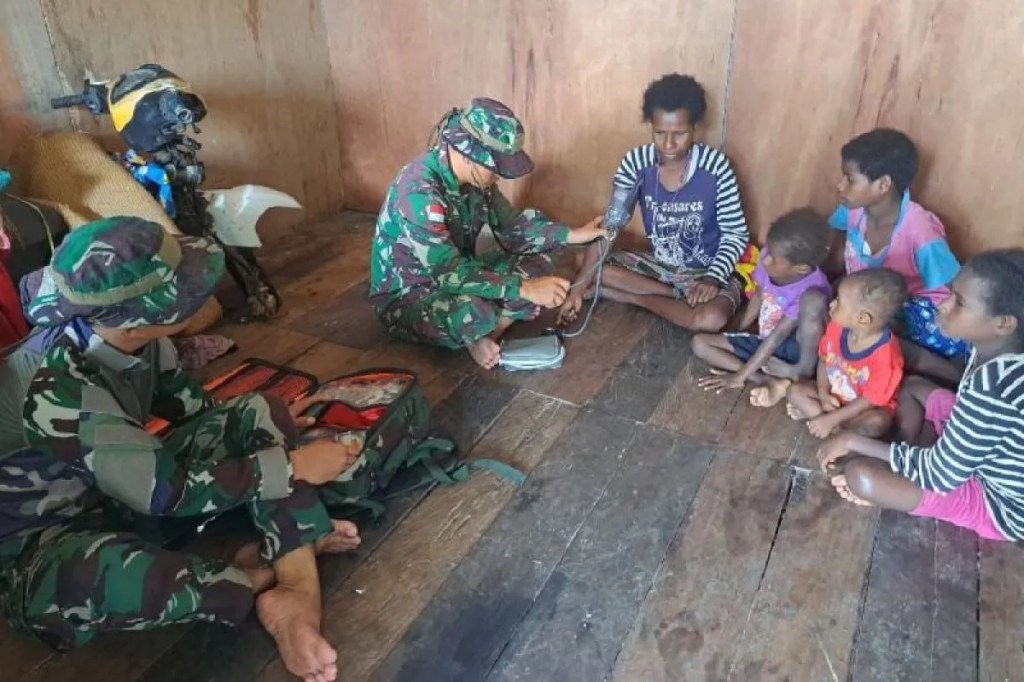
Jayapura, Papua (ANTARA) – Indonesian soldiers from the 125/SMB Infantry Battalion Task Force provided free healthcare services to native Papuans in Kiworo Village, Kimaam Sub-district, Merauke District, South Papua Province.

Located on Yos Sudarso Island, some 129 kilometers away from Merauke, Kimaam Sub-district can only be reached by airplane or ship, Kimaam Post Commander Second Lieutenant Raden Andika stated.


During this community service, the army paramedics visited the households in need of healthcare services, he noted in a press statement that ANTARA received in Jayapura City on Wednesday.

Apart from providing healthcare services to the villagers, the army personnel also conducted a knowledge-sharing session on healthy lifestyle and clean environment, Andika remarked.

A Kiworo villager named Margaretha Muyak thanked the army personnel for the community service.


In addition to Kiworo, Kimaam Sub-district has several other villages, including Kimaam, Mambum, Woner, Deka, Komolom, Kumbis, Turiram, Webu, Umanderu, Kalilam, Purawander, Teri, and Sabudom.

ANTARA reported earlier that Indonesian soldiers stationed in Papua have demonstrated exemplary capability in maintaining peace and stability in the region for decades in their endeavors to safeguard the country’s territorial integrity.

The soldiers are chiefly tasked with securing peace and stability in the country’s easternmost region.

However, they are also living and mingling with members of local communities, which has provided them a glimpse of the challenges faced by native Papuans in their day-to-day lives.

Indonesia’s Jokowi does a Machiavelli 

By Warief Djajanto Basorie 

Nov 20, 2024

Power is the proverbial drug that leaders find hard to quit.

After ten years as Indonesia’s president, Joko “Jokowi” Widodo has passed the baton to Prabowo Subianto October 20.

However, Jokowi is no lame duck. He has made moves that can still allow his influence to be felt.

Jokowi’s stay-in-power thoughts and done deals could match the power precepts of Niccolo Machiavelli, a public official in 16th Century Florence, a major principality under the autocratic rule of Lorenzo de Medici. Machiavelli was imprisoned and tortured by de Medici.

A ruler can act unethically and immorally to hold on to power. He or she can exercise any means to that end.

This is a key postulate Machiavelli (1469-1527) underscored in his 1513 treatise, Il PrincipeThe Prince.

Another principle is “keep your friends close and your enemies closer”.

Machiavelli maintains that leaders should always mask their true intentions. For sure, Jokowi never stated outright his intentions. But his subtle steps were detectable.

Jokowi’s post-presidential influence is noted in Prabowo’s cabinet lineup the new president announced the night after his inauguration. Jokowi had 34 ministers. Prabowo announced 48 ministers and 56 deputy ministers.

Prabowo retained 18 ministers from Jokowi’s cabinet. They include respected finance minister Sri Mulyani Indrawati to calm world investors, state-owned enterprises minister Erick Thohir, home affairs minister Tito Karnavian, and energy and natural resources minister Bahlil Lahadalia.

Beginnings

Jokowi, 63, was a small furniture businessman who became mayor of his hometown, Solo, in 2005 and later as governor of Jakarta in 2012. In 2014 Jokowi successfully ran to be president as a common man candidate opposite strongman retired General Prabowo Subianto who hails from the political elite.

In his first five-year term, Jokowi scored high public approval ratings for building toll-roads, developing public transport and delivering social benefits like the costly but highly favoured BPJS program in universal health care.

In the start of his second and final five-year term in 2019, Jokowi announced what was to be his signature legacy, a new US$33 billion capital named Nusantara (Archipelago) in the Borneo jungle.

However, the world-wide onslaught of the Covid-19 pandemic impaired the construction of this planned carbon-neutral, environment-friendly, hi-tech cyber city.

Jokowi realised that by the end of his presidency he could not yet move the capital from flood-fraught, pollution and traffic-jam-prone Jakarta to Nusantara, 1260 km to Jakarta’s northeast in East Kalimantan province.

To finish incomplete programs, Jokowi quietly sought to amend the Constitution to allow him a third term but failed to get parliamentary traction.

Jokowi’s alternative course was how to exercise power indirectly after he leaves office.

House call

Jokowi won his first and second terms by trouncing Prabowo, a former special forces Army commander. Prabowo took defeat vindictively. Knowing this, Jokowi acted to assuage that spite.

Jokowi called on Prabowo’s residence. The incumbent caught Prabowo unaware by inviting him to join his Cabinet as defence minister. This is the victor respecting and reverting the loser to be his ally. Prabowo accepted this invite arguing it was for national unity.

In public statements, Prabowo would profusely praise Jokowi’s character and policies including the building of the new capital.

Meanwhile, Gibran Rakabuming Raka, Jokowi’s first son, has been elected mayor of Solo in 2021.

Jokowi’s thinking was to have Gibran stand for Central Java governor. Subnational elections for governors, mayors and regents are scheduled for Nov 27 this year.

However, in the year before the Feb 14 2024 presidential and legislative voting, Prabowo sought permission from Jokowi to have Gibran as his vice presidential running mate.

Prabowo, 73, has publicly stated Indonesia’s future is in the hands of young leaders. He declared he wanted to be the bridge to the next generation.

Given that Jokowi has enjoyed consistently high approval ratings, Prabowo judged that having Gibran on his ticket and his father’s endorsement would be a double benefit.

Age was a conditional issue. Under Indonesia’s election law, Indonesians running for president and vice president must be at least 40 years old. Gibran is 37.

Coercion

Jokowi’s brother-in-law who was then the chief justice of the Constitutional Court cut the Gordian knot for Gibran. The Constitutional Court ruled the 40-year-old age limit remains but younger candidates who already hold elected public office can also run.

A public outcry ensued. Academics and rights activists accuse Jokowi of building a political dynasty.

Prabowo was pitted against two other tickets: former Jakarta governor Anies Baswedan and former Central Java governor Ganjar Pranowo. Prabowo vanquished them, capturing 58.6% of the vote. A ballot distance of more than 30% to either of his opponents ruled out a second round of voting.

No manipulation in vote counting was reported in the Feb 14 election. However, in the campaign, pre-election coercion and intervention profited the Prabowo/Gibran ticket.

Jokowi deployed the military and police in the provinces to pressure grassroots leaders like village heads to get their population to vote for Prabowo-Gibran.

The president would also visit vote-rich districts in the central island of Java and distribute 10 kilo sacks of rice to low income residents as one form of social assistance. Java has 56% of Indonesia’s population of 280 million people.

Jokowi also commanded sway on eight of the nine political parties with seats in parliament. The lone out-of-the-ring party was the Islam-based PKS that rejected Jokowi’s new capital scheme.

Further, in August energy minister Bahlil Lahadalia got to become general chair of the influential Golkar party that has the second most seats in the newly elected parliament. Golkar was the political vehicle that kept authoritarian president Soeharto in power from 1966 to 1998.

Bahlil is a Jokowi loyalist who undertook the failed lobbying to get parliamentary approval for a third term for Jokowi.

Democracy in decline

In its July 29, 2024 edition on ten years as president, the Jakarta-based news weekly Tempo viewed in a strident editorial that Jokowi has “pulled back the progress of democracy”.

“Indonesia is now afflicted with the four characteristics of democratic reversal: a legal system that is not impartial, a bureaucracy that is not neutral, excessive executive power, and media that is not independent,” the editorial exclaimed.

The magazine reported Jokowi has committed 18 sins in his 10 years in power that turn back the 1998 reform drive after the 32-year rule of General Soeharto. Tempo detailed each sin in up to six pages.

These anti-democracy moves include political dynasty and oligarchy building, weakening of democratic institutions, and debilitating the erstwhile independent Corruption Eradication Commission, KPK, making its officers into government employees.

In his second term, Jokowi did not hide his pro-business drive. He pushed policies that allowed investors laxity of environment protection regulations and KPK scrutiny.

Tempo’s serious fault-finding, however, did not slacken favourable polling of Jokowi’s work performance. The nonpartisan daily Kompas gave Jokowi an approval rating of 75.6% in June 2024, up from 73.5% in December 2023.

More recently, pollster Indikator Politik Indonesia gave Jokowi a 75% favourable rating based on a Sept 22-29 survey with 1200 respondents in 11 of the most populated provinces.

The nation’s elite, however, may not share that poll-based sentiment. On October 1, newly elected and returned legislators of the 580-member House of Representatives were sworn in.

When the House Speaker acknowledged the presence of President Joko Widodo, the vast chamber fell silent. When the Speaker stated the name of president-elect Prabowo Subianto, House members gave rousing applause.

What are Jokowi’s sources of power? Australian National University’s annual Indonesia Update conference Sept 13-14 2024 notes three points: popularity, coercion, and power sharing with elites.

Delivery matters

Apparently voters are more into what a leader can deliver. They are indifferent to dynasty formation that is also found at the subnational level.

When Jokowi stepped down on October 20, one question is how he can influence matters of state.

Through Gibran, his son and even Prabowo, Jokowi can get access to cabinet deliberations. Jokowi also maintains links to the parties that endorse Prabowo, particularly Golkar.

It is Jokowi’s intent that his unfinished programs stay on track. This includes the Nusantara national capital where he has taken office in the capacious presidential palace the past month. Another is down streaming industries turning raw minerals like nickel and bauxite into manufactured goods. Also plantation crops like oil palm converted to biofuel.

But the key determinant would be the new president. Prabowo has his own signature programs. One is providing free nutritional lunches to Indonesian school kids. Another is to boost the annual economic growth rate to 8% from the present 5%. Prabowo has the closing call.

 Kiwi pilot kidnapping in West Papua leads to police raids in Australia

 By APR editor –  November 19, 2024

By Duncan Graham

An alleged plot involving firearms and threatening the life of New Zealand pilot Philip Mehrtenswhen held hostage in Papua this year is being investigated by the Australian Federal Police.

The case involves “advancing a political cause by the separation of West Papua from Indonesia . . . with the intention of coercing by intimidation the governments of New Zealand and Indonesia”.

Named in the AFP search warrant seen by MWM is research scholar Julian King, 63, who has studied and written extensively about West Papuan affairs.

He has told others his home in Coffs Harbour, Queensland, was raided violently earlier this month by police using a stun grenade and smashing a door.

During the search, the police seized phones, computers and documents about alleged contacts with the West Papua rebel group Organisasi Papua Merdeka, OPM (Free Papua Organisation) and a bid to seek weapons and ammunition.

However, no arrests are understood to have been made or charges laid.

King, a former geologist and now a PhD student at Wollongong University, has been studying Papuan reaction to the Indonesian takeover since 1963. He has written in a research paper titled “A soul divided: The UN’s misconduct over West Papua” that West Papuans:

‘LIVE UNDER A MILITARY DICTATORSHIP DESCRIBED BY LEGAL SCHOLARS AND HUMAN RIGHTS ADVOCATES AS SYSTEMIC TERROR AND ALLEGED GENOCIDE.’

Also named in the warrant alongside King is Amatus Dounemee Douw, confirmed by MWMcontacts to be Australian citizen Akouboo Amatus Douw, who chairs the West Papua Diplomatic and Foreign Affairs Council, an NGO that states it seeks to settle disputes peacefully.

Risk to Australia-Indonesia relations
The allegations threaten to fragment relations between Indonesia and Australia.

It is widely believed that human rights activists and church organisations are helping Papuan dissidents despite Canberra’s regular insistence that it officially backs Jakarta.

Earlier this year, Deputy PM Richard Marles publicly stressed: “We, Australia, fully recognise Indonesia’s territorial sovereignty. We do not endorse any independence movement.”

In August, Douw alleged Indonesian troops shot Kiwi Glen Conning on August 5 in Central Papua. The government version claims that the pilot was killed by “an armed criminal group” after landing his helicopter, ferrying local people who fled unharmed.

When seized by armed OPM pro-independence fighters in February last year, Mehrtens was flying a light plane for an Indonesian transport company.

He was released unharmed in September after being held for 593 days by the West Papua National Liberation Army (Tentara Pembebasan Nasional Papua Barat – TPNPB), the military wing of the OPM.

Designated ‘terrorist’ group, journalists banned
OPM is designated as a terrorist organisation in Indonesia but isn’t on the Australian list of proscribed groups. Jakarta bans foreign journalists from Papua, so little impartial information is reported.

After Mehrtens was freed, TPNPB spokesman Sebby Sambom alleged that a local politician had paid a bribe, a charge denied by the NZ government.

However, West Papua Action Aotearoa spokesperson Catherine Delahunty told Radio NZ the bribe was “an internal political situation that has nothing to do with our government’s negotiations.”

Sambom, who has spent time in Indonesian jails for taking part in demonstrations, now operates out of adjacent Papua New Guinea — a separate independent country.

Australia was largely absent from the talks to free Mehrtens that were handled by NZ diplomats and the Indonesian military. The AFP’s current involvement raises the worry that information garnered under the search warrants will show the Indonesian government where the Kiwi was hidden so that locations can be attacked from the air.

AT ONE STAGE DURING HIS CAPTIVITY, MEHRTENS APPEALED TO THE INDONESIAN MILITARY NOT TO BOMB VILLAGES.

It is believed Mehrtens was held in Nduga, a district with the lowest development index in the Republic, a measure of how citizens can access education, health, and income. Yet Papua is the richest province in the archipelago — the Grasberg mine is the world’s biggest deposit of gold and copper.

OPM was founded in December 1963 as a spiritual movement rejecting development while blending traditional and Christian beliefs. It then started working with international human rights agencies for support.

Indigenous Papuans are mainly Christian, while almost 90 percent of Indonesians follow Islam.

Chief independence lobbyist Benny Wenda lives in exile in Oxford. In 2003 he was given political asylum by the UK government after fleeing from an Indonesian jail.  He has addressed the UN and European and British Parliaments, but Jakarta has so far resisted international pressure to allow any form of self-determination.

Questions for new President Prabowo
Indonesian President Prabowo Subianto is in the UK this week, where Papuans have been drumming up opposition to the official visit. In a statement, Wenda said:

‘PRABOWO HAS ALSO RESTARTED THE TRANSMIGRATION SETTLEMENT PROGRAMME THAT HAS MADE US A MINORITY IN OUR OWN LAND.’

“For West Papuans, the ghost of (second president) Suharto has returned — (his) New Order regime still exists, it has just changed its clothes.”

Pleas for recognition of Papuan’s concerns get minimal backing in Indonesia; fears of balkanisation and Western nations taking over a splintered country are well entrenched in the 17,000-island archipelago of 1300 ethnic groups where “unity” is considered the Republic’s foundation stone.

Duncan Graham has a Walkley Award, two Human Rights Commission awards and other prizes for his radio, TV and print journalism in Australia. He now lives in Indonesia. He has been an occasional contributor to Asia Pacific Report and this article was first published by Michael West Media.

The 63rd   Anniversary of West Papua’s Declaration of Independence 

The Australia West Papua Association (SA) inc

Invite you to celebrate

The 63rd   Anniversary of West Papua’s Declaration of Independence 

At a Melanesian Feast

 To be held at 99 Day Terrace , West Croydon  

On Sunday   1st December  from 12.00 -3 p.m.

For catering purposes you need to  let us know if you are  coming by Thursday 29th Nov

BYO  drinks   Food will be provided .

to    dave-arkins@bigpond.com or phone 0408345593

Hope you can come !!

For those interstate details of local events will soon be available   

On Australia’s door step we have a situation very similar to what is happening in Gaza and the West Bank of Palestine.

Stop the militarisation of West Papua

Stop the Colonial Transmigration Program to West Papua

Stop the Land Grab

Stop travelling  to Bali in protest !

The new Indonesian President Prabowo Subianto has deepened the occupation of West Papua .

He has sent in the army of soldiers and workers to achieve this by force.

Indonesia has continued to divide West Papua by dividing it from one province into 6 smaller provinces

each with hand picked local Government and by situating an additional  Military command bases in every one , indeed in nearly every village .,

President Subianto  has  reopening the Ministry of Transmigration to facilitate  after it had ceased in the year 2000  when Special Autonomy was brought in.

Thousands of Immigrant workers from various parts of Indonesia  are being chosen  to work on the massive Food estates  in Merauke in the Southern part of Papua .

The land will be used to grow rice , Sugar and Palm oil   

Over 200 bulldozer have already arrived and work is moving at a rapid pace .

Over 10,000 new The Indonesian Army  Tentara Negara Indonesia TNI  forces have been sent there .

They are now constructing a new highway over 135 kilometres and cleared one kilometer wide  to transport the food.

There has been no consultation with the Indigenous owners about this.

The project has been deemed  to be in the National interest good as it will provide  food security for a rapidly expanding Indonesian  population in the time of climate change .

“We told him the destruction and impact that we suffered from the project. We already complained to him but he did nothing. So, we are appalled whom he protects? We reject the corporation, but they already bulldoze our forest, dig up our water fountain, drive away fish, deer, kangaroo, pigs and other animals. So, we came here to Jakarta to raise our concerns to the government ministries here.”

Vincent, another landowner from Jagegob District, continues, “In my area, they plan to grow sugarcane. My clan has already rejected the project. We are a bit better off than Mama Sinta’s situation because we did not deal with the [military] troops. We only deal with Bintara Pembina Desa (Babinsa, low ranking army officers) who go around door to door to tell off people to give up their land. This [action] has caused tension and rift within families. For some families, where brother agrees to receive compensation, his sister opposes or vice versa so they have family fight.”

Simon, the Coordinator of Forum Solidaritas Merauke (Solidarity Forum of Merauke), narrated his story. “Around June-July 2024, we saw a luxury cruise with five decks and helipad belongs to Haji Ihsam harboured in Mariana strait. Towards the end of July 2024, some 100 excavators arrived, and they are now clearing the forest aiming to construct 135 km road with 1 km wide straight from District Ilwayap in the West to District Muting in the East [see the long orange line in the middle of Figure 1]. The excavators are so cruel. They just killed deer by crushing them with their claws just like that. Meanwhile, the army are flying around with choppers and shoot dead at any deer they see are running away from the excavators. Then they collect and bring them to the camp to eat. They never ask for our permission.”

Conflict escalation in Intan Jaya comes with civilian casualties and further internal displacement

Human Rights Monitor

CasesHuman Rights News / IndonesiaWest Papua / 15 November 2024 

The Indonesian military continues to intensify its operations in West Papua, leading lately to increased displacement of indigenous communities and severe human rights abuses. Recent reports from the conflict-ridden region of Intan Jaya in Papua province have raised serious concerns about the safety of civilians caught in the crossfire between the Indonesian National Army (TNI) and the West Papua National Liberation Army (TPNPB). Reports also indicate that the military has seized land belonging to the Moni Tribe in Intan Jaya Regency, without the consent or agreement of the indigenous community. The land, located in Silatugapa Village, is intended for the construction of a new military battalion. This move has sparked outrage among local communities and human rights organisations. The Moni Tribe, like many other indigenous groups in Papua, relies heavily on the forest for their livelihoods and cultural practices. The military’s presence in the area could severely restrict their access to vital resources and traditional lands.

Since 18 October 2024, the Indonesian military has been engaged in a counterattack against the TPNPB Kodap VIII Intan Jaya troops in Sugapa District. While there were no reported casualties on either side during the initial clashes, the situation has escalated, leading to casualties and significant civilian displacement and further potential human rights violations. Civilians in Titigi, Eknemba, and Ndugisiga Villages have fled to the forest due to the deployment of military troops in their areas. Schools have been closed, and civilian homes and infrastructure have been damaged by gunfire. The operation have been ongoing until at least 25 October.

On 1 November 2024, an incident occurred when a 27-year-old civilian, Justinus Sani, was shot by the TNI in the village of Joparu. The shooting, allegedly carried out with a sniper rifle from a distance of 400 meters, left Sani injured.The military has also been accused of using excessive force, arbitrary arrests, torture, and extrajudicial killings. In addition, the establishment of military posts in civilian areas has disrupted the daily lives of communities and limited their freedom of movement.

Human rights organisations have expressed deep concern over the ongoing conflict and the escalating human rights abuses. Civilians, including women, children, and the elderly, have been caught in the crossfire, with many suffering from injuries, displacement, and even death.

Local communities and human rights organisations have called on the Indonesian government to immediately cease military operations in Papua, respect the rights of indigenous communities, and hold perpetrators of human rights abuses accountable. They have also urged the international community to increase pressure on the Indonesian government to address the crisis in Papua. Key recommendations include:

Independent Investigation: A thorough investigation into the civilian casualties, conducted by impartial authorities.

Transparency: Public disclosure of the number of military personnel deployed to Papua and the legal basis for their operations.

Adherence to International Law: Strict adherence to international humanitarian law and human rights law.

Peaceful Dialogue: The facilitation of dialogue between the government and the TPNPB to find a peaceful solution.

Photos of victim Justinus Sani

Health risk claims ‘a hoax’: Indonesian Ambassador

The Indonesian Ambassador to Vanuatu, Siswo Pramono, has dismissed recent claims of health risks associated with Indonesian medical services as baseless.

“This is not an allegation but a hoax,” he said. He defined a hoax as a “deliberate act meant to deceive or trick people into believing something false, often for personal gain, amusement, or to create confusion.”

Prior to the arrival of the Indonesian navy hospital ship, WSH-991, in Port Vila, the Special Envoy of West Papua in Vanuatu Morris Kaloran warned the people of health risks and urged them to stay away.

He also describes the vessel’s presence as a ‘slap in the face’ to the Melanesian people, particularly Vanuatu which has been a vocal advocate for the rights of west Papuans.

In his response, Ambassador Pramono emphasized the advances made in public health in Papua, Indonesia, citing statistics that demonstrate improved life expectancy among Papuans over the last five years under Indonesia’s public health services.

“In Indonesia, health services are pretty much standardized,” he said.

He drew a comparison between Port Vila, which has a population of around 50,000, and the Regency of Keerom in Papua, which has approximately 60,000 residents.

According to data from the Statistics of Papua Provinces in 2021, Keerom is served by 33 doctors, 234 nurses, 114 midwives, 30 pharmacists, and 29 nutritionists.

“This shows that the government of Papua’s provinces is committed to promoting public health, with significant support from Indonesia’s central government,” he said.

In alignment with Vanuatu’s public health goals, Pramono noted that, at Prime Minister Charlot Salwai’s request, Indonesia recently dispatched ten experienced nursing trainers to Port Vila to enhance the quality and capacity of nursing services.

“The mission is to help improve the quality and capacity of Port Vila’s nursing services, and we will continue this program into next year,” he said.

Ambassador Pramono, who is based in Australia, also highlighted Indonesia’s international reputation for public health development.

During the COVID-19 pandemic, Indonesia was entrusted by the United Nations to serve as a co-chair of the COVID-19 Vaccines Global Access (COVAX) Advance Market Commitment, ensuring equitable vaccine distribution among developing countries, including Vanuatu.

“According to Our World in Data, Indonesia was among the five countries with the highest COVID vaccination rates among developing nations,” he said.

He said that the Economist Intelligence Unit (EIU) recognized Indonesia’s effective governance during the pandemic by raising its Democracy Index from 6.3 in 2020 to 6.71 in 2021.

“This progress reflects the Indonesian government’s commitment to providing the basic human right of health,” he said.

In response to Vanuatu’s request for further healthcare support, the recent visit of the Indonesian Navy hospital ship to Port Vila is seen as an extension of Indonesia’s humanitarian cooperation with Vanuatu.

“This mission, like our support during COVID-19 through COVAX, illustrates our commitment to being a good partner,” said Mr. Pramono.

He said that Vanuatu’s government has expressed interest in expanding the program, with requests for the hospital ship to visit other islands.

“As the Indonesian Ambassador, I will recommend that the Indonesian government seriously consider this request,” he added.

glenda@dailypost.vu

West Papuan leader makes ‘raise our banned flag’ plea over new threat

By APR editor – 

November 14, 2024

Asia Pacific Report

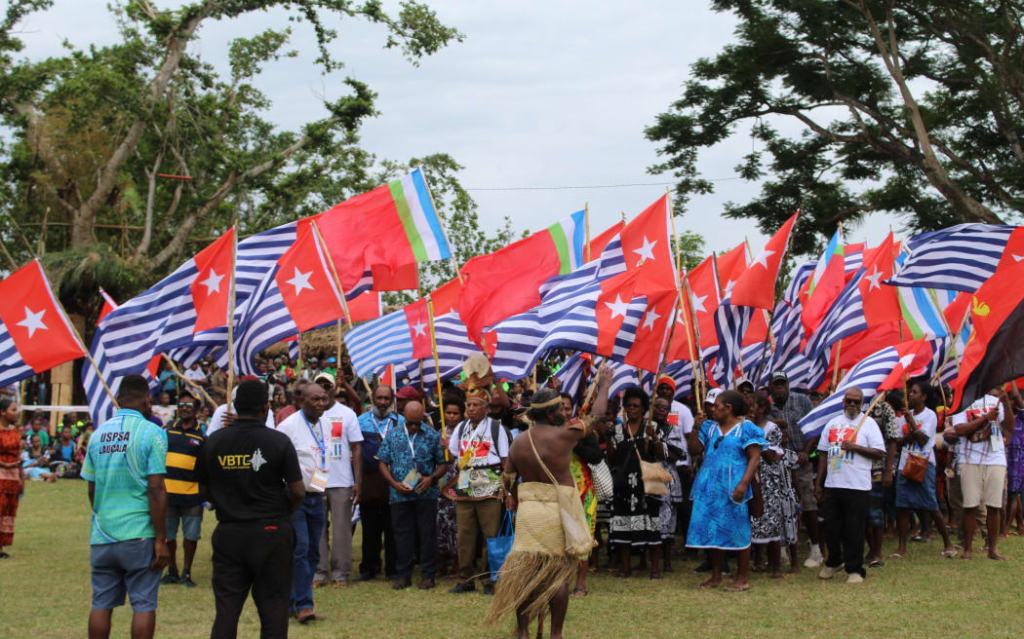
An exiled West Papuan leader has called on supporters globally to show their support by raising the Morning Star flag — banned by Indonesia — on December 1.

“Whether in your house, your workplace, the beach, the mountains or anywhere else, please raise our flag and send us a picture,” said United Liberation Movement for West Papua (ULMWP) interim president Benny Wenda.

“By doing so, you give West Papuans strength and courage and show us we are not alone.”

The plea came in response to a dramatic step-up in military reinforcements for the Melanesian region by new President Prabowo Subianto, who was inaugurated last month, in an apparent signal for a new crackdown on colonised Papuans.

January 1 almost 63 years ago was when the Morning Star flag of independence was flown for the first time in the former Dutch colony. However, Indonesia took over in a so-called “Act of Free Choice” that has been widely condemned as a sham.

“The situation in occupied West Papua is on a knife edge,” said the UK-based Wenda in a statement on the ULMWP website.

He added that President Prabowo had announced the return of a “genocidal transmigration settlement policy”.

Indigenous people a minority
“From the 1970s, transmigration brought hundreds of thousands of Javanese settlers into West Papua, ultimately making the Indigenous people a minority in our own land,” Wenda said.

“At the same time, Prabowo [is sending] thousands of soldiers to Merauke to safeguard the destruction of our ancestral forest for a set of gigantic ecocidal developments.

“Five million hectares of Papuan forest are set to be ripped down for sugarcane and rice plantations.

“West Papuans are resisting Prabowo’s plan to wipe us out, but we need all our supporters to stand beside us as we battle this terrifying new threat.”

The Morning Star is illegal in West Papua and frequently protesters who have breached this law have faced heavy jail sentences.

“If we raise [the flag], paint it on our faces, draw it on a banner, or even wear its colours on a bracelet, we can face up to 15 or 20 years in prison.

“This is why we need people to fly the flag for us. As ever, we will be proudly flying the Morning Star above Oxford Town Hall. But we want to see our supporters hold flag raisings everywhere — on every continent.

‘Inhabiting our struggle’
“Whenever you raise the flag, you are inhabiting the spirit of our struggle.”

Wenda appealed to everyone in West Papua — “whether you are in the cities, the villages, or living as a refugee or fighter in the bush” — to make December 1 a day of prayer and reflection on the struggle.

“We remember our ancestors and those who have been killed by the Indonesian coloniser, and strengthen our resolve to carry on fighting for Merdeka — our independence.”

Wenda said the peaceful struggle was making “great strides forward” with a constitution, a cabinet operating on the ground, and a provisional government with a people’s mandate.

“We know that one day soon the Morning Star will fly freely in our West Papuan homeland,” he said.

“But for now, West Papuans risk arrest and imprisonment if we wave our national flag. We need our supporters around the world to fly it for us, as we look forward to a Free West Papua.”

——————————

  •  

Indonesia: Survey warning on Papua mega project appears to go unheeded

Indigenous Papuans from Merauke in eastern Indonesia protest against plans to convert indigenous and conservation lands into sugar cane plantations and rice fields, Oct. 16, 2024.

Land clearance was underway even before the feasibility study was completed.

Stephen Wright for RFA 2024.11.13

Indonesia’s plan to convert over 5 million acres of conservation and indigenous lands into agriculture will cause long-term damage to the environment, create conflict and add to greenhouse gas emissions, according to a feasibility study document for the Papua region mega-project.

The 96-page presentation reviewed by Radio Free Asia was drawn up by Sucofindo, the Indonesian government’s inspection and land surveying company. Dated July 4, it analyzes the risks and benefits of the sugar cane and rice estate in Merauke regency on Indonesia’s border with Papua New Guinea and outlines a feasibility study that was to be completed by mid-August.

Though replete with warnings that “comprehensive” environmental impact assessments should take place before any land is cleared, the feasibility process appears to have been a box-ticking exercise. Sucofindo did not respond to questions from RFA, a news service affiliated with BenarNews, about the document.

Even before the study was completed, then-President Joko “Jokowi” Widodo participated in a ceremony in Merauke on July 23 that marked the first sugar cane planting on land cleared of forest for the food estate, the government said in a statement. Jokowi’s decade-long presidency ended last month.

In late July, dozens of excavators shipped by boat were unloaded in the Ilyawab district of Merauke where they destroyed villages and cleared forests and wetlands for rice fields, according to a report by civil society organization Pusaka. 

Hipolitus Wangge, an Indonesian politics researcher at Australian National University, told RFA the feasibility study document does not provide new information about the agricultural plans. But it makes it clear, he said, that in government there is “no specific response on how the state deals with indigenous concerns” and their consequences.

The plan to convert as much as 5.7 million acres of forest, wetland and savannah into rice farms, sugarcane plantations and related infrastructure in the conflict-prone Papua region is part of the government’s ambitions to achieve food and energy self-sufficiency. Previous efforts in the nation of 270 million people have fallen short of expectations.

Echoing government and military statements, Sucofindo said increasingly extreme climate change and the risk of international conflict are reasons why Indonesia should reduce reliance on food imports.

Taken together, the sugarcane and rice projects represent at least a fifth of a 10,000 square km (38,600 square mile) lowland area known as the TransFly that spans Indonesia and Papua New Guinea and which conservationists say is an already under-threat conservation treasure.

Indonesia’s military has a leading role in the 2.47 million acre rice plan while the government has courted investors for the sugar cane and related bioethanol projects.

The likelihood of conflict with indigenous Papuans or of significant and long-term environmental damage applies in about 80% of the area targeted for development, according to Sucofindo’s analysis.

The project’s “issues and challenges,” Sucofindo said, include “deforestation and biodiversity loss, destruction of flora and fauna habitats and loss of species.”

It warns of long-term land degradation and erosion as well as water pollution and reduced water availability during the dry season caused by deforestation.

Sucofindo said indigenous communities in Merauke rely on forests for livelihoods and land conversion will threaten their cultural survival. It repeatedly warns of the risk of conflict, which it says could stem from evictions and relocation.

“Evictions have the potential to destabilize social and economic conditions,” Sucofindo said in its presentation.

If the entire area planned for development is cleared, it would add about 392 million tons of carbon to the atmosphere in net terms, according to Sucofindo.

That’s about equal to half of the additional carbon emitted by Indonesia’s fire catastrophe in 2015 when hundreds of thousands of acres of peatlands drained for pulpwood and oil palm plantations burned for months. 

Indonesia’s contribution to emissions that raise the average global temperature is significantly worsened by a combination of peatland fires and deforestation. Carbon stored in its globally important tropical forests is released when cut down for palm oil, pulpwood and other plantations.

In a speech on Monday to the annual United Nations climate conference, Indonesia’s climate envoy, a brother of recently inaugurated president Prabowo Subianto, said the new administration has a long-term goal to restore forests to 31.3 million acres severely degraded by fires in 2015 and earlier massive burnings in the 1980s and 1990s.

Indonesia’s government has made the same promise in previous years including in its official progress report on its national contribution to achieving the Paris Agreement goal of keeping the rise in average global temperature to below 2 degrees Celsius.

“President Prabowo has approved in principle a program of massive reforestation to these 12.7 million hectares in a biodiverse manner,” envoy Hashim Djojohadikusumo said during the livestreamed speech from Baku, Azerbaijan. “We will soon embark on this program.”

Prabowo’s government has announced plans to encourage outsiders to migrate to Merauke and other parts of Indonesia’s easternmost region, state media reported this month.

Critics said such large-scale movements of people would further marginalize indigenous Papuans in their own lands and exacerbate conflict that has simmered since Indonesia took control of the region in the late 1960s.

Papuan indigenous peoples struggle has become much harder after court ruling: Walhi

Suara Papua – November 4, 2024

Jayapura – The struggle by Papuan indigenous people to save their customary forests from the invasion by corporations and the government has become harder after legal efforts reached a dead end with the Supreme Court’s (MA) rejection of the Awyu tribe’s appeal which challenged the environmental feasibility permit issued to the company PT Indo Asiana Lestari (IAL) by the Papua provincial government.

The court’s decision, as per Supreme Court document number 458 K/TUN/LH/2024, was taken at a deliberation meeting of the panel of judges on September 18. The full document was only able to be accessed on November 1.

Following the Supreme Court’s ruling, Hendrikus Franky Woro, an environmental activist from the Awyu tribe with the Coalition to Save Papua’s Customary Forests, expressed his deep disappointment because the Supreme Court appeal by the Awyu indigenous people, which was an effort to defend their customary forests from the expansion of palm oil corporations in Boven Digoel district, South Papua, now seemed to have been vain.

Woro and the Awyu tribe took their appeal to the Supreme Court after the Jayapura State Administrative Court (PTUN) and the Makassar State Administrative High Court (PTTUN) rejected their lawsuit and appeal.

The legal challenge was reasonable considering that the environmental feasibility permit issued by the provincial government for PT IAL was considered illegal and has a huge impact on the customary landowners and their future generations. This is because the palm oil company is operating on 36,094 hectares of land owned by the Woro clan, part of the Awyu tribe.

In a press release on Monday November 4, Indonesian Forum for the Environment (Walhi) Regional Executive Director Maikel Primus Peuki said that the verdict adds to the list of bad news for indigenous peoples and local communities who are fighting in courts against the threat of companies damaging the environment.

Woro’s disappointment, according to Peuki, was also felt by the Coalition to Save Papua’s Customary Forests. Peuki also felt the same because the court’s decision to reject the cassation appeal will make indigenous people’s struggle more difficult.

That is why Peuki regrets the Supreme Court’s ruling which seems to give false power to the company.

“The island of Papua is a customary land owned by more than 200 clans living in the land of Papua. This Supreme Court decision seems to give false power to the company. However, the Awyu indigenous people still have the right to their customary forests that have been with them for generations since they first lived in this customary area”, he said.

Walhi Papua hopes that the permit owned by the company will not eliminate the rights of indigenous peoples to their land, because it is clear that the owners of the customary rights have not relinquished their customary rights to anyone.

“We hope that the public will continue to support the struggle of the Awyu tribe and indigenous peoples throughout Papua who are fighting to defend their customary lands and forests”, said Peuki.

It turns out that one of the three judges who tried the case, Yodi Martono Wahyunadi, issued a dissenting opinion.

One of the important points in the dissenting opinion concerns the 90-day lawsuit deadline, which was previously used as a pretext by the Makassar PTTUN to reject Woro’s appeal. In his considerations, Judge Wahyunadi referred to Article 5 Paragraph (1) of Supreme Court Regulation Number 6/2018 which states that the calculation of the deadline only refers to working days. The deadline calculation should also have included local holidays in Papua province.

But considering substantive justice rather than formal justice, Judge Wahyunadi was of the opinion that the court needed to set aside the deadline provision by carrying out a practical invalidation.

Tigor Gemdita Hutapea, a member of the Save Papua’s Customary Forests advocacy team stated, “From the considerations in the dissenting opinion regarding this deadline, we consider the Supreme Court to be inconsistent in applying the rules they make. Even though the Supreme Court regulation is a guide used by the judiciary internally”.

“This Supreme Court’s ruling does not mean that the object of the lawsuit is correct because two judges did not examine the substance. But one [member of the] panel of judges in their dissenting opinion stated that the issuance the AMDAL [Environmental Impact Analysis] was proven not to have accommodated losses in areas where indigenous peoples live, which have been managed and utilised for generations”, said Hutapea.

In the dissenting opinion Wahyunadi said that the object of the lawsuit, the environmental permit for PT IAL, is clearly contrary the principles in Law Number 32/2009 on Environmental Protection and Management, so it must be annulled. Unfortunately, Judge Wahyunadi lost the vote.

[Translated by James Balowski. The original title of the article was “WALHI Papua Sebut Perjuangan Masyarakat Adat Kian Berat Pasca Putusan MA”.]

Source: https://suarapapua.com/2024/11/04/walhi-papua-sebut-perjuangan-masyarakat-adat-kian-berat-pasca-putusan-ma/

————————–