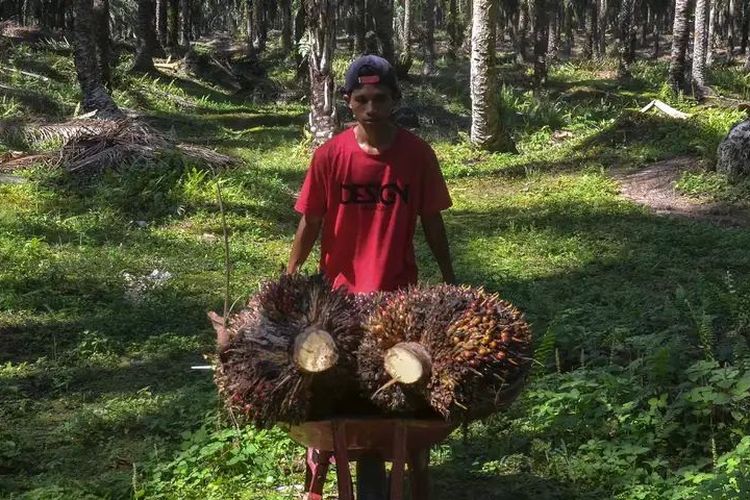
Sabrina Asril, Jakarta — The Indonesian Legal Aid Foundation (YLBHI) has condemned the arrest of nine palm oil farmers in the area of the new capital city Nusantara (IKN) who were opposing the construction of the VVIP Airport in North Penajam Paser, East Kalimantan, on Monday February 26.
“The YLBHI condemns the actions of the East Kalimantan regional police who carried out the inhuman and arbitrary arrests, because it was done without showing an arrest warrant and did not clearly notify them of the reason they were arrested”, said YLBHI Chairperson Muhammad Isnur said in a written statement on Monday.
Isnur said that the arrests can be categorised as a systematic act against communities defending their right to life. According to Isnur, the arrest of nine farmers by the police as a case of using the law to coerce the community.
“The police for the umpteenth time have used this method, in securing national strategic projects (PSN)”, said Isnur.
Isnur said that the same thing had happened at the Rempang Eco-City project in the Riau Islands and in the case of a land dispute in Seruyan, Central Kalimantan.
“The actions of the East Kalimantan regional police violated the law and human rights, where any person who is arrested has the right to be told the reason why they were arrested and the police are required to show an arrest warrant”, said Isnur.
Earlier, nine members of the Saloloang farmers group in North Penajam Paser (PPU) were arrested by the police on Saturday evening, February 24. The arrests were related a land dispute between a group of farmers and the IKN VVIP Airport national strategic project.
East Kalimantan regional police public relations head Senior Commissioner Artanto said that the nine farmers were arrested because it was said that they had threatened the IKN VVIP Airport construction project.
Artanto explained that on Friday February 23, a group of people approached VVIP project workers and threatened them so they would stop working.
The next day, on Saturday at around 8.30 am, the group returned to stop the construction of the VVIP Airport. The incident occurred on the northern side of Zone 2 when they brought Mandau (a kind of sword made in Borneo) and the operators immediately stopped work.
“On the basis of the incident, field supervisors at the location of the planned VVIP Airport made an official police report with the PPU regional police on that day as well”, Artanto said on Monday.
[Translated by James Balowski. The original title of the article was “YLBHI Kecam Penangkapan 9 Petani Sawit di Wilayah IKN”.]
Ihsanuddin, Jakarta — It is believed that the misuse of social aid
(bansos) from the government during the 2024 elections can be categorised as corruption.
Indonesian Legal Aid and Human Rights Association (PBHI) Chairperson Julius Ibrani conveyed this during a discussion titled “A Fair and Democratic Indonesia Movement” with the theme “An Election Right of
Inquiry: A Release of 30 Names of DPR Members Being Encouraged to Submit a Right of Inquiry” in Jakarta on Tuesday February 27.
“Including bansos. It must be included in the category of corruption.
Why? Because it benefits certain parties, either personally or as corporate institutions and others”, said Ibrani in his presentation.
He is of the view that the government’s social aid program was a tool to raise the votes for a certain presidential and vice presidential candidate ticket.
As is known, President Joko “Jokowi” Widodo eldest son Gibran Rakabuming Raka ran as a vice presidential candidate in the 2024 presidential election under ticket number 2 as presidential candidate Prabowo Subianto’s running mate.
Ibrani said that the distribution of social aid ahead of voting day in the presidential election (Pilpres) also influenced survey results and the electability of the Prabowo-Gibran ticket.
“This was systemic, indeed the system that was seen was wherever there was a lack of vote for the beloved child he would pour water there”, said Ibrani.
“Until it then affected the results of electoral surveys, surveys, exit polls, why? People didn’t want to answer if they don’t choose Gibran, [they were] afraid of not getting social aid. That’s systemic”, he added.
Not only that, he also believes there are suspicions of the use of the state apparatus in the process to ensure a victory for presidential candidate pair number 2.
Moreover, he also considers that this year’s election process was systematically rotten.
“Also the use of state officials, just to mention a few, the TNI [Indonesian military], the Polri [Indonesian police], village officials, ministries and all kinds of facilities within this which should be categorised as corruption. Because it was used for the benefit of one or two particular parties”, he said.
The disbursement of social aid during the election campaign period this year has been in the public spotlight and was seen to be politically charged.
But despite being in the spotlight, the government still boosted the distribution of social aid and even promised it would continue to distribute social aid until June 2024.
In the realisation of the social aid program, President Widodo even “came from the mountain” to check the distribution of social aid in the Central Java city of Salatiga on Monday January 22.
Widodo said the government would try to continue the distribution of rice social assistance until June 2024 and that he hoped that the state budget (APBN) would remain strong so that social aid could continue.
Aside from Widodo, Coordinating Minister for the Economy Airlangga Hartarto also went into the field to distribute social aid directly and distributed assistance from government rice reserves in Indramayu, West Java, on Wednesday January 24.
Airlangga said that food assistance was intended to accelerate the elimination of extreme poverty in Indonesia. He also gave assurances that the government would continue the El Nino Direct Cash Assistance Program (BLT) which is now still in the disbursement stage.
“Direct cash assistance [to compensate] for El Nino amounting to 200,000 rupiah per month is now in process and it is hoped that at the end of the month or at the beginning of next month it can be launched”, he said.
However Presidential Special Staff Coordinator Ari Dwipayana said that the social aid distributed by the government was not related to the general election process.
Dwipayana asserted that the social aid was assistance for small communities that had already been mutually agreed upon by the government and the House of Representatives (DPR).
“It must be remembered that social aid is an affirmation program from the government for the ordinary people and poor families, the funding for which is sourced from the APBN”, said Dwipayana in a written statement given to journalists on Thursday January 4.
“And it was already agreed to jointly between the government and DPR.
So, it has nothing to do with the election process”, he said.
[Translated by James Balowski. The original title of the article was “Penyalahgunaan Bansos Saat Pemilu Dinilai Bisa Masuk Kategori Korupsi”.]
A leaked document circulating on the Internet detailing the reasons behind the dismissal of presidential candidate Prabowo Subianto from military service on Aug. 21, 1998, has cast doubts on the former general’s suitability to serve as president, if elected on July 9.The document, which was a scanned copy of the official letter signed by members of the Indonesian Military’s (TNI) Officer’s Honorary Council (DKP) tasked with hearing the cases of Prabowo’s complicity in the kidnapping of pro-democracy activists in 1998, revealed that the former Army’s Special Forces (Kopassus) commander was also fired from his position due to insubordination.Signatories in the document include then Lt. Gen. Susilo Bambang Yudhoyono, the current President; then Army chief of staff Gen. Soebagyo Hadi Siswoyo; Lt. Gen. Fachrul Razi; and Lt. Gen. Agum Gumelar.If the authenticity of the document is verified, it could deal a blow to Prabowo’s credibility as a military man and presidential candidate.The document states Prabowo, as Kopassus commander, overstepped his authority by ordering the Mawar and Melati units to ‘arrest and detain’ the activists of the radical People’s Democratic Party (PRD).Mawar and Melati are military units under the command of Kopassus, which answer to the commander of the TNI.However, the document reveals the Mawar unit did not act on its own initiative, like Prabowo’s campaign team have repeatedly claimed.The document suggests the Mawar unit carried out the kidnappings after Prabowo reassured them that it ‘had been reported’ and that the operation was based on ‘a direct order from on high’, when in fact a report was never made by Prabowo to then Indonesian Armed Forces (or ABRI, as the TNI was then known) commander Gen. Wiranto.The kidnapping was only reported in April 1998 after pressure from then head of the Armed Forces Intelligence Body (BIA) Maj. Gen. Zacky Anwar Makarim.The document, which was uploaded on the website indonesia-2014.com, is the first document made public that details how Prabowo was dismissed from the military.The document states the DKP not only dismissed Prabowo on charges of human rights violations in relation to the abductions, but also on a number of other actions that demonstrated his insubordination and disregard for the military code.Among the other charges brought against him in the DKP hearing were that Prabowo had carried out or had taken over several operations that were under the authority of the ABRI commander, including the involvement of military forces in East Timor (now Timor Leste) and Aceh; the release of hostages in Wamena in then-Irian Jaya; and Kopassus’ involvement in securing president Soeharto’s visit to Vancouver, Canada in 1997, shortly before the strongman was ousted from power.In conclusion, the DKP said Prabowo had disgraced and disregarded the military system and committed a criminal offense.In response to the circulating document, the leader of the Prabowo-Hatta Rajasa election campaign team, Mahfud MD, reiterated that Prabowo was honorably discharged from the military.’Pak Prabowo did receive his marching orders, but take note that he was discharged with respect,’ Mahfud told reporters at Polonia House in East Jakarta.’There is no problem with this document circulating, I want to emphasize it [the dismissal] was done with respect. It would only be a problem if he were dishonorably discharged,’ the former Constitutional Court chief justice said. (tjs)
Jakarta — Scores of civil society organisations have expressed their opposition to President Joko “Jokowi” Widodo’s decision to award Defense Minister Prabowo Subianto with an honorary rank of four-star general.
The Coalition believes that the policy is a transactional electoral political move and that Widodo wants to annul Prabowo’s involvement in past gross human rights violations.
“With regard to this decision, the Civil Society Coalition condemns giving an honorary promotion in rank (HOR) of four-star general to Prabowo Subianto. This is not right, but also injures the feelings of the victims and betrays the 1998 reformasi [process]”, said the groups in a written statement on Wednesday February 28.
The Coalition is making five recommendations. First, that Widodo cancel giving the honorary rank to Prabowo.
Second, that the National Human Rights Commission (Komnas HAM) must seriously investigate the cases of crimes and gross human rights violations committed by Prabowo. Third, the Attorney General must conduct a criminal investigation into and prosecute cases of gross human rights violations in 1997-98.
“The government, in this case the president and his officials, must pursue the DPR’s [House of Representatives] 2009 recommendations, namely forming an ad hoc Human Rights Court, finding the 13 abduction victims that are still missing, rehabilitating and providing compensation to the families of the missing victims and ratifying the Convention Against Enforced Disappearances”, said the Coalition.
Fifth, the TNI-Polri (Indonesian military-Indonesian police) must maintain neutrality and not be involved in political activities.
The opposition to Prabowo’s honorary rank was conveyed by 22 organisations. They are the Commission for Missing Persons and Victims of Violence (Kontras), Indonesian Human Rights Watch (Imparsial), the Indonesian Association of the Families of Missing Persons (IKOHI), Asia Justice and Rights (AJAR), the Indonesian Legal Aid Foundation (YLBHI) and the Community Legal Aid Institute (LBHM).
Then the Institute for Public Research and Advocacy (ELSAM), the Human Rights Working Group (HRWG), the Indonesian Legal Aid and Human Rights Association (PBHI), Centra Initiative, the Lokataru Foundation for Human Rights, Amnesty International Indonesia, Public Virtue, the Setara Institute for Peace and Democracy and Migrant Care.
The Institute for Ecosoc Rights, Greenpeace Indonesia, the Public Interest Lawyers Network (Pil-NET Indonesia), Kontras Surabaya, the Banten Legal Aid Foundation for Justice (LBH Keadilan), the Institute for Legal Development and Human Rights (LPSHAM) and the Kontras Federation.
President Widodo has denied that awarding Prabowo with an honorary rank of four-star general is a reciprocal move and a form of transactional politics.
“Yeah, if was transactional politics we would have given it to him before the elections”, said Widodo after attending a TNI-Polri leadership meeting in Cilangkap, East Jakarta, on Wednesday February 28.
“This is after the elections, right, so there wouldn’t be any suspicions like that”, he added.
Widodo explained that giving the honorary rank to Prabowo was a proposal from the TNI commander which did not come out of the blue but rather through various processes. (dhf/pmg)
Notes
In 1997-98 as many as 23 pro-democracy activists were abducted by members of the Army’s Special Forces (Kopassus). After extended periods of detention — in many cases the victims were severely tortured — most were released although 13 remain missing and are presumed dead. Former Kopassus commander Lieutenant General Prabowo Subianto, who was at the time President Suharto’s son-in-law, has admitted to ordering the abductions but claims they were all released alive and well. He was subsequently dismissed from the military over the abductions but has never been tried in court.
[Translated by James Balowski. The original title of the article was “Ramai-ramai Tolak Pangkat Jenderal Kehormatan Prabowo”.]
Indonesia’s president-elect, Prabowo Subianto, has form. As the son-in-law of the former dictator, Suharto, he rose quickly through the ranks of the military to become head of the greatly feared Indonesian special forces, Kopassus. To put it bluntly, in 1983 he was involved in one of the biggest massacres in Indonesian-occupied Timor-Leste, in Kraras in the south of the country. His soldiers killed up to 300 men, women and children in the biggest mass killing in Timor-Leste’s 24-year war with Indonesia. He was also involved in the killing of the first president of Timor-Leste, Nicolau Lobato, whose body was taken by Indonesian forces and never recovered.
Prabowo was finally thrown out of the army in 1998 following the detention and disappearances that year of pro-democracy Indonesian activists in Jakarta, who were protesting against Suharto and calling for his overthrow. Thirteen of the activists disappeared and were never seen again, presumed killed by Kopassus troops who were under his command. Prabowo was given a travel ban to the United States, where he had previously trained in counterinsurgency with US special forces at Fort Benning and Fort Bragg, and to Australia. He has always denied his involvement in kidnapping, torture and killings, and has never been charged in relation to any of the allegations against him and his men.
Prabowo orchestrated the strategy of separating those fighting for independence and the population. In Timor-Leste, Aceh and West Papua, troops under his command carried out countless casual human rights abuses.
Coopting former resistance fighters into his own control was one of the lessons he learnt in America and he put it into effect firstly in Timor-Leste. He created auxiliaries called Hansips and later two notorious Indonesian-led but Timorese-staffed battalions, 744 and 745. Both were among the most brutal towards their own people. They killed civilians, students, nuns, priests and journalists, right up until the final Indonesian withdrawal in 1999. Prabowo orchestrated the strategy of separating those fighting for independence and the population. In Timor-Leste, Aceh and West Papua, troops under his command carried out countless casual human rights abuses.
Some acts, such as the prominent killing of West Papuan leader Chief Theys Eluay in 2001, were blamed on his subordinates, who were given brief and sometimes-ignored convictions and jail terms.
Prabowo rose quickly in the military. By the age of 32, he was a major. He was untouchable and powerful. When I spoke to Indonesian human rights workers, student activists, independence supporters, members of Timor-Leste resistance fighters Falintil in the mountains, or their civilian supporters in Fretilin and CNRT, Prabowo’s name always came up.
I remember talking to Munir, an Indonesian human rights leader who had come to Timor-Leste after the fall of Suharto in May 1998 to document the abuses of the Indonesian military there. In August 1998, he told me about Prabowo’s role in recruiting and organising the Indonesian-led and funded militias that were starting to form back then in Timor-Leste. Munir was later killed by a poisoned cup of orange juice on a Garuda flight to Singapore as he tried to flee Indonesia after reporting on Indonesian military abuses in Aceh. Kopassus was blamed.
In many ways August, September and October in 1998 were extraordinary times in Timor-Leste. The Indonesian military, unsure if it was allowed to shoot demonstrators as it used to under Suharto, stood aside as Timorese students mounted louder and more heavily attended rallies in the capital Dili and in regional centres such as Manatuto and Baucau.
The lid was off and they came in their thousands, chanting, singing and waving pro-independence flags. Apart from the occasional killing, the Indonesian military seemed to tolerate the speeches and calls for independence, but they were always there watching, taking photos and video, identifying those who spoke out. They always had guns and you never knew if that day was the day they would start shooting.
As the protests continued, I joined the students on a trip to Lacluta in the remote south-east of the island. The trip down there felt like a day off – sitting in an open-backed truck. The group sitting on the roof would sing the solo verse and the others the chorus. The villagers couldn’t believe their defiance. We got to Viqueque.
There had been trouble in the area: houses burnt, a few men killed by a new group of Indonesian soldiers. When we arrived for the rally the next day it was mostly the students from Dili and a few old people. Horrible things had happened in this area. On August 8, 1983, Indonesian soldiers from Battalion 501, who later trained in Australia, entered the town of Kraras and began rounding up the men. They killed them all in a group and threw their bodies in a swamp. They killed the children by swinging them against walls or stabbing them with knives. There had been 3000 people living in this village and only about 1300 escaped. The killings in that area went on until September.
Later, when the militia violence was in full swing, I went up into the mountains to interview the Falintil commander Falur Rate Laek. Things had cracked down and it involved lots of planning. There was a long drive and a long mountain walk in monsoonal rain, trying to be quiet to avoid Indonesian military patrols. It was hard and nerve-racking. In this sparse mountain camp of tarps with bush thrown over the top, the guerillas spoke in whispers. I had done this before and knew what to expect. The threat of being captured with them was ever-present. They were taking a risk to speak and I was taking a risk going up there.
Ostensibly I was there to interview Falur Rate Laek about the recent killings in the village of Alas. The Indonesian soldiers and militia had killed at least 50 men the previous November. I had walked there too and been run out of town by armed Indonesians troops and militia, who shot at me and my guide as we scrambled up the muddy hill to get out of that place.
I got Falur’s version of the killings, which his men had witnessed. After endless coffee and cigarettes in the night, our talk turned to Prabowo. I knew Falur had once been in the Indonesian army and had deserted back to Falintil. I asked him why. He told me he had been forced to join the Indonesian military in 1980 and deserted in 1983. He told me it was because of what he had seen in Kraras.
He wanted to talk and, with the rain pelting down on the branch-covered tarp, he spoke in a low voice. He told me he had never talked to a Western journalist about this before.
He told me he was forced to witness the killing of his own people in Kraras in 1983 – when the entire male population, including children, were killed by the Indonesian military. After that, he rejoined the guerillas in the bush. He told me the troops who carried out the killings were under the command of then Captain Prabowo Subianto, who was head of Koppasandha, later to become Kopassus, in the district at the time. Prabowo may not have been there on the day – but it was his men who carried out the killings.
Prabowo is now president-elect of Indonesia. Lieutenant General Falur Rate Laek is now commander of the Timor-Leste Defence Force.
John Martinkus first wrote for The Saturday Paper in October 2015.
This article was first published in the print edition of The Saturday Paper on March 2, 2024 as “Chasing Prabowo in Timor-Leste”.
If liberty means anything at all, it means the right to tell people what they don’t want to hear. ― George Orwell (Eric Blair)
Later this year it’s unlikely you’ll be reading columns like this unless keyboarded outside Indonesia. Ex-pat writers will fear deportation for lese majeste aka ‘subversion’ and ‘against our culture’ while local journalists will risk jail time.
In October, the third largest albeit-flawed democracy (after India and the US) will revert to an army-based government led by disgraced former general Prabowo Subianto, elected the Republic’s eighth president at a national poll on 14 February.
Prabowo was cashiered in 1998 and fled to exile in Jordan. He was banned from entering the US because of alleged human-rights abuses. More details here.
In the latest reinstatement chapter, Prabowo has been made an honorary four-star general by a tone-deaf President Joko ‘Jokowi’ Widodo. The disgraced runaway soldier has been recognised for his “dedication and contribution to the military and defence world.”
When Prabowo met Defence Minister Richard Marles in Jakarta last month he reportedly gave the unlicensed Australian a rifle that can’t be imported without special authority and good reason. Having Opposition members in his sights would not be reason enough.
The present government has laws against criticising authority – though so far not well-used. That could change with the fate of the three solemn academics who produced the Dirty Votevideo aired just ahead of the 14 February election. They’ve been dobbed into the police by hard-line Islamic students.
The well-referenced documentary that producers say has been clicked more than eight-million times, alleges systemic election fraud by Jokowi and his administration. It runs for two hours, while a cuddly Prabowo TikTok cartoon that dominated the campaign takes just seconds to watch and absorb.
Like other dictators, Prabowo fears and hates criticism. He’s a cosmopolitan polyglot having been educated in the UK and US, but his reported fiery outbursts are a worry.
Few in Canberra realise how bad the situation could become – and what to do when Prabowo assaults democracy, and civil society’s hostilities to the new president harden and thicken.
Once in power an early target is likely to be the media. The Jakarta Post reported a video of Prabowo “launching a tirade against the press, in which he says that he keeps tabs on all negative coverage of him.” It should be a full file.
Ary Hermawan, a former editor at the Indonesian daily and now a Melbourne Uni graduate researcher, fears the oligarchs as much as Prabowo:
“ …the real question is what the oligarchs are up to now that Prabowo is in charge. At this point, Indonesia’s democracy is already in tatters”.
Indonesia is facing a crisis that threatens to split the country; the progressive and better-educated worrying about the democratic destiny of the Republic and trying to repair the wrongs – and Prabowo’s backers.
Barring an external event – such as a more virulent version of Covid or a deadly plague, the only present hope is that the pudgy septuagenarian will suffer a heart attack; myths of that happening stalk him daily. Life expectancy for Indonesian men is 69. Prabowo will be 73 when he takes office in October.
Between now and then the seriously wounded opposition will have to regroup, get the prosthetics fitted, learn how to use them and grab the wheel before the truck tips over the cliff. At the moment they’re still prone with pain trying to understand what happened.
One reason is the rejection of the U-20 World Cup soccer contest (five months before the 7 October Hamas attack) because it included an Israeli team, so denying Indonesia a host’s right to play on the world stage.
The decision endorsed by Central Java governor Ganjar Pranowo- a presidential candidate- infuriated millions of fans. Indonesians play badly but cheer lustily. Sport scores better than politics.
Gibran’s Pop is the present president Jokowi who was elected in 2014 and again in 2019. In both cases his opponent was Prabowo. Local wisdom claims electors think that having Gibran in Jakarta’s Palace will ensure Daddy’s policies will stay intact.
Gibran is a small-town mayor and caterer who has found himself as Number Two in the world’s fourth most populated nation after India, China and the US. His predecessors were known as ‘spare tyres’ only wanted in a breakdown.
Whether he’ll be able or want to get in the front seat is the critical question. At the moment he looks more like a bunny in the spotlight than the assertive egoists he’ll encounter.
When the opposition regroups and finds an acceptable leader of international standing and credibility, she or he needs to have an open airline ticket to any Western nation and a car with a driver who knows the jalan tikus – back streets – to a private airport.
Saudi Arabia, Israel and Russia aren’t the only states capable of eliminating opponents. In 2004 human rights lawyer and activist Munir Said Thalib was murdered by arsenic in a soft drink given by an off-duty pilot on a flight to the Netherlands with the national carrier Garuda.
The poisoner Pollycarpus Budihari Priyanto, an alleged agent of the State Intelligence Service was jailed, claiming he acted on orders from above. He’s since died.
Indonesia – specifically the island of Hindu Bali – is now the first choice for holidaying Australians. They may want to revert to New Zealand – it’s dearer but safer.
Indonesia, Australia’s largest neighbour, will go to the polls on 14 February 2024 to elect a new President. Some 160 million eligible voters are expected to turn out in the largest single-day contest.
Under Indonesian law, the candidates must secure more than fifty per cent of the votes to avoid a run-off, scheduled on 26 June.
The front runners Prabowo Subianto and Gibran Widodo are trying hard to settle the score in their favour on the ballot day.
A run-off is more likely.
Many believe a run-off will favour the former Governor of Jakarta. Anies Baswedan is popular with the younger voters who make up a big chunk of those voting. Anies has also been gaining ground lately where he performed well in the Presidential debates carried live throughout the entire archipelago.
The fallouts from the atrocities in Gaza, Lebanon, Syria, and Yemen may favour Anies. Likewise, the decision of the International Court of Justice to sanction Israel for its genocidal policies in Gaza is likely to turn the fence sitters into Anies’ voters.
Besides, Ganjar Pronowo, another contender for the Presidency, currently running low in popularity despite endorsement from matriarch Megawati Sukarnoputri, leader of the PDI-Party, may throw a spanner in the Presidential elections that can tip the balance.
Ganjar and Anies may settle for an election pact in the run-off to deny Prabowo and Gibran their political ambition.
The issues are mainly domestic. Ideology does not matter much as all candidates subscribe to Pancasila. Race, culture, corruption, and identity politics will continue to feature alongside religion, climate change and economic issues, among others.
Voters who worry about inflation, aging infrastructure, jobs, income disparity, crimes, and traffic congestions want assurances from the prospective Presidential team.
Unlike Prabowo, Gibran and President Jokowi, other voters are not concerned with reports that Jakarta is sinking. However, President Jokowi’s project of building a new capital at Nusantara, estimated to cost more than US $40 billion, is mired in controversy that may benefit Anies and Ganjar who criticised the project as a wasted legacy.
Geopolitical issues are not critical in the coming Presidential election. While security issues concerning China’s expansionist claims in the South China Sea and the impact of US-China rivalry on Indonesia’s have been raised during the Presidential debates, they are not likely to be translated into votes outside Jakarta.
The elected President is likely to strengthen relations with China, US, Japan, and the immediate neighbours like Australia and the member states of Asean. Indonesia will maintain its membership in G 20 and other multilateral institutional organisations as it pushes for membership of BRICS.
Shaping the Indonesian presidential election is a complex interplay of diverse forces that collectively determine its outcome. However, in this election, the old guards and other traditional power brokers are not likely to assert excessive influence.
The role of the media, technology, and external factors, on the other hand, cannot be overlooked as they play pivotal roles in shaping public opinions.
Besides the media and technology, one game changer that can throw the analysis into haywire is the role of the incumbent President (he leaves in October). Many expect him to help his son who is on Prabowo’s ticket to clinch the Presidential deal.
BA HAMZAH Hamzah BA writes regularly under on geopolitics, Asean and maritime security and law. Professor, National Defence University Malaysia, Kuala Lumpur ——
Indonesia invites Turkish investors to develop tuna farms in Papua
by Basten Gokkon on 30 January 2024
Indonesia has invited Turkish investors to participate in offshore tuna farming in the Papua region’s Biak Numfor district, aiming to make it a hub for tuna exports.
The Indonesian fisheries ministry said Turkish fisheries operators can bring innovation to enhance productivity and ensure sustainability of the tuna fishery.
Indonesia, a significant contributor to global tuna production, faces sustainability challenges due to excessive harvesting of wild tuna.
The outreach to Türkiye is the latest in efforts to get foreign investors to help develop Indonesia’s various fisheries, including a similar offer earlier in January for Vietnam to invest in lobster farms.
JAKARTA — The Indonesian government has invited Turkish investors to help develop an offshore tuna farm in the country’s eastern Papua region, which it aims to turn into a major tuna export hub.
The move is the latest outreach by Indonesia’s fisheries ministry to other countries to invest in and develop its fisheries potential. Earlier in January, the minister made a similar offer to Vietnam to invest in lobster farming.
On a recent visit to Türkiye, the Indonesian fisheries minister, Sakti Wahyu Trenggono, said Turkish investment and aquaculture technology could help kick-start tuna farming in the waters of Biak Numfor district in Papua province. The minister spoke at a fish-fattening farm in the Türkiye’s Gulf of İzmir, where various marine fish species, including Atlantic bluefin tuna (Thunnus thynnus), are held in pens after being captured from the wild and fed to increase their weight.
“Some of our territorial waters are habitat for tuna, so we need innovation to increase the productivity of this commodity and ensure its sustainability,” Trenggono said in a statement published Jan. 24.
At the start of his second term in office, in 2019, President Joko Widodo ordered the fisheries ministry to boost the country’s aquaculture productivity. Indonesia’s tuna fishery is an important source of livelihood for coastal communities in the Southeast Asian nation and a key source of food for consumers around the world, contributing about 16% to the total global tuna production.
However, the excessive harvesting of wild tuna in Indonesian waters has rendered the fishery unsustainable. A substantial portion of the country’s fishing areas in the Pacific and Indian oceans has been fully utilized, leading to overfishing of numerous tuna species.
Trenggono said Turkish investors were specifically interested in Biak Numfor, located within the biodiverse Cenderawasih Bay and part of the Pacific Coral Triangle, the leading hotspot for marine biodiversity.
“This is the most suitable area because it borders the northern Pacific waters, so the most suitable location is Biak [and] Kupang which is very close to the Indian [Ocean] waters,” Trenggono told Mongabay on the sidelines of an event in Jakarta.
The Papuan district last November opened its first so-called modern fishing village with key infrastructure for tuna fisheries, such as ice factories, cold storage, catch-landing shelters and docking yards, all built by the central government. Other supporting facilities include a training center, clean water installation, drainage, street lighting, waste water management installation, and management office.
The tuna fishery in Biak Numfor is a rich source of yellowfin tuna (Thunnus albacares), with officials estimating it could produce up to 1 million metric tons annually. There are also plans to expand direct export by air from Papua to Japan, one of Indonesia’s top tuna buyers. Currently, there’s only one flight a week flying that route. There were 29 freight shipments between January and August 2023, with a total of 140.4 metric tons of tuna sent to Japan from Biak Numfor, according to the district fisheries agency.
Indonesia’s waters are also home to several other species of commercially valuable tuna, including longfin or albacore (T. alalunga), bigeye (T. obesus) and southern bluefin (T. maccoyii).
In 2021, Indonesia caught 791,000 metric tons of tuna, with a total value of about $1.4 billion. About a fifth of this catch was exported, primarily to United States, Japan, Thailand, Saudi Arabia, the European Union, Australia, Vietnam, the United Kingdom, and the Philippines.
The growth of Indonesia’s fisheries is part of a global trend in aquaculture, which expanded by 527% between 1990 and 2018, with Indonesia one of the top contributors. In the third quarter of 2021, Indonesia’s aquaculture output reached 12.25 million metric tons, reflecting a 6% rise from the same period in 2020. The aquaculture sector has also grown in economic importance, generating revenue in excess of government targets, according to the fisheries ministry.
The ministry has implemented various initiatives to maintain sustainable levels of tuna production. These include implementing harvest controls, monitoring specific species in selected fisheries areas, regulating the use of fish-aggregating devices, and pushing for international-standard sustainability certification among fishers. Developing tuna farms is the latest in efforts to ease the pressure on wild stocks.
The government is also pushing for more tuna fisheries in Indonesia to achieve sustainability certification and eco-labeling. Numerous programs are available to ensure the certification of sustainable fish stocks, minimize environmental impacts, uphold labor rights, establish transparency and traceability in the supply chain, and govern management according to best practices.
Basten Gokkon is a senior staff writer for Indonesia at Mongabay. Find him on 𝕏@bgokkon.
ayapura, Jubi – Jhon Magal, the Director of the Indigenous People’s Institution of the Amungme Tribe (LEMASA), has requested President Joko Widodo to conduct a reevaluation of the second Environmental Impact Assessment (AMDAL) concerning underground mining and tailings of PT Freeport Indonesia. It is worth noting that the reassessment did not involve the indigenous people in the vicinity of the mining area and those affected.
In a brief message to Jubi on January 24, 2024, Magal conveyed the aspirations of the Amungme Tribe, particularly those in the Nemangkawi Region, specifically in the Waa, Tsinga, and Arwanop valleys. He highlighted the direct impact of Freeport’s operations, expressing a sense of injustice, deception, poverty, and powerlessness experienced by the local community.
Magal stated that ever since Freeport entered the ancestral land of Bumi Amungsa Nemangkawi through the First Contract of Work signed by the Indonesian government and Freeport on April 7, 1967, based on Law No. 1/1967 on Foreign Capital Investment, the sacred land of the Amungme Tribe was then destroyed, contaminated, and their sacred mountain has suffered damage.
“The damage, ranging from the highest peak to the sea, has had a significant impact on our environment as a result of mining activities,” he said.
He pointed out that since the presence of Freeport, the lives of the Amungme Tribe have been significantly affected. Though in 2018, the 51% share divestment made the Indonesian government the majority shareholder, the implications for justice and the welfare of the community remain concerning.
From 2018 to 2021, PT Freeport Indonesia conducted an AMDAL study without the participation of the directly affected community in the company’s activities. Magal criticized the management of Freeport for choosing to interact with community groups that support their business sustainability but do not represent the comprehensive layers directly impacted.
Magal emphasized that since the company’s presence in their ancestral land, the basic rights of the indigenous people have been ignored. He called on President Joko Widodo to intervene in the Freeport’s AMDAL process, ensuring a transparent reevaluation involving those directly affected.
Furthermore, Magal requested the President to consider the aspirations of the Amungme Tribe in light of the recent changes in the law regarding Special Autonomy for the Province of Papua. He urged that the social department’s aspirations of Freeport be handed over to the indigenous landowners directly affected.
In the third and final request, Magal highlighted the economic significance of the ancestral land and sacred mountain of the Amungme Tribe, which has contributed significantly to the national economy. (*)
Jayapura, Jubi – The Bishop of Jayapura, Mgr. Yanuarius Theofilus Matopai You, has expressed concerns over the deployment of Indonesian Military (TNI) and Police personnel from outside Papua to the region, stating that it instills fear and discomfort among the local residents. Bishop Yanuarius made these remarks during a discussion titled “Quo Vadis Papua Land of Peace?” organized by the Secretariat for Justice, Peace, and the Integrity of Creation of the Franciscan Papua in Jayapura City on Monday, January 29, 2024.
“The excessive deployment of security forces causes the community to live in fear,” he said.
Bishop Yanuarius argued that the deployment of security forces to Papua, under the pretext of maintaining sovereignty, has significant implications for the lives of civilians. According to him, the people of Papua are already traumatized by the presence of the TNI and police.
“The deployment of forces is making security in Papua increasingly non-conducive. Papua is not a military emergency area. Yet the people have to leave their villages, gardens, and businesses and go elsewhere. Their lives are very difficult, and it continues,” he said.
Bishop Yanuarius emphasized that the central government should create space for dialogue. Dialogue is a wise step to discuss and find solutions to the conflicts in Papua.
“If the dialogue space is not opened, we will continue like this. What have we done wrong? What sins have we committed that the central government and the president allow us to live in this situation?” the Bishop questioned.
A report from the Democracy Alliance for Papua (AlDP) in 2023 noted that at least 10,250 TNI soldiers and 1,416 police from outside Papua were sent and stationed in the region. These thousands of security personnel are involved in various tasks, including the Cartenz Peace Operation, border security operations between Indonesia and Papua New Guinea, territorial community operations, public order, security operations for PT Freeport Indonesia, and Susi Air pilot rescue.
The Director of the Secretariat for Justice, Peace, and the Integrity of Creation of the Franciscan Papua, Alexandro Rangga OFM, emphasized the need for all parties to honestly discuss the issues in Papua. This is crucial for those with interests in Papua to take sincere actions to realize a peaceful Papua.
“We need to talk honestly about our home [Papua],” said Alexandro on Monday.
Alexandro stressed the importance of advocating for a peaceful Papua as conflicts persist in the region. He expressed concern that armed conflicts could escalate and trigger dangerous horizontal conflicts or conflicts between residents.
“If not, the slogan Papua Tanah Damai (Papua Land of Peace) that started 22 years ago will remain just a slogan. Those experiencing the lack of peace in Papua are the people themselves, regardless of the decisions made by political elites. The pressure on the people is increasing, and it is dangerous because every reaction to anarchic actions has a comprehensive effect in Papua,” he added. (*)


 Australia West Papua Association Adelaide