During the military operation the security forces conducted house to house searches and opened fire in an indiscriminate fashion resulting in 15 deaths. According to community sources soldiers buried most of the bodies with some still to be found.
Human Rights Monitor
Joe Collins of AWPA said, “as with previous military operations local people fled in fear of their lives. In this case up to 145 residents fled from Soanggama, Janamba, and Kulapa. There are now over 100,000 displaced people in West Papua. Many are malnourished and children are missing out on their education”.
The security forces claimed that the dead were members of the West Papua National Liberation Army (TPNPB) and they were killed in a firefight.
However, TPNPB Spokesperson Sebby Sambom reported only three of the dead were TPNPB members.
Local church leaders and civil society groups also disputed the official narrative. The Intan Jaya Conflict Mediation Team stated that not all 15 victims were affiliated with the TPNPB, identifying at least nine civilians, including a deaf man and a housewife who died while fleeing.
The Head of the Intan Jaya Conflict Mediation Team, Yoakim Mujizau, said that his team had visited Soanggama Village and identified the victims and gathered information from residents who witnessed the incident. The team also received information from members of the Indonesian National Armed Forces (TNI) stationed there.
The latest information is that all the victims have been buried by the Task Force in different locations. Two victims were buried in Soanggama Hamlet in front of the Protestant Church. Six people were buried in Dusandigi Hamlet, Soanggama Village, and one woman was buried in Jembatan Hamlet, on the Wuisiga River.
Meanwhile, the bodies of the other six victims have not yet been found.
“The security forces are still unwilling to provide information. Where are the shooting victims? And where are they buried? So we are still investigating the whereabouts of the bodies, and we have not yet identified them,” he said.
Collins said, “we have statements from the Indonesia military saying it reclaimed/ liberated a village from the TPNPB when the only liberation that needs to be done is the liberation of West Papuans from the oppression of the Indonesian security forces”.
Joe Collins said,” we have a massacre of Papuan civilians on our doorstep and there is no comment from Canberra on the incident. No concern about the ongoing human rights abuses, the military operations or the death of civilians in the territory”.
All Canberra does “is to train and exercise with the Indonesian military. Sign a defence treaty with PNG and build up bases for US forces in the north. All to prepare for some imaginary invasion from China. Australia has always been concerned about stability in the region to our north, but the West Papua issue is the one issue that could cause the very instability the Canberra fears.
The West Papuan issue is not going away. Time for Canberra to become involved and put pressure on Jakarta to control its military in West Papua, as a first small step.
Ends
Sources
Jubi, Human Rights Monitor and Civil society reports
Jayapura, Jubi – Amnesty International Indonesia Chapter Universitas Papua or Amnesty UNIPA urges the Pegunungan Bintang Regency Government, Papua Pegunungan Province, and the TNI Leadership to guarantee the rights of civilian refugees who are threatened in Oksop District, Pegunungan Bintang Regency.
Amnesty UNIPA Coordinator, Paskalis Haluk, expressed his concern over the threats to the rights of civilians who fled from Oksop District to Oksibil and its surroundings to protect themselves from military operations. He asked the government to immediately take concrete steps to ensure protection for residents who were forced to flee due to the sweeping of villages and residents’ homes.
According to Haluk, who saw firsthand the refugee camp in Mumbakon Village, Oksibil District, at the end of December 2024, the TNI’s actions have threatened the rights of the people in Oksop District since November until today.
“Kopassus is still occupying residents’ houses and churches, while other residents are still in the forest. Some residents have entered safe villages. I myself went down to see the field directly on December 29, 2024 to bring donations to the refugee community in Mumbakon Village, Oksibil District,” said Paskalis Haluk to Jubi in Jayapura City, Papua on Tuesday (1/21/2025).
The Amnesty UNIPA Coordinator emphasized that the situation faced by the Oksop community is a serious violation of human rights, as regulated in the 1945 Constitution and various national and international legal instruments. Article 28G paragraph (1) of the 1945 Constitution expressly guarantees the right of every person to a sense of security and protection from the threat of fear.
In addition, Indonesia is also bound by the Universal Declaration of Human Rights (UDHR) and the 1949 Geneva Convention, which regulates the protection of refugees and civilians in situations of armed conflict, he said.
“The people in Oksop District are threatened with losing access to basic needs such as shelter, food, and health services. This is unacceptable because these rights are part of human rights that must be protected by the state,” said Haluk.
Paskalis Haluk explained the importance of respecting the basic principles of Human Rights in Military Operations (Basic Principles on the Use of Force and Firearms by Law Enforcement Officials), which were ratified by the UN Congress on the Prevention of Crime and the Treatment of Criminals. This principle emphasizes that the use of force by officers must be carried out proportionally, non-discriminatory, and respect human dignity.
He asked the Pegunungan Bintang Regency Government and the Papua Pegunungan Provincial Government to ensure that the refugee community receives full protection, including access to basic needs, health services, and children’s education. He also asked the TNI to prioritize dialogue and a humanist approach in resolving the conflict in the Papua region.
“All forms of human rights violations committed by members of the security forces must be investigated independently, and the perpetrators must be held accountable. We ask the National Human Rights Commission (Komnas HAM) to continue to monitor the situation on the ground. And respect for human rights is the main foundation in maintaining the integrity of the nation. We cannot build peace on human rights violations. The state has an obligation to ensure justice and security for all its citizens, including the people in Oksop,” he said.
The Director of Justice, Peace, and Integrity of Creation Ordo Fratrum Minorum (JPIC OFM) Papua, RP Alexandro Rangga OFM said, based on findings in the field at the end of November 2024, residents of five villages in Oksop District reported increased military activity in their area.
“Fear of armed conflict has encouraged people to flee to a safer place, namely Oksibil District,” said Rangga as quoted from a press release to Jubi in Jayapura, Papua, Friday (17/1/2025).
Until now, he continued, it is estimated that around 327 people have fled, with most of the others choosing to hide in the forest. There is detailed data on the number of refugees, including by gender, age, and village of origin.
“However, for the safety of the refugees, we cannot share this data with the public. Based on the testimony of the refugees, the presence of the military in Oksop District has caused fear and insecurity among the community,” he said.
“Some actions taken by the military, such as setting up posts inside churches and using public facilities without permission, have made the situation worse,” he said. (*)
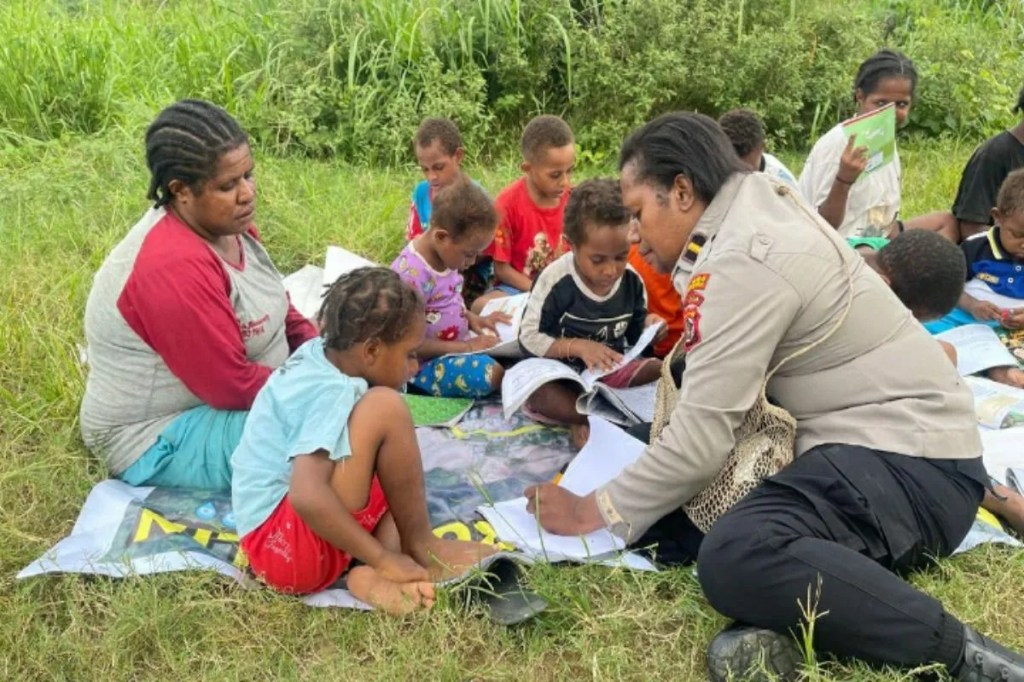
Jayapura, Papua (ANTARA) – The Reading and Writing Program (Gabus) implemented by the Jayapura Police since 2021 has effectively boosted the area’s community literacy, considering that the ability to read, write, and count is important for all.
Some Jayapura Police personnel were willing to increase the local residents’ literacy amid their busy schedules of maintaining security and social order. The program, which has been running for three years, is starting to show improvement.
Before running the program, the Jayapura Police prepared its personnel by involving them in a teaching program.
The police participated in training conducted by the Bunda PAUD (Early Childhood Education) program, which is implemented by the Ministry of Education and Culture. Through this training, the police gained a better understanding of effective teaching.
The police decided to participate in the education duty since they saw that several children had dropped out of school and were not fluent in reading and writing in the area. In addition, the same was noticed in several adults, thereby necessitating the implementation of the Gabus program.
In the future, all police stations in the Jayapura Police area are expected to implement a similar program to help the community around them.
“Through the Gabus program, the Jayapura Police are trying to help residents improve their literacy,” said Jayapura Police Chief Adjunct Senior Commissioner Fredrickus W. A. Maclarimboen.
Activities involving personnel are carried out amid their daily duties, with some even doing it after office hours.
The personnel usually carry out the program between visits to the community, while the policewomen usually execute it after office hours, with a teaching duration of around one hour.
The Jayapura Police have 106 active personnel who are members of the program, and the number of participants is currently 127.
Students who are already fluent in reading and writing will be reported to the Ministry of Education and Culture to take part in the test program and receive a Literacy Certificate (Sukma). Some 12 participants have received Sukma, and more are expected to take the equivalency exam in the future.
The Jayapura Police expressed hope that agencies or parties involved in the education sector would be willing to help and work together to eradicate illiteracy among residents in the district and Papua as well.
Outdoor study
Agustina Felle, a teacher at Komba Elementary School in Sentani Subdistrict, said she was called to join forces with members of the Jayapura Police to teach children and adults who cannot read fluently or who are still illiterate.
As a teacher, she feels responsible for the children around her who cannot read and write fluently, which hinders their education and even causes them to drop out of school.
Hence, the Gabus program is expected to teach children and adults to become more fluent in reading, writing, and even arithmetic so they can pursue higher education in the future.
“They are the future of the nation, so all parties are expected to help educate children,” Felle said.
Apart from teaching, she also provides one of the rooms in her house for teaching and learning activities.
Adjunct Commissioner Khatarina H.L. Aya, a member of the Jayapura Police, said she was glad to teach in the Gabus program.
Aya said that she sometimes carries out these activities in an open space for closer interactions by visiting residents and adjusting to their schedules.
This is different from teaching children and young people who have dropped out of school or who cannot read and write fluently, which she usually does in some residents’ yards.
“We are ready to teach them anywhere. The most important thing is their spirit to learn,” she remarked.
Learning with no shame
Ina Wenda, a Gabus program participant who has recently become literate, commended the dedication of the police, who are willing to take time out to teach those who cannot yet read and write.
Despite being a 50-year-old woman who sells staple goods at Sentani Market, she said she was not embarrassed to study alongside other students.
She was seen diligently writing word by word and listening to the lessons imparted by the policewoman using a small table.
“I want to be able to read and write fluently like everyone else,” Wenda revealed.
Children participating in the program echoed the same aspiration, saying that the Gabus program helps them understand lessons at school.
After participating in the Gabus program, one student, along with several other participants, admitted to having developed greater fluency in reading and writing.
“Thank you to our police who have been teaching us to read and write fluently,” stated Isak, one of the students.
The police’s efforts through this program can change the future of the Gabus participants. By reading and writing fluently, the horizons of the children will be increasingly broadened.
Coordinating Minister for Food Affairs, Zulkifli Hasan, has set a target to achieve national food self-sufficiency by 2029 and utilize idle land in Papua to meet the growing demand for food production.
Zulkifli cited that the idea of using land in Papua for agriculture has been proposed since 2014, highlighting the diminishing agricultural capacity in Java.
“Land in Java continues to decrease, and living conditions are becoming unsustainable due to pollution and sinking coastal areas,” he told a media conference at the Ministry of Trade on Monday, October 21, 2024.
He sees Papua as the future of Indonesia’s agricultural industry and has programmed the cultivation of 600,000 to 2 million hectares of land in the region. The main crops to be planted include sugarcane, rice, and corn.
“We have vast land in Papua that has not been optimized. With everyone’s support and prayers, we aim to achieve food self-sufficiency,” Zulkifli said.
Indonesia’s food demand is projected to rise alongside its growing population. Statistics Indonesia (BPS) estimates that by 2050, the population will reach 328 million, driving demand for key food commodities, including 40-50 million tons of rice.
However, this year’s rice production is expected to reach only 30.34 million tons, a 2.43 percent decline from the previous year, with harvested land shrinking by 1.64 percent.
This underscores the country’s food vulnerability, as local production remains insufficient to meet domestic needs.
According to the Global Food Security Index, Indonesia’s food security score stands at 60.2, slightly below the global average of 62.2.
President Prabowo Subianto has expressed confidence that his administration can achieve national food self-sufficiency within four years. He is optimistic that Indonesia can even become a global food hub.
Prabowo stressed the importance of reducing food imports, particularly in light of potential global crises where countries prioritize their own food needs over exports.
“We must aim for food self-sufficiency as soon as possible. We cannot rely on food sources from abroad,” Prabowo stated in his inauguration address on Sunday, October 20, 2024.
AWPA condemns the latest Indonesian security force operation in in the Bibida District, Paniai Regency which has resulted in more than 5,000 people from 15 villages in Bibida and Paniai fleeing their villages.
Joe Collins of AWPA said, “this number is added to the already large number of IDPs in the highlands who have fled their villages in the past few years because of the ongoing conflict ” .
According to a HRM report only elderly people who could no longer walk and sick people remained in the villages.
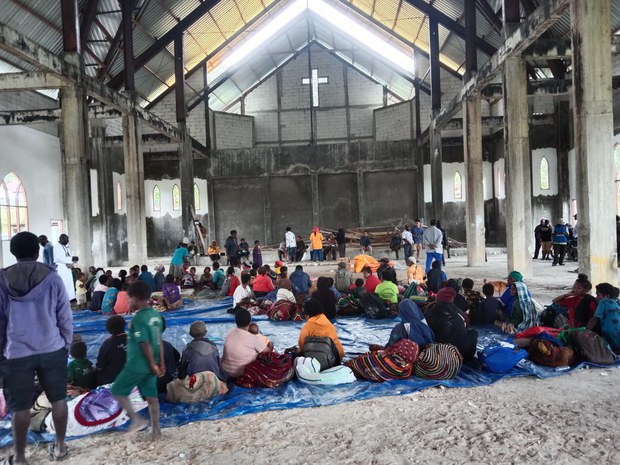
A number of villagers fled in fear to the Madi Holy Cross Parish Church because the security forces were pursuing a TPNPB OPM group after a taxi driver was killed by the TPNPB according to the military on the Enarotali-Bibida road, in Kopo village.
HRM report from information received from local sources, that the “security forces entered the Bibida District with ten trucks around 8.00 am and began searching houses. The operation was accompanied by four helicopters circulating over Bibida. One of them reportedly released multiple shootings during the raid causing thousands of people from the villages Bibida, Dama-Dama, Kolaitaka, Kugaisiga, Odiyai, Tuwakotu, and Ugidimi to flee their homes. In the Paniai Timur Districts, people from the villages Amougi, Timida, Kopo, Wouye Butu, Uwibutu, Madi, Ipakiye, and Pugotadi (see table below). https://humanrightsmonitor.org/news/security-force-operation-in-districts-bibida-and-paniai-timur-more-than-5000-indigenous-moni-and-me-people-flee-their-homes/
Joe Collins said, “it’s a pity that the only mainstream media reports on the Indonesian security force operations are those in the Indonesian media with the usual statements from military spokespersons such as
“The TNI personnel continue to restore security, law and order in Bibida following their success in reclaiming the sub-district area from the Undius Kogoya-led insurgents on Friday, June 14”,
“The success of TNI soldiers in shooting two OPM people has reduced the strength of the OPM, which, of course, has a positive impact on maintaining security and stability for the smooth process of accelerating development in Papua,” Lt. Gen. Richard Tampubolon remarked.
Collins said “statements so similar to military statements in other conflicts that there must be a conflict 101 lesson for military spokespersons”.
Local organisations such as the Catholic Youth have asked for the important role of the Paniai district government to quickly resolve the situation in Bibida so that a peaceful atmosphere can be restored, so that residents can return to their hometowns.
Hopefully, the Australian Government will also urge the Indonesian Government to stop using a military approach to every incident in Papua as all it does is increase the loss of life and create even more internal refugees”.
A security force raid in the Bibida District, Paniai Regency, has caused the internal displacement of an estimated more than 5,000 persons from 15 villages in Bibida and Paniai Timur District on 14 June 2024. Only elderly people who could no longer walk and sick people reportedly stayed. Churches have seized operations in the affected villages. Simultaneously, joint police and military forces established checkpoints and controlled passing vehicles in Enarolati town and Madi Village on 12 June 2024.
The districts Bibida and Paniai Timur are inhabited by the indigenous Moni and Me tribes. People fled their houses in fear of the security force operations and armed violence between the West Papua National Liberation Army (TPNPB) and Indonesian security forces. The operation was launched after TPNPB members shot dead a civilian Non-Papuan in the Kopo Village, Paniai Timur District, on 11 June 2024.
According to information from local sources, security forces entered the Bibida District with ten trucks around 8.00 am and began searching houses. The operation was accompanied by four helicopters circulating over Bibida. One of them reportedly released multiple shootings during the raid causing thousands of people from the villages Bibida, Dama-Dama, Kolaitaka, Kugaisiga, Odiyai, Tuwakotu, and Ugidimi to flee their homes. In the Paniai Timur Districts, people from the villages Amougi, Timida, Kopo, Wouye Butu, Uwibutu, Madi, Ipakiye, and Pugotadi (see table below)……….
Hundreds of residents in Indonesia’s restive Papua region have sought shelter in a church after clashes between security forces and West Papua independence fighters left two insurgents, a soldier and a civilian dead.
Fighting flared in Paniai regency in Central Papua province after the West Papua National Liberation Army (TPNPB), part of the Free Papua Movement (OPM), burned a public minivan and killed its driver last week, the military said in a statement.
Two-hundred-and-fifty civilians fled the latest clash, the military said, but a local human rights activist told BenarNews at least twice the number have sought refuge.
As at last October, 76,228 refugees from the ongoing conflict were displaced in the Papuan provinces, the Papua Legal Aid Institute has reported, from a total population of 5.6 million people.
The violent conflict in the western half of New Guinea island is estimated to have cost hundreds-of-thousand of mainly Papuan lives since the 1960s, with the Indonesian government and independence groups accusing each other of serious human rights abuses.
Military forces pursued the TPNPB into the Bibida district of Paniai on Friday, resulting in a deadly firefight on Monday that killed two combatants, according to military spokesperson Lt. Col. Yogi Nugroho.
Residents of Bibida district requested assistance from security forces to temporarily relocate to Madi Church in the neighboring East Paniai district, he said.
“The people of Bibida have never accepted the presence of the OPM in their area due to their arbitrary actions and cruel acts, such as forcibly taking crops, livestock, and even some young girls,” Yogi told BenarNews.
TPNPB spokesperson Sebby Sambom has denied the group committed any criminal acts in Bibida that led to the displacement of residents.
“That’s not true. That’s the Indonesian military and police propaganda,” he told BenarNews.
A human rights and church activist in Papua, Yones Douw, accused the presence of government troops in Bibida of fueling fear among Papuans and causing them to flee.
Douw also said the number of displaced residents was 574, not 250 as stated by the military.
“I asked the people of Bibida directly, and they said that it was not true. They [TPNPB] have never stolen crops, and they have never killed livestock,” Douw told BenarNews, adding they usually bought local produce from residents.
“The TPNPB-OPM allowed them to evacuate because Bibida would be used as a battleground,” he added.
Yogi said according to security forces’ observations, insurgents seeking to destabilize Bibida had taken positions in the forest and nearby regions.
“Therefore, if there are people moving into the Bibida forest, they can be confirmed as sympathizers or members of the OPM,” he said.
Security forces on Friday retook Bibida, which had been under TPNPB-OPM control, Yogi said.
One of the slain Liberation Army members was identified as Danis Murib, a deserter from the Indonesian military who had abandoned his post in April.
“Yes, he was a former active member of the Indonesian military who joined the TPNPB four months ago,” Sambom told BenarNews.
On Saturday, the TPNPB shot dead a government soldier, identified as Hendrik Fonataba, in the neighboring Puncak regency, Yogi said.
In 1963, Indonesian forces invaded Papua – like Indonesia, a former Dutch colony – and annexed the region.
Papua was incorporated into Indonesia in 1969 after a United Nations-sponsored referendum, which locals and activists have decried as a sham because it involved only about 1,000 people. However, the U.N. accepted the result endorsing Jakarta’s rule.
The Indonesian Defense Ministry said last month it had requested a bigger budget to buy high-tech weapons that can “detect or retaliate” against Papuan groups who know the region’s terrain better.
Human rights activists criticized the ministry proposal, arguing it would escalate violence and lead to more civilians being caught in the crossfire in the mineral-rich but underdeveloped region.
The Secretariat of Justice and Peace (SKP in Indonesian) of the Catholic Church throughout Papua says 46,926 civilians were displaced from their villages due to armed conflict and urges the government to return the refugees to their hometowns. The urge was conveyed through the Pastoral Appeal of the SKP of the Catholic Church throughout Papua issued in Sorong, West Papua Province, on 12 October 2023. The pastoral call was signed by the Director of SKPKC Fransiscan Papua Yuliana Langowuyo, Director of SKP Diocese of Agats RD Linus Dumatubun, Head of SKP Diocese of Timika Saul Wanimbo, Director of SKPKC OSA Christus Totus Papua RP Heribertus Lobya OSA, Head of SKP Diocese of Manokwari Sorong RD Izaak Bame, and Secretary of the KPKC Commission of Jayapura Diocese Elias Gobay. The urge came after visiting refugees from Maybrat in Sorong Regency. (see photo/ SKP-Papua).
Moreover, the Cenderawasih Papua Catholic Student Association (MKC Papua) has called upon the Papuan Government, the Indonesian Bishops Conference (KWI/Konferensi Waligereja Indonesia), and bishops across Papua to take proactive measures to address the dire situation of refugees in Papua. The appeal was made following a discussion regarding the evolving situation in Papua, held in Tomohon, North Sulawesi, on 17 October 2023.
Nicolaus Huby, the Chairman of MKC Papua, emphasised the need for the Catholic church leadership to acknowledge and respond to the critical conditions in Papua. Huby expressed concerns that the current situation, marked by escalating violence and armed conflicts between the Indonesian National Army/Indonesian National Police (TNI/Polri) and the West Papua National Liberation Army/Free Papua Organization (TPNPB/OPM) from 2018 to 2023, requires urgent attention.
According to reports by humanitarian activists, a significant number of residents have been displaced from their homes. For instance, approximately 674 residents from Muara Bontoh (Yahukimo) were forced to flee to Dekai, while 2,252 people in Kiwirok and surrounding areas sought refuge in the Oksibil and neighbouring Papua New Guinea. Furthermore, over 37,000 Nduga residents from various districts had to leave their homes and relocate to Asmat Regency, Mimika Regency, and Jayawijaya Regency. Additionally, around 1,000 residents of Intan Jaya fled to Nabire Regency, Paniai Regency, and Mimika Regency, while approximately 6,000 Maybrat residents sought refuge in Kmurkek, Sorong Regency, and Sorong City.
The issue of refugees has been compounded by instances of violence, including the shooting of a Catholic catechist in October 2020 by the Indonesian military. Despite claims by the government and security forces that refugees have returned to their hometowns, reports from SKP in Papua and Komnas HAM suggest that many are still displaced. For example, there are still 5,296 people residing in refugee camps in Maybrat.
These refugees have been enduring difficult living conditions in overcrowded settings. They have called for assistance in providing health and education for their children, as their current resources are insufficient. Above all, they express their desire to return to their hometowns, provided that the military presence in East Aifat is reduced to ensure peace and safety.
The plight of these refugees has been compared to that of Joseph and Mary, who were forced to leave their hometown. Pope Francis has drawn parallels between the present-day refugees and the biblical narrative, highlighting the need for empathy and assistance.
Cenderawasih Papua Catholic Students have urged the Catholic church, the Indonesian government, and relevant authorities to take immediate action by:
Facilitating the repatriation of refugees to their hometowns through meaningful consultations with internally displaced Papuans.
Ensuring the safety of returning refugees and preventing intimidation.
Providing reparations or compensation for all losses suffered by internally displaced persons, including physical, property, psychological, and mental losses.
Guaranteeing basic rights for refugees before their return, including temporary shelters, food, healthcare, and access to education.
Allowing humanitarian assistance from other organizations to reach internally displaced people.
Halting military operations in Papua.
Ending the dispossession of customary land rights of the Papuan people.
Taking responsibility for resolving human rights violations in Papua.
On 2 November 2023, the Jayapura State Administrative Court (PTUN Jayapura) rejected a lawsuit filed by the indigenous Awyu Tribe in Papua Province (see photo, credit Gusti Tanati/ Greenpeace). The lawsuit was related to an environmental feasibility permit issued by the Investment and One-Stop Integrated Service Office (DPMPTSP) for PT Indo Asiana Lestari (PT IAL) to develop oil palm plantations covering 36,096.4 hectares in the Mandobo and Fofi Districts in Boven Digoel Regency, South Papua Province. The Awyu Tribe argued that the permit was issued without their knowledge or consent.
The panel of judges, led by Merna Cinthia SH MH, along with member judges Yusup Klemen SH and Donny Poja SH, declared the lawsuit unreasonable and rejected it. They argued that the procedure and substance of the Environmental Impact Analysis (AMDAL) issuance did not contradict laws and regulations or the principles of good governance. As a result, PT IAL’s environmental feasibility permit was declared valid.
Emanuel Gobay, a lawyer for the Awyu Tribe, expressed dissatisfaction with the judge’s decision, stating that it did not align with environmental law principles. Mr Gobay pointed out that the judges did not adequately consider the substance of the problematic AMDAL document and rejected requests for field inspections. The legal team also intended to evaluate the judge’s attitude in deciding the case.
Furthermore, Tigor Hutapea, a member of the Papuan Customary Law Enforcement Coalition, argued that the judges erred by accepting an investment support letter from the Indigenous Peoples’ Agency (LMA) of Boven Digoel as meaningful participation. He emphasised that LMA had an unclear legal status and did not represent the indigenous Awyu people and the Woro clan. According to Hutapea, LMA had no authority to approve the release of forests belonging to indigenous peoples, disregarding the principle of free, prior, and informed consent from affected communities.
The lawsuit received significant support from various communities and organisations. A petition compiled by the Solidarity Movement to Save Papua’s Customary Forests garnered signatures from 73 institutions and 94 individuals, demonstrating widespread backing for the Awyu Tribe’s cause.
Dr Totok Dwi Diantoro, an expert witness for the Awyu Tribe, emphasised that indigenous peoples’ consent is a fundamental requirement for permits related to business activities in their customary areas. This requirement is in line with the United Nations Declaration on the Rights of Indigenous Peoples, which enshrines the principle of Free, Prior, and Informed Consent (FPIC) as a right of Indigenous peoples when dealing with new activities in their territories.
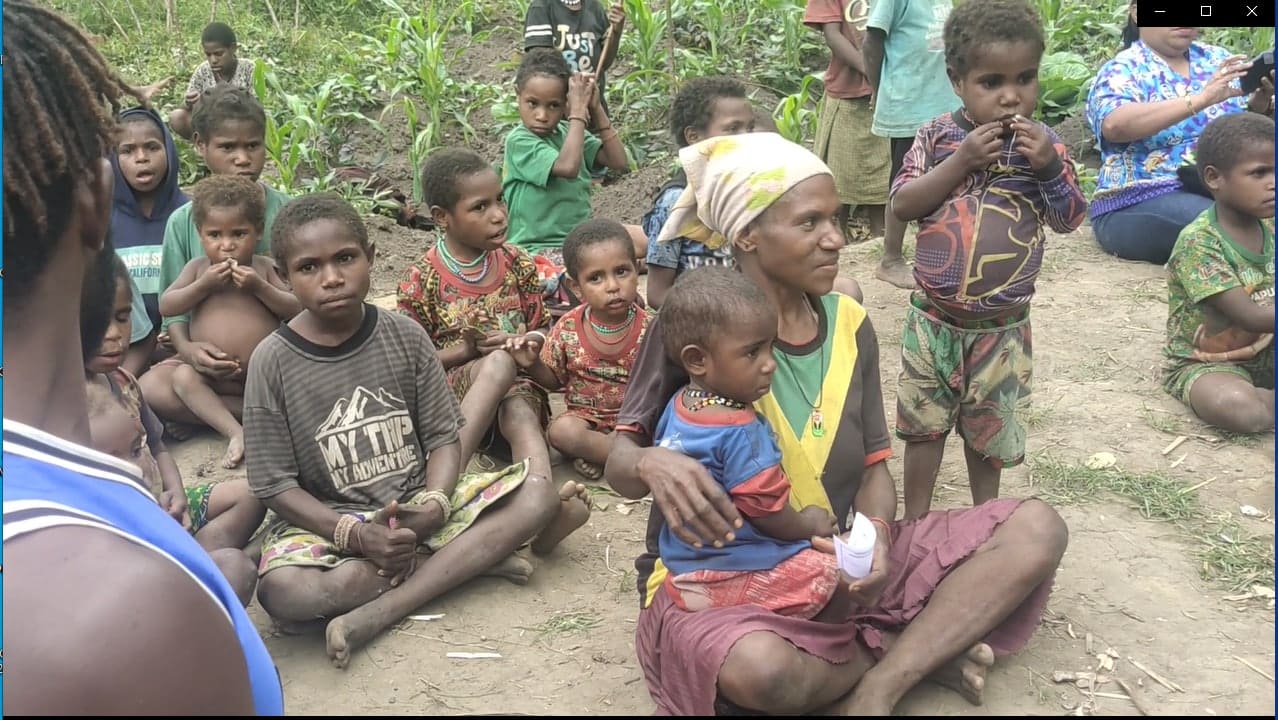
Nduga refugee children receiving aid from one of the educational foundations in Papua at the refugee general post in Wamena, Jayawijaya Regency. – Jubi/Imma Pelle
Wamena, Jubi – Thousands of Nduga residents who since 2018 have been displaced in Wamena and several other areas, admit that they are still crying during Christmas and do not feel the peace of Christmas.
One of the human rights observers from Nduga, Benny Murip, said that as a result of the ongoing armed conflict between the Indonesian Military (TNI) and Police and the West Papua National Liberation Army (TPNPB), people have not been able to gather with their families and celebrate or enjoy Christmas in peace.
“The people of Nduga are still living in tears and grief because they cannot gather with their families, friends, brothers and sisters. All of them have been separated in several places, some have even died in refugee camps,” he said in Wamena on Monday, December 26, 2022.
He also explained that in the Nduga Regency, which consists of 11 districts, houses and churches are currently still controlled by the TNI and police. Residents have fled to several places that are considered safe.
“Some even ran to the forest, it has been five years now,” said Murip.
Nduga children living in refugee camps in Muliama District Jayawijaya as a result of armed conflict in the central highlands of Papua 8211 JubiYuliana Lantipo
Murip asked people outside Papua not to think that Papua was safe and peaceful. Papua are still haunted with terrors, shootings of civilians such as in Tolikara, and military operations against Papuan civilians.
Murip said some time ago, he had been to the capital of Nduga Regency, Kenyam, and witnessed how the people there lived like prisoners.
;
“Gardening or other activities is very difficult to do. Residents’ activities are only limited to 9 p.m., they can no longer roam outside the house past curfew because they are always watched by the authorities with weapons,” he explained.
Murip further said that even though the Nduga residents who have been displaced for five years wanted to return to their hometown, it was very difficult to realize because the war continues between the security forces and the TPNPB. Neither TPNPB leader Egianus Kogoya nor President Joko Widodo have issued a statement to stop the conflict. (*)