Indigenous community faces criminalization and land seizures as Merauke Food Estate Project advances

16 October 2025 / 4 minutes of reading

The Indonesian government’s ambitious National Strategic Project (PSN) in Merauke has entered a critical phase marked by escalating conflict between indigenous landowners and corporations backed by state authority, with customary land seizures now accompanied by police criminalization of community members resisting plantation development on their ancestral territories. On 29 September 2025, Coordinating Minister for Food Zulkifli Hasan announced plans to convert 481,000 hectares of Papuan forest in Wanam, Merauke Regency, for rice, oil palm, sugarcane, and cassava production, alongside renewable energy facilities, including bioethanol and biodiesel processing industries. The government claims the forest area has already been “released” from protected status, with Minister of Agrarian Affairs, Nusron Wahid, stating the land “does not belong to the community because it was previously state forest,” allocating 263,000 hectares for rice fields in Wanam, 41,000 hectares in Merauke City, 146,000 hectares for oil palm, and 1,140 hectares for ports and settlements. This massive land conversion contradicts the lived reality of indigenous Yei communities like the Kwipalo clan, whose ancestral territories are being forcibly seized by PT Murni Nusantara Mandiri (MNM). The company is part of the PT Global Papua Abadi consortium holding a 52,700-hectare concession for sugar cane plantation development.

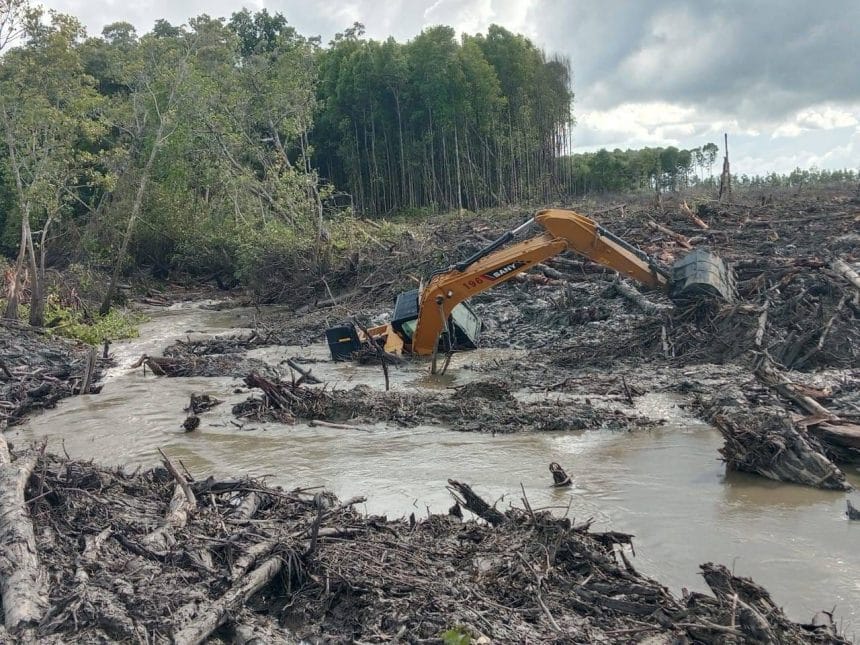
The conflict reached a new level on 15 September 2025, when Mr Vincen Kwipalo and his relatives physically stopped PT MNM employees operating excavators and bulldozers clearing their customary forest to build road access through Kwipalo clan territory in Jagebob District. Following this confrontation, PT MNM used one of its employees to file a police report against Mr Kwipalo at the Merauke Resort Police Station. Following the police report, Mr Kwipalo was summoned for clarification on 2 October 2025. On 17 September 2025, Mr Kwipalo and three relatives erected traditional barriers named “Sasi“ using tree trunks across the cleared land, painting them orange and posting warning signs reading “No entry to the Kwipalo customary area,” to protect the 2,308 hectares of ancestral land threatened by corporate encroachment. As of August 2025, PT MNM had already cleared 4,912 hectares of the concession area, with periodic monitoring by Pusaka Bentala Rakyat Foundation documenting ongoing deforestation.

The Kwipalo clan’s resistance reflects systematic violations of indigenous land rights under Indonesian law, particularly Article 43(3) of Law No. 2/2021, requiring that provision of customary and individual land “for any purpose” must be “carried out through deliberation with the customary law community and residents concerned to reach an agreement on the transfer of required land and compensation.”

The Kwipalo Clan has manifested its rejection through multiple channels: planting red crosses on customary territory as traditional symbols of prohibition, openly declaring rejection through the national media, staging demonstrations in both Merauke and Jakarta, and filing an ongoing lawsuit with Indonesia’s Constitutional Court challenging the project’s legality. His position is reinforced by Article 21 of Merauke Regency Regulation No. 5/2013. The article obligates the South Papua Governor and Merauke Regent to immediately order PT. MNM to stop the criminal act of seizing and embezzling the customary land of the Kwipalo clan and protect Mr. Vinsen Kwipalo from the threat of criminalisation. State institutions, including the police, have become enforcement mechanisms for corporate land acquisition. Ín addition, the military has established the 817th Territorial Development Infantry Battalion within PT MNM’s concession area on Kwipalo customary land in July 2025, without clan permission or consent. The developments support growing concerns of deliberate militarization for the purpose of securing corporate business interests.

The Merauke PSN represents a broader pattern documented across Indonesia, where National Strategic Projects systematically dispossess indigenous communities under the legal framework established by the Job Creation Law. Civil society organizations argue that the law provides “facilitation and acceleration” mechanisms that bypass normal consultation and compensation requirements. The case parallels the displacement of 75 families from Soa Village in Tanah Miring District by PT Global Papua Abadi for road and bridge construction, and other conflicts at other PSN sites, including Rempang Island (Riau Islands), Indonesian Green Industrial Zone (North Kalimantan), and the National Capital (East Kalimantan), where communities face forced evictions for development projects. Greenpeace Indonesia Forest Campaigner, Mrs Sekar Banjaran Aji, notedthat “PSN Merauke has deprived indigenous peoples of their rights, destroyed natural forests, and threatened the biodiversity of the landscape,” while emphasizing that “the involvement of the army and police in the project has also caused terror among the community and indigenous Papuans.” 

Indonesia’s National Human Rights Commission has documented violations in PSN Merauke activities. Yet the government continues advancing the project as part of President Prabowo Subianto’s vision referenced at the UN General Assembly, positioning Indonesia as a “candidate for the world’s food barn.” The Papua Law Enforcement and Human Rights Coalition has called on the President to “immediately revoke the National Strategic Project policy that legalizes PT. MNM’s seizure and misappropriation of the customary land of the Kwipalo clan. The criminalization of Mr Vincen Kwipalo represents an “early example” of tactics that will be deployed against indigenous land rights holders resisting investment projects throughout the South Papua Province and in other PSN sites across Indonesia.

Mr Vinsen Kwipalo stops PT MNM excavators from destroying the Kwipalo clan’s customary forest, 17 September 2025

Mr Vinsen Kwipalo and supporters in front of the Merauke District Police Station, 2 October 2025

Detailed Case Data
Location: Jagebob, Merauke Regency, South Papua, Indonesia (-7.9103659, 140.7624493)Kwipalo customary land in Jagebob District
Region: Indonesia, South Papua, Merauke, Jagebob
Total number of victims: dozens

#Number of VictimsName, DetailsGenderAgeGroup AffiliationViolations
1.Vincent Kipalo

maleelderly Human Rights Defender (HRD), Indigenous Peoples
2.dozens 

mixedunknown Indigenous Peoples

Period of incident: 15/09/2025 – 15/10/2025
Perpetrator: Private Company, Government
Issues: business, human rights and FPIC, human rights defenders, indigenous peoples

New interactive mapping platform exposes accelerating environmental destruction in West Papua

Human Rights News / IndonesiaWest Papua / 30 July 2025 

Groundbreaking satellite data analysis and interactive mapping tools have revealed the unprecedented scale of deforestation and ecosystem destruction across West Papua, with the National Strategic Projects driving 24% of the forest loss in 2024. A comprehensive new study published by Nusantara Atlas has unveiled a detailed analysis of land clearing trends across West Papua, revealing alarming acceleration in environmental destruction driven by government mega-projects and corporate expansion. The research introduces powerful new data visualization tools that allow interactive monitoring of ecological changes across one of the world’s last intact tropical wilderness areas.

The research methodology combines multiple data sources, including satellite imagery analysis, land-use planning documents obtained through information requests, and ground-based verification, to create a comprehensive picture of environmental change across West Papua. The publication’s combination of scientific analysis and accessible data visualisation tools marks a new era in environmental monitoring, providing the evidence base necessary for urgent policy intervention to protect one of Earth’s most biodiverse regions.

The Nusantara Atlas publication represents a breakthrough in environmental transparency by opening public access to civil society organisations, researchers, and policymakers with sophisticated tools previously available only to government agencies and large corporations. The interactive mapping platform allows public access to environmental monitoring data, enabling real-time tracking of ecological destruction and corporate accountability.

New data platform transforms environmental monitoring

The publication introduces “Papua Watch,” an interactive story map that provides unprecedented access to satellite-based monitoring of land clearing activities across 13 key locations in West Papua. The platform combines high-resolution satellite imagery, land-use planning data, and comparative analysis tools to track the ongoing expansion of food estates, oil palm plantations, mining operations, and infrastructure development in the region.

The mapping application’s most significant innovation lies in its ability to provide comparative satellite imagery analysis, allowing users to observe environmental changes over time with precision previously unavailable to the public. Users can visualize the exact locations where deforestation occurred, identify which ecosystems were affected, and track the companies responsible for the destruction.

Key data visualisation features include:

  • Time-series satellite imagery comparison showing before-and-after environmental changes
  • Detailed mapping of forest loss by driver and geographic location
  • Interactive overlay of protected areas, indigenous territories, and development projects
  • Real-time tracking of road construction and infrastructure expansion
  • Ecosystem-specific analysis distinguishing between primary forest, swamp forest, savanna, and grassland conversion

Alarming acceleration of environmental destruction

The research reveals that primary forest loss in West Papua rose 10% from 2023 to 2024, reaching 25,300 hectares, with preliminary 2025 data indicating the pace is accelerating further. Most significantly, the Merauke National Strategic Project (PSN) emerged as the top driver of deforestation in 2024, resulting in the loss of 5,936 hectares of primary forest. This figure equals 24% of all recorded forest destruction.

The satellite data shows that from January 2024 to June 2025, the Merauke PSN cleared 22,272 hectares of natural ecosystems, including primary forest (9,835 ha), Melaleuca swamp forest, natural savanna, and grassland. This represents only a fraction of the project’s ultimate target of converting up to 3 million hectares for rice fields and sugarcane plantations.

Interactive tools reveal corporate networks behind destruction

The mapping platform’s corporate tracking capabilities expose the key players driving environmental destruction in West Papua. The analysis identifies the Jhonlin, Fangiono, and Salim groups as the three primary actors. The interactive data allows users to trace specific concessions to their corporate owners and track their clearing activities over time.

Major findings through the mapping analysis revealed that PT Global Papua Abadi (linked to the Fangiono family) cleared 11,751 hectares between January 2024 and June 2025. Land clearings associated with the oil palm expansion in the first half of 2025 are already equal to those of all of 2024, indicating an accelerating pressure on land and resources. According to the satellite imagery analysis on the infrastructure development, 40 km of a planned 135 km access road have been completed, opening new areas for exploitation that have previously been inaccessible.

Mining threats exposed through island-specific analysis

The research platform also provides a detailed analysis of mining impacts on West Papua’s ecologically sensitive small islands, particularly in Raja Ampat. The mapping reveals that PT Gag Nikel cleared 35 hectares between January 2024 and June 2025, while PT Kawei Sejahtera Mining cleared an additional 35 hectares on Kawe Island.

The platform’s ecosystem-specific analysis demonstrates why island mining poses exceptional risks. Smaller islands are home to globally significant biodiversity, which cannot regenerate once damaged by industrial operations due to their geographical limitation and their exposure to various forms of erosion.

Infrastructure development catalyses environmental destruction

The mapping shows that completion of planned infrastructure will inevitably increase accessibility to protected areas, including Danau Bian and Bupul Nature Reserves, facilitate speculative land clearing as road access increases land values, and enable expansion of transmigration sites with associated population pressure.

The platform’s road network analysis reveals the strategic nature of current development. The new PSN road, when completed, will connect to the existing Trans-Papua Highway and MIFEE road networks, creating a continuous corridor across southern Papua’s wilderness. The mapping illustrates that this corridor ends less than 1 km from the Danau Bian Nature Reserve, putting this protected ecosystem at immediate risk.

The comparative satellite imagery supports the observation that road construction acts as a catalyst for broader environmental destruction, with clearing expanding along transport corridors and facilitating industrial access to previously protected areas.

Scientific validation of environmental concerns

The research validates concerns about the environmental suitability of current projects through detailed ecosystem analysis. The mapping reveals that much of the targeted area consists of acidic peat soils and seasonally flooded wetlands, conditions that have caused similar food estate projects to fail elsewhere in Indonesia.

The platform’s soil and climate data integration shows that Merauke’s tropical wet-dry savanna climate, combined with naturally occurring annual wildfires and highly acidic soils, creates conditions “far from ideal for rice cultivation.” The research notes that while the Indonesian government claims a successful first rice harvest on a 4-hectare plot in May 2025, initial yields often succeed due to residual soil nutrients before productivity typically declines as tropical soils become increasingly acidic and nutrient-poor.

International implications and conservation priorities

The research platform positions West Papua’s environmental crisis within global conservation priorities, noting that the region represents one of the world’s last intact tropical wilderness areas. The mapping demonstrates that without urgent intervention, such as Indigenous land rights recognition, science-based land use planning, and a permanent halt to the Merauke Strategic National Project, West Papua is at high risk of losing irreplaceable ecosystems.

Interestingly, the study warns that continued destruction could jeopardize Indonesia’s 2030 net-zero emissions target, as the clearing of carbon-rich peat forests and wetlands releases significant greenhouse gases into the atmosphere.

Urgent call for policy response

The research concludes with specific policy recommendations based on the mapping analysis. Recommendations include implementing a moratorium on forest conversion to oil palm, banning mining on small islands, recognizing Indigenous land rights, and adopting science-based land use planning. The interactive platform provides policymakers with the precise geographic and temporal data needed to implement targeted conservation measures.

Civil society condemns government denial and calls for international intervention

Human Rights News / IndonesiaUN on West PapuaWest Papua / 2 July 2025 

In the past months, the situation surrounding the National Strategic Project (PSN) in Merauke, Papua Selatan Province, has further escalated. In the Soa Village, Tanah Miring District, indigenous women from 75 families have collectively opposed the land encroachment by PT. Global Papua Abadi, which received a government concession for an energy project without the community’s free, prior, and informed consent (FPIC). This project threatens to destroy their natural sources of livelihood and violates their rights to land and self-determination. Similarly, on 23 June 2025, indigenous land belonging to the Kwipalo clan in Kakyo Village, Semangga District, was reportedly seized by the military for the construction of a post without consent or legal process, constituting a grave act of militarisation and forced dispossession.

Investigations by the National Commission on Human Rights (Komnas HAM) in May and June 2025 revealed widespread violations across multiple districts in Merauke. These include forced evictions, destruction of sacred sites, and the complete disregard for FPIC principles. Indigenous communities, religious leaders, and civil society groups have united in protest, calling the PSN an instrument of structural injustice and ecocide. On 17 June 2025, the Indonesian Fellowship of Churches (PGI) condemned the PSN for violating indigenous rights, destroying ecosystems, and exacerbating the climate crisis.

In addition to public mobilisation and advocacy, a coalition of Indonesian civil society organisations (CSOs) issued a formal response to the joint communication of nine UN Special Rapporteurs dated 7 March 2025. The CSOs strongly criticised the Government of Indonesia’s reply of 6 May 2025 for denying ongoing and well-documented human rights and environmental violations related to the National Strategic Project (PSN) in Merauke. They noted that the government’s response ignored empirical evidence and failed to address the substantive issues raised by the UN experts, including land dispossession, militarisation, food insecurity, ecological destruction, and the lack of respect for FPIC principles

According to the CSOs, the government’s reply reflected a broader institutional reluctance to engage meaningfully with international human rights norms. They pointed out that the Indonesian state has failed to comply with recommendations made by Komnas HAM, as well as with constitutional and international legal standards safeguarding indigenous peoples’ rights. Furthermore, they underscored that permits and business licences had been granted to companies in areas with customary land claims, without community consent or proper consultation. The coalition urged the UN Special Rapporteurs to conduct direct monitoring in Merauke and called for the immediate suspension of PSN implementation to prevent the continued expansion of human rights and environmental violations.

The PSN’s implementation in Merauke reflects a deeper failure of democratic governance and environmental responsibility. It undermines constitutional protections and international legal obligations, particularly under the UN Declaration on the Rights of Indigenous Peoples. The Indonesian government’s response to concerns raised by UN Special Rapporteurs has been criticised as evasive and dishonest. Indigenous leaders and civil society continue to demand the immediate suspension of all PSN activities, restoration of customary lands, adequate reparations, and a UN-led investigation. Without urgent corrective action, the PSN will inevitably destroy the ecological, cultural, and spiritual fabric of West Papua’s indigenous communities.

The military seized land belonging to the Kwipalo Clan in the Kakyo Village, Semangga District, without consent or legal process

 Planetary urbanisation: Why Indonesia destroys its green islands to ‘green’ cities elsewhere 

Sediment is clearly visible close to nickel mining operations on Kawe Island, Raja Ampat, discolouring the water in one of Indonesia’s most biodiverse marine areas. The concession covers an area of 5,922 hectares and is located within the mega-biodiversity region of Raja Ampat, West Papua.

BY DWIYANTI KUSUMANINGRUM

26 JUNE 2025

This article is reproduced courtesy of University of Melbourne’s unit Indonesia at Melbourne

The controversy over nickel mining in Raja Ampat, Papua, is a telling example of how capitalist-driven planetary urbanisation is reshaping the world we live in.

Today, urbanisation occurs on a global scale. It is taking place not only within cities and urban areas but even in many non-city zones that serve as ‘operational landscapes’ for supplying cities’ demands. This concept of ‘planetary urbanisation’ explains how non-urban realms in the Global South have played a strategic role as operational landscapes supporting cities in the Global North.

Environmentally destructive nickel mining activities within the Raja Ampat UNESCO Global Geopark, a global tourism site widely known for its idyllic scenery and marine biodiversity, is a case in point. It shows how the current global demand for urban environmental sustainability has incentivised policymakers in the Global South to provide the materials needed for the cities in the North to be more sustainable.

It also tells the disturbing story of how Indonesia, in a nutshell, is willing to destroy its invaluable green islands for the sake of ‘greening’ cities in China and Europe.

Colonial origin of planetary urbanisation

Indonesia’s rich natural resources have been a source of vital global commodities since the colonial era. In the 15th century, high demand for commodities from Europe encouraged exploration in tropical countries, paving the way for colonialism. 

Resource exploitation by colonial powers played a critical role in the growth of cities in Indonesia and Europe, since the extraction from Indonesia funded the growth of the Netherlands and its cities. This is one of the first examples of planetary urbanisation — where the South was squeezed to provide for the North.

During colonial times, most Indonesian cities were basically just ‘operational landscapes’ of Dutch cities. By the late 18th century, for example, Makassar and Ternate were important cities in the global spice route and became hubs for the ‘local government’ of the VOC (Vereenigde Oost-Indische Compagnie, the Dutch East India Company). A similar trajectory also happened to Pangkalpinang, with its tin mining on Bangka Island, and Padang, a port city that supplied gold powder from the Minang kingdom.

The locations of Indonesia’s new ‘cities’ later expanded beyond those determined by geographical localities (resources sites). In the inland of Java, cities grew organically around train stations as a result of the expansion of transportation networks and the extensive exploitation of plantations in many different locations.

This process of planetary urbanisation continues today, as nickel becomes the latest commodity sought after by major cities in the northern hemisphere.

Nickel boom and resource nationalism

The global demand for renewables such as wind turbines, solar panels and EV batteries has fuelled excessive extraction of nickels in many countries including Indonesia, where more than half the world’s nickel supply is located. According to US Geological Survey, Indonesia has as many as 55.000.000 metric tons of nickel reserve.

Under former president Joko “Jokowi” Widodo, Indonesia introduced a series of policies aimed at downstreaming its nickel mining industry. These included banning  nickel ore export  and promoting domestic nickel processing industry.

However, this seemingly nationalistic policy is not necessarily beneficial for the Indonesian people. Scholars have argued that “resource nationalism” is in fact a pseudo-nationalism, because it is plagued by rent-seeking practices. A revealing Watchdoc investigative documentary has shown that the nickel industry in Indonesia largely benefits just a few mining oligarchs. To make matters worse, more than 90% of nickel processing infrastructure is owned by Chinese companies.

Nickel mining and environmental degradation 

Nickel mining activities in the eastern part of Indonesia are embodiments of ‘operational landscapes’ in ‘planetary urbanisation’. This is indicated by the spatial and social concentration of capital in the forms of infrastructural facilities and the influx of migrant workers, some of whom are from China, in the region.

Look at the private airports in the Indonesia Morowali Industrial Park (IMIP) and on Gag Island, Raja Ampat. At IMIP alone, there are 91,581 Indonesian workers and 11,615 foreign workers working in the industry. Or look at Teluk Weda’s smelters and port, which serves as a hub for vessels carrying nickels from small islands in the eastern part of Indonesia.

It remains to be seen, however, if these new ‘operational landscapes’ will eventually lead to the creation of new local cities as it was the case during colonial times, or if they will only destroy the environment in Indonesia to support cities in other countries.

The reality is that nickel mining sites are believed to have caused anthropogenic disasters (floods and landslides), and environmental degradation (air, land, and water pollutions), adversely affecting the local communities.

Floods in Morowali, for example, are attributed by many observers to IMIP industrial zones replacing local forest that previously served as a catchment area. In Teluk Weda, for example, Forest Watch Indonesia has found that the expansion of nickel industry encroaching into nearby forested areas has increased the flood risk in the surrounding areas.

In Obi Island, North Maluku, local media reported that mining activities had directly dumped their waste into the ocean. In Teluk Weda, nickel mining allegedly polluted  the river and groundwater, affecting the lives of the locals in Halmahera.

The Watchdoc documentary also emphasises the impact of the mining industry on Teluk Weda’s public health. Levels of the heavy metal arsenic have been detected in blood samples taken from residents, mining workers, and fishermen in the area. This demonstrates how the nickel mining industry can have fatal consequences.

Sustainable for whom? 

Capitalism can be cruel. Yet, there is no denying that capitalist-driven Dutch colonialism, which heavily relied on plantations, played a role in the making of major cities in Indonesia with less severe environmental degradation. The ongoing process of mining activities in eastern part of Indonesia seems much more ominous.

We need to ask who really benefits from the global campaign for’ sustainable development’. Of course Indonesia should tap this economic opportunity, but we cannot let it happen at the expense of our own natural habitat and our society’s wellbeing.

Indigenous Moi Tribe rejects massive palm oil project threatening last remaining forests in West Papua

Human Rights News / IndonesiaWest Papua / 26 June 2025 

The Indonesian government’s plan to implement a National Strategic Project (PSN) worth 24 trillion rupiah in the Papua Barat Daya Province has sparked resistance from indigenous communities. They understand the massive palm oil development as an existential threat to their ancestral lands and way of life. PT Fajar Surya Persada Group’s proposal, submitted to the Governor on 27 May 2025, seeks to establish an integrated palm oil-based food industry across 98,824.97 hectares covering key districts in Sorong and Tambrauw regencies. The project involves a consortium of five companies that would control vast swaths of traditional Moi territory, including PT Inti Kebun Sawit (18,425.78 hectares), PT Inti Kebun Sejahtera (307.91 hectares), PT Sorong Global Lestari (12,115.43 hectares), PT Omni Makmur Subur (40,000 hectares), and PT Graha Agrindo Nusantara (13,799.51 hectares).

The indigenous Moi Tribe has voiced resistance against what they describe as systematic land grabbing disguised as development. On 21 June 2025, Moi communities from 13 affected districts held traditional consultation meetings in the Klaso District, culminating in sacred oath-taking ceremonies (see photo on top, source: Suara Papua) and the planting of “Tui” bamboo poles, traditional symbols of prohibition and spiritual protection. Traditional leader, Dance Ulimpa declared that the Moi people “can live without palm oil, but cannot live without our customary forests,” emphasizing that these represent their last remaining forest territories. The communities have threatened to paralyze government offices in the provincial capital and the Sorong Regency if authorities accept the company’s application.

Evidence from existing palm oil operations in the region reveals devastating environmental and social impacts that fuel indigenous resistance. According to community testimonies, palm oil companies already operating in Sorong District have caused severe ecological damage, including pollution of the once-pristine Malalis and Klasof rivers where PT Hendrison Inti Persada and PT Inti Kebun Sejahtera operate. Traditional representative Desi Karongsan reported that the Klasof River now runs yellow and oily during rainy seasons, killing fish and causing skin rashes among children. Despite promises of economic benefits, only one Moi person reportedly works for the palm oil companies, while customary land is leased at exploitative rates of just 100,000 rupiah (approximately € 6.00) per hectare per month. The economic marginalization is so severe that some indigenous land is leased at only 6,000 rupiah per hectare, highlighting the gross inequality in benefit distribution.

Political resistance is building at multiple levels, with the West Papua Regional Parliament (DPRP) committing to draft regional regulations protecting indigenous rights and imposing a moratorium on palm oil expansion. A coalition of 18 organizations, including the Moi Great Tribe Council, Indigenous Peoples Alliance of the Archipelago (AMAN), Greenpeace Indonesia, and various human rights groups, has formally rejected the PSN, arguing that despite Papua’s Special Autonomy Law intended to protect indigenous rights, communities continue facing poverty, displacement, and human rights violations. The coalition demands an immediate halt to all PSN activities that deprive indigenous communities of their ancestral land. The coalition calls for development policies that prioritize indigenous participation and environmental protection over corporate interests in what they describe as West Papua’s transformation into “a testing ground for greedy and reckless development.”

Greenpeace and Raja Ampat youth confront nickel industry during conference

Igor ONeill June 3, 2025 

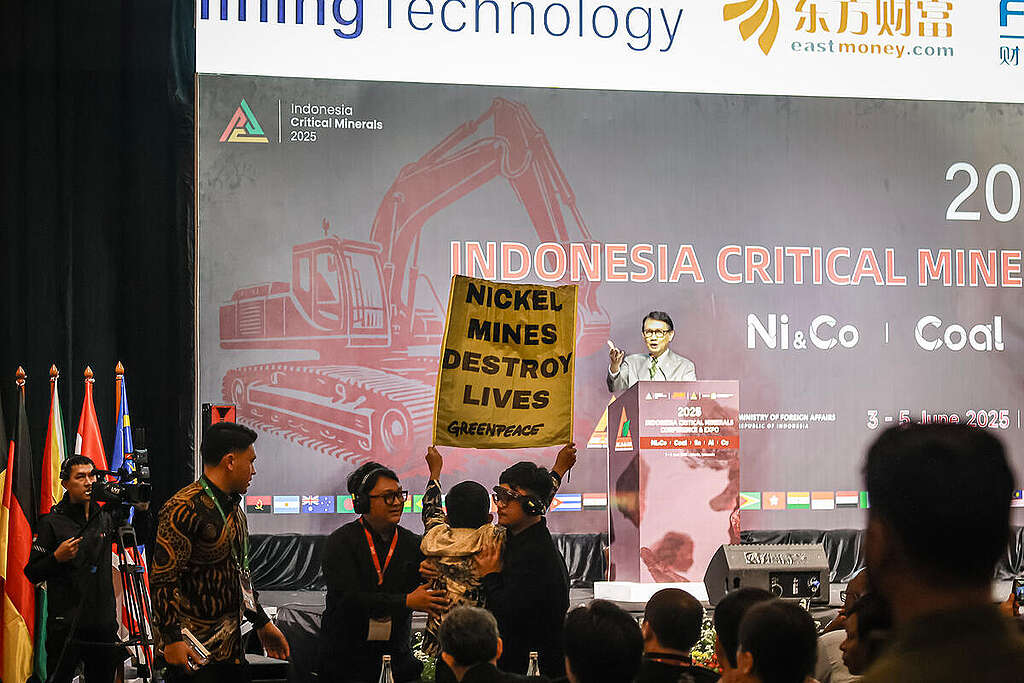
Banners unfurled at Indonesia Critical Minerals Conference demand accountability: What is the True Cost of Your Nickel? Greenpeace Indonesia activists, alongside four young West Papuans from the Raja Ampat archipelago, staged a peaceful protest about the impacts of nickel mining while Indonesia’s Deputy Minister for Foreign Affairs addressed the Indonesia Critical Minerals Conference in Jakarta © Dhemas Reviyanto / Greenpeace Jakarta, June 3, 2025 – Greenpeace Indonesia activists, alongside four young West Papuans from the Raja Ampat archipelago, staged a peaceful protest today to expose the devastating environmental and social consequences of nickel mining and smelting. While Deputy Minister for Foreign Affairs, Arief Havas Oegroseno, addressed the Indonesia Critical Minerals Conference in Jakarta, the activists deployed a banner reading, “What’s the True Cost of Your Nickel?” and unfurled others with messages: “Nickel Mines Destroy Lives” and “Save Raja Ampat from Nickel Mining.”

Through this direct action, Greenpeace aims to deliver an urgent message to the Indonesian government, nickel industry executives gathered at the event, and the wider public: nickel mining and processing are inflicting profound suffering on affected communities across Eastern Indonesia. The industry is razing forests, polluting vital water sources, rivers, seas, and air, and is exacerbating the climate crisis through its reliance on captive coal-fired power plants for processing.

“While the government and mining oligarchs discuss expanding the nickel industry at this conference, communities and our planet are already paying an unbearable price,” said Iqbal Damanik, Greenpeace Indonesia Forest Campaigner. “The relentless industrialization of nickel – accelerated by soaring demand for electric cars – has destroyed forestlands, rivers, and seas from Morowali, Konawe Utara, Kabaena, and Wawonii, to Halmahera and Obi. Now, nickel mining even threatens Raja Ampat in West Papua, a globally renowned biodiversity hotspot often called the last paradise on Earth.”

Following an investigative journey through West Papua, Greenpeace exposed mining activities on several islands within the Raja Ampat archipelago, including Gag Island, Kawe Island, and Manuran Island. These three are classified as small islands and, under the law concerning the management of coastal areas and small islands, should be off-limits to mining.

Greenpeace analysis reveals that nickel exploitation on these three islands has already led to the destruction of over 500 hectares of forest and specialised native vegetation. Extensive documentation shows soil runoff causing turbidity and sedimentation in coastal waters – a direct threat to Raja Ampat’s delicate coral reefs and marine ecosystems – as a result of deforestation and excavation.

Beyond Gag, Kawe, and Manuran, other small islands in Raja Ampat such as Batang Pele and Manyaifun are also under imminent threat from nickel mining. These two adjacent islands are situated approximately 30 kilometers from Piaynemo, the iconic karst island formation pictured on Indonesia’s Rp100,000 banknote.

Raja Ampat is celebrated for its extraordinary terrestrial and marine biodiversity. Its waters are home to 75 percent of the world’s coral species and over 2,500 species of fish. The islands themselves support 47 mammal species and 274 bird species. UNESCO has designated the Raja Ampat region as a global geopark.

Ronisel Mambrasar, a West Papuan youth from the Raja Ampat Nature Guardians (Aliansi Jaga Alam Raja Ampat), said, “Raja Ampat is in grave danger due to the presence of nickel mines on several islands, including my own home in Manyaifun and Batang Pele Islands. Nickel mining threatens our very existence. It will not only destroy the sea that has sustained our livelihoods for generations but is also fracturing the harmony of our communities, sowing conflict where there was once harmony.”

Greenpeace Indonesia urgently calls on the government to fundamentally reassess its nickel industrialization policies, which have already triggered a cascade of problems. The hollow boasts about the benefits of downstreaming, championed by the previous administration and now perpetuated during the presidency of Prabowo Subianto, must end. The nickel industrialization drive has proven to be a tragic irony: instead of delivering a just energy transition, it is systematically destroying the environment, violating the rights of Indigenous Peoples and local communities, and deepening the damage to an Earth already buckling under the weight of the climate crisis.

ENDS

Photos and videos are available in the Greenpeace Media Library.

Contacts:

Iqbal Damanik, Greenpeace Indonesia Forest Campaigner +62-811-4445-026

Igor O’Neill, Greenpeace Indonesia, ioneill@greenpeace.org +61-414-288-424

Indonesia food plan risks ‘world’s largest’ deforestation

 by Marchio Gorbiano with Sara Hussein in Bangkok

An Indonesian soldier gives a thumbs up as he crosses a rice field on a combine harvester in remote Papua, where a government food security mega-project has raised fears of mass deforestation.

Keen to end its reliance on rice imports, Indonesia wants to plant vast tracts of the crop, along with sugar canefor biofuel, in the restive eastern region.

But environmentalists warn it could become the world’s largest deforestation project, threatening endangered species and Jakarta’s climate commitments.

And activists fear the scheme will fuel rights violations in a region long plagued by alleged military abuses as a separatist insurgency rumbles on.

The project’s true scale is hard to ascertain; even government statements vary.

At a minimum, however, it aims to plant several million hectares of rice and sugar cane across South Papua province’s Merauke. One million hectares is around the size of Lebanon.

Deforestation linked to the plan is already under way.

By late last year, more than 11,000 hectares had been cleared—an area larger than Paris—according to Franky Samperante of environmental and Indigenous rights NGO Yayasan Pusaka Bentala Rakyat.

That figure has only increased, according to analysis by campaign group Mighty Earth and conservation start-up The TreeMap.

Their work shows areas cleared include primary and secondary natural dryland and swamp forest, as well as secondary mangrove forest, savanna and bush.

“Usually, deforestation is a product of government not doing its job,” said Mighty Earth chief executive Glenn Hurowitz.

“But in this case, it’s actually the state saying we want to clear some of our last remaining forests, carbon-rich peatlands, habitat for rare animals,” he told AFP.

Indonesia’s government says the land targeted is degraded, already cultivated or in need of “optimization,” dismissing some areas as little more than swamps.

‘Tragedy’

Environmentalists argue that misunderstands the local ecosystem.

“In South Papua, the landscape and the ecosystem is lowland forest,” said Samperante.

“There are often misconceptions or even belittling” of these ecosystems, he added.

Mapping done by Mighty Earth shows the project threatens a broader ecosystem range—including peatlands and forests the group says should be protected by a government moratorium on clearing.

“The tragedy in this project,” said Hurowitz, “is that Indonesia has made so much progress in breaking the link between agricultural expansion and deforestation.”

“Unfortunately, this single project threatens to undermine all progress.”

Indonesia has some of the world’s highest deforestation rates and Papua retains some of the largest remaining untouched tracts.

Indonesian think-tank CELIOS says cutting down so much forest could derail Jakarta’s plan to reach net-zero by 2050.

For President Prabowo Subianto’s government, criticism of the project ignores Indonesia’s agricultural and economic realities.

He has made the scheme a priority, visiting soon after taking office.

In January, he said the country was on track to end rice imports by late 2025, and reiterated its energy independence needs.

The agriculture ministry did not respond to AFP’s request for comment.

In Papua, planting is in full swing. In the region’s Kaliki district, AFP saw farmers supported by soldiers tending rice paddies in recently-cleared land.

“This location used to be like the one on the right here. Non-productive and neglected land,” said Ahmad Rizal Ramdhani, a soldier serving as the agriculture ministry’s food resilience taskforce chief, at an event lauding the project.

That characterization is disputed by Mighty Earth’s satellite analysis, which found that at least two areas in the region cleared for rice overlap with government-designated peatland.

Indonesia’s military is heavily involved in the project.

Local farmer Yohanis Yandi Gebze told AFP soldiers gave him “tools, agricultural equipment and machinery” for rice cultivation.

Speaking not far from Ramdhani’s event, he praised the military.

“I see them cooperating with the people very well,” he said.

‘Cannot refuse’

Others say that is only part of the story.

Indonesia officially seized Papua, a former Dutch colony, in a widely criticized but UN-backed vote in 1969.

It has since been accused of abuses in a decades-long separatist conflict in the region.

“The community feels intimidated,” said Dewanto Talubun, executive director at Merauke-based environmental and rights group Perkumpulan Harmoni Alam Papuana.

“Not all members of the community agree with this project, and they cannot directly refuse,” he told AFP.

Samperante too reported local fears.

“Almost every day a human rights violation occurs,” he said.

The defense ministry told AFP the military had the resources and “high discipline” to accelerate the food project while securing “stability and security” in the region.

However, there are significant doubts about the project’s viability.

“Soils in Merauke are likely too acidic and the climate too extreme… to grow rice,” said David Gaveau, founder of The TreeMap.

He warned that draining Merauke’s wetlands for agriculture risks turning the area “into a tinder box”—a fate seen elsewhere in Indonesia.

Critics do not dispute Jakarta’s food security needs, but said crops should be grown elsewhere on abandoned agricultural land.

“It should be done in places that are capable of absorbing it,” said Hurowitz.

“Without destroying Indonesia’s gorgeous, beautiful natural heritage and community lands.”

© 2025 AFP

Facing palm oil nonsense

There are still many sustainable ways in store to enhance palm oil output, especially through long-neglected replanting efforts rather than opening new plantations by clearing forests. 

editorial board (The Jakarta Post) Jakarta Wed, January 15, 2025

P resident Prabowo Subianto might not have thought his remarks would spark a controversy when he recently suggested that Indonesia expand oil palm plantations without worrying about deforestation. 

His statement sent the wrong signal about his administration’s stance on the sustainability of the commodity. Worse, his words undermine years of progress in curbing deforestation from the palm oil industry, which is partly thanks to moratoriums on the issuance of new permits and licenses for oil palm plantations decades ago. 

The statement could be dangerous if industries interpret it as the time to ditch sustainable practices or if foreign buyers lose faith in Indonesian palm oil products and switch to other substitutes or other producing countries with better sustainability standards. It is easy to take pride in palm oil, with the commodity and its products Indonesia’s top exports and now perhaps poised to play a pivotal role in the President’s energy security dream through the biodiesel programs. Despite the ambition, efforts to boost palm oil production should not sacrifice the environment. 

There are still many sustainable ways to enhance output, especially through long-neglected replanting efforts rather than by clearing forests to open new plantations.

The government through the Oil Palm Plantation Fund Management Agency (BPDPKS) channeled over Rp 179 trillion (US$10.36 billion) in subsidies to the biodiesel program from 2015 to 2023, according to research by Auriga Nusantara.


Meanwhile, the agency only disbursed Rp 8.5 trillion for replanting efforts within the same period, according to BPDPKS data from November 2023. Others measures to boost production can also include better seeds and fertilizers, which universities and research institutions in Indonesia have knowledge about and can produce. 

Losing forests will not only deprive Indonesia of its invaluable biodiversity but will also make it harder for the country to meet its net-zero emissions targets, especially after the Prabowo administration plans to accelerate the process to achieve the goal by 2050.

And oil palms, although they do have leaves, are not the same as complex forest ecosystems. Experts have suggested that oil palm plantations can not only reduce the ability to capture carbon but also suck up nutrients that will make it difficult to restore natural forests. 

During the Asia-Pacific Economic Cooperation (APEC) summit in November last year, Prabowo may have thought the country could be self-sufficient in green energy by relying on its natural resources, including forms of bioenergy like palm-oil based biodiesel. However, Prabowo must also remember if the source of the biodiesel leads to deforestation, then there is nothing green in the biodiesel just as there is nothing green about electric vehicles if the power is still sourced from coal-fired power plants. Furthermore, President Prabowo will need to evaluate millions of hectares of oil palm plantations in the country, following findings last year that over 3.3 million of them were illegal. 

The Development Finance Comptroller (BPKP) has pointed out a lack of compliance that led to Rp 300 trillion in potential lost revenue. A blind expansion drive would only lead to more illegal plantations and more revenue losses for the government, especially if it continues neglecting its homework of improving compliance in the palm oil industry. Plans to boost palm oil production should come with adequate measures to maintain adequate farmgate prices and an increase in supply should not mean that smallholders earn less. 

The government also needs to step up efforts to assert the country’s control over palm oil prices, which are currently still tied to Malaysia’s commodity exchange and will likely remain that way in the years to come even though Indonesia has already established its own exchange for the commodity. It would be ironic if Indonesia, with all its palm oil glory, must settle for following standards that others have set despite the country’s pride as the world’s leading palm oil producer.
————————

Jakarta pips Dutton in nuclear race

Peter Dutton’s hopes for Australia to be the first nation in the Southern Hemisphere to pioneer the use of small-to-medium nuclear reactors seem dashed.

Not because of ALP hostility, doomscrolling by economists, a twitchy electorate, forests of greenies and swags of sceptics – but because we could be overtaken by Indonesia hurtling down the fast lane.

(Below the Equator the 40-year-old Koeberg reactor in South Africa is not an SMR.)

While we argue on the minuses, Indonesia is adding the positives and deleting (or overlooking) the negatives.

Despite being geologically unstable and having no experience in the dicey business of juggling atoms for peace (the country’s research reactor is a sexagenarian), Indonesia is planning for at least 20 nuclear units.

Once opponents are trampled, a $1.63 billion prototype could be in place by 2028, boiling kettles and powering tools four years later.

Several locations have been proposed, frightening the locals.  The currently favoured hot spot eliminates community concerns, for the 221-hectare Kelasa Island on the east side of Sumatra is uninhabited.

Economic Affairs Minister, Airlangga Hartarto reportedly told investors in December that the “PLN  (the State-owned power-generation monopoly PT Perusahaan Listrik Negara) has already partnered with American and Japanese companies to develop small modular reactors with a capacity of less than 300 MW.”

In March 2023, Indonesia and the US Trade and Development Agency signed an agreement to develop modular reactor technology. PLN got a $1 million grant for feasibility studies.

Facts are scarce. This story has more quirks and qualifiers than a commentator’s election predictions. “Probably, potentially, expressions of interest, expected, estimated …”.  The list is long. The confusion is deep and deliberate.

There’s a little mutton on the menu.   PT ThorCon Power Indonesia has been named as the force behind the proposal “crafted in collaboration with key stakeholders.”

This show is hardly General Electric. One site says it has only three employees, another almost 20.

Its website reports that it’s a wholly foreign-owned company involved in Indonesia since 2018. It has “engaged closely with the Indonesian Government …and had consultations with BAPETEN.” Badan Pengawas Tenaga Nuklir is the Nuclear Energy Regulatory Agency.

What’s going on when foreign hustlers can be ushered into Jakarta’s top-floor boardrooms and given time to PowerPoint?

Here’s the clue, coming from the US-based non-profit agency the Institute for Energy Economics and Financial Analysis: It writes about Indonesia’snuclear power euphoria” then adds it’s “all smoke and mirrors with no current technical, financial or market viability”.

Such negativity from a credible source should smother the idea.  However, Generation WiFi is impatient. An opinion survey last decade alleged “a consistent year-on-year increase in support for nuclear” – as it would, having been generated by the World Nuclear Association.

Former President Joko ‘Jokowi’ Widodo told the UN Framework Convention on Climate Change his nation would slash greenhouse gas emissions, promising carbon neutrality by 2050.

Difficult in a country with 132 million petrol-powered motorbikes and 37 coal-fired stations plus a further 15 starting up this year, (‘25) Lesser sources are oil, hydro, biomass, solar, wind and geothermal. Industrial and domestic power users have little choice – diesel gensets or PLN.

Australia isn’t the only lucky country for goodies to dig and sell. Three of Indonesia’s mega billionaires are King Coals. Chinese-owned nickel over-producers in Sulawesi have forced ten Australian mines to close.

The archipelago has an estimated 23 billion metric tonnes of low-calorie coal mostly in East Kalimantan.  Ironically this is where the new capital Nusantara is rising as an “eco-city” running on renewables.

China, India and the Philippines are the main buyers.   Last year (2024) exports topped expectations by more than eight per cent.

Selling more to reduce needs sounds like the Vietnam Battle of Bến Tre quote: “We had to destroy the town to save it.”

Domestic rooftop solar panels are rare in Indonesia. The technology has few enthusiasts and fewer installers. There are only two “utility-scale wind farms” in the country with a total of 50 turbines.

Said an IEEFA report: “Despite the steady erosion of nuclear power’s competitive potential, key Southeast Asian energy ministries continue to be lobbied by nuclear advocates.

“In growing power markets like Indonesia, decision-makers are facing a barrage of pro-nuclear media coverage as the nuclear industry floods the market with panels and webinars.

“Many of these offerings are sponsored by lobbyists for the international backers of new small modular reactor technologies, who are actively engaging with governments and utilities.”

That’s happening with  ThorCon Power Indonesia that spruiks:

“Given the limited potential for renewable energy in Indonesia’s base-load capacity, nuclear energy is seen as a viable solution to meet the country’s substantial low-carbon energy demand. ThorCon’s nuclear facility will utilize a Thorium Molten Salt Reactor (TMSR), expected to provide 500 MW of low-carbon electricity.

“ThorCon has to be potentially become the first company to build and operate Indonesian first Nuclear Power Plant.”  Hopefully, their techs are better with uranium than grammar.

The untested plan has units assembled in South Korea and barged to Indonesia. Waste won’t be an issue as Mr Dutton reportedly says it can fit in a Coke can.  The nation with the world’s fourth-largest thirst has an abundance.

The costs, inevitable blowouts and uncertainties involved in new tech are worries enough, but the biggest barrier is the Ring of Fire. It’s a 40,000 km long tectonic belt of trembling soils, big bang mountains and seafloor upheavals causing tsunamis – like the 2004 Aceh tragedy,

The moods of Indonesia’s 127 active volcanoes are idiosyncratic.  Every year several spew fire and fumes, burning people and property.  Having a nuclear reactor nearby, however small, green and funded by private investors may not be the government’s best thought bubble.

ThorCon’s impressive name and offices in Jakarta and Bangka belie the reality that its public information is confusing.

One site says it’s a “Singapore-based special purpose company which (sic) established for the purpose of financing the $USD 1,2 billion Indonesia project.”

ThorCon US, Inc. reports it’s “a business company in the US, owned by the founder of ThorCon Power, that owns the intellectual property for the ThorCon TMSR500 design.”

Another site claims it’s headquartered in Dubai and appears to be a door-opener for big investors – the most prominent is Virya.

This private Belgium-based company is “committed to finding the best investment opportunities globally and building investment portfolios for sustained rapid growth … progressing with you in the wealth creation journey and enjoy a prosperous and beautiful life together!”

No mention of nuclear.

Indonesia has a record of speedily completing major industrial projects using Chinese money and cheap labour toiling 24/7. Java toll roads and Sulawesi nickel smelters have been built years faster than similar jobs in Australia.

Cutting health and safety measures and barging aside community and environmental naysayers has put pedal to metal. In the time it takes Canberra to publish another committee report, SMRs in Indonesia could be lighting the way to a brighter future.

Or one more hazardous.

Can you help Pearls and Irritations?

Can you help Pearls and Irritations? Pearls & Irritations appears to be one of the few media with an independent voice left in Australia that is willing to focus on issues of substance. May their voice grow stronger! Donor, NSW You can make a monthly or one-off donation by clicking anywhere here. Please consider a donation to help Pearls and Irritations extend its voice and reach.
Duncan Graham

Duncan Graham has been a journalist for more than 40 years in print, radio and TV. He is the author of People Next Door (UWA Press). He is now writing for the English language media in Indonesia from within Indonesia.
Duncan Graham has an MPhil degree, a Walkley Award, two Human Rights Commission awards and other prizes for his radio, TV and print journalism in Australia. He lives in East Ja

Indigenous Papuans prepare for return to transmigration policy under new Indonesian government

Andrew Mathieson – December 15, 2024

An Indonesian minister within Prabowo Subianto’s new government took little time to announce plans to resume a former transmigration program throughout the eastern regions of a sovereign Indonesia, including the largest Papua province in western New Guinea, saying it was needed to enhance unity and provide locals with welfare.

Transmigration is the controversial process of forcibly moving Indigenous people on from their existing residences in a densely populated part of Indonesia to less densely populated areas of the country.

But for Indigenous Papuans that have a cultural connection and far more in common with their brothers in Papua New Guinea, displacement of Papuan populations remain a historical sore point.

The ministry intends to revitalise 10 zones in Papua, potentially using local relocation rather than bringing in outsiders and/or foreigners for work.

The program had been on pause for 23 years after it was found to severely propagate and to accelerate the Papuan independence movement in the western half of the New Guinea that has been under Indonesian control since October 1962 following the exodus of Dutch colonists.

“We want Papua to be fully united, as a part of Indonesia in terms of welfare, national unity and beyond,” Muhammad Iftitah Sulaiman Suryanagara, the revived minister of transmigration, said.

Mr Iftitah has promised strict evaluations focusing on community welfare rather than just relocation numbers.

Despite the minister’s promises, the plan has since drew outcry from Indigenous Papuans, citing social and economic concerns.

The purpose of this program was officially to reduce poverty and to provide opportunities for hard-working poor people by providing a workforce to utilise natural resources of the nation.

But in Papua, a remote and resource-rich region, it is viewed as a form of indentured labour.

The program has been a flashpoint for conflict, with its people enduring decades of alleged military abuse and human rights violations under Indonesian rule.

Simon Balagaize, a young Papuan leader from Merauke, highlighted the negative impacts of transmigration efforts in Papua under dictator Suharto’s New Order during the 1960s.

“Customary land was taken, forests were cut down, (while) the indigenous Malind people now speak Javanese better than their native language,” he told the independent Southeast Asian, BenarNews, last month.

The Papuan Church Council stressed locals desperately do require increased services, but could do without more transmigration

“Papuans need education, health services and welfare – not transmigration that only further marginalizes landowners,” Rev Dorman Wandikbo, a council member, told BenarNews.

Transmigration into Papua has sparked protests on concerns about reduced employment opportunities for Indigenous people.

Human rights advocate Theo Hasegem criticised the government’s step back, arguing the human rights issues are ignored under transmigration, and non-Papuans could also be endangered because separatist groups often target newcomers.

“Do the president and vice president guarantee the safety of those relocated from Java?” Hasegem told BenarNews.

The program dates to 1905 during the Dutch East Indies administration and was a program an independent Indonesia adopted and continued through a number of its administrations under the guise of promoting development and unity.

It also aimed to promote social and cultural unity by relocating citizens across regions.

Transmigration involved 78,000 families in Papua from 1964 to 1999, according to statistics from the Papua provincial government.

The program only had paused in 2001 after a special Indonesian autonomy law required regional regulations to be followed.

A Papuan legislator, John N R Gobay, questioned the role of Papua’s latest autonomous regional governments for the transmigration process.

He cited an article of the law mandating that transmigration proceeds only with gubernatorial consent and regulatory backing.

Without clear regional regulations, he warned, transmigration lacks a strong legal foundation and could conflict with special autonomy rules that exist in Western New Guinean provinces.

United Nations data estimates between 60,000 and 100,000 Papuans have been displaced since 2022, after Indonesia denies UN officials access to the region, while human rights advocates in the area recently said the figure is 79,000.