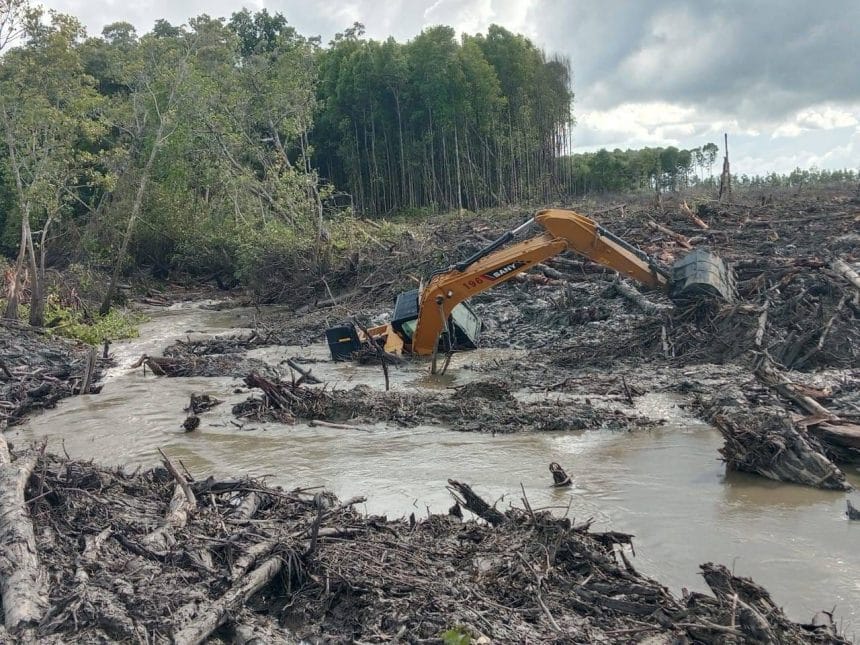
The Indonesian government’s ambitious National Strategic Project (PSN) in Merauke has entered a critical phase marked by escalating conflict between indigenous landowners and corporations backed by state authority, with customary land seizures now accompanied by police criminalization of community members resisting plantation development on their ancestral territories. On 29 September 2025, Coordinating Minister for Food Zulkifli Hasan announced plans to convert 481,000 hectares of Papuan forest in Wanam, Merauke Regency, for rice, oil palm, sugarcane, and cassava production, alongside renewable energy facilities, including bioethanol and biodiesel processing industries. The government claims the forest area has already been “released” from protected status, with Minister of Agrarian Affairs, Nusron Wahid, stating the land “does not belong to the community because it was previously state forest,” allocating 263,000 hectares for rice fields in Wanam, 41,000 hectares in Merauke City, 146,000 hectares for oil palm, and 1,140 hectares for ports and settlements. This massive land conversion contradicts the lived reality of indigenous Yei communities like the Kwipalo clan, whose ancestral territories are being forcibly seized by PT Murni Nusantara Mandiri (MNM). The company is part of the PT Global Papua Abadi consortium holding a 52,700-hectare concession for sugar cane plantation development.
The conflict reached a new level on 15 September 2025, when Mr Vincen Kwipalo and his relatives physically stopped PT MNM employees operating excavators and bulldozers clearing their customary forest to build road access through Kwipalo clan territory in Jagebob District. Following this confrontation, PT MNM used one of its employees to file a police report against Mr Kwipalo at the Merauke Resort Police Station. Following the police report, Mr Kwipalo was summoned for clarification on 2 October 2025. On 17 September 2025, Mr Kwipalo and three relatives erected traditional barriers named “Sasi“ using tree trunks across the cleared land, painting them orange and posting warning signs reading “No entry to the Kwipalo customary area,” to protect the 2,308 hectares of ancestral land threatened by corporate encroachment. As of August 2025, PT MNM had already cleared 4,912 hectares of the concession area, with periodic monitoring by Pusaka Bentala Rakyat Foundation documenting ongoing deforestation.
The Kwipalo clan’s resistance reflects systematic violations of indigenous land rights under Indonesian law, particularly Article 43(3) of Law No. 2/2021, requiring that provision of customary and individual land “for any purpose” must be “carried out through deliberation with the customary law community and residents concerned to reach an agreement on the transfer of required land and compensation.”
The Kwipalo Clan has manifested its rejection through multiple channels: planting red crosses on customary territory as traditional symbols of prohibition, openly declaring rejection through the national media, staging demonstrations in both Merauke and Jakarta, and filing an ongoing lawsuit with Indonesia’s Constitutional Court challenging the project’s legality. His position is reinforced by Article 21 of Merauke Regency Regulation No. 5/2013. The article obligates the South Papua Governor and Merauke Regent to immediately order PT. MNM to stop the criminal act of seizing and embezzling the customary land of the Kwipalo clan and protect Mr. Vinsen Kwipalo from the threat of criminalisation. State institutions, including the police, have become enforcement mechanisms for corporate land acquisition. Ín addition, the military has established the 817th Territorial Development Infantry Battalion within PT MNM’s concession area on Kwipalo customary land in July 2025, without clan permission or consent. The developments support growing concerns of deliberate militarization for the purpose of securing corporate business interests.
The Merauke PSN represents a broader pattern documented across Indonesia, where National Strategic Projects systematically dispossess indigenous communities under the legal framework established by the Job Creation Law. Civil society organizations argue that the law provides “facilitation and acceleration” mechanisms that bypass normal consultation and compensation requirements. The case parallels the displacement of 75 families from Soa Village in Tanah Miring District by PT Global Papua Abadi for road and bridge construction, and other conflicts at other PSN sites, including Rempang Island (Riau Islands), Indonesian Green Industrial Zone (North Kalimantan), and the National Capital (East Kalimantan), where communities face forced evictions for development projects. Greenpeace Indonesia Forest Campaigner, Mrs Sekar Banjaran Aji, notedthat “PSN Merauke has deprived indigenous peoples of their rights, destroyed natural forests, and threatened the biodiversity of the landscape,” while emphasizing that “the involvement of the army and police in the project has also caused terror among the community and indigenous Papuans.”
Indonesia’s National Human Rights Commission has documented violations in PSN Merauke activities. Yet the government continues advancing the project as part of President Prabowo Subianto’s vision referenced at the UN General Assembly, positioning Indonesia as a “candidate for the world’s food barn.” The Papua Law Enforcement and Human Rights Coalition has called on the President to “immediately revoke the National Strategic Project policy that legalizes PT. MNM’s seizure and misappropriation of the customary land of the Kwipalo clan. The criminalization of Mr Vincen Kwipalo represents an “early example” of tactics that will be deployed against indigenous land rights holders resisting investment projects throughout the South Papua Province and in other PSN sites across Indonesia.
Mr Vinsen Kwipalo stops PT MNM excavators from destroying the Kwipalo clan’s customary forest, 17 September 2025
Mr Vinsen Kwipalo and supporters in front of the Merauke District Police Station, 2 October 2025
Period of incident: 15/09/2025 – 15/10/2025 Perpetrator: Private Company, Government Issues: business, human rights and FPIC, human rights defenders, indigenous peoples
Groundbreaking satellite data analysis and interactive mapping tools have revealed the unprecedented scale of deforestation and ecosystem destruction across West Papua, with the National Strategic Projects driving 24% of the forest loss in 2024. A comprehensive new study published by Nusantara Atlas has unveiled a detailed analysis of land clearing trends across West Papua, revealing alarming acceleration in environmental destruction driven by government mega-projects and corporate expansion. The research introduces powerful new data visualization tools that allow interactive monitoring of ecological changes across one of the world’s last intact tropical wilderness areas.
The research methodology combines multiple data sources, including satellite imagery analysis, land-use planning documents obtained through information requests, and ground-based verification, to create a comprehensive picture of environmental change across West Papua. The publication’s combination of scientific analysis and accessible data visualisation tools marks a new era in environmental monitoring, providing the evidence base necessary for urgent policy intervention to protect one of Earth’s most biodiverse regions.
The Nusantara Atlas publication represents a breakthrough in environmental transparency by opening public access to civil society organisations, researchers, and policymakers with sophisticated tools previously available only to government agencies and large corporations. The interactive mapping platform allows public access to environmental monitoring data, enabling real-time tracking of ecological destruction and corporate accountability.
New data platform transforms environmental monitoring
The publication introduces “Papua Watch,” an interactive story map that provides unprecedented access to satellite-based monitoring of land clearing activities across 13 key locations in West Papua. The platform combines high-resolution satellite imagery, land-use planning data, and comparative analysis tools to track the ongoing expansion of food estates, oil palm plantations, mining operations, and infrastructure development in the region.
The mapping application’s most significant innovation lies in its ability to provide comparative satellite imagery analysis, allowing users to observe environmental changes over time with precision previously unavailable to the public. Users can visualize the exact locations where deforestation occurred, identify which ecosystems were affected, and track the companies responsible for the destruction.
Detailed mapping of forest loss by driver and geographic location
Interactive overlay of protected areas, indigenous territories, and development projects
Real-time tracking of road construction and infrastructure expansion
Ecosystem-specific analysis distinguishing between primary forest, swamp forest, savanna, and grassland conversion
Alarming acceleration of environmental destruction
The research reveals that primary forest loss in West Papua rose 10% from 2023 to 2024, reaching 25,300 hectares, with preliminary 2025 data indicating the pace is accelerating further. Most significantly, the Merauke National Strategic Project (PSN) emerged as the top driver of deforestation in 2024, resulting in the loss of 5,936 hectares of primary forest. This figure equals 24% of all recorded forest destruction.
The satellite data shows that from January 2024 to June 2025, the Merauke PSN cleared 22,272 hectares of natural ecosystems, including primary forest (9,835 ha), Melaleuca swamp forest, natural savanna, and grassland. This represents only a fraction of the project’s ultimate target of converting up to 3 million hectares for rice fields and sugarcane plantations.
The mapping platform’s corporate tracking capabilities expose the key players driving environmental destruction in West Papua. The analysis identifies the Jhonlin, Fangiono, and Salim groups as the three primary actors. The interactive data allows users to trace specific concessions to their corporate owners and track their clearing activities over time.
Major findings through the mapping analysis revealed that PT Global Papua Abadi (linked to the Fangiono family) cleared 11,751 hectares between January 2024 and June 2025. Land clearings associated with the oil palm expansion in the first half of 2025 are already equal to those of all of 2024, indicating an accelerating pressure on land and resources. According to the satellite imagery analysis on the infrastructure development, 40 km of a planned 135 km access road have been completed, opening new areas for exploitation that have previously been inaccessible.
Mining threats exposed through island-specific analysis
The platform’s ecosystem-specific analysis demonstrates why island mining poses exceptional risks. Smaller islands are home to globally significant biodiversity, which cannot regenerate once damaged by industrial operations due to their geographical limitation and their exposure to various forms of erosion.
Infrastructure development catalyses environmental destruction
The mapping shows that completion of planned infrastructure will inevitably increase accessibility to protected areas, including Danau Bian and Bupul Nature Reserves, facilitate speculative land clearing as road access increases land values, and enable expansion of transmigration sites with associated population pressure.
The platform’s road network analysis reveals the strategic nature of current development. The new PSN road, when completed, will connect to the existing Trans-Papua Highway and MIFEE road networks, creating a continuous corridor across southern Papua’s wilderness. The mapping illustrates that this corridor ends less than 1 km from the Danau Bian Nature Reserve, putting this protected ecosystem at immediate risk.
The comparative satellite imagery supports the observation that road construction acts as a catalyst for broader environmental destruction, with clearing expanding along transport corridors and facilitating industrial access to previously protected areas.
Scientific validation of environmental concerns
The research validates concerns about the environmental suitability of current projects through detailed ecosystem analysis. The mapping reveals that much of the targeted area consists of acidic peat soils and seasonally flooded wetlands, conditions that have caused similar food estate projects to fail elsewhere in Indonesia.
International implications and conservation priorities
The research platform positions West Papua’s environmental crisis within global conservation priorities, noting that the region represents one of the world’s last intact tropical wilderness areas. The mapping demonstrates that without urgent intervention, such as Indigenous land rights recognition, science-based land use planning, and a permanent halt to the Merauke Strategic National Project, West Papua is at high risk of losing irreplaceable ecosystems.
Interestingly, the study warns that continued destruction could jeopardize Indonesia’s 2030 net-zero emissions target, as the clearing of carbon-rich peat forests and wetlands releases significant greenhouse gases into the atmosphere.
Urgent call for policy response
The research concludes with specific policy recommendations based on the mapping analysis. Recommendations include implementing a moratorium on forest conversion to oil palm, banning mining on small islands, recognizing Indigenous land rights, and adopting science-based land use planning. The interactive platform provides policymakers with the precise geographic and temporal data needed to implement targeted conservation measures.
In the past months, the situation surrounding the National Strategic Project (PSN) in Merauke, Papua Selatan Province, has further escalated. In the Soa Village, Tanah Miring District, indigenous women from 75 families have collectively opposed the land encroachment by PT. Global Papua Abadi, which received a government concession for an energy project without the community’s free, prior, and informed consent (FPIC). This project threatens to destroy their natural sources of livelihood and violates their rights to land and self-determination. Similarly, on 23 June 2025, indigenous land belonging to the Kwipalo clan in Kakyo Village, Semangga District, was reportedly seized by the military for the construction of a post without consent or legal process, constituting a grave act of militarisation and forced dispossession.
According to the CSOs, the government’s reply reflected a broader institutional reluctance to engage meaningfully with international human rights norms. They pointed out that the Indonesian state has failed to comply with recommendations made by Komnas HAM, as well as with constitutional and international legal standards safeguarding indigenous peoples’ rights. Furthermore, they underscored that permits and business licences had been granted to companies in areas with customary land claims, without community consent or proper consultation. The coalition urged the UN Special Rapporteurs to conduct direct monitoring in Merauke and called for the immediate suspension of PSN implementation to prevent the continued expansion of human rights and environmental violations.
The PSN’s implementation in Merauke reflects a deeper failure of democratic governance and environmental responsibility. It undermines constitutional protections and international legal obligations, particularly under the UN Declaration on the Rights of Indigenous Peoples. The Indonesian government’s response to concerns raised by UN Special Rapporteurs has been criticised as evasive and dishonest. Indigenous leaders and civil society continue to demand the immediate suspension of all PSN activities, restoration of customary lands, adequate reparations, and a UN-led investigation. Without urgent corrective action, the PSN will inevitably destroy the ecological, cultural, and spiritual fabric of West Papua’s indigenous communities.
The military seized land belonging to the Kwipalo Clan in the Kakyo Village, Semangga District, without consent or legal process
The Indonesian government’s plan to implement a National Strategic Project (PSN) worth 24 trillion rupiah in the Papua Barat Daya Province has sparked resistance from indigenous communities. They understand the massive palm oil development as an existential threat to their ancestral lands and way of life. PT Fajar Surya Persada Group’s proposal, submitted to the Governor on 27 May 2025, seeks to establish an integrated palm oil-based food industry across 98,824.97 hectares covering key districts in Sorong and Tambrauw regencies. The project involves a consortium of five companies that would control vast swaths of traditional Moi territory, including PT Inti Kebun Sawit (18,425.78 hectares), PT Inti Kebun Sejahtera (307.91 hectares), PT Sorong Global Lestari (12,115.43 hectares), PT Omni Makmur Subur (40,000 hectares), and PT Graha Agrindo Nusantara (13,799.51 hectares).
The indigenous Moi Tribe has voiced resistance against what they describe as systematic land grabbing disguised as development. On 21 June 2025, Moi communities from 13 affected districts held traditional consultation meetings in the Klaso District, culminating in sacred oath-taking ceremonies (see photo on top, source: Suara Papua) and the planting of “Tui” bamboo poles, traditional symbols of prohibition and spiritual protection. Traditional leader, Dance Ulimpa declared that the Moi people “can live without palm oil, but cannot live without our customary forests,” emphasizing that these represent their last remaining forest territories. The communities have threatened to paralyze government offices in the provincial capital and the Sorong Regency if authorities accept the company’s application.
Evidence from existing palm oil operations in the region reveals devastating environmental and social impacts that fuel indigenous resistance. According to community testimonies, palm oil companies already operating in Sorong District have caused severe ecological damage, including pollution of the once-pristine Malalis and Klasof rivers where PT Hendrison Inti Persada and PT Inti Kebun Sejahtera operate. Traditional representative Desi Karongsan reported that the Klasof River now runs yellow and oily during rainy seasons, killing fish and causing skin rashes among children. Despite promises of economic benefits, only one Moi person reportedly works for the palm oil companies, while customary land is leased at exploitative rates of just 100,000 rupiah (approximately € 6.00) per hectare per month. The economic marginalization is so severe that some indigenous land is leased at only 6,000 rupiah per hectare, highlighting the gross inequality in benefit distribution.
Political resistance is building at multiple levels, with the West Papua Regional Parliament (DPRP) committing to draft regional regulations protecting indigenous rights and imposing a moratorium on palm oil expansion. A coalition of 18 organizations, including the Moi Great Tribe Council, Indigenous Peoples Alliance of the Archipelago (AMAN), Greenpeace Indonesia, and various human rights groups, has formally rejected the PSN, arguing that despite Papua’s Special Autonomy Law intended to protect indigenous rights, communities continue facing poverty, displacement, and human rights violations. The coalition demands an immediate halt to all PSN activities that deprive indigenous communities of their ancestral land. The coalition calls for development policies that prioritize indigenous participation and environmental protection over corporate interests in what they describe as West Papua’s transformation into “a testing ground for greedy and reckless development.”
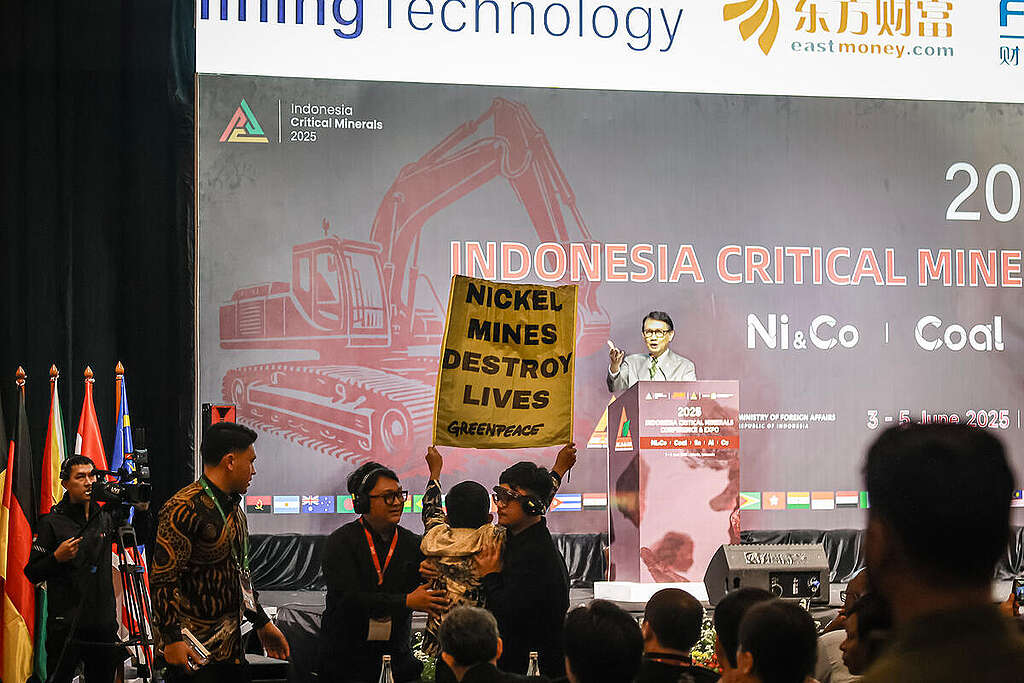
Through this direct action, Greenpeace aims to deliver an urgent message to the Indonesian government, nickel industry executives gathered at the event, and the wider public: nickel mining and processing are inflicting profound suffering on affected communities across Eastern Indonesia. The industry is razing forests, polluting vital water sources, rivers, seas, and air, and is exacerbating the climate crisis through its reliance on captive coal-fired power plants for processing.
“While the government and mining oligarchs discuss expanding the nickel industry at this conference, communities and our planet are already paying an unbearable price,” said Iqbal Damanik, Greenpeace Indonesia Forest Campaigner. “The relentless industrialization of nickel – accelerated by soaring demand for electric cars – has destroyed forestlands, rivers, and seas from Morowali, Konawe Utara, Kabaena, and Wawonii, to Halmahera and Obi. Now, nickel mining even threatens Raja Ampat in West Papua, a globally renowned biodiversity hotspot often called the last paradise on Earth.”
Following an investigative journey through West Papua, Greenpeace exposed mining activities on several islands within the Raja Ampat archipelago, including Gag Island, Kawe Island, and Manuran Island. These three are classified as small islands and, under the law concerning the management of coastal areas and small islands, should be off-limits to mining.
Greenpeace analysis reveals that nickel exploitation on these three islands has already led to the destruction of over 500 hectares of forest and specialised native vegetation. Extensive documentation shows soil runoff causing turbidity and sedimentation in coastal waters – a direct threat to Raja Ampat’s delicate coral reefs and marine ecosystems – as a result of deforestation and excavation.
Beyond Gag, Kawe, and Manuran, other small islands in Raja Ampat such as Batang Pele and Manyaifun are also under imminent threat from nickel mining. These two adjacent islands are situated approximately 30 kilometers from Piaynemo, the iconic karst island formation pictured on Indonesia’s Rp100,000 banknote.
Raja Ampat is celebrated for its extraordinary terrestrial and marine biodiversity. Its waters are home to 75 percent of the world’s coral species and over 2,500 species of fish. The islands themselves support 47 mammal species and 274 bird species. UNESCO has designated the Raja Ampat region as a global geopark.
Ronisel Mambrasar, a West Papuan youth from the Raja Ampat Nature Guardians (Aliansi Jaga Alam Raja Ampat), said, “Raja Ampat is in grave danger due to the presence of nickel mines on several islands, including my own home in Manyaifun and Batang Pele Islands. Nickel mining threatens our very existence. It will not only destroy the sea that has sustained our livelihoods for generations but is also fracturing the harmony of our communities, sowing conflict where there was once harmony.”
Greenpeace Indonesia urgently calls on the government to fundamentally reassess its nickel industrialization policies, which have already triggered a cascade of problems. The hollow boasts about the benefits of downstreaming, championed by the previous administration and now perpetuated during the presidency of Prabowo Subianto, must end. The nickel industrialization drive has proven to be a tragic irony: instead of delivering a just energy transition, it is systematically destroying the environment, violating the rights of Indigenous Peoples and local communities, and deepening the damage to an Earth already buckling under the weight of the climate crisis.
An Indonesian soldier gives a thumbs up as he crosses a rice field on a combine harvester in remote Papua, where a government food security mega-project has raised fears of mass deforestation.
Keen to end its reliance on rice imports, Indonesia wants to plant vast tracts of the crop, along with sugar canefor biofuel, in the restive eastern region.
But environmentalists warn it could become the world’s largest deforestation project, threatening endangered species and Jakarta’s climate commitments.
And activists fear the scheme will fuel rights violations in a region long plagued by alleged military abuses as a separatist insurgency rumbles on.
The project’s true scale is hard to ascertain; even government statements vary.
At a minimum, however, it aims to plant several million hectares of rice and sugar cane across South Papua province’s Merauke. One million hectares is around the size of Lebanon.
Deforestation linked to the plan is already under way.
By late last year, more than 11,000 hectares had been cleared—an area larger than Paris—according to Franky Samperante of environmental and Indigenous rights NGO Yayasan Pusaka Bentala Rakyat.
That figure has only increased, according to analysis by campaign group Mighty Earth and conservation start-up The TreeMap.
Their work shows areas cleared include primary and secondary natural dryland and swamp forest, as well as secondary mangrove forest, savanna and bush.
“Usually, deforestation is a product of government not doing its job,” said Mighty Earth chief executive Glenn Hurowitz.
“But in this case, it’s actually the state saying we want to clear some of our last remaining forests, carbon-rich peatlands, habitat for rare animals,” he told AFP.
Indonesia’s government says the land targeted is degraded, already cultivated or in need of “optimization,” dismissing some areas as little more than swamps.
‘Tragedy’
Environmentalists argue that misunderstands the local ecosystem.
“In South Papua, the landscape and the ecosystem is lowland forest,” said Samperante.
“There are often misconceptions or even belittling” of these ecosystems, he added.
Mapping done by Mighty Earth shows the project threatens a broader ecosystem range—including peatlands and forests the group says should be protected by a government moratorium on clearing.
“The tragedy in this project,” said Hurowitz, “is that Indonesia has made so much progress in breaking the link between agricultural expansion and deforestation.”
“Unfortunately, this single project threatens to undermine all progress.”
Indonesia has some of the world’s highest deforestation rates and Papua retains some of the largest remaining untouched tracts.
Indonesian think-tank CELIOS says cutting down so much forest could derail Jakarta’s plan to reach net-zero by 2050.
For President Prabowo Subianto’s government, criticism of the project ignores Indonesia’s agricultural and economic realities.
He has made the scheme a priority, visiting soon after taking office.
In January, he said the country was on track to end rice imports by late 2025, and reiterated its energy independence needs.
The agriculture ministry did not respond to AFP’s request for comment.
In Papua, planting is in full swing. In the region’s Kaliki district, AFP saw farmers supported by soldiers tending rice paddies in recently-cleared land.
“This location used to be like the one on the right here. Non-productive and neglected land,” said Ahmad Rizal Ramdhani, a soldier serving as the agriculture ministry’s food resilience taskforce chief, at an event lauding the project.
That characterization is disputed by Mighty Earth’s satellite analysis, which found that at least two areas in the region cleared for rice overlap with government-designated peatland.
Indonesia’s military is heavily involved in the project.
Local farmer Yohanis Yandi Gebze told AFP soldiers gave him “tools, agricultural equipment and machinery” for rice cultivation.
Speaking not far from Ramdhani’s event, he praised the military.
“I see them cooperating with the people very well,” he said.
‘Cannot refuse’
Others say that is only part of the story.
Indonesia officially seized Papua, a former Dutch colony, in a widely criticized but UN-backed vote in 1969.
It has since been accused of abuses in a decades-long separatist conflict in the region.
“The community feels intimidated,” said Dewanto Talubun, executive director at Merauke-based environmental and rights group Perkumpulan Harmoni Alam Papuana.
“Not all members of the community agree with this project, and they cannot directly refuse,” he told AFP.
Samperante too reported local fears.
“Almost every day a human rights violation occurs,” he said.
The defense ministry told AFP the military had the resources and “high discipline” to accelerate the food project while securing “stability and security” in the region.
However, there are significant doubts about the project’s viability.
“Soils in Merauke are likely too acidic and the climate too extreme… to grow rice,” said David Gaveau, founder of The TreeMap.
He warned that draining Merauke’s wetlands for agriculture risks turning the area “into a tinder box”—a fate seen elsewhere in Indonesia.
Critics do not dispute Jakarta’s food security needs, but said crops should be grown elsewhere on abandoned agricultural land.
“It should be done in places that are capable of absorbing it,” said Hurowitz.
“Without destroying Indonesia’s gorgeous, beautiful natural heritage and community lands.”
An Indonesian minister within Prabowo Subianto’s new government took little time to announce plans to resume a former transmigration program throughout the eastern regions of a sovereign Indonesia, including the largest Papua province in western New Guinea, saying it was needed to enhance unity and provide locals with welfare.
Transmigration is the controversial process of forcibly moving Indigenous people on from their existing residences in a densely populated part of Indonesia to less densely populated areas of the country.
But for Indigenous Papuans that have a cultural connection and far more in common with their brothers in Papua New Guinea, displacement of Papuan populations remain a historical sore point.
The ministry intends to revitalise 10 zones in Papua, potentially using local relocation rather than bringing in outsiders and/or foreigners for work.
The program had been on pause for 23 years after it was found to severely propagate and to accelerate the Papuan independence movement in the western half of the New Guinea that has been under Indonesian control since October 1962 following the exodus of Dutch colonists.
“We want Papua to be fully united, as a part of Indonesia in terms of welfare, national unity and beyond,” Muhammad Iftitah Sulaiman Suryanagara, the revived minister of transmigration, said.
Mr Iftitah has promised strict evaluations focusing on community welfare rather than just relocation numbers.
Despite the minister’s promises, the plan has since drew outcry from Indigenous Papuans, citing social and economic concerns.
The purpose of this program was officially to reduce poverty and to provide opportunities for hard-working poor people by providing a workforce to utilise natural resources of the nation.
But in Papua, a remote and resource-rich region, it is viewed as a form of indentured labour.
The program has been a flashpoint for conflict, with its people enduring decades of alleged military abuse and human rights violations under Indonesian rule.
Simon Balagaize, a young Papuan leader from Merauke, highlighted the negative impacts of transmigration efforts in Papua under dictator Suharto’s New Order during the 1960s.
“Customary land was taken, forests were cut down, (while) the indigenous Malind people now speak Javanese better than their native language,” he told the independent Southeast Asian, BenarNews, last month.
The Papuan Church Council stressed locals desperately do require increased services, but could do without more transmigration
“Papuans need education, health services and welfare – not transmigration that only further marginalizes landowners,” Rev Dorman Wandikbo, a council member, told BenarNews.
Transmigration into Papua has sparked protests on concerns about reduced employment opportunities for Indigenous people.
Human rights advocate Theo Hasegem criticised the government’s step back, arguing the human rights issues are ignored under transmigration, and non-Papuans could also be endangered because separatist groups often target newcomers.
“Do the president and vice president guarantee the safety of those relocated from Java?” Hasegem told BenarNews.
The program dates to 1905 during the Dutch East Indies administration and was a program an independent Indonesia adopted and continued through a number of its administrations under the guise of promoting development and unity.
It also aimed to promote social and cultural unity by relocating citizens across regions.
Transmigration involved 78,000 families in Papua from 1964 to 1999, according to statistics from the Papua provincial government.
The program only had paused in 2001 after a special Indonesian autonomy law required regional regulations to be followed.
A Papuan legislator, John N R Gobay, questioned the role of Papua’s latest autonomous regional governments for the transmigration process.
He cited an article of the law mandating that transmigration proceeds only with gubernatorial consent and regulatory backing.
Without clear regional regulations, he warned, transmigration lacks a strong legal foundation and could conflict with special autonomy rules that exist in Western New Guinean provinces.
United Nations data estimates between 60,000 and 100,000 Papuans have been displaced since 2022, after Indonesia denies UN officials access to the region, while human rights advocates in the area recently said the figure is 79,000.
Indonesia’s forestry minister says 20 million hectares (50 million acres) of forest can be converted to grow food and biofuel crops, or an area twice the size of South Korea.
Experts have expressed alarm over the plan, citing the potential for massive greenhouse gas emissions and loss of biodiversity.
They also say mitigating measures that the minister has promised, such as the use of agroforestry and the involvement of local communities, will have limited impact in such a large-scale scheme.
The announcement coincides with the Indonesian president’s call for an expansion of the country’s oil palm plantations, claiming it won’t result in deforestation because oil palms are also trees.
JAKARTA — An Indonesian government plan to clear forests spanning an area twice the size of South Korea for food and biofuel crops has sparked fears of massive greenhouse gas emissions and biodiversity loss.
The country’s forestry minister, Raja Juli Antoni, announced on Dec. 30, 2024, that his office had identified forest areas spanning 20 million hectares (50 million acres) for potential conversion into “food and energy estates.”
The announcement triggered an immediate backlash, as similar food estate programs in the past have failed, often leaving a legacy of environmental destruction. Indonesia has the world’s third-largest expanse of tropical rainforest, after Brazil and the Democratic Republic of Congo, and such a vast amount of deforestation would deal a major blow to global efforts of limiting global warming, said Amalya Reza Oktaviani, bioenergy campaign manager at the NGO Trend Asia.
The clearing of 20 million hectares of forests could release up to 22 billion metric tons of carbon dioxide, equivalent to the annual emissions from nearly 5,300 coal-fired power plants.
“This [food and energy estate plan] shows how the government doesn’t have a commitment to reforest and rehabilitate natural forests,” Amalya said. “In reality, we don’t have the luxury of deforesting amid the climate crisis.”
Yet the plan aligns with the platform of President Prabowo Subianto, who has prioritized achieving both food and energy self-sufficiency as cornerstones of his administration. Since his election campaign in late 2023 and early 2024, Prabowo has emphasized the need for Indonesia to achieve sovereignty in these critical sectors to bolster economic resilience and national security.
Over decades, unbridled agricultural expansion has already destroyed vast swaths of Indonesia’s rainforests, turning the country into a significant global emitter of greenhouse gases. From 2013 to 2022, Indonesia ranked as the world’s second-largest emitter from land-use change, contributing 20% of global land-use emissions.
Agroforestry claims
In response to criticism, Forestry Minister Raja said the government would minimize deforestation by implementing agroforestry, a system where crop cultivation is interspersed among trees. Potential crops include rice and sugar palms, which, Raja said, would allow for sustainable food production.
“By planting various trees [together with food and energy crops], our forests can provide food self-sufficiency through a very sustainable system,” he said at his office in Jakarta on Jan. 6.
Studies suggest agroforestry can help maintain tree cover and wildlife habitats; examples from places like Brazil suggest it can improve farmer livelihood and slow down forest loss. Agroforestry can also help maintain tree cover and wildlife habitat, particularly in regions where agriculture is a major driver of deforestation.
However, critics say that at the scale that the Indonesian government wants to expand its crop estate, agroforestry alone will be insufficient to prevent large-scale deforestation. Agroforestry only works if forest cover is retained, according to Herry Purnomo, a senior scientist at the Center for International Forestry Research (CIFOR). If forests are cleared for crops, then even under an agroforestry system this loss of intact forests would contribute to biodiversity loss and emissions, he said.
“My hope is that intact forests are not cut down and replaced with rice fields,” Herry, who is also a professor at the Bogor Institute of Agriculture (IPB), told Mongabay.
Secondary forests ‘not expendable’
A key uncertainty remains about the Ministry of Forestry’s plan: where are the 20 million hectares of forest it’s targeting for the food and biofuel crops?
The ministry has indicated it will prioritize abandoned or idle forestry concessions, known by the Indonesian acronym PBPH. These include selective logging concessions that the ministry says no longer contain primary forest.
Ade Tri Ajikusumah, head of the ministry’s planning department, said approximately 20 million hectares of Indonesia’s 37 million hectares (91 million acres) of forestry concessions are inactive.
“That’s what we use for agroforestry, so there’s no land clearing,” he told Mongabay.
Since these concessions have already been logged in the past, they no longer contain old-growth, or primary, forest, defined as forests that haven’t been damaged by human activity and thus are some of the densest and most ecologically significant forests on Earth, Ade said.
However, critics contend that even idle concessions can still contain significant forest cover. Greenpeace Indonesia forest campaigner Sekar Banjaran Aji pointed out that there were still 18.9 million hectares (47 million acres) of natural forests within forestry concessions, including selective logging and industrial forest concessions, as of 2022.
“Nearly 20 million hectares of forestry concessions are still forested, which means there’s a high risk of deforestation” if those areas are then converted for the food and energy estates, she told Mongabay.
Selective logging concessions in particular typically have higher forest cover because companies only harvest timber from certain commercially valuable trees above a certain size, leaving much of the forest structure relatively undisturbed and allowing the logged forest to regenerate over time.
Ade said that even if the idle concessions are still forested, they’re likely to be forests that were previously logged and thus have been degraded, also known as secondary forest.
But not all secondary forests are heavily degraded, said Timer Manurung, director of Indonesian environmental NGO Auriga Nusantara. Many are still in good condition, with high carbon stock, lots of biodiversity, and still providing invaluable environmental services, he said.
“Secondary forests often have higher biodiversity than primary forests,” Timer told Mongabay. “Species like tigers, elephants and orangutans are abundant in these areas. The idea that secondary forests are expendable is a fatal misconception.”
Timer called on the government to protect all natural forests, including secondary forests within concessions, rather than differentiating them based on degradation status. He also called on the government to make it clear what criteria it uses to determine whether a concession is idle.
What crops?
Another question is what crops will be planted for the food and energy estates.
So far Raja has only mentioned rice and sugar palms as potential crops. Trend Asia’s Amalya said another likely candidate is oil palm, given that Indonesia is the world’s largest producer of palm oil. Past food estate programs also ended up planting oil palms, even though they were initially planned for rice, Amalya said.
Furthermore, Indonesia’s energy policy also promotes bioenergy, which focuses on palm oil-based biodiesel. Currently the country already uses the world’s highest proportion of palm oil in its biodiesel, and Prabowo has a plan to increase the blend with conventional diesel to 50%, known as B50, as early as this year.
But to produce enough palm oil to meet the B50 program need alone, the total planted area of oil palms will need to expand by up to three times the current size, which already covers 16 million hectares (40 million acres).
The potential inclusion of palm oil in the food and energy estate program has raised concerns among environmentalists, as oil palm plantations have historically been a significant driver of deforestation in the country. Over the past 20 years, these plantations accounted for one-third of Indonesia’s loss of old-growth forest — an area of 3 million hectares (7.4 million acres), or half the size of Belgium.
These concerns have been inflamed by recent comments from President Prabowo, who suggested that deforestation for palm oil expansion isn’t environmentally destructive.
“And I think in the future, we also need to plant more palm oil. We don’t need to be afraid of endangering — what’s it called — deforestation, right?” he said.
“Oil palms are trees, right? They have leaves, right?” he went on.
The expansion of palm oil for energy could spell disaster for Indonesia’s forests and contradict the country’s energy transition agenda to reduce emissions, Amalya said.
“The emissions from forest clearing, combined with those from burning palm oil for biofuel in transportation and biomass in power generation, will worsen the climate crisis,” she said. “In the energy sector, the government needs to revisit bioenergy policies, particularly those involving palm oil and wood-based feedstocks.”
Conflict risk
Besides deforestation risk, the plan to establish 20 million hectares of food and energy estates also poses a high risk of agrarian conflicts with local and Indigenous communities, Timer said.
The idle concessions identified by the Ministry of Forestry are likely to overlap with villages and areas already managed by communities, he said. “This will create conflicts with local communities.”
Amalya stressed the importance of completing forest boundary delineation to avoid such conflicts. As of December 2022, only 89% of Indonesia’s forest areas had been formally delineated. Without clear boundaries, the food and energy estate program could encroach on community lands or protected areas, Amalya said. As such, large-scale projects like this shouldn’t proceed until forest boundaries are fully delineated, she added.
Ade, whose department is in charge of the delineating process, acknowledged that delineation is a priority, adding that the physical mapping process is complete, with legal recognition pending.
Community involvement
Besides finishing the delineating process, the Ministry of Forestry will also include Indigenous and local communities in the food and energy estate plan through agroforestry to respect their rights, Ade said.
“We also need to collaborate with people through agroforestry and social forestry program [in establishing the food and energy estates],” he said.
Herry of CIFOR welcomed the inclusion of communities but questioned the feasibility at such a large scale.
“If the size [of the estates] is big, then the actors [involved] must be big as well,” Herry said. “How can communities manage 10,000 hectares [25,000 acres of land]? The ones who can manage 10,000 hectares are medium to large [corporations],” he said. This raises the risk of the government handing over management of these lands from communities to corporations, but Herry said the government has a duty to work with communities to build their capacity.
He and other experts agree that while agroforestry and community involvement are steps in the right direction, without robust safeguards, including transparency, the protection of all natural forests, clear boundary delineation and meaningful community participation, the program is bound to fail, much like previous food estate programs in Indonesia.
Alternative to crop expansion
In the mid-1990s, the government initiated a food estate project that sought to establish 1 million hectares (2.5 million acres) of rice plantations on peatlands across the Bornean province of Central Kalimantan to boost food security.
The project failed spectacularly, leaving behind a dried-out wasteland that burns on a large scale almost every year. Subsequent attempts to replicate the project in other regions, like the easternmost region of Papua, also ended in failure.
Given such high risks and a record of failures, parliament has urged the Ministry of Forestry to proceed carefully.
“The forestry minister should be cautious and not rush in making decisions. Do in-depth studies [first], invite academics and civil society in making a comprehensive plan where development is in line with forest conservation,” said Ahmad Yohan, a deputy head of the parliamentary commission that oversees environmental and agricultural issues. “Even if it’s for food and energy security, don’t sacrifice the forest.”
If the risks are too high, he said, the government should go back to the drawing board and seek other means of achieving food security without establishing new agricultural fields and clearing forests in the process.
For instance, the government could work with experts to increase the yield of existing agricultural fields through technology, Ahmad said. It could also improve farmers’ access to fertilizer, provide them with training, and modernize their agricultural equipment, he said.
“This way, achieving food security and self-sufficiency doesn’t require destroying forests to establish new plantations,” Ahmad said. “We can maximize the use of existing lands, improve the irrigation systems and the technology.”
Banner image: Forest near Rabia on the island of Waigeo in Raja Ampat, West Papua, Indonesia. Image by Rhett Ayers Butler/Mongabay.
The National Committee of West Papua Star Mountains Region (KNPB-WPB) informs from the scene regarding the refugee situation and conditions in Oksop District that, All the residents of Oksop district of the Star Mountains region have fled to various points, and not a single Community stays in the Village Because of the Action by the Very Armed Forces without dignity & criminal character.
Military Entered Oxop District not Through public roads but through rat roads, and as far as the District Capital, they do not occupy in the District Offices or Social housing existing, but they take place in the forests and then outnumber the civilians in the villages and forests inhabited by the civilians. The actions done by the Military are very scary for the Civil Society of Oksop District So the citizens are very endangered and need help from all parties.
Refugee data
To record casualties of civilians on the field, we had field constraints and were hampered by such a large Military Power, but there is some refugee data we got from the ground among others:
1. Toddler turns 54
2. Launching 23
3. Pregnant mom of 5
4. a serious patient 2
In the statement We Made at some points, civilians are very Unacceptable and Disappointed to the Treatment of the Indonesian Military that is very Inhumane and Criminal. Refugees also say that, December is a big day for us Christians and KAMTIBMAS Day. But this great day (Christmas) we don’t feel the joy and usher the savior’s birth with joy. This is the Worst Christmas present of previous years for us Two denominations “Reveal one citizen representing two Church Denominations (Catholic & Protestant).
Military data
The first stage of Military Power a total of 300 personnel and the second stage of drowning of 3 Cars. While the Military Power is growing and we can’t fully confirm the numbers. As a result of the refugee activities such as Looking for food, drinking, etc. are very narrow because the situation is so tense & many Military Forces expresses their Criminal character.
Therefore, We Request Support & Prayer and Monitoring From Various Parties.
On the southeastern coast of Jayapura city lies a mangrove forest where only women are permitted to enter
By EDNA TARIGAN and FIRDIA LISNAWATI – Associated Press 8 hrs ago
JAYAPURA, Indonesia (AP) — On the southeastern coast of the city of Jayapura, Petronela Merauje walked from house to house in her floating village inviting women to join her the next morning in the surrounding mangrove forests.
Merauje and the women of her village, Enggros, practice the tradition of Tonotwiyat, which literally means “working in the forest.” For six generations, women from the 700-strong Papuan population there have worked among the mangroves collecting clams, fishing and gathering firewood.
“The customs and culture of Papuans, especially those of us in Enggros village, is that women are not given space and place to speak in traditional meetings, so the tribal elders provide the mangrove forest as our land,” Merauje said. It’s “a place to find food, a place for women to tell stories, and women are active every day and earn a living every day.”
The forest is a short 13 kilometers (8 miles) away from downtown Jayapura, the capital city of Papua, Indonesia’s easternmost province. It’s been known as the women’s forest since 2016, when Enggros’ leader officially changed its name. Long before that, it had already been a space just for women. But as pollution, development and biodiversity loss shrink the forest and stunt plant and animal life, those in the village fear an important part of their traditions and livelihoods will be lost. Efforts to shield it from devastation have begun, but are still relatively small.
Women have their own space — but it’s shrinking
One early morning, Merauje and her 15-year-old daughter took a small motor boat toward the forest. Stepping off on Youtefa Bay, mangrove trees all around, they stood chest-deep in the water with buckets in hand, wiggling their feet in the mud to find bia noor, or soft-shell clams. The women collect these for food, along with other fish.
“The women’s forest is our kitchen,” said Berta Sanyi, another woman from Enggros village.
That morning, another woman joined the group looking for firewood, hauling dry logs onto her boat. And three other women joined on a rowboat.
Women from the next village, Tobati, also have a women’s forest nearby. The two Indigenous villages are only 2 kilometers (1.2 miles) apart, and they’re culturally similar, with Enggros growing out of Tobati’s population decades ago. In the safety of the forest, women of both villages talk about issues at home with one another and share grievances away from the ears of the rest of the village.
EDITOR’S NOTE: This is part of a series of on how tribes and Indigenous communities are coping with and combating climate change.
Alfred Drunyi, the leader of Drunyi tribe in Enggros, said that having dedicated spaces for women and men is a big part of the village’s culture. There are tribal fines if a man trespasses and enters the forest, and the amount is based on how guilty the community judges the person to be.
“They should pay it with our main treasure, the traditional beads, maybe with some money. But the fines should be given to the women,” Drunyi said.
But Sanyi, 65, who’s been working in the forest since she was just 17, notes that threats to the space come from elsewhere.
Development on the bay has turned acres of forest into large roads, including a 700-meter (2,300-foot) bridge into Jayapura that passes through Enggros’ pier. Jayapura’s population has exploded in recent decades, and around 400,000 people live in the city — the largest on the island.
In turn, the forest has shrunk. Nearly six decades ago, the mangrove forest in Youtefa Bay was about 514 hectares (1,270 acres). Estimates say it’s now less than half that.
“I am so sad when I see the current situation of the forest,” Sanyi said, “because this is where we live.” She said many residents, including her own children, are turning to work in Jayapura instead of maintaining traditions.
Pollution puts traditions and health at risk
Youtefa Bay, where the sea’s brackish water and five rivers in Papua meet, serves as the gathering bowl for the waste that runs through the rivers as they cross through Jayapura.
Plastic bottles, tarpaulin sheets and pieces of wood are seen stuck between the mangrove roots. The water around the mangrove forest is polluted and dark.
After dozens of years being able to feel the clams on the bay with her feet, Sanyi said she now often has to feel through trash first. And once she removes the trash and gets to the muddy ground where the clams live, there are many fewer than there used to be.
Paula Hamadi, 53, said that she never saw the mangrove forest as bad as it is now. For years, she’s been going to the forest almost every day during the low tide in the morning to search for clams.
“It used to be different,” Hamadi said. “From 8.00 a.m. to 8:30 in the morning, I could get one can. But now, I only get trash.”
The women used to be able to gather enough clams to sell some at the nearest village, but now their small hauls are reserved for eating with their families.
A study in 2020 found that high concentrations of lead from waste from homes and businesses were found at several points in the bay. Lead can be toxic to humans and aquatic organisms, and the study suggests its contaminated several species that are often consumed by the people of Youtefa Bay.
Other studies also showed that populations of shellfish and crab in the bay were declining, said John Dominggus Kalor, a lecturer on fisheries and marine sciences at Cenderawasih University.
“The threats related to heavy metal contamination, microplastics, and public health are high,” Kalor said. “In the future, it will have an impact on health.”
Some are trying to save the land
Some of the mangrove areas have been destroyed for development, leading to degradation throughout the forest.
Mangroves can absorb the shocks of extreme weather events, like tsunamis, and provide ecosystems with the needed environment to thrive. They also serve social and cultural functions for the women, whose work is mostly done between the mangroves.
“In the future people will say that there used to be a women’s forest here” that disappeared because of development and pollution, said Kalor.
Various efforts to preserve it have been made, including the residents of Enggros village themselves. Merauje and other women from Enggros are trying to start mangrove tree nurseries and, where possible, plant new mangrove trees in the forest area.
“We plant new trees, replace the dead ones, and we also clean up the trash around Youtefa Bay,” Merauje said. “I do that with my friends to conserve, to maintain this forest.”
Beyond efforts to reforest it, Kalor said there also needs to be guarantees that more of the forest won’t be flattened for development in the future.
There is no regional regulation to protect Youtefa Bay and specifically the women’s forests, but Kalor thinks it would help prevent deforestation in the future.
“That should no longer be done in our bay,” he said.
The Associated Press’ climate and environmental coverage receives financial support from multiple private foundations. AP is solely responsible for all content. Find AP’s standards for working with philanthropies, a list of supporters and funded coverage areas at AP.org.