Prabowo Subianto’s human rights abuses in Timor-Leste

Indonesia’s president-elect, Prabowo Subianto, has form. As the son-in-law of the former dictator, Suharto, he rose quickly through the ranks of the military to become head of the greatly feared Indonesian special forces, Kopassus. To put it bluntly, in 1983 he was involved in one of the biggest massacres in Indonesian-occupied Timor-Leste, in Kraras in the south of the country. His soldiers killed up to 300 men, women and children in the biggest mass killing in Timor-Leste’s 24-year war with Indonesia. He was also involved in the killing of the first president of Timor-Leste, Nicolau Lobato, whose body was taken by Indonesian forces and never recovered.

Prabowo was finally thrown out of the army in 1998 following the detention and disappearances that year of pro-democracy Indonesian activists in Jakarta, who were protesting against Suharto and calling for his overthrow. Thirteen of the activists disappeared and were never seen again, presumed killed by Kopassus troops who were under his command. Prabowo was given a travel ban to the United States, where he had previously trained in counterinsurgency with US special forces at Fort Benning and Fort Bragg, and to Australia. He has always denied his involvement in kidnapping, torture and killings, and has never been charged in relation to any of the allegations against him and his men.

Prabowo orchestrated the strategy of separating those fighting for independence and the population. In Timor-Leste, Aceh and West Papua, troops under his command carried out countless casual human rights abuses.

Coopting former resistance fighters into his own control was one of the lessons he learnt in America and he put it into effect firstly in Timor-Leste. He created auxiliaries called Hansips and later two notorious Indonesian-led but Timorese-staffed battalions, 744 and 745. Both were among the most brutal towards their own people. They killed civilians, students, nuns, priests and journalists, right up until the final Indonesian withdrawal in 1999. Prabowo orchestrated the strategy of separating those fighting for independence and the population. In Timor-Leste, Aceh and West Papua, troops under his command carried out countless casual human rights abuses.

Some acts, such as the prominent killing of West Papuan leader Chief Theys Eluay in 2001, were blamed on his subordinates, who were given brief and sometimes-ignored convictions and jail terms.

Prabowo rose quickly in the military. By the age of 32, he was a major. He was untouchable and powerful. When I spoke to Indonesian human rights workers, student activists, independence supporters, members of Timor-Leste resistance fighters Falintil in the mountains, or their civilian supporters in Fretilin and CNRT, Prabowo’s name always came up.

I remember talking to Munir, an Indonesian human rights leader who had come to Timor-Leste after the fall of Suharto in May 1998 to document the abuses of the Indonesian military there. In August 1998, he told me about Prabowo’s role in recruiting and organising the Indonesian-led and funded militias that were starting to form back then in Timor-Leste. Munir was later killed by a poisoned cup of orange juice on a Garuda flight to Singapore as he tried to flee Indonesia after reporting on Indonesian military abuses in Aceh. Kopassus was blamed.

In many ways August, September and October in 1998 were extraordinary times in Timor-Leste. The Indonesian military, unsure if it was allowed to shoot demonstrators as it used to under Suharto, stood aside as Timorese students mounted louder and more heavily attended rallies in the capital Dili and in regional centres such as Manatuto and Baucau.

The lid was off and they came in their thousands, chanting, singing and waving pro-independence flags. Apart from the occasional killing, the Indonesian military seemed to tolerate the speeches and calls for independence, but they were always there watching, taking photos and video, identifying those who spoke out. They always had guns and you never knew if that day was the day they would start shooting.

As the protests continued, I joined the students on a trip to Lacluta in the remote south-east of the island. The trip down there felt like a day off – sitting in an open-backed truck. The group sitting on the roof would sing the solo verse and the others the chorus. The villagers couldn’t believe their defiance. We got to Viqueque.

There had been trouble in the area: houses burnt, a few men killed by a new group of Indonesian soldiers. When we arrived for the rally the next day it was mostly the students from Dili and a few old people. Horrible things had happened in this area. On August 8, 1983, Indonesian soldiers from Battalion 501, who later trained in Australia, entered the town of Kraras and began rounding up the men. They killed them all in a group and threw their bodies in a swamp. They killed the children by swinging them against walls or stabbing them with knives. There had been 3000 people living in this village and only about 1300 escaped. The killings in that area went on until September.

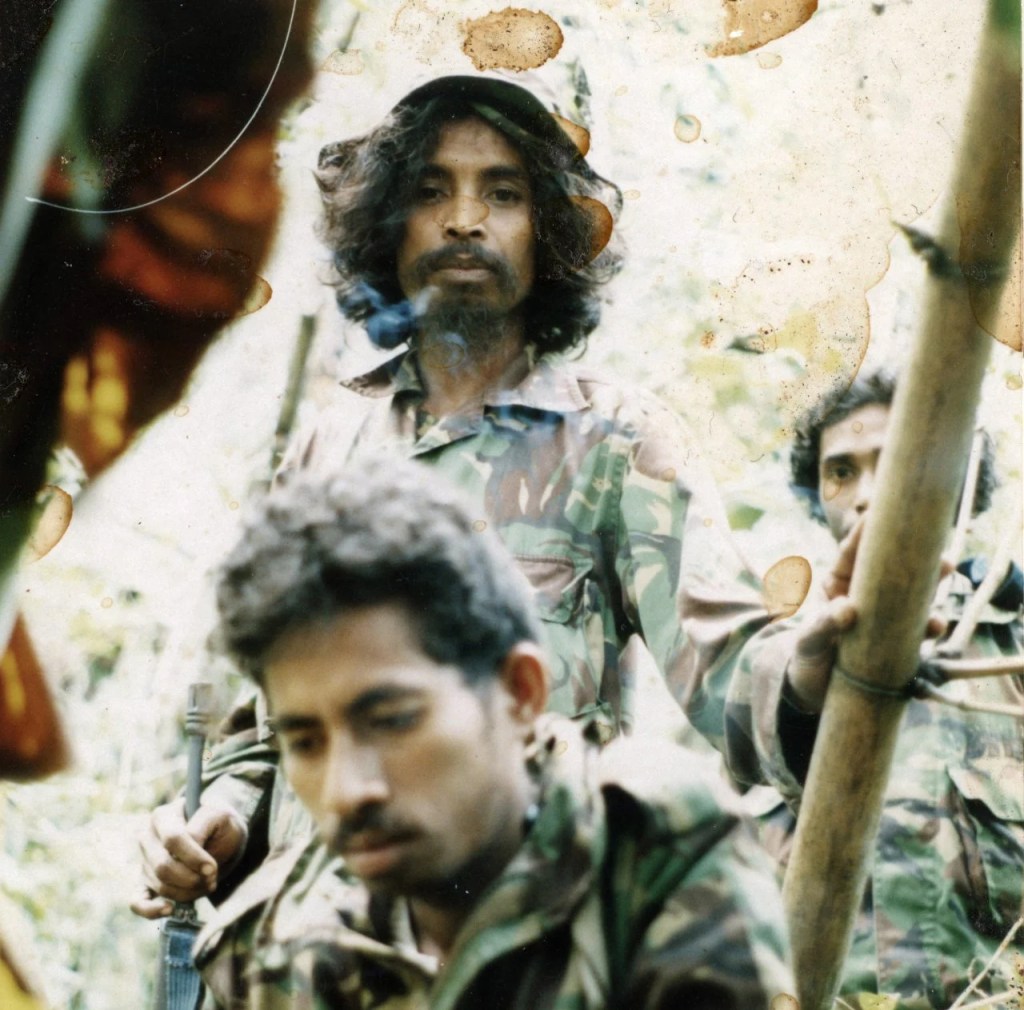
Later, when the militia violence was in full swing, I went up into the mountains to interview the Falintil commander Falur Rate Laek. Things had cracked down and it involved lots of planning. There was a long drive and a long mountain walk in monsoonal rain, trying to be quiet to avoid Indonesian military patrols. It was hard and nerve-racking. In this sparse mountain camp of tarps with bush thrown over the top, the guerillas spoke in whispers. I had done this before and knew what to expect. The threat of being captured with them was ever-present. They were taking a risk to speak and I was taking a risk going up there.

Ostensibly I was there to interview Falur Rate Laek about the recent killings in the village of Alas. The Indonesian soldiers and militia had killed at least 50 men the previous November. I had walked there too and been run out of town by armed Indonesians troops and militia, who shot at me and my guide as we scrambled up the muddy hill to get out of that place.

I got Falur’s version of the killings, which his men had witnessed. After endless coffee and cigarettes in the night, our talk turned to Prabowo. I knew Falur had once been in the Indonesian army and had deserted back to Falintil. I asked him why. He told me he had been forced to join the Indonesian military in 1980 and deserted in 1983. He told me it was because of what he had seen in Kraras.

He wanted to talk and, with the rain pelting down on the branch-covered tarp, he spoke in a low voice. He told me he had never talked to a Western journalist about this before.

He told me he was forced to witness the killing of his own people in Kraras in 1983 – when the entire male population, including children, were killed by the Indonesian military. After that, he rejoined the guerillas in the bush. He told me the troops who carried out the killings were under the command of then Captain Prabowo Subianto, who was head of Koppasandha, later to become Kopassus, in the district at the time. Prabowo may not have been there on the day – but it was his men who carried out the killings.

Prabowo is now president-elect of Indonesia. Lieutenant General Falur Rate Laek is now commander of the Timor-Leste Defence Force. 

John Martinkus first wrote for The Saturday Paper in October 2015.

This article was first published in the print edition of The Saturday Paper on March 2, 2024 as “Chasing Prabowo in Timor-Leste”.

Candidate profile: Prabowo Subianto 

Published in The Jakarta Post 24/11/23

Prabowo Subianto Djojohadikusumo, 72, is a retired Army lieutenant general, a businessman and the incumbent Defense Minister (2019-present). Due to his proximity to power throughout his military career, he entered politics in 2004 to pursue his dream of becoming the nation’s president.

He cofounded the Gerindra Party in 2008 and as its chairman (2014-present), he made two unsuccessful bids for the presidency in 2014 and 2019. Prabowo accepted his party’s nomination on Aug. 12, 2022 to run for a third time.

 He registered as a presidential candidate on Oct. 25, 2023, with the backing of the Gerindra-led Onward Indonesia Coalition (KIM), which groups several pro-government parties of the ruling coalition. What is his background? Prabowo was born in Jakarta on Oct. 17, 1951, the third of four children to one of the most powerful families in Indonesia. His father, Soemitro Djojohadikusumo, was a prominent economist and politician who held several ministerial posts under presidents Sukarno and Soeharto. His mother, Dona Marie Siregar, was a housewife who studied surgical nursing in the Netherlands.

His grandfather, Margono Djojohadikusumo, was the founder of Bank Negara Indonesia (BNI) and the first head of the Supreme Advisory Council, which was disbanded in 2003. Prabowo spent most of his childhood overseas due to his father’s involvement in the Revolutionary Government of the Republic of Indonesia (PRRI), which was set up in 1958 in opposition to the Sukarno administration. As a result, Prabowo is fluent in French, German, English and Dutch.

 Prabowo joined the military, then called the Indonesian Armed Forces (ABRI), shortly after he graduated from the Armed Forces Academy (AKABRI) in 1974. He served with ABRI for 28 years before he was dishonorably discharged following the collapse of Soeharto’s New Order regime in 1998. He married Soeharto’s daughter Siti Hediati Hariyadi in 1983, but they separated soon after the autocratic president’s ouster. 

The couple have a son, Ragowo “Didit” Hediprasetyo Djojohadikusumo, a fashion designer based in Paris, France. He returned to Indonesia in 2001 from self-exile in Jordan and followed in the footsteps of his businessman brother, Hashim Djojohadikusumo. Prabowo set up pulp and paper company Nusantara Energy and later founded the Nusantara Group, a conglomerate with businesses in the palm oil, coal and gas, mining, agriculture and fishery industries. 

He tried his luck but failed at the Golkar Party national convention in 2004 to select a presidential nominee. Four years later, he cofounded Gerindra and was nominated as the running mate of Indonesian Democratic Party of Struggle (PDI-P) chair Megawati Soekarnoputri’s presidential bid in 2009, but also lost. He was elected as Gerindra chairman in 2014. What does he stand for? As a member of the ruling class, Prabowo was in a privileged position to pursue his dreams.

 He had an illustrious military career before it came to an abrupt end in 1998. Just two years after he joined the Army, Prabowo was recruited into the Sandhi Yudha division of Kopassandha (Special Forces Command), the precursor to the Army’s Special Forces (Kopassus). He was sent to then-East Timor in 1976 to quell the secessionist movement there. Prabowo became commander to the airborne infantry battalion of the Army Strategic Reserves Command (Kostrad) in 1987 after completing a Special Forces Officer Course at Fort Benning in the United States. 

He returned to the Army’s special forces in 1993 to lead a unit running clandestine operations and eventually became Kopassus general commander in 1996. In March 1998, Prabowo was appointed as Kostrad commander, a position previously held by Soeharto, his former father-in-law.

Prabowo was removed from this position soon after Soeharto stepped down in May 1998 and vice president BJ Habibie was elevated to the presidency, due to an alleged attempt to launch a coup without the knowledge of ABRI chief Wiranto. In July 1998, ABRI formed an Officers Ethics Council (DKP) to investigate Prabowo. 

The DKP eventually decided to dishonorably discharge Prabowo due to a number of actions he carried out, which the council deemed demonstrated his insubordination and disregard for the military code. He and other members of Kopassus were banned from traveling to the US over the alleged human rights abuses they committed against the people of Timor-Leste. 

This ban lasted until 2022, when it was effectively lifted so Prabowo could visit the US as Indonesia’s defense minister. During his 2019 presidential campaign, Prabowo courted the support of some hard-line Muslim groups against the reelection bid of President Joko “Jokowi” Widodo, who was seen as a pluralist leader. 

The strategy resulted in a highly polarizing election that divided the Indonesian public and led to the post-election riots in Jakarta, in which at least eight people were killed and hundreds injured in clashes with police. What does he bring to the table? Prabowo is the wealthiest of all the 2024 presidential candidates. As of March 31, 2023, he is valued at over Rp 2 trillion (US$ 128 million). Prabowo has proven his resilience in national politics. After losing in the last round of the 2004 Golkar convention to his former commander Wiranto, 

Prabowo set up Gerindra with his brother, former student activist Fadli Zon and former State Intelligence Agency (BIN) deputy Muchdi Purwoprandjono. As running mate to former president Megawati in her 2009 election bid, the pair lost to incumbent Susilo Bambang Yudhoyono, who was on the DKP when it issued Prabowo’s dishonorable discharge. Despite the loss in 2009, Prabowo’s rising popularity helped propel Gerinda’s electability within a relatively short time. 

The party secured 11.81 percent of total votes in the 2014 general election to come in third, behind the PDI-P and Golkar. In the 2014 election, Prabowo lost to then-Jakarta governor Jokowi with a margin of 6.35 percentage points. He filed an unsuccessful lawsuit with the Constitutional Court alleging “massive and systemic” election fraud, which was dismissed. He tried to make another bid for the presidency in 2019, with then-Jakarta deputy governor Sandiaga Uno as his running mate, and lost with a margin of 11 points. Prabowo supporters took to the city’s streets to protest the election result, which turned violent. He again filed a lawsuit with the court alleging widespread vote rigging, but his claim was again rejected.

 Following the bitterly contested election, Jokowi offered Prabowo the post of defense minister in an effort to bring Gerindra into the cabinet: The party had secured 12.5 percent of votes to become the second largest party in the country. Prabowo took the offer and subsequently buried the hatchet with Jokowi, reinventing himself and basking in the coattail-effect of supporting the President. But he still cuts a polarizing figure because of his military record.

 Prabowo was reportedly sent back to East Timor in 1983, during which he was allegedly involved in the Kraras massacre, although he has repeatedly denied this. As Kopassus commander, Prabowo was allegedly involved in the forced disappearances of pro-democracy activists between 1997 and 1998 amid growing resistance to the Soeharto regime. 

He has denied the allegations, but his subordinates at the time were convicted and sentenced to prison. Prabowo also has been accused of engineering the May 1998 riots in Jakarta and several other large cities, allegedly in an attempt to urge the Soeharto regime to declare martial law. No legal actions have been taken against Prabowo over this allegation.

Bodies of four fallen soldiers sent home for burial: TNI  

Jakarta (ANTARA) – Coffins of four soldiers killed in a gunfight with Papuan rebels in Paro Sub-district, Nduga District, Papua Province, on November 25, were sent home for burial, Indonesian Military (TNI) Commander General Agus Subiyanto stated.

Speaking to journalists after attending a meeting on integrated law enforcement here, Monday, Subiyanto remarked that the fallen heroes’ heirs had also received compensation.

The heirs of fallen heroes received more than Rp500 million each. The compensation funds were given by state insurer Asuransi Sosial Angkatan Bersenjata Republik Indonesia (Asabri), Indonesian Army (TNI-AD), Bank BRI, and Bank BJB, he noted.

Chief Private Yipsan Ladou, Chief Private Dwi Bekti Probo Siniwoko, First Private Miftahul Firdaus, and Second Private Darmawan got killed in the gunfight during their mission to hunt down the armed rebels who had assaulted and slain civilians in the Paro area.

The fallen soldiers belong to the Army Strategic Reserved Command’s (Kostrad’s) Mechanized Infantry Battalion Task Force, he stated, adding that Siniwoko, 28, had been buried in a military procession at Madiun City’s Heroes Cemetery in East Java on Monday.

“We all are deeply saddened by this incident,” he remarked, adding that the state conferred the fallen soldiers a posthumous promotion to one rank higher than they had held at the time of their death.

ANTARA reported earlier that over the past few years, armed Papuan groups have often employed hit-and-run tactics against Indonesian security personnel and mounted acts of terror against civilians in the districts of Intan Jaya, Nduga, and Puncak to instill fear among the people.

The targets of such acts of terror have included construction workers, motorcycle taxi (ojek) drivers, teachers, students, street food vendors, and also civilian aircraft.

On December 2, 2018, a group of armed Papuan separatists brutally killed 31 workers from PT Istaka Karya engaged in the Trans Papua project in Kali Yigi and Kali Aurak in Yigi Sub-district, Nduga District.

On March 2, 2022, several members of an armed Papuan group operating in Beoga Sub-district, Puncak District, killed eight Palaparing Timur Telematika (PTT) workers, who were repairing a base transceiver station (BTS) tower belonging to state-owned telecommunications operator Telkomsel.

The workers were identified as B, R, BN, BT, J, E, S, and PD, while another worker, identified by his initials as NS, survived the assault, according to Papua Police spokesperson, Police Chief Commissioner Ahmad Kamal.

On February 7, 2023, New Zealander pilot Phillip Mark Mehrtens was held hostage by the Egianus Kogoya-led armed group whose members set his aircraft on fire in Nduga District.

Mehrtens was piloting an aircraft belonging to Indonesian airline Susi Air when he was captured by the Kogoya-led armed group.

On October 16, 2023, Papuan separatists assaulted several traditional gold miners in Yahukimo District, Papua Pegunungan Province, killing seven of them. 


Civil society concerned over politicisation of TNI ahead of 2024 elections

Kompas.com – November 6, 2023

Krisiandi, Jakarta — The Civil Society Coalition is concerned that there is a politicisation of the TNI (Indonesian military) occurring in the lead upt to the 2024 elections.

Coalition member Julius Ibrani, who is also the chairperson of the Indonesian Legal Aid and Human Rights Foundation (PBHI), said this concern emerged after President Joko “Jokowi” Widodo nominated General Agus Subiyanto as the replacement for TNI commander Admiral Yudo Margono.

According to Ibrani, an aroma of nepotism has begun to be apparent because of Widodo’s closeness to Subiyanto who was the Surakarta (Solo) district military commander (Dandim) from 2009 to 2011 when Widodo was mayor.

“The president’s proposed TNI commander, namely Agus Subiyanto, was once the Surakarta Dandim when Jokowi held the post of mayor in the same city”, said Ibrani in a written release on Monday November 6.

According to Ibrani, the replacement of Margono seems to be leading towards practical politics and partisan group interests.

Ibrani said that these interests can be seen from Widodo’s meddling

(cawe-cawe) in the 2024 elections, particularly in relation to his eldest son and Solo Mayor Gibran Rakabuming Raka who has been nominated as Defense Minister Prabowo Subianto’s vice presidential running mate.

“I our view, the name Agus Subiyanto is rife with political dimensions.

This proposed name also has great potential for misuse by the president in the 2024 electoral contest”, he said.

“Therefore, the wider community should also be concerned about the potential politicisation of the TNI as an institution in the upcoming

2024 electoral contest”, he added.

In addition to this, the Coalition also noted that during his term in office Widodo has often gives posts to people based on their closeness to him.

Such as national police chief General Listyo Sigit Prabowo who was Solo municipal police chief when Widodo was the mayor of the city.

TNI commander (now retired) General Andika Perkasa, who once held the post of Presidential Security Guard Commander (Danpaspampres) in

2014-2016 during Widodo’s first term in office.

“[And] TNI commander Air Chief Marshal (now retired) Hadi Tjahjanto, who served as the commander of the Adi Soemarmo Air Base in 2010-2011 when Joko Widodo was mayor of Solo and military secretary to the president in

2015-2016 when Joko Widodo served his first term as president”, asserted Ibrani.

General Subiyanto has not responded specifically to the issue of being “close to” Widodo. When asked by journalists he just smiled and claimed to still be focusing on his position as Army Chief of Staff (KSAD), a position he was appointed to by Widodo only a week earlier.

[Translated by James Balowski. The original title of the article was “Koalisi Sipil Khawatirkan Politisasi TNI Jelang Pemilu 2024”.]