Prabowo expands military’s role in test of fragile democracy 

President Prabowo Subianto taps armed forces for major projects

Ananda Teresia (Reuters) Jakarta Wed, January 29, 2025 

Nearly three decades after the fall of Indonesia’s authoritarian leader Soeharto, the nation’s new president is causing unease among liberals and others by increasingly turning to the once-all-powerful military to carry out his governing vision. 

Critics of President Prabowo Subianto point to the former defense minister’s early actions as a worrying sign of his tendency to replace civilian functions with the military, raising comparisons to a Soeharto-era doctrine called “dwifungsi” (dual function) that allowed the armed forces to crush dissent and dominate public life. 

Just three months into office after sweeping to a landslide election victory last year, Prabowo has quickly expanded the armed forces’ roles in several public areas—including running much of his flagship project to serve free school meals. His allies in parliament are also preparing legislation that would allow Prabowo to appoint active military officers into senior government positions, dismantling some of the safeguards put in place after Soeharto was overthrown in 1998 following an economic crisis and popular uprising. Prabowo’s resounding victory in last year’s election was largely driven by younger voters, polls showed, a generation with little or no memory of Soeharto’s military-backed New Order regime.

Soeharto, who was Prabowo’s former father-in-law, had been a middle-ranking military officer when he took over from Sukarno, the country’s first president and founding father, in 1966.

Soeharto rose to power amid a bloody communist purge that had brought down the Indonesian Communist Party (PKI), then Sukarno’s strongest ally, and killed hundreds of thousands of people accused to be communists. Prabowo, a son of renowned economist Soemitro Djojohadikusumo, was a special forces commander under his repressive 32-year reign and was later dismissed from the military amid unproven allegations of human rights abuses. Supporters of Prabowo, who has denied past rights abuses, say tapping the military for important projects offers efficiencies.

But critics see in Prabowo’s moves, including a recent expansion of military command structure, a worrying lurch towards re-militarization in the world’s largest Muslim-majority country. “He’s not abiding by civil supremacy,” said analyst Yanuar Nugroho of Prabowo. “He instead wants to restore the glory of military … where various kinds of civic-works can be done by the military, arguing it will be faster, more effective,” said Yanuar, a former deputy chief of presidential staff to Prabowo’s predecessor, Joko “Jokowi” Widodo. Read also: Critics slam new proposal to allow soldiers to conduct business Prabowo’s office did not respond to repeated requests for comment on military deployment for government projects.

Although not replicating the “dual function” of the past, Prabowo’s early reliance on the military is raising concerns among Indonesian observers about the undoing of democratic reforms that sprang up after Soeharto was ousted. “There’s a lot of aspects of the Prabowo administration that are seeking to replicate what existed under his former father-in-law Soeharto,” said political analyst and author of the Indonesia-focused newsletter Reformasi Weekly, Kevin O’Rourke. “Restoring military roles in politics is one aspect.” Under Soeharto, there were no checks and balances and the military was also involved in business, O’Rourke said, adding that the same pattern now could erode democratic oversight of government institutions, affecting policymaking.

 Combat-trained cooks and farmers Prabowo, who had a 81 percent approval rating after his first 100 days in office, has wasted little time in handing over large projects to the armed forces since taking office. The most visible example has been his US$28 billion signature project to provide free school meals. Air Force Colonel Satrya Dharma Wijaya is a case in point. His usual job is aircraft maintenance, but since November, he has been busy ordering stoves, refrigerators and frying pans to cook meals for thousands of children at a time at a base in Jakarta. “This was previously a marshalling area where we prepared troops to deploy for an assignment,” said Satrya, wearing his short-sleeved blue uniform at Halim Perdanakusuma air base’s newly expanded kitchen.

The military was running 100 of the 190 kitchens operating by the project’s launch in collaboration with the newly formed National Nutrition Agency, cooking up and delivering food for 570,000 children on its opening day. Army chief General Maruli Simanjuntak said that a plan is under way for the military to form 100 special “territorial development” units assigned to farming, fisheries and animal husbandry. Prabowo has also moved swiftly to vastly expand other military-run projects established when he was defense minister. A program for soldiers to clear land for cultivation has been increased by 50-fold with the aim of boosting Indonesia’s food security from an initial 60,000 hectares to a projected 3 million hectares—an area about the size of Belgium. 

Read also: Retreat for new regional heads raises recentralization concerns 

He has also ordered the expansion of another of his projects, directing the Air Force to convert its idle land into rice and corn fields to be managed by soldiers and villagers to supply food for the free-meals project. In addition, he has declared a nationwide extension of a third small military civil-works initiative—laying water pipes for plumbing and irrigation in remote, poor areas. Army chief Simanjuntak said that turning to soldiers to help run large programs is effective, as the army follows a strong chain of command, adding that rules are in place to prevent military repression. “It’s impossible to return to the New Order (Suharto) era. There’s no way,” Simanjuntak said.

 Soldiers leading ministries? One key area of concern for critics is around upcoming legislation that would allow Prabowo to appoint active duty military officers to top government jobs for first time in decades. The legislation, prepared by Prabowo’s allies, will soon go before parliament where the president’s coalition controls 74 percent of seats. The bill will be deliberated in coming months, several lawmakers told Reuters.

 The president has already tapped former military officers for top roles—such as Foreign Minister Sugiono, who served in the army’s special forces before retiring. Sufmi Dasco Ahmad, deputy speaker of parliament from Prabowo’s Gerindra party, said the president should be free to appoint active officers anywhere in government. “These strategic programmes must be run by people who are disciplined, highly committed and have been trained to be responsible and disciplined,” Sufmi said. ‘Democratic backsliding’ But even some former military men have concerns about Prabowo’s instinct to turn to the armed forces. “Don’t give a blank check where soldiers could be placed at any posts. It will ruin the system,” retired Lt. Gen. Agus Widjojo, one of several generals who led post-Soeharto military reforms, told Reuters. Widjojo said the tendency would have policy implications by weakening civilian institutions. Analyst Yanuar said he fears the trend of militarization under Prabowo will lead to a “democratic backsliding” and centralization of power.

 “A strong president who is backed by a strong military with almost full control in the parliament,” Yanuar said. “This is similar to Soeharto: military with dual function.” ————————————————

Military members allegedly kill two Papuans in Pegunungan Bintang – Military officials claim victims were TPNPB members

Cases / IndonesiaWest Papua / 16 January 2025 

On 28 November 2024, a tragic incident unfolded in Parim Village, Serambakon District, Pegunungan Bintang Regency, when Indonesian National Armed Forces (TNI) personnel killed Mr Methodius Uropmabin, 28, and Mr Nerius Oktemka,25. The TNI claimed the victims were on a wanted list (DPO) for their alleged involvement with the TPN-PB KODAP 35 Bintang Timur, following an incident in 2020. However, the operation raised serious concerns about due process and the use of lethal force, as the victims were reportedly abducted from their homes, detained, and killed under circumstances suggesting extrajudicial execution. The TNI justified their actions by citing reports from the local community about the victims’ alleged activities.

In the early hours of 28 November, at approximately 2:00 am, TNI forces entered Parim Village without prior consultation with the local community. They forcibly circled the house in which Mr Uropmabin and Mr Oktemka were sleeping. According to the information received, the military forces opened fire, with bullets piercing through the wooden walls. Mr Uropmabin died instantly, while Mr Oktemka survived the shooting. He was brought to the Kalomdol District Military Command. When the car passed the Seram District Office, Mr Oktemka reportedly attempted to flee and was fatally shot three times. Both bodies were later returned to their families by TNI personnel after local officials intervened. They were buried in Parim Village that same day.

This case highlights critical human rights violations, including the lack of judicial oversight, the use of excessive force, and the apparent absence of fair trial rights. The extra-judicial nature of the killings contravenes international human rights standards and Indonesia’s obligations under domestic and international law. The reliance on unverified community reports as grounds for lethal action further exacerbates the issue, raising questions about the accountability of the TNI and the systemic failure to ensure justice. This incident underscores the urgent need for independent investigations and structural reforms to prevent the recurrence of such violations.

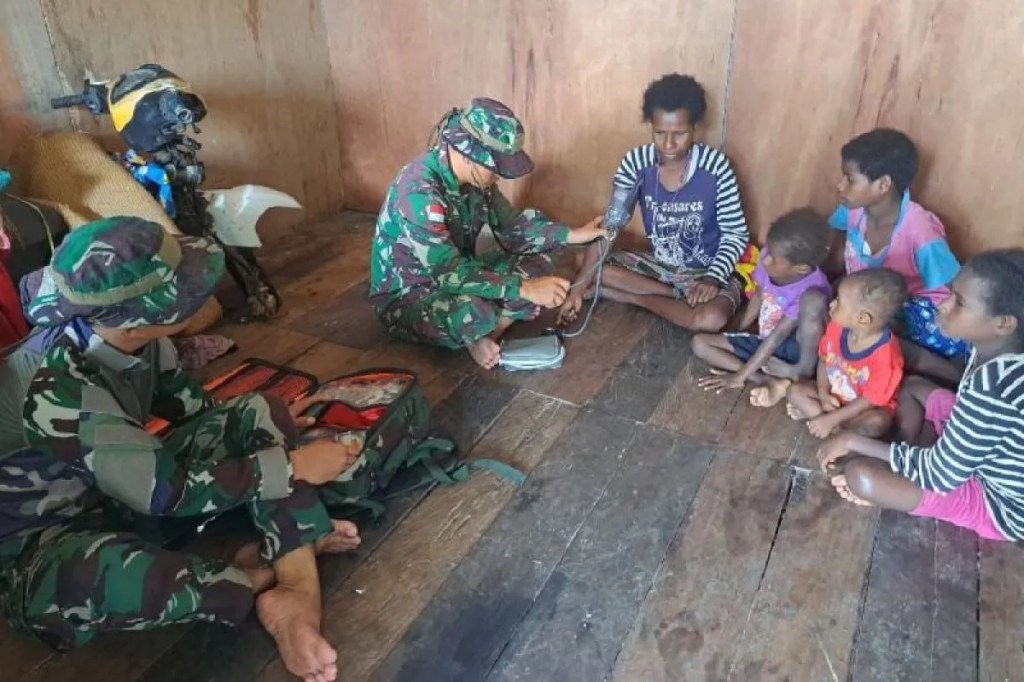
Army providing free healthcare services to native Papuans in Kimaam

Jayapura, Papua (ANTARA) – Indonesian soldiers from the 125/SMB Infantry Battalion Task Force provided free healthcare services to native Papuans in Kiworo Village, Kimaam Sub-district, Merauke District, South Papua Province.

Located on Yos Sudarso Island, some 129 kilometers away from Merauke, Kimaam Sub-district can only be reached by airplane or ship, Kimaam Post Commander Second Lieutenant Raden Andika stated.


During this community service, the army paramedics visited the households in need of healthcare services, he noted in a press statement that ANTARA received in Jayapura City on Wednesday.

Apart from providing healthcare services to the villagers, the army personnel also conducted a knowledge-sharing session on healthy lifestyle and clean environment, Andika remarked.

A Kiworo villager named Margaretha Muyak thanked the army personnel for the community service.


In addition to Kiworo, Kimaam Sub-district has several other villages, including Kimaam, Mambum, Woner, Deka, Komolom, Kumbis, Turiram, Webu, Umanderu, Kalilam, Purawander, Teri, and Sabudom.

ANTARA reported earlier that Indonesian soldiers stationed in Papua have demonstrated exemplary capability in maintaining peace and stability in the region for decades in their endeavors to safeguard the country’s territorial integrity.

The soldiers are chiefly tasked with securing peace and stability in the country’s easternmost region.

However, they are also living and mingling with members of local communities, which has provided them a glimpse of the challenges faced by native Papuans in their day-to-day lives.

TNI raises five battalions for Papua food resilience program 

 October 2, 2024 20:00 GMT+700 Jakarta (ANTARA) – Commander of the Indonesian National Armed Forces (TNI) General Agus Subiyanto on Wednesday inaugurated five infantry battalions (Yonif) to support the government’s food resilience program in Papua region.

The battalions will be dispatched to five regions of Papua to collaborate with the Agriculture Ministry and local residents to cultivate essential crops, including rice, he said.

“These battalions are specialized in different aspects, such as construction and production. We will carry out agricultural programs in Papua with their help,” he told journalists after the inauguration in the National Monument (Monas) area, Central Jakarta.

The battalions include Yonif 801/Ksatria Yuddha Kentswuri, which will be stationed in Keerom, Papua Province; Yonif 802/Wimane Mambe Jaya, which will be posted in Sarmi, Papua; Yonif 803/Nduka Adyatma Yuddha, which will be sent to Boven Digoel, South Papua; and Yonif 804/Dharma Bhakti Asasta Yudha, which will work in Merauke, South Papua.

Meanwhile, Yonif 805/Ksatria Satya Waninggap will be based in Sorong, Southwest Papua.

Based on data obtained by ANTARA, each infantry battalion consists of 691 personnel drawn from different regional military commands (Kodam) across the country.

Kodam I/Bukit Barisan has dispatched 150 soldiers, Kodam II/Sriwijaya 150 soldiers, Kodam III/Siliwangi 450 personnel, Kodam IV/Diponegoro 400 officers, Kodam V/Brawijaya 230 personnel, and Kodam VI/Mulawarman has fielded 25 officers for the battalions.

Furthermore, Kodam IX/Udayana has contributed 306 soldiers, Kodam XII/Tanjungpura 43 officers, Kodam XIII/Merdeka 157 personnel, Kodam XIV/Hasanuddin 225 soldiers, Kodam XVI/Pattimura 294 officers, Kodam XVII/Cenderawasih 100 soldiers, and Kodam XVIII/Kasuari has sent 20 personnel.

Meanwhile, the Jaya Kodam of Jakarta and Iskandar Muda Kodam of Aceh have contributed 350 and 100 soldiers, respectively, to the special battalions. 

The third floor is occupied by security forces, Paniai Regional Hospital services are completely paralyzed

Paramedics are frightened by the presence of security forces at Paniai Regional Hospital. Inpatients were sent home and transferred to other hospitals.

May 26, 2024 in Political, Legal and Security Affairs

  0

Writer: Abeth You – Editor: Aries Munandar

Enarotali, Jubi – All medical services at the Regional General Hospital or Paniai Regional Hospital have been completely paralyzed since Sunday morning (26/5/2024). The paramedics were afraid because joint TNI and Polri troops occupied the third floor of the hospital building.

Paniai Hospital Director Agus said there were no paramedics on duty since the security forces occupied the third floor of the hospital building. Because of this, they entrusted six inpatients to the Deiyai Pratama General Hospital. The rest were transferred to the Enarotali Community Health Center and returned to their homes.

“So, temporarily services [at Paniai Regional Hospital] have been transferred to Enarotali Community Health Center and Deiyai Pratama General Hospital. “[Patients who are sent home] can still consult [with a doctor] by telephone,” said Agus via mobile instant message.

Agus said there were six inpatients transferred to Deiyai Pratama Hospital. They are pediatric patients.

“There is a pediatrician there. “However, we still cover [the need for] medicine, oxygen and consumable medical materials [for these patients],” he said.

Agus admitted that the deployment of security forces was not a policy from the Paniai Regional Hospital management, but rather an instruction from the Ministry of Health. He hopes that all parties can work together well so that services return to normal at Paniai Hospital.

Director of the Deiyai Pratama General Hospital, Selvianus Ukago, said that they were continuing to coordinate with the Paniai Regional Hospital in treating the six entrusted patients. Paniai Regional Hospital has also met all of the patient’s medical needs.

“Pediatricians from both hospitals have coordinated with each other [regarding patient care]. “Paniai Regional Hospital has also met the patient’s medical needs,” said Ukago.

Head of the Enarotali Community Health Center, Rosalina Yogi, said that a number of patients entrusted from Paniai Regional Hospital had also arrived at the community health center. The patients were about to undergo labor.

“Mothers who [wanted to] give birth at the Paniai Regional Hospital have been transferred to the Enarotali Community Health Center. “That’s because we have officers, tools and complete facilities [for delivery services],” said Yogi.

Move location

Acting Regent of Paniai Denci Meri Nawipa said they would immediately move the presence of security officers from Paniai Regional Hospital. The transfer plan will be put together on Monday.

“Tomorrow, the security forces will move them to the regent’s residence, or near the [Enarotali] terminal. “That’s so that services at Paniai Regional Hospital continue to run,” said Nawipa when called by Jubi.

According to him, there are several versions regarding the reasons for placing a number of security officers at the Paniai Regional Hospital. One version states that the placement was triggered by rumors about the Paniai Regional Hospital fire, so health officials wanted security at the Regional Hospital.

“Last night [Saturday], security forces entered [occupying] the Paniai Regional Hospital. That’s because there were medical officers spreading information about the fire at the doctor’s and nurse’s house. “The fire occurred in another resident’s house,” said Nawipa.

Nawipa said he had also reported to Acting Governor Ribka Haluk regarding the deployment of security forces at the Paniai Regional Hospital. To Haluk, Nawipa confirmed that they were solving the problem.

Move location

Acting Regent of Paniai Denci Meri Nawipa said they would immediately move the presence of security officers from Paniai Regional Hospital. The transfer plan will be put together on Monday.

“Tomorrow, the security forces will move them to the regent’s residence, or near the [Enarotali] terminal. “That’s so that services at Paniai Regional Hospital continue to run,” said Nawipa when called by Jubi.

According to him, there are several versions regarding the reasons for placing a number of security officers at the Paniai Regional Hospital. One version states that the placement was triggered by rumors about the Paniai Regional Hospital fire, so health officials wanted security at the Regional Hospital.

“Last night [Saturday], security forces entered [occupying] the Paniai Regional Hospital. That’s because there were medical officers spreading information about the fire at the doctor’s and nurse’s house. “The fire occurred in another resident’s house,” said Nawipa.

Nawipa said he had also reported to Acting Governor Ribka Haluk regarding the deployment of security forces at the Paniai Regional Hospital. To Haluk, Nawipa confirmed that they were solving the problem.

Broken key

Head of the Information Center for the Cenderawasih Regional Military Command, Lieutenant Colonel Candra Kurniawan, said that the deployment of troops to the Paniai Regional Hospital was at the request of local medical officers. They felt their safety was threatened by the actions of the Free Papua Organization (OPM).

“The information circulating on social media regarding the expulsion of patients and the closure of the emergency room at Paniai Regional Hospital is a hoax. “At that time, TNI officers were actually securing the Paniai Regional Hospital because there were complaints from the public that the OPM mob was going to burn down the hospital,” said Candra in a written statement.

A similar denial was conveyed by the Head of Paniai Police, Adjunct Police Commissioner Abdus Syukur Felani. He asked the public not to easily believe information whose source is unclear.

“The closure of the emergency room was an initiative of Paniai Regional Hospital officers because the door lock was broken. “The picket officer had not arrived on Sunday morning so he closed the emergency room door to prevent theft in that room,” said Abdus.

OPM denied rumors about plans to burn Paniai Regional Hospital. They actually accused the TNI and Polri of disrupting community services at the RSUD.

“From the [widely circulated] video, we can see that the TNI/Polri ordered medical officers to close the emergency room door at Paniai Regional Hospital. “So, they have set up a scenario [planning to close the emergency room],” said West Papua Army Commander Damianus Magai Yogi. (*)

Soldiers building comfortable public toilet in Papua’s Naira Village

May 21, 2024 14:20 GMT+700

Jayapura, Papua (ANTARA) – The Jayapura/1701 Military Command (Kodim) is building a comfortable public toilet in Naira Village, located 133 km from Jayapura, Papua Province’s capital, to help locals lead a clean and healthy lifestyle, a military officer stated.

Building the public toilet in Naira Village, which administratively belongs to Airu Sub-district in Jayapura District, is part of the 120th TNI Manunggal Masuk Desa (TMMD) Community Service Program, according to the Indonesian Military (TNI) press statement published here, Monday (May 20).

The TMMD Program is the continuation of ABRI Masuk Desa (AMD), which is TNI’s community service program, introduced and routinely carried out during the leadership era of Indonesia’s second president, Suharto.

The availability of the public toilet would hopefully help villagers improve their quality of life amid a lack of basic sanitation facilities in the village, 120th TMMD Task Force commander, Major Afandi, stated.

Apart from building the comfortable public toilet, the TMMD personnel also launched a public awareness campaign to help the villagers get familiarized with a clean and healthy lifestyle, he remarked.

The public awareness campaign was carried out by collaborating with those from the district’s health office and other government agencies, he added.

As reported earlier, Indonesian soldiers in Papua are required to multitask amid the government’s incessant efforts to bridge the regional development gap between Papua and other provinces.

Soldiers deployed in the Papua region are required to be responsive in seeking solutions to problems and challenges faced by Papuan communities in their daily lives.

They are also expected to play the role of problem solvers for local communities amid their central task to defend the country’s territorial integrity and guard the safety of Indonesians.

The geopolitical and geostrategic position of Papua, which shares land and sea borders with Papua New Guinea, occupies a significance in matters of Indonesia’s sovereignty and territorial integrity.

Over the past few years, soldiers stationed in the region have been facing security threats posed by armed Papuan separatist groups operating in several districts.

Despite the security-related challenges, soldiers have actively engaged in community service activities, highlighting their commitment to supporting local populations.

Several personnel of the Indonesia-PNG Border Security Task Force, for instance, have been assisting locals through community services, such as voluntary teaching, mobile libraries, and street cleanup programs. 

Related news: Papua: Soldiers provide free health services to villagers

Related news: Prioritizing soft approach toward armed Papuan groups: TNI


Translator: Evarukdijati, Rahmad Nasution
Editor: Tia Mutiasari

Amnesty International Report 2023/24

I

INDONESIA

Peaceful demonstrators were arrested and excessive force was used to break up protests. Military operations in Papua resulted in unlawful killings and torture and other ill-treatment. Pro-independence activists were imprisoned. Torture and other ill-treatment by security forces of criminal suspects was commonplace, in some cases resulting in deaths. Non-state armed groups in Papua were also responsible for unlawful killings. The government failed to conduct meaningful consultations with populations affected by controversial development projects. Indonesia remained heavily reliant on coal for energy generation and plans to phase out fossil fuels were inadequate.

Background
Tensions in Papua increased following the taking hostage in February of a pilot, a New Zealand national, by members of the National Liberation Army of Free Papua Organization (TPNPB-OPM) at Paro Airport in the remote highlands of Nduga regency, Papua Pegunungan province. In response the Indonesian military raised the operational status in Nduga to “combat alert” and deployed additional troops to the area, raising fears for the safety of civilians there and in surrounding areas.

Freedom of assembly
Security forces arrested peaceful demonstrators and used excessive force to disperse protests, often resulting in injuries.

On 5 August, police arrested 18 people who were resting in West Sumatra Grand Mosque in the provincial capital Padang during protests against plans for an oil and petrochemical refinery in Nagari Air Bangis village in Barat regency. Police removed other protesters from the building, some of whom were praying at the time, including women who were dragged from the mosque. At least five journalists who were live-streaming or reporting on the event were physically assaulted and threatened by police officers. All of those arrested, including community leaders and activists, students and lawyers, were subsequently released without charge. These events followed a six-day protest in Nagari Air Bangis by residents concerned about the risk posed by the construction of the refinery to their livelihoods and the local environment.

On 14 August, security forces arrested seven people and used tear gas to disperse protesters who were blocking a road in the city of Bandung, West Java, to protest against the planned eviction of around 300 residents of Dago Elos, a suburb of the city. Those arrested included Dago Elos residents and a lawyer who was supporting them in the land dispute. All were released on 16 August but three were charged with committing violent acts. Several people were reportedly injured as a result of excessive use of force by the police.1

Freedom of expression
Authorities continued to prosecute people for crimes against the security of the state for exercising their right to freedom of expression, including those calling for independence of Papua. At least three Papuan activists were imprisoned during the year for expressing their opinions.

On 8 August, Jayapura District Court found Yoseph Ernesto Matuan, Devio Tekege and Ambrosius Fransiskus Elopere guilty of treason under Articles 55 and 106 of the Criminal Code and sentenced them to 10 months’ imprisonment each. The three students were arrested in November 2022 while participating in a vigil at Jayapura University of Technology and Science to commemorate the 21st anniversary of the abduction and killing of pro-independence leader Theys Eluay, at which the Morning Star flag, a symbol of Papuan independence, was raised. All three were released in September having served their sentences.2

Unlawful killings
At least 26 incidents resulting in unlawful killings by security forces were reported in Papua, involving a total of 58 victims.

In September, security forces shot and killed five Indigenous Papuans in Dekai, the capital of Yahukimo regency, Papua Pegunungan province. The security forces claimed that the five, who were aged between 15 and 18, were killed in a firefight with the TPNPB-OPM. Other sources denied that the youths were members of the armed group but rather were returning to their village having bought food in Dekai. Anyone leaving Dekai was required to report to a security post on the outskirts of the city and if they failed to do so they were automatically considered to be members of the TPNPB-OPM. The authorities had not initiated investigations into the alleged killings by the end of the year.

Torture and other ill-treatment
Security forces subjected detainees to torture and other ill-treatment to extract information or confessions.

Torture and other ill-treatment remained commonplace in Papua, where incidents of arbitrary detention and torture also occurred in the context of military operations in and around Nduga regency. On 6 April, the military detained and tortured six Indigenous Papuans from Kwiyawagi village in Lanny Jaya regency, Papua Pegunungan province. The six, who included four boys, were transported by helicopter to the military headquarters in Timika, where 17-year-old Wity Unue died, reportedly as a result of injuries sustained from torture. The five others were released without charge on 20 April, but were reported to be in poor health. No one had been brought to justice by the end of the year.

In September, eight members of the narcotics division of Jakarta Metropolitan Police were named as suspects in the beating to death of a suspected drug dealer during interrogation in July. None of the eight had been charged by the end of the year.

In August, the body of Imam Masykur was found more than three weeks after he was abducted and tortured by three soldiers from the Presidential Security Force and the Indonesian military. According to the Asian Human Rights Commission, the three detained the 25-year-old in the capital, Jakarta, after accusing him of selling illegal drugs and demanded a ransom for his release. Imam Masykur’s body was found in a reservoir in West Java. In December, the three perpetrators were sentenced to life imprisonment and dismissed from the military.

Abuses by armed groups
Eleven incidents resulting in the unlawful killings of 24 victims by the TPNPB-OPM in Papua were documented during the year.

On 28 August, a spokesperson for the armed group claimed that it had killed Michelle Kurisi Doga in Kolawa, Lanny Jaya regency, Papua Pegunungan province. At the time of her death, Michelle Kurisi Doga was travelling to gather data on displacement resulting from military operations in Nduga, but according to the spokesman they suspected her of being a member of military intelligence.3

The New Zealand national taken hostage by the TPNPB-OPM in February had not been released by the end of the year.

Economic, social and cultural rights
The government failed to carry out meaningful consultations and effective human rights due diligence processes before allowing work to start on the Rempang Eco-City project, a multibillion-dollar industrial and tourism development project on Rempang Island. The project involves the relocation of around 7,500 residents from 16 villages primarily inhabited by the Tempatan Indigenous Peoples that would result in loss of access to their ancestral lands. The national development project met with strong opposition from Tempatan Peoples and other local communities. Consultations on the project were held with affected communities in August, but security at some of the meetings was reportedly heavy and observers described the meetings as a one-way dissemination of information from the government and the company to residents.

A series of protests against the acquisition of land for the Rempang Eco-City project were held in August and September, culminating in clashes with security forces on 7 September during which some protesters threw stones and water bottles and security forces responded with water cannon, tear gas and rubber bullets. At least 20 protesters were injured and approximately 25 pupils from two schools located near the site of the protests required hospital treatment from the effects of tear gas. Following the events of 7 September, new joint police/military security posts were established on the island. According to the local branch of the NGO Legal Aid Institute, at least 35 people were charged with using or threatening to use violence against officials carrying out their duties, which carries a maximum prison sentence of one year and four months.4

Right to a healthy environment
Although Indonesia generated an increasing amount of its electricity from renewables, it remained heavily reliant on coal for electricity generation. Coal was also Indonesia’s biggest export product. Plans to phase out the use of fossil fuels in energy production, set out in Presidential Regulation No. 112 of 2022 on the Acceleration of Renewable Energy Development for Power Supply, were inadequate because, among other factors, although the regulation banned new coal-fired energy plants, it permits the development of those already planned. As such, the government proceeded with a planned 35 thousand-megawatt power generation project, agreed in 2015, involving the construction of 109 mainly coal-fired power plants across the country

NDONESIA 2023

The Australia West Papua Association condemns the brutal torture of a West Papuan man by Indonesian troops in Yahukimo.

A video of the  torture is circulating on social media. The video shows soldiers brutally beating a man as he stands in a barrel of water and slashing him with a knife.

Joe Collins of AWPA said , “one can only imagine the fear and terror the Papuan man must feel at this brutal torture being inflicted on him”.

Gustaf R. Kawer, chair of PAHAM Papua, (The Human Rights Lawyers Association)  said they have  tried to carry out a brief investigation and suspect that this torture incident was carried out by Non-Organic Troops from Kodam III/Siliwangi, Yonif Raider Unit 300/Brajawijaya, against civilians around Puncak or Puncak Jaya Regency (Mulia, Ilaga, Sinak, etc.).

PAHAM Papua is calling on Indonesia’s National Human Rights Commission (and the TNI Commander) to immediately carry out a thorough investigation and take the perpetrators to court.

Benny Wenda has also condemned the torture stating 

“I am truly horrified by the video that has emerged from Yahukimo of Indonesian soldiers torturing a West Papuan man. More than anything, the sadistic brutality on display shows how urgently West Papua needs a UN Human Rights visit”. 

The video (with the warning : graphic, violent content ) is on the ULMWP webpage at 

https://www.ulmwp.org/president-wenda-a-crime-against-humanity-has-been-committed-in-yahukimo


Joe Collins said, “as more information comes to light about the incident , AWPA  will be writing to the Australian Foreign Minister  Penny Wong  not only about this incident but about the deteriorating human rights situation in the territory”. 

Ends.
——————————

Image from FB

————————-
PAHAM Papua media release (Translated) (posted on AWPA FB page)

Commanders and perpetrators of torture against civilians MUST be prosecuted and dismissed from the unit.

Good morning fellow Papuan media and activists, observing the video of very sadistic torture carried out by TNI officers in Papua which is circulating quite widely on online media, it is very important for us to work together to urge the perpetrators to be prosecuted, including the commander of this unit.

We have tried to carry out a brief investigation, while it is suspected that this torture incident was carried out by Non-Organic Troops from Kodam III/Siliwangi, Yonif Raider Unit 300/Brajawijaya, against civilians around Puncak or Puncak Jaya Regency (Mulia, Ilaga, Sinak, etc.).

This act of torture against one of the civilians was very sadistic, carried out by TNI officers without prioritizing the principle of presumption of innocence. If the person concerned was suspected of committing a criminal act/was involved in the TPN PB organization, TNI in sufficient numbers was accompanied by complete military equipment and faced with A mere civilian, helpless, does not deserve to be subjected to cruel acts of sadistic torture as circulated in the video. According to regulations, the TNI handed over suspected criminals to the police for legal proceedings before the court and the court determined the person guilty based on the facts of the trial.

The actions of the TNI officers constitute an act of extrajudicial torture, a thorough investigation needs to be carried out and if it is discovered that the victim has died, then the actions of the officers can be categorized as extrajudicial killing.

We from PAHAM Papua urge the Republic of Indonesia’s National Human Rights Commission and the TNI Commander to immediately carry out a thorough investigation and take the perpetrators to court until they receive the maximum verdict, including being fired from the unit.

That’s our press release.

Best regards,

Gustaf R. Pawer

Chairman

 ——————-

Indonesian military probes viral video allegedly showing Papuan’s brutal torture by soldiers

Victor Mambor and Dandy Koswaraputra

Indonesian military probes viral video allegedly showing Papuan’s brutal torture by soldiers

Victor Mambor and Dandy Koswaraputra
2024.03.22
Jayapura, Indonesia, and Jakarta

Share on Facebook

Share

A

 2024.03.22 Jayapura, Indonesia, and Jakarta

Military officials in Indonesia’s restive Papua region said Friday they were verifying the authenticity of a video that has gone viral and appears to show Indonesian servicemen beating and cutting with a bayonet a man believed to be an indigenous Papuan. 

Human rights activists demanded a swift inquiry to determine if soldiers were involved in what would be yet another case of torture and abuse, which is a longstanding accusation against Indonesian military and security forces in Papua.

The location and time of the alleged incident are unclear.

“We are verifying its authenticity,” Col. Gusti Nyoman Suriastawa, a military spokesman in Papua, told BenarNews. “If it is genuine, we need to determine where and when it occurred.”

The graphic video footage, viewed by BenarNews, shows men in trousers that resemble Indonesian military uniform fatigues, taunting the victim who is seen inside a water-filled drum.

“How does that feel? Head up! Head up,” the men say as they hit him and make incisions on his back with a bayonet.

As the men continue to inflict the wounds, the water in the drum can be seen turning red.

In a statement issued after the video was widely circulated, PAHAM Papua, a local human rights organization, issued a statement that makes the assumption that the abusers in the footage are members of the Indonesian Armed Forces [TNI].

“If the individual was suspected of criminal activity, the TNI should not have resorted to such brutal and sadistic torture as shown in the video,” PAHAM chairman Gustaf Kawer said.

“The act of torture inflicted on [the] civilian was extremely cruel, carried out by TNI [personnel without adhering to the principle of presumption of innocence.”

PAHAM urged the National Commission on Human Rights (Komnas HAM) and the Indonesian military to conduct a “comprehensive investigation.”

Theo Hesegem, executive director of the Papua Human Justice and Integrity Foundation, urged authorities “to ensure that the perpetrators of the torture are processed swiftly.”

“It is clear that the individual subjected to torture is a native Papuan,” he said in a statement.

Komnas HAM, meanwhile, indicated that initial findings point to the incident taking place in the Puncak regency of Central Papua province. 

“This compounds the toll of violence from the ongoing conflict in Papua, with suspicions pointing to torture by authorities,” Komnas HAM chairwoman Atnike Nova Sigiro Atnika said in a statement. 

Rights groups have long accused Indonesian security forces of abuses in Papua, including arbitrary arrests, torture, and extrajudicial killings. 

Papua, at the far-eastern end of the Indonesian archipelago, has seen an escalation in violence following an insurgent attack that resulted in the deaths of 19 road construction workers and a soldier in 2018.

The heavy military presence and ongoing violence have stifled development in the region.

On Friday, Rumadi Ahmad, a deputy chief of the Indonesian presidential staff, said that President Joko “Jokowi” Widodo had committed to accelerating development in Papua, but these efforts would be hampered if the military was responsible for the violence in the video.

“While we hold a strong hope that our soldiers are not involved in such reprehensible acts, if proven true, the individuals responsible must be held accountable in accordance with the applicable rules and regulations,” Rumadi said in a statement.

He said the military played a strategic role “in bringing about a sense of security” in Papua.

“If the video is proven to be true, the actions by a few irresponsible individuals could be very disruptive to the development that has been planned and implemented so well,” Rumadi said.

Insurgents have also been responsible for civilian fatalities, targeting those they suspect of espionage for the authorities. In 2022, rebels killed eight employees of Telkomsel, the nation’s leading telecommunications provider, who were constructing cellular towers in the Puncak regency.

However, one armed separatist group, the West Papua National Liberation Army, quickly distanced itself from the incident in the video and condemned the acts therein, which spokesman Sebby Sambom attributed to the TNI.

“The actions of the Indonesian military and police are akin to [those of] ISIS terrorists,” Sambom said, referring to the Islamic State militant group.

Papua, a mineral-rich and underdeveloped region, has been grappling with a separatist insurgency for decades. The mineral extraction and alleged discrimination against indigenous Papuans by the Indonesian government have fueled the conflict. 

Papuans have long felt marginalized economically and politically, despite the immense wealth their land generates.

The territory was incorporated into Indonesia in the 1960s after a controversial United Nations-backed plebiscite. 

Many Papuans allege the vote was rigged and have since fought for independence.

Adding TNI commands waste of budget, won’t bolster national defense says Coalition

CNN Indonesia – March 2, 2024

Jakarta — The Civil Society Coalition for Security Sector Reform is asking the Indonesian military Headquarters (Mabes TNI) to cancel a plan to add Regional Military Commands (Kodam) in all Indonesian provinces.

The Coalition believes that this will not contribute to strengthening national defense and will only cause disputes in the management of domestic security and have a negative impact on democracy.

“The Mabes TNI must stop the plan to add Kodams to all Indonesian provinces … The additional Kodams are also a form of wasting the national defense budget amid a limited budget for the fulfillment of and modernisation of our current Alutsista (primary defense equipment(“, said the group in a written statement on Friday March 1.

The Coalition believes that the addition of Kodams also shows a strong orientation to a development posture, as well as the degree to which the TNI’s forces are more aimed at and oriented towards being inward looking, not outward looking.

According to the coalition, this has implications for the tendency for the military to become involved in political life. As a consequence, it is difficult to create a TNI that is a strong, professional and modern national defense tool.

The coalition also said that the 1998 TNI reform agenda mandates the political authorities, namely the government and the House of Representatives (DPR), to restructure the TNI’s territorial command structure, namely the existence of Kodam down to Koramil (sub-district military commands) at the lowest level.

“The government and DPR should immediately restructure the territorial commands (Kodam to Koramil) and replace them with a military force posture model and title that is more contextual to the dynamics of threats and the geographical conditions of Indonesia as an archipelagic country”, said the Coalition.

The plan to add additional Kodams was raised again by TNI commander General Agus Subiyanto at a TNI-Indonesian police leadership meeting on Wednesday February 28. Currently, there are a total of 15 Kodams throughout Indonesia and the plan is to add 22 more.

“The TNI AD (Army) plans to build and deploy 37 Kodams where there will be 37 Kodams rolled out, 15 Kodams will be strengthened with Korems [sub-regional military commands], while 22 Kodams will be without Korems under them, this includes the construction of the IKN [new capital city Nusantara in East Kalimantan] Kodam and two new battalions”, said Subiyanto on Wednesday February 28.

Meanwhile, Army Chief of Staff (KSAD) General Maruli Simanjuntak has said that they will accommodate criticism regarding the plan to add more Kodams. However Simanjuntak said that the additional Kodams are also in response to requests from the public.

“If I visit a region, they ask for this. Yeah, there are many places, where they even say, ‘Pak [Sir], we’ll prepare the land. Pak, please make a Kodam here, a battalion, a Koramil [sub-district military command] and so on’. Because indeed our presence is needed by them”, Simanjuntak said following an Army (TNI AD) leadership meeting on Thursday February 29.

Simanjuntak explained that the formation of military commands at the smallest level has consequences for organisational management at higher levels.

“We have been asked for Ramil [Koramil] posts, which means there must be a coordinator after several dozen, a Kodim. After there are several Kodim [district military commands] we must have a Korem, after there are several Korems, most of them must have a Pangdam [regional military commander]” said Simanjuntak.

“Because maybe people don’t realise what it’s like to be a military commander covering three provinces in Kalimantan. Just moving from province to province, you have to go through Jakarta, that’s basically the problem”, he added. (yoa/chri)

Notes

The TNI’s territorial command structure mandates the deployment of military command posts and detachments at all levels of the civil

administration: provincial, district, sub-district and village. This structure provides the organisational framework for the TNI to act as a political security force at all levels of society. The five respective commands are: Kodam — Komando Daerah Militer, Regional Military Command; Korem — Komando Resort Militer, Military Command at a level below the residency; Kodim — Komando Distrik Militer, District Military Command; Koramil — Komando Rayon Militer, Sub-District Military Command

(Kecamatan) level and; Babinsa — Bintara Pembina Desa, Non-commissioned military officer posted in villages and wards and affiliated with the civilian administration. Since becoming Defense Minister in 2019, Prabowo Subianto, who is set to become Indonesia’s next president in October, has on several occasions pushed the idea of establishing Kodam in every province.

[Translated by James Balowski. The original title of the article was “Koalisi Sipil Minta TNI Hentikan Rencana Tambah Kodam di Tiap Provinsi”.]

Source:

https://www.cnnindonesia.com/nasional/20240302000428-20-1069493/koalisi-sipil-minta-tni-hentikan-rencana-tambah-kodam-di-tiap-provinsi

—————————————————————