
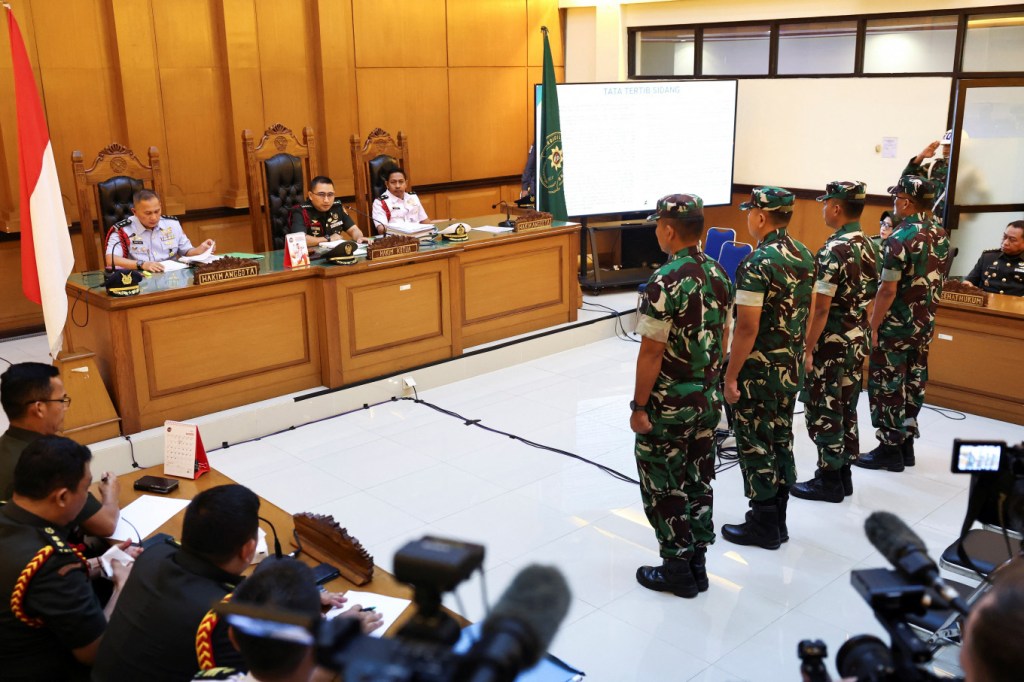
Rights groups and petitioners have hailed a Constitutional Court ruling requiring Indonesian Military (TNI) personnel accused of general crimes to stand trial in civilian courts, urging the revision to the 1997 Military Tribunal Law without delay.
In a unanimous decision on Thursday, the court ruled that the three-decade-old law failed to clearly distinguish military offenses from general crimes, allowing soldiers accused of ordinary criminal acts to be tried in military courts.
The nine justices said the jurisdictions of military and civilian courts needed to be clearly defined, noting that military courts operated under a distinct system shaped by the military chain of command, subordinate responsibility and prioritization of military interests.
“When an offense does not have military characteristics but accountability for it remains within a system built on military principles […], there is a structural risk that military interest may conflict with the need for independent and impartial legal process,” Justice Enny Nurbaningsih said while reading out the ruling.
When an offense lacked military characteristics, she added, “the justification for maintaining military court jurisdiction loses its basis.
” Read also: Military court slammed for reducing penalties in activist acid attack case Morning Brief Every Monday, Wednesday and Friday morning. Delivered straight to your inbox three times weekly, this curated briefing provides a concise overview of the day’s most important issues, covering a wide range of topics from politics to culture and society.
The court ordered the House of Representatives and the government to amend the law within two years, warning it would otherwise become unconstitutional.
The ruling favored petitioners Lenny Damanik, whose 15-year-old son died after being assaulted by a soldier in 2024, and Eva Meliani Pasaribu, the daughter of a journalist who died alongside his wife, child and grandchild in a fire linked to his reporting on a gambling operation allegedly backed by military personnel.
A military court sentenced the soldier who assaulted Lenny’s son to just 10 months in prison without dismissing him from service. In Eva’s father’s case, a district court sentenced three civilians to life and 20 years in prison, but a TNI soldier suspected of masterminding the attack remains unpunished.
Both petitioners welcomed the ruling, expressing hope that it would help them pursue justice in their respective cases. Their lawyer, Irvan Syahputra, described the decision as “progressive” and “a people’s victory.”
“This ruling accommodates not only Lenny and Eva, but also the struggle of all victims who have been denied justice in military courts,” he said on Friday. An activist lights up a candle during a prayer gathering on March 17 for Andrie Yunus, a Commission for Missing Persons and Victims of Violence (Kontras) activist targeted in an acid attack, in front of the National Commission on Human Rights (Komnas HAM) in Jakarta.
(
The petition, filed last December, gained wider public attention following the March acid attack on Andrie Yunus, an activist with the Commission for Missing Persons and Victims of Violence (Kontras).
The soldiers accused of attacking him were tried in a military court despite his objections. Four soldiers were found guilty, but an appeal court reduced the prison terms of two defendants and annulled their dismissals from military service, prompting activists to warn that the decision reinforced impunity.
Jane Rosalina of Kontras said Thursday’s ruling had broken through the wall of military impunity and offered an opportunity for the government, lawmakers and the Supreme Court to accelerate military justice reform.
According to Kontras, prison sentences for soldiers implicated in criminal cases tended to be lenient, ranging from 10 months to three years.
The organization also recorded at least 130 cases involving civilian victims over the past year.
“This is an urgent task for us to make the TNI more professional and accountable for general crimes committed by its personnel,” she said. Read also: Light sentences still mar military justice system:
Kontras The petitioners, Kontras and other groups under the Advocacy for Democracy Team (TAUD) urged the House to revise the law immediately rather than wait for the two-year deadline.
House Commission I deputy chair Dave Laksono of the Golkar Party, who oversees defense affairs, said revising the law was important to provide legal certainty and clarify the position of military courts within the judicial system under the Supreme Court.
“Clear regulation is needed to ensure every case is handled in appropriate judicial mechanism, while upholding the principle of equality before the law,” he said Friday, adding that lawmakers and the government should use the ruling as a guide in deliberations.
TNI spokesperson Brig. Gen Muhammad Nas said on Friday that the military would abide by the ruling and uphold the rule of law. Gen. Maruli Simanjuntak, who was appointed deputy TNI chief on Thursday, said he would study the ruling but rejected allegations that military courts fostered impunity.
He argued that military courts sometimes imposed harsher sentences than civilian courts, including life imprisonment.
“I think military regulations are stricter. In some cases, if we examine the proceedings, we could understand why a case ends in what seems to be a lighter sentence,” he told a press briefing.
reprinted courtesy Jakarta post

