
Unknown's avatar

About AWPA Adelaide administrator

AWPA Adelaide site manager

TPNPB Kodap XXXV Bintang Timur Claims to Burn School Buildings and Teachers’ Housing in Okbab Pegunungan Bintang

July 16, 2024 in Politics, Law and Security

0

Author: Admin Jubi – Editor: Edho Sinaga

One of the school rooms that was burned in Okbab – Jubi/Dok Warga

Jayapura, Jubi – The West Papua National Liberation Army (TPNPB) from the XXXV Bintang Timur Regional Defense Command (Kodap), Pegunungan Bintang, has reportedly burned down the Okbab Junior High School and Senior High School buildings as well as teachers’ housing in Okbab District, Pegunungan Bintang Regency, Papua Pegunungan Province, on Saturday (13/7/2024).

TPNPB spokesperson, Sebby Sambom, confirmed that the KOMNAS TPNPB headquarters had received an official report from the TPNPB Commander of Kodap XXXV Bintang Timur, Brigadier General Ananias Ati Mimin, and his troops. They conveyed this information on Sunday (14/7/2024) that all junior high school, senior high school buildings, and teachers’ housing in Borban Village, Okbab District, Pegunungan Bintang Regency, had been burned down on Saturday, July 13, 2024.

“TPNPB Kodap XXXV Bintang Timur has announced to the President of Indonesia since December 5, 2021 that they will burn down all school buildings in our operational area,” said Sambom.

Sebby Sambom stated that the Indonesian version of education in Papua is destroying the cultural, historical, and ideological values ​​of the Papuan people who fought for independence from Indonesia. According to him, students are forced to memorize the Constitution of the Republic of Indonesia and Indonesian heroes, which he considers an attempt to make the young generation of Papua stupid.

“It’s time for schools to be burned, government buildings to be burned. It’s time for Papuans to think about fighting for Papuan independence. Later, after independence, we will build better schools, hospitals, and government buildings in West Papua,” he said

Smoke was seen rising from the junior high and high school buildings and teachers’ housing in Borban village, Okbab district, Pegunungan Bintang regency, Papua Pegunungan province on Saturday (13/7/2024). Jubi/Doc Warga. 

Sambom also appealed to all students and college students throughout Indonesia to return to Papua and fight for Papuan independence. He added that after independence, all students and college students will be sent abroad to pursue better education using Papua’s own state funds.

Meanwhile, the Head of the Cartenz 2024 Peace Operation, Brigadier General Faizal Ramadhani, confirmed that the Armed Group had acted up again by burning down a school building and an elementary school office in Borban Village, Okbab District, Pegunungan Bintang Regency, on Friday (12/7/2024).

“We deeply regret this incident. This action not only harms children and teachers, but also damages the future of our young generation,” he said.

Brigadier General Faizal emphasized that the burning of this school was an extraordinary crime that must be dealt with firmly. Security forces will continue to make maximum efforts to arrest and punish the perpetrators of this crime.

In line with this statement, the Head of the Public Relations Task Force for the Cartenz-2024 Peace Operation, Senior Commissioner Bayu Suseno also strongly condemned the actions of the Armed Group. He stated that the burning of schools by the KKB was very inhumane and could not be tolerated.

“We will tighten security in conflict-prone areas and try to provide a sense of security to the community. We will not allow such heinous acts to destroy the enthusiasm of Papuan children to learn,” he said.

The burning of schools by the TPNPB adds to the long list of violence carried out by the group, which continues to disturb the community and disrupt security stability in Papua. The government and security forces continue to strive to overcome this security disturbance and restore conditions in the affected areas so that the community can return to their activities in peace.

“The community is expected to remain vigilant and report any suspicious activity to the authorities,” said Senior Commissioner Bayu Suseno.

One of the residents of Okbab District who witnessed the incident in Borban Village reported that the fire at the Okbab Junior High School and Senior High School buildings and the teachers’ housing was allegedly carried out by the TPNPB Kodap XXXV Bintang Timur group at 10:15 a.m. Papua time. This incident resulted in seven junior high school classes, six teachers’ houses, and three rooms at the Okbab Senior High School burning down.

“It is true that the junior high school, senior high school, and teachers’ housing burned down. “In SMA Negeri 1 Okbab there were 3 classrooms, the SMA Negeri Okbab office, 4 buildings burned down, textbooks burned down, and various other important documents,” said the resident when confirmed by Jubi. (*)
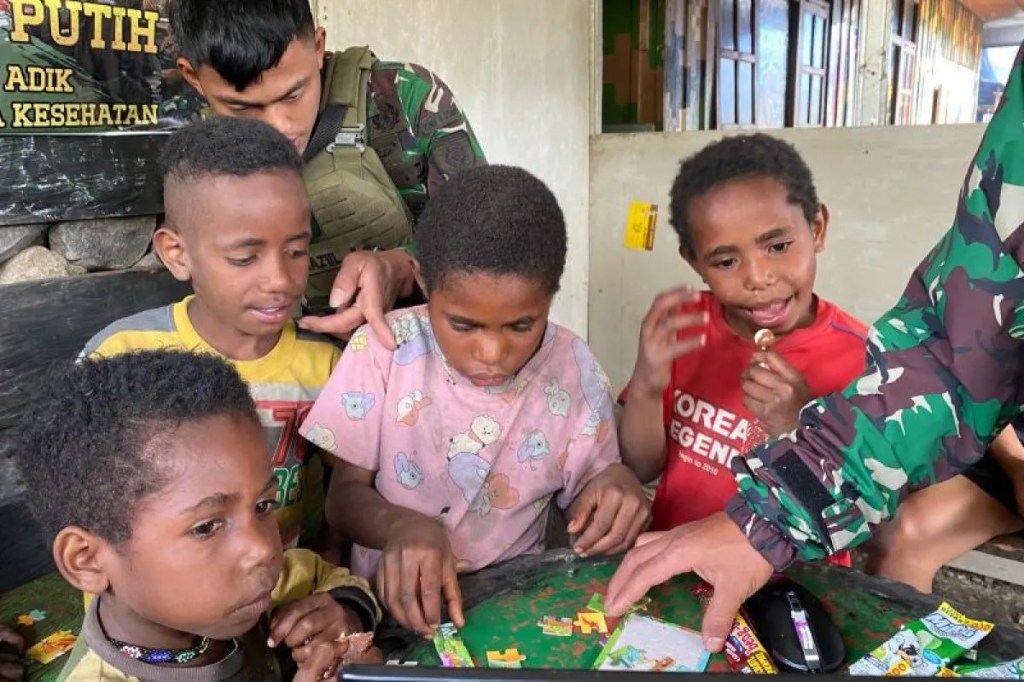
TNI officers hosts study activity for Central Papua children  

Children of Kago village participating in the “Smart Papua” study activity organized by officers of the Indonesian Armed Forces (TNI’s) Raider Infantry Battalion 323/Buaya Putih Kostrad task force stationed at the Koper Post in Puncak District, Central Papua, Saturday (July 13, 2024). ANTARA/HO-Koops Habema/nbl.

July 14, 2024 18:40 GMT+700 Bandung, West Java (ANTARA) – The Indonesian Armed Forces (TNI) has organized a “Smart Papua” study activity for primary school children of Kago village, in Puncak District, Central Papua while maintaining security in the region.

The community service was organized by officers of the TNI’s Raider Infantry Battalion 323/Buaya Putih Kostrad task force, operating under the command of the Habema Operational Command, stationed at the Koper Post in the village.

“The initiative of the 323 Task Force to organize the Smart Papua program at Koper Post reflects TNI’s commitment to providing basic needs, primarily education service for school-age children, to accelerate the development in Papua,” TNI’s Habema operational commander, Brigadier General Lucky Avianto, said in a press statement issued on Sunday.

Koper Post commander, First Lieutenant Anggun, personally invited primary school children in Kago village to take part in the activity organized by his unit on Saturday (July 13).

He noted the local children’s enthusiasm to flock to the activity, which he felt thankful for.

Apart from teaching school lessons, the TNI officers also taught children about respecting parents and their peers, as well as reminding them about the importance of ethics in a community.

Meanwhile, a local student, Lukas Tinal said he is happy to attend the learning activity by the TNI. “Thank you, ‘Uncle Soldier’. We enjoyed studying at the Kostrad 323 post. God bless you,” he remarked.

TNI’s humane approach in Papua is consistent with Presidential Instruction No. 9 of 2020 on the Acceleration of Welfare Development in Papua, which mandates the military to engage with local figures and strategic groups to promote regional development.

It also aligns with the soft power strategy devised by TNI commander General Agus Subiyanto to address Papua issues.

Habema Operational Command, a joint military-police task force, was set up earlier this year to optimize joint security operations in Papua to prevent local conflicts and neutralize the threat posed by armed Papuan groups, especially the Free Papua Movement (OPM).

INDONESIA: Torture is still big homework for Indonesia

The Asian Human Rights Commission (AHRC) supports Indonesian civil society organisations to promote the eradication of torture. The organisations consist of the Sekretariat RFP (Aliansi Masyarakat Sipil untuk Reformasi Kepolisian), the LBH Masyarakat (LBHM), the Yayasan Lembaga Bantuan Hukum Indonesia (YLBHI) and the Komisi untuk Orang Hilang dan Korban Tindak Kekerasan (KontraS).

June 26 is an important moment for the international community to commemorate the United Nations International Day in Support of Victims of Torture. This warning began with the formation of the Convention against Torture and Other Cruel, Inhuman or Degrading Treatment or Punishment (Convention against Torture [CAT]) which came into force on 26 June 1987 for all Member Countries. The enactment of the CAT is the main instrument in the struggle to prevent the practice of torture and to respect human dignity.

Indonesia is one of the Member States that has ratified the CAT through Law Number 5 of 1998, exactly 25 years ago on 28 September 1998. However, the practice of torture and cruel punishments still occurs in the law enforcement cycle in Indonesia. Based on the findings of the YLBHI and LBH Jakarta, from 2013-2022, there were at least 58 victims of torture by members of the Police, 25 of whom were victims of wrongful arrest or wrongful conviction and six who were children. From these findings, all the actors or perpetrators were members of the Police. In 2022-2023, the YLBHI and LBH recorded 46 cases of torture with a total of 294 victims. Meanwhile, during 2020-2023, there were 24 victims of extrajudicial killings in detention handled by the legal aid offices. These extrajudicial killings all occurred by means of torture, most of which were carried out by members of the Police. 

Apart from that, from the documentation carried out by the LBHM in three Detention Centres (Rutan) in the DKI Jakarta area in the January-May 2024 period, there were 35 (three women and 32 men) out of a total of 204 detainees who admitted to being tortured. As many as 15 of the 35 detainees who admitted to having experienced torture were suspected of being involved in narcotics cases, and the remaining 20 were suspected of committing general crimes (as regulated in the Criminal Code). The torture cases occurred during the Police investigation stage. This data is a small part of the darkness of the criminal justice system, especially at the Police level, which has minimal supervision and intervention from the civil society.

Meanwhile, the Commission for the Disappeared and Victims of Violence (KontraS) throughout the June 2023 – May 2024 period also documented 60 cases of torture and cruel punishment related practices spread across Indonesia. During this period, KontraS again noted that the Police was an institution that was consistently the dominant actor in various cases of torture which occurred with 40 cases, followed by the Indonesian National Army (Army, Navy and Air Force) with 14 events; and the Warden or Correctional Institution Officer with six cases. The increasing number of torture cases based on KontraS monitoring data from the previous year (2023) shows that the culture of violence in various State institutions is still a problem that must be resolved thoroughly. This ongoing practice is caused by the absence of an adequate legal system and legal culture to prevent and eliminate all forms of torture related practices.

The Government’s steps in ratifying the CAT were not accompanied by the establishment of more rigid regulations at the national level. In fact, to date, Indonesia has not yet ratified the Optional Protocol to the CAT which actually shows the Government’s compromised attitude and disregard for the act of torture itself. 

On the other hand, it took more than 20 years to accommodate acts of torture as a criminal offense in Law Number 1 of 2023 concerning the Criminal Code (New Criminal Code). 

Articles 529 and 530 actually contain elements of acts of torture that are almost similar to the CAT. However, the threat of punishment given to officials who commit acts of torture is not rational enough. Article 529 carries a maximum prison sentence of four years, while Article 530 is a maximum of seven years. This is very different when compared to criminal acts of abuse – where acts are carried out by ordinary civilians – with variations in prison sentences from six months to 15 years, and can even be made worse by qualifying certain actions (Articles 466 to 471 of the New Criminal Code). 

Apart from that, there are also many other power related practices that are equivalent to torture but may be excluded from these torture related Articles. One example is the death penalty which is part of a type of punishment that degrades human dignity. Based on data from the Institute for Criminal Justice Reform (ICJR), as of 19 October 2023, there were at least 509 people on death row in Indonesia. The majority of the cases on death row were for narcotics, namely 351 people (69%). Apart from being a type of punishment that demeans human dignity, the waiting line phenomenon is also a form of torture that causes great psychological suffering because they continue to live in endless terror over the threat of death which could occur at any time.

Regulations in Indonesia still have a number of problems in the formal or procedural legal aspects of the criminal justice system, especially at the Police level. The freedom to carry out detention for 60 days opens up room for torture. A new torture test mechanism can be proposed after coercive measures are taken when someone has the status of a suspect or defendant. As the starting point for the operation of the criminal justice system, the Police actually has enormous authority without optimal supervision. Internal and external monitoring institutions (Propam and the National Police Commission [Kompolnas]) often become tools of impunity for perpetrators of precision related jargon. 

This condition is exacerbated by the discourse to revise Law Number 2 of 2002 concerning the Police of the Republic of Indonesia (RUU Polri), the substance of which actually expands the authority of the Police in invading human rights without clear control and supervision. Torture and cruel punishment should not be underestimated. The Government needs to take serious steps to prevent repeated acts of torture and create a law enforcement climate that relies on human rights based principles.

Based on the above, we encourage the Government and the law enforcement officials to:

  1. The Government and the House of Representative (DPR RI) must immediately ratify the Optional Protocol to the CAT;
  2. The Government and the DPR RI must immediately revise or amend the Criminal Procedure Code, specifically regarding control and testing mechanisms for the authority of law enforcement officials, as well as for the reparation for victims of acts of torture;
  3. The Government and the DPR RI must immediately stop discussing the National Police Bill which threatens democracy and human rights. The revision of the Police Law of the Republic of Indonesia should be carried out comprehensively, not carried out behind closed doors and ignoring the meaningful participation of citizens. The Bill needs to be directed at institutional and system reform that ensures that the National Police becomes a professional, transparent and accountable institution through a humanist approach, rather than strengthening the character of militarism with large powers of repression but without supervision;
  4. In order to effectively prevent the practice of torture, institutions that are the dominant perpetrators, such as the National Police, the National Military (TNI), correctional institutions and prison guards, must improve and develop preventive and anticipatory steps in order to reduce the number of torture cases in their respective institutions. These various institutions can build intensive collaboration with various external supervisory institutions to encourage public accountability;
  5. There must be an improvement in the supervision and law enforcement system that is impartial, transparent and fair to perpetrators of torture, whether in the National Police, the TNI, correctional institutions or other institutions so that there is no impunity for the perpetrators and the practice of torture does not continue to be repeated.

# # #

The Asian Human Rights Commission (AHRC) works towards the radical rethinking and fundamental redesigning of justice institutions in order to protect and promote human rights in Asia. Established in 1984, the Hong Kong based organisation is a Laureate of the Right Livelihood Award, 2014. 

Read this Statement online

Papua asks seven districts to carry out open defecation-free program  

June 23, 2024 21:03 GMT+700

Jayapura, Papua (ANTARA) – The Government of Papua Province asked seven districts in the province to immediately implement the open defecation free program to reach the target of 100 percent elimination by the end of 2024.

“The seven districts are Jayapura, Keerom, Sarmi, Waropen, Yapen Islands, Mamberamo Raya, and Supiori,” Papua Governor’s Expert Staff for Community and Human Development Daniel R Senis said here on Sunday.

According to him, the only regions in Papua that have reached 100 percent elimination of open defecation are Biak Numfor District and Jayapura City.

Related news: BKKBN attributes stunting prevalence to living environment quality

“Open defecation cannot be taken lightly because it is a serious problem that has a detrimental impact on the environment, and has the potential to transmit disease germs such as diarrhea, typhoid, dysentery, and cholera,” he said.

He explained that children who frequently have those diseases will have their growth and development disrupted and ultimately this can result in stunting and even death.

“For that reason, we are encouraging the seven districts to immediately reach the target of 100 percent open defecation elimination in villages because this is in line with the mandate of sustainable development goals,” Senis said.

Meanwhile, UNICEF Indonesia’s Chief Field Office of Papua Aminuddin Ramdan stated that his office will continue to support the government in promoting the importance of good sanitation in villages to handle stunting.

Stunting reduction is a priority program of the Indonesian government, which is seeking to bring down stunting prevalence to 14 percent this year.

“Sanitation also has many relations with other diseases such as polio, whose transmission occurs through feces,” he said.

He noted that based on data, there are 500 villages in Papua that are not yet free from open defecation.

Related news: Mayors should use CSR funds for MCKs: Jakarta acting governor

Translator: Qadri Pratiwi, Raka Adji
Editor: Rahmad Nasution

From social media to the Supreme Court: The battle to save Papua’s forests

The recent slogan “All Eyes on Papua” emerged in response to the viral “All Eyes on Rafah” campaign on Instagram. Indigenous communities and the youth in Papua hope that this movement will foster real solidarity with Papuan issues. The first post, shared more than three million times, called for support for the Awyu people in Boven Digoel, who are battling deforestation caused by the palm oil company PT Indo Asiana Lestari.

The fight for customary land

The Awyu tribe is striving to protect 36,094 hectares of customary land from palm oil expansion. The campaign, initially focused on agrarian conflicts, has now broadened to address issues such as education, health, hunger, and armed conflicts in Papua. These issues have led to numerous deaths and displacements over the decades.Hendrikus Franky Woro, a representative of the Awyu Tribe, has become a central figure in this movement, despite not using social media. He recently expressed gratitude for the support from netizens and emphasized the tribe’s reliance on the Supreme Court to fairly resolve their lawsuit against PT Indo Asiana Lestari.

Broader socio-political issues

The campaign gained traction after the Awyu representatives held a protest in front of the Supreme Court office in Jakarta on 27 May 2024. They performed traditional dances and chants, displaying posters with messages like “Save Papua’s Customary Forests” and “Papua is Not Empty Land.”The “All Eyes on Papua” slogan went viral shortly after this protest. The campaign was bolstered by public figures, including Indonesian national footballer Sandy Walsh, and it drew significant attention to the extensive deforestation in Papua, documented by Yayasan Pusaka Bentala Rakyat. This deforestation, notably in Boven Digoel, threatens the livelihoods and heritage of indigenous communities.The movement has highlighted not only environmental but also socio-political issues in Papua. Campaigners, such as Greenpeace’s Sekar Banjaran Aji, stress the importance of public support in pressuring the Supreme Court to protect the forests. The campaign also seeks to raise awareness about the broader challenges faced by indigenous Papuans, including economic, health, and human rights issues.

Government response and criticism

The Indonesian government has responded with mixed signals. Presidential special staff Billy Mambrasar claimed to have recommended a review of the company permits to President Joko Widodo. However, this claim was questioned by researchers and activists who pointed out the government’s historical neglect of indigenous rights and environmental concerns.The United Liberation Movement for West Papua (ULMWP) criticised the Indonesian government for ignoring long-standing conflicts and human rights abuses in Papua while condemning international conflicts like those in Palestine. They argue that the Indonesian government’s approach has resulted in slow-motion genocide, ethnocide, and ecocide in Papua.

The legal battle continues

The legal battle for the Awyu and Moi tribes continues, with hopes pinned on the Supreme Court’s upcoming decision. Despite setbacks in lower courts, the tribes remain determined to defend their customary lands. Their struggle represents not only a fight for environmental justice but also a broader call for recognition and protection of indigenous rights in Indonesia.The “All Eyes on Papua” campaign serves as a powerful reminder of the ongoing struggles in Papua and the urgent need for solidarity and action to protect the region’s people and environment. The movement urges the public to educate themselves about Papuan issues and support the indigenous communities’ efforts to secure their rights and heritage.

Papua’s Customary Forests Are Threatened with Disappearance by the Expansion of the Palm Oil Industry

All Eyes On Papua, the solidarity movement to save customary forests in Cenderawasih continues to resonate  

byRedaksi Asiatoday

June 3, 2024

in SCIENCE AND ENVIRONMENT

Reading Time: 3 mins read

ASIATODAY.ID, JAKARTA – The social media scene in Indonesia in the last few days has been filled with uploads of posters reading “All Eyes on Papua”.  This poster has been widely uploaded by residents as a form of support for the Papuan indigenous people, especially the Awyu and Moi tribes who are struggling to defend their customary forests.

This is because the customary forest, which has been a source of livelihood for the Awyu tribe in Boven Digoel, South Papua, and the Moi tribe in Sorong, West Papua, is at risk of being lost due to the expansion of the palm oil industry which is clearing land in Bumi Cenderawasih.

The “All Eyes on Papua” campaign has increasingly come into the public spotlight and gained momentum after environmental fighters from the Awyu and Moi tribes staged a protest at the Supreme Court, Jakarta, on Monday, May 27 2024.

Based on official information from the Coalition to Save Papua Customary Forests published on the official Greenpeace Indonesia website, the Awyu tribe and Moi tribe communities are both involved in legal action against the local government and palm oil companies to defend their customary forests. Both lawsuits have now reached the cassation stage at the Supreme Court.

An environmental fighter from the Awyu tribe, Hendrikus Woro, sued the Papua Provincial Government for issuing an environmental feasibility permit for PT IAL.

PT IAL has an environmental permit covering an area of ​​36,094 hectares, or more than half the area of ​​Jakarta City, and is located in the traditional forest of the Woro clan – part of the Awyu tribe.

However, Hendrikus’ lawsuit failed in the first and second instance courts. Now, the cassation at the Supreme Court is his remaining hope to defend the customary forest which has been his ancestral heritage and support the Woro clan for generations.

Apart from the PT IAL case’s cassation, a number of Awyu indigenous communities are also filing an cassation against the lawsuit of PT Kartika Cipta Pratama and PT Megakarya Jaya Raya, two palm oil companies which have also expanded and will expand in Boven Digoel. PT KCP and PT MJR, which previously lost at the Jakarta PTUN, filed an appeal and were won by a judge at the Jakarta State Administrative High Court (PTUN).

“We have been tormented for quite a long time by the existence of palm oil plans in our traditional territory. We want to raise our children through natural products. Palm oil will destroy our forests, we reject it,” said Rikarda Maa, an Awyu traditional woman.

The Moi Sigin sub-tribe is fighting against PT SAS which will clear 18,160 hectares of Moi Sigin customary forest for oil palm plantations. PT SAS previously held a concession of 40 thousand hectares in Sorong Regency.

In 2022, the central government will revoke PT SAS’s forest area release permit, followed by the revocation of business permits. Not accepting this decision, PT SAS sued the government at the Jakarta PTUN.

Representatives of the Moi Sigin indigenous community also fought back by submitting themselves as intervention defendants at the Jakarta PTUN in December 2023. After the judge rejected the lawsuit in early January, the Moi Sigin indigenous community filed an appeal to the Supreme Court on May 3 2024.

“I urge the Supreme Court to provide legal justice for us indigenous peoples. The customary forest is where we hunt and gather sago. The forest is a pharmacy for us. Our needs are all in the forest. If our traditional forests disappear, where else will we go?” said Fiktor Klafiu, a representative of the Moi Sigin indigenous community who was the defendant in the intervention.

According to the Coalition to Save Papuan Traditional Forests, the existence of oil palm plantations is said to destroy forests which are a source of livelihood, food, water, medicine, culture and knowledge for the Awyu and Moi indigenous communities. This forest is also a habitat for endemic Papuan flora and fauna, as well as storing large carbon reserves.

It is feared that palm oil plantation operations will trigger deforestation which will release 25 million tonnes of CO2e into the atmosphere, exacerbating the impact of the climate crisis in the country.

“The panel of judges needs to prioritize aspects of environmental and climate justice, the impacts of which will not only be felt by the Awyu and Moi tribes but also other Indonesian people,” said Tigor Hutapea, a member of the legal team for the Awyu and Moi tribes from Pusaka Bentala Rakyat.

Greenpeace Indonesia Forest Campaigner, Sekar Banjaran Aji, said that the struggle of the Awyu and Moi tribes was an honorable effort for the sake of customary forests, for the lives of their children and grandchildren today and in the future, and indirectly all of us.

“We invite the public to support the struggle of the Awyu and Moi tribes and speak out about saving Papua’s forests which are our stronghold in facing the climate crisis.” (AT Network)

Follow Us at Google News and WA Channel

AWPA condemns latest military operation in West Papua. Over 5000 villagers flee

AWPA condemns the latest Indonesian security force operation in in the Bibida District, Paniai Regency which has resulted in more than 5,000 people  from 15 villages in Bibida and Paniai  fleeing their villages.

Joe Collins of AWPA said, “this number is added to the already large number of IDPs in the highlands who have fled their villages in the past few years because of the ongoing conflict ” .

Human Rights Monitor (HRM) in its June update reported that there are “over 76,919 people in West Papua, mainly  indigenous Papuans, who remain internally displaced due to the armed conflict in the region.   https://humanrightsmonitor.org/news/idp-update-june-2024-urgent-call-for-humanitarian-access-to-conflict-areas/

Suara Papua media  reported (15 June) that Kugapa and Ugidimi villages in Bibida district, Paniai regency were  reported to be empty  since Friday afternoon (14/6/2024) as residents had fled to other places that are considered safe. https://suarapapua.com/2024/06/15/warga-bibida-mengungsi-ke-pastoran-madi-pemuda-katolik-desak-penanganan-cepat/#google_vignette

According to a HRM report only elderly people who could no longer walk and sick people remained in the villages. 

 A number of villagers fled in fear  to  the Madi Holy Cross Parish Church because the security forces were pursuing  a TPNPB OPM group after  a taxi driver was killed by the TPNPB according to the military on the Enarotali-Bibida road, in Kopo village.  

HRM report from   information received from local sources, that the “security forces entered the Bibida District with ten trucks around 8.00 am and began searching houses. The operation was accompanied by four helicopters circulating over Bibida. One of them reportedly released multiple shootings during the raid causing thousands of people from the villages Bibida, Dama-Dama, Kolaitaka, Kugaisiga, Odiyai, Tuwakotu, and Ugidimi to flee their homes. In the Paniai Timur Districts, people from the villages Amougi, Timida, Kopo, Wouye Butu, Uwibutu, Madi, Ipakiye, and Pugotadi (see table below). https://humanrightsmonitor.org/news/security-force-operation-in-districts-bibida-and-paniai-timur-more-than-5000-indigenous-moni-and-me-people-flee-their-homes/

Joe Collins said, “it’s a pity that the only mainstream media reports on the Indonesian security force operations are those in the Indonesian media with the usual statements from military spokespersons such as 

“The TNI personnel continue to restore security, law and order in Bibida following their success in reclaiming the sub-district area from the Undius Kogoya-led insurgents on Friday, June 14”,

“The success of TNI soldiers in shooting two OPM people has reduced the strength of the OPM, which, of course, has a positive impact on maintaining security and stability for the smooth process of accelerating development in Papua,” Lt. Gen. Richard Tampubolon remarked.

And in an  Antara News report,  Armed Papuan rebels use civilians as human shields: TNI officer. https://en.antaranews.com/news/316266/armed-papuan-rebels-use-civilians-as-human-shields-tni-officer

Collins said “statements so similar to military statements in other conflicts  that there must be a conflict 101 lesson for military spokespersons”.

Local organisations such as the Catholic Youth have asked for the important role of the Paniai district government to quickly resolve the situation in Bibida so that a peaceful atmosphere can be restored, so that residents can return to their hometowns.

Hopefully, the Australian Government will also urge the Indonesian Government to stop using a military approach to every incident in Papua as all it does is increase  the loss of life and create even more internal refugees”.

Ends.

Photos below from Suara Papua report

Security force operation in districts Bibida and Paniai Timur – more than 5,000 Indigenous Moni and Me people flee their homes

Cases, Human Rights News / Indonesia, West Papua / 17 June 2024 

A security force raid in the Bibida District, Paniai Regency, has caused the internal displacement of an estimated more than 5,000 persons from 15 villages in Bibida and Paniai Timur District on 14 June 2024. Only elderly people who could no longer walk and sick people reportedly stayed.  Churches have seized operations in the affected villages. Simultaneously, joint police and military forces established checkpoints and controlled passing vehicles in Enarolati town and Madi Village on 12 June 2024.

The districts Bibida and Paniai Timur are inhabited by the indigenous Moni and Me tribes. People fled their houses in fear of the security force operations and armed violence between the West Papua National Liberation Army (TPNPB) and Indonesian security forces. The operation was launched after TPNPB members shot dead a civilian Non-Papuan in the Kopo Village, Paniai Timur District, on 11 June 2024.

According to information from local sources, security forces entered the Bibida District with ten trucks around 8.00 am and began searching houses. The operation was accompanied by four helicopters circulating over Bibida. One of them reportedly released multiple shootings during the raid causing thousands of people from the villages Bibida, Dama-Dama, Kolaitaka, Kugaisiga, Odiyai, Tuwakotu, and Ugidimi to flee their homes. In the Paniai Timur Districts, people from the villages Amougi, Timida, Kopo, Wouye Butu, Uwibutu, Madi, Ipakiye, and Pugotadi (see table below)……….

https://humanrightsmonitor.org/news/security-force-operation-in-districts-bibida-and-paniai-timur-more-than-5000-indigenous-moni-and-me-people-flee-their-homes

—————————————————————

Four killed, hundreds flee as Indonesian military battles Papuan fighters

————————

https://www.benarnews.org/english/news/pacific/hundreds-flee-four-killed-papua-fighting-06192024025101.html

Hundreds of residents in Indonesia’s restive Papua region have sought shelter in a church after clashes between security forces and West Papua independence fighters left two insurgents, a soldier and a civilian dead.

Fighting flared in Paniai regency in Central Papua province after the West Papua National Liberation Army (TPNPB), part of the Free Papua Movement (OPM), burned a public minivan and killed its driver last week, the military said in a statement.

Two-hundred-and-fifty civilians fled the latest clash, the military said, but a local human rights activist told BenarNews at least twice the number have sought refuge.

As at last October, 76,228 refugees from the ongoing conflict were displaced in the Papuan provinces, the Papua Legal Aid Institute has reported, from a total population of 5.6 million people.

The violent conflict in the western half of New Guinea island is estimated to have cost hundreds-of-thousand of mainly Papuan lives since the 1960s, with the Indonesian government and independence groups accusing each other of serious human rights abuses.

Military forces pursued the TPNPB into the Bibida district of Paniai on Friday, resulting in a deadly firefight on Monday that killed two combatants, according to military spokesperson Lt. Col. Yogi Nugroho.

Residents of Bibida district requested assistance from security forces to temporarily relocate to Madi Church in the neighboring East Paniai district, he said.

“The people of Bibida have never accepted the presence of the OPM in their area due to their arbitrary actions and cruel acts, such as forcibly taking crops, livestock, and even some young girls,” Yogi told BenarNews.

TPNPB spokesperson Sebby Sambom has denied the group committed any criminal acts in Bibida that led to the displacement of residents.

“That’s not true. That’s the Indonesian military and police propaganda,” he told BenarNews.

A human rights and church activist in Papua, Yones Douw, accused the presence of government troops in Bibida of fueling fear among Papuans and causing them to flee.

Douw also said the number of displaced residents was 574, not 250 as stated by the military.

“I asked the people of Bibida directly, and they said that it was not true. They [TPNPB] have never stolen crops, and they have never killed livestock,” Douw told BenarNews, adding they usually bought local produce from residents.

“The TPNPB-OPM allowed them to evacuate because Bibida would be used as a battleground,” he added.

Yogi said according to security forces’ observations, insurgents seeking to destabilize Bibida had taken positions in the forest and nearby regions.

“Therefore, if there are people moving into the Bibida forest, they can be confirmed as sympathizers or members of the OPM,” he said.

Security forces on Friday retook Bibida, which had been under TPNPB-OPM control, Yogi said.

One of the slain Liberation Army members was identified as Danis Murib, a deserter from the Indonesian military who had abandoned his post in April.

“Yes, he was a former active member of the Indonesian military who joined the TPNPB four months ago,” Sambom told BenarNews.

On Saturday, the TPNPB shot dead a government soldier, identified as Hendrik Fonataba, in the neighboring Puncak regency, Yogi said.

In 1963, Indonesian forces invaded Papua – like Indonesia, a former Dutch colony – and annexed the region.

Papua was incorporated into Indonesia in 1969 after a United Nations-sponsored referendum, which locals and activists have decried as a sham because it involved only about 1,000 people. However, the U.N. accepted the result endorsing Jakarta’s rule.

The Indonesian Defense Ministry said last month it had requested a bigger budget to buy high-tech weapons that can “detect or retaliate” against Papuan groups who know the region’s terrain better. 

Human rights activists criticized the ministry proposal, arguing it would escalate violence and lead to more civilians being caught in the crossfire in the mineral-rich but underdeveloped region.

TNI distributes food parcels for Highland Papua’s Batas Batu residents 

June 23, 2024 22:29 GMT+700


Jakarta (ANTARA) – The Indonesian Armed Forces (TNI) on Sunday has distributed food parcels to residents of Batas Batu Sub-district in Nduga, Highland Papua, in an effort to nurture relations with them.

The community service was carried out by TNI’s Para Raider Infantry Batallion 503/Mayangkara Kostrad task force officers operating under the command of the Habema Operational Command amidst its patrol mission in Batu Batas, according to a press statement.

“The ‘Blessed Sunday’ service carried out by the 503 Task Force in Batas Batu Sub-district is part of TNI’s mission to implement inclusive social communication to accelerate Papua development,” TNI’s Habema Operational Commander Brigadier General Lucky Avianto stated.

During the “Blessed Sunday” community service, officers visited several villages along their patrol route in Batas Batu and distributed food parcels to residents.

The brigadier general explained that the community service was carried out by officers from Batas Batu Post of the infantry battalion led by its commandant, First Lieutenant Galih Nugroho.

The activity provided a medium to promote positive interaction between the military and locals, especially as officers were warmly welcomed by residents they met, he added.

Avianto informed that the community service for Batas Batu residents was carried out according to Presidential Instruction No. 9 of 2020 on Acceleration of Welfare Development in Papua, which mandated the military to engage with local figures and strategic groups to promote local development.

It is also in line with the soft-power strategy devised by TNI Commander General Agus Subiyanto in addressing Papua issues.

Over the past few years, armed Papuan groups have time and again employed hit-and-run tactics against Indonesian security personnel and mounted acts of terror against civilians in the districts of Intan Jaya, Nduga, and Puncak.

In response, the military and the police set up the Habema Operational Command earlier this year to optimize joint security operations in Papua to prevent local conflicts and neutralize the threats of armed Papuan insurgents.

Related news: TNI provides healthcare services for Central Papua’s Bilogai villagers
Related news: Army providing free healthcare services to native Papuans in Kimaam

Reporter: Nabil Ihsan
Editor: Rahmad Nasution