Unknown's avatar

About AWPA Adelaide administrator

AWPA Adelaide site manager

The West Papuan Legislative Council Has Held Its Inaugural Meeting in Jayapura

BY PAUL GREGOIRE PUBLISHED ON 17 JUL 2025 

The 5 July 2025 inauguration of the West Papuan Legislative Council in West Papua’s Jayapura City “marked the rebirth of the West Papuan state”, remarked United Liberation Movement West Papua president Benny Wenda in a 10 July 2025 statement, adding that the globe  “should respect” that it has “fulfilled all international requirements to be recognised as a government-in-waiting”.

According to reports, 350 members were inaugurated into the West Papuan Legislative Council on 5 July, along with thousands of regional council members, to represent the Indigenous peoples of the land across the seven customary regions that the ULMWP government recognises in West Papua: not the six provinces that the colonial Indonesian administration has imposed upon the region.

The establishment of the West Papuan government-in-waiting is the latest stage in a heightened push by the West Papuan liberation movement began with the September 2017 presentation of the West Papuan People’s Petition to the United Nations General Assembly, prior to the December 2020 founding of a provisional government and subsequent establishing of infrastructure on the ground.

These bounds towards independence, however, have also seen an intensification of Indonesian military attacks on occupied West Papuans, which began on villages in Nduga Regency, and continues to the present day, while the inauguration of alleged habitual war crimes perpetrator Prabowo Subianto as Indonesian president last year neither bodes well for the Melanesian region.

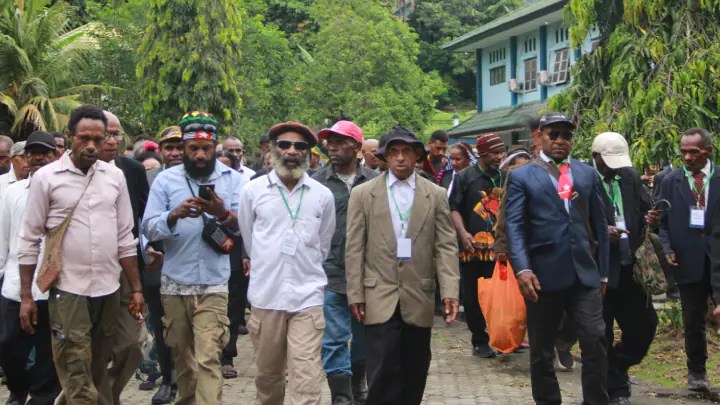
But as ULMWP Legislative Council chair Buchtar Tabuni led thousands of West Papuans, who’d just attended the first session of the West Papuan Legislative Council held in Jayapura City, in a procession through the main streets of one of the nation of West Papua’s largest cities, the message was clear: West Papua now has a government-in-waiting, and it does not want to wait too long.

A nation-in-waiting

“We have now completed our internal structure, implementing democracy even before winning independence,” said ULMWP president Benny Wenda, who currently lives in exile. “The world should respect the fact that we have fulfilled all international requirements to be recognised as a government-in-waiting,”

“We have our own provisional government, cabinet, laws, constitution and Green State Vision for a liberated West Papua,” the president-in-waiting continued, as he noted the commitment an independent West Papua has made to becoming a truly green state. “We also have a network of diplomatic representatives around the world, ready to engage with international diplomats.”

In the lead up to the Netherland colonisers 1962 departure, the West New Guinea Council, which was made up of West Papuans, celebrated their nation’s coming independence on 1 December 1961, Wenda recalled, with the raising of the Morning Star flag, and diplomats from the UK, France, Papua New Guinea, Australia and the Netherlands all bore witness to the ceremony.

As Wenda explains the roll out of the Legislative Council finishes the process of actualising an entire Indigenous government on the ground, which commenced with the first meeting of the West Papuan congress in November 2023.

This finishes the establishment of the legislative framework for an independent West Papua, as well as produces a body to legitimise this point on the global stage.

“With the 2020 provisional government, we built a legitimate governance structure and declared Indonesian presence in West Papua to be illegal,” Wenda underscored. 

“With this inauguration, we have deepened our sovereignty on the ground. The ULMWP is now present at every level of West Papuan life.”

Never any choice

As it was leaving West Papua, the Netherlands handed control of the territory to the United Nations, as per the 1962 New York Agreement, and then in May 1963, it passed on interim administration to Indonesia, another country that had been colonised by the Dutch, who’d left in 1949. This handover was done on the basis that Jakarta let the West Papuans hold a referendum on independence.

Indonesia then held the 1969 UN-brokered “Act of Free Choice”, which saw the Indonesian military select 1,026 West Papuans to take part in, and via threat of gunpoint, they all voted to remain with Jakarta. So, the New York Agreement was never honoured, a fraud vote occurred and the 1.8 million West Papuans, or 70 percent of the population, who signed the petition, want a real referendum.

Since 1 May 1963, Jakarta has killed over half a million West Papuans, and, as Indonesia has been running a transmigration program into the Melanesian region since the 1970s, the 90 percent of the population that the locals, the West Papuans, had made up at that time, has now dropped down to comprising of less than 50 percent of the people living in the region.

The attacks on villages and displacement of local West Papuans has picked up since 2018, and this has been accompanied by the construction of the Trans-Papua Road project, which is a highway needlessly being rolled out that harms the West Papuan landscape and people. The attacks on people in the highlands and coastal regions across the nation of West Papua continue to this day.

The real choice awaits

Former Kopassus general and now Indonesian president Prabowo has a notorious reputation for the brutal manner in which he carried out operations in the former colony of East Timor and the continuing colony of West Papua.

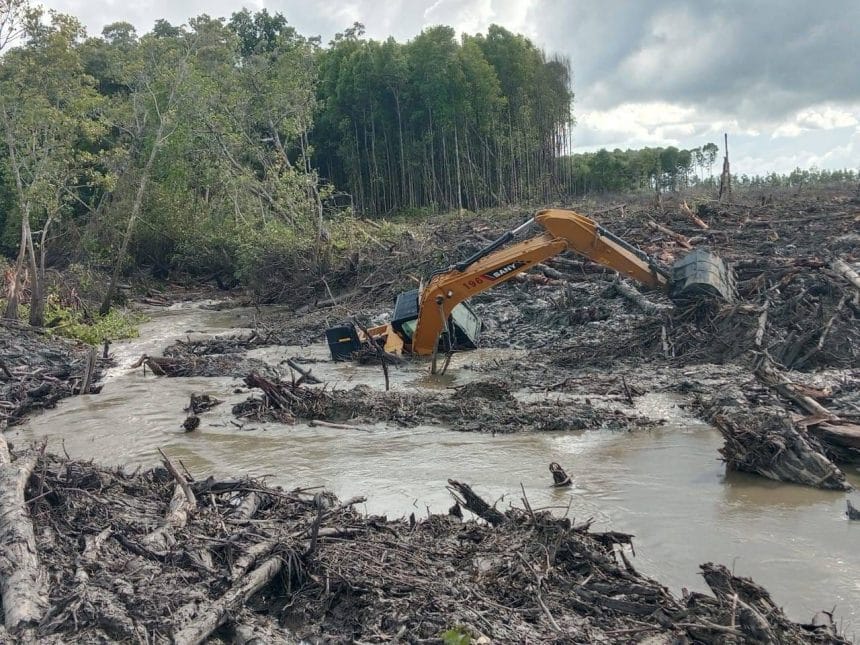
Under the new president’s watch, the aerial bombing of West Papuan villages has heightened recently and the world’s largest act of deforestation is being committed on West Papuan soil in the name of sugarcane farming.

But so too has the West Papuan Legislative Council just met for the first time under Prabowo’s watch, and Wenda points out that for the United Liberation Movement of West Papua to be recognised as legitimate on the international stage has precedent, and he raised the Vanuatu People’s provisional government and the Palestine Liberation Organisation as examples of this.

ULMWP Legislative Council chair Tabuni said a fortnight ago that the 5 July plenary council meeting was an “historical milestone” that involved “the formation of a legitimate and representative legislative structure”, which has “strengthened the foundation of our government, as a nation ready for sovereignty”.

“The ULMWP is ready to play that role,” Wenda underscored. “We are ready to take our seat at the table, to help find a diplomatic political solution to the West Papuan issue through international political mechanisms.”

 PAUL GREGOIRE 

Paul Gregoire is a Sydney-based journalist and writer. He’s the winner of the 2021 NSW Council for Civil Liberties Award For Excellence In Civil Liberties Journalism. Prior to Sydney Criminal Lawyers®, Paul wrote for VICE and was the news editor at Sydney’s City Hub.

————————————-

New Gecko Project documentary exposes the dark reality of Indonesia’s Strategic National Project in Merauke

Human Rights News / IndonesiaWest Papua / 17 July 2025 

A new documentary reveals the devastating impact of Indonesia’s National Strategic Project (PSN) in Merauke, Papua Selatan Province, exposing how large-scale agricultural expansion under the guise of national food security results in the systematic violation of indigenous rights and environmental degradation. The project aims to convert at least 1.6 million hectares of indigenous Malind territory into rice fields and sugarcane plantations, backed by heavy equipment and military presence. Indigenous communities report land seizures without giving their free, prior informed consent (FPIC), while military forces secure the project areas, underscoring the militarisation of development in West Papua.

The film highlights growing resistance from indigenous Malind communities, who reject all forms of corporate investment on their customary lands. In March 2025, over 250 participants at the ‘Merauke Solidarity’ forum condemned the PSN as a corporate-driven initiative that disregards indigenous rights and causes irreversible environmental harm. The project has already triggered deforestation, water contamination, and loss of livelihoods. A government decree has allowed the conversion of more than 13,000 hectares of forest, including protected areas and peatlands, raising serious concerns about Indonesia’s climate commitments.

Despite widespread protests and criticism, government officials, including President Prabowo Subianto, continue to promote the Merauke food estate as a modern agricultural hub. The project aligns with broader patterns of repression across West Papua, where opposition is met with violence and intimidation. Since August 2024, demonstrations against PSN and transmigration have faced heavy-handed crackdowns, reflecting a national strategy that prioritises economic interests over indigenous survival.

The documentary serves as a timely and urgent record of these developments, revealing the complex interplay between state power, corporate interests, and indigenous resistance. It underscores the need for international scrutiny and intervention, warning that the unchecked expansion of PSN projects will exacerbate land conflicts, environmental destruction, and cultural extinction in West Papua.


Joint security forces torture and arbitrarily arrest four KNPB activists in Dekai, Yahukimo

CasesHuman Rights News / IndonesiaWest Papua / 17 July 2025 

On the night of 12 July 2025, joint security forces consisting of Navy’s Marine Corps, Police Mobile Brigade (Brimob), and the local police raided the secretariat of the West Papua National Committee (KNPB) in Dekai, Yahukimo Regency, Papua Pegunungan Province, and arbitrarily arrested the four KNPB members, Mr Sinduk Enggalim, Mr Deko Kobak, Mr Hulu Amosoho, and Mr Ronal Kobak. The four activists were subjected to severe physical abuse during and after their arrest, amounting to torture. They were released two days later, on 14 July 2025, in a physically injured state and without charges filed against them.

On 12 July 2025, at 10:35 pm, police forces arrived at the KNPB office in a patrol vehicle and remained parked on the main road for approximately 20 minutes. At 10:55 pm, joint security forces entered the KNPB office compound. Three police officers approached two activists sitting on the veranda, followed by dozens of Brimob and military personnel. Security forces entered the building and started searching the office while devastating the interior. Witnesses reported hearing cries of pain from inside the secretariat.

The four activists were then apprehended, their hands bound behind their backs, their eyes blindfolded with duct tape, and loaded onto a military vehicle. The activists testified they were severely beaten while en route to the Koramil military post, causing two of them to urinate involuntarily. Upon arrival, they were thrown onto the ground and subjected to a six-hour torture session that included burning of skin, electrocutions, beatings with hard objects to the head and body, and being submerged in drums filled with water, in an attempt to force confessions regarding alleged affiliations with the West Papua National Liberation Army (TPNPB). Mr Hulu Amosoho was separated from the group and tortured in isolation.

On 13 July 2025, around 06:00 am, they were transferred to the Yahukimo Police Station, where the torture continued. Police officers reportedly burned their hair and beards. Despite a subsequent visit to the hospital, only minimal treatment was provided following instructions from military personnel. All four were released on 14 July 2025, at 3:00 pm, due to the lack of incriminating evidence.

Legal and human rights analysis

The arrest and detention of the four activists constitute grave violations of international human rights law, including the prohibition of torture under the Convention Against Torture (CAT), to which Indonesia is a party. The arrest was carried out without a warrant, at night, and in the absence of any visible or declared legal basis, violating Article 18 of Indonesia’s own Criminal Procedure Code (KUHAP), which mandates due process safeguards.

Moreover, the involvement of military personnel in civilian law enforcement, particularly in the arbitrary arrest and inhumane treatment of political activists, further constitutes a breach of the principle of civilian supremacy and violates Article 9 of the International Covenant on Civil and Political Rights (ICCPR), which guarantees the right to liberty and security of person.

The prolonged incommunicado detention, denial of access to legal counsel and family members, and the lack of judicial oversight strongly suggest the presence of enforced disappearance-like practices during the initial hours of detention.

The Indonesian government is obliged under international human rights law to launch an independent investigation into acts of torture and arbitrary arrest committed by state agents, ensuring that those responsible will face criminal prosecution. The Indonesian Government should refrain from the use of military personnel in civilian law enforcement roles, particularly against political actors. All victims of arbitrary arrest and torture must receive comprehensive medical treatment, psychosocial support, and reparations, including compensation and rehabilitation in accordance with international standards.

Table of KNPB activists arrested and tortured during police detention in Dekai on 12 July 2025

NoNameAgeAffiliationAdditional information
1Sinduk Enggalim28Chairman, KNPB YahukimoBeaten, could not sit or stand for extended periods
2Deko Kobak25Activist, KNPB YahukimoChin laceration requiring stitches, unable to eat; he was beaten with a blunt object to the face, sustained a cut above the left eye
3Hulu Amosoho23Activist, KNPB YahukimoHead and facial injuries required stitches
4Ronal Hiben Ris Kobak23Activist, KNPB YahukimoBeaten, suffered from inability to sit or stand for long

Photos showing the physical condition of four KNPB activists after being tortured in Yahukimo

Video testimony by four KNPB activists after being released on 14 July’25

Not waving, drowning – Indonesia may lose warming battle

T

This is the way the world ends, not with a bang but a flooding: With apologies to T. S. Eliot

By Duncan Graham 11/7/25

Every year the UN runs a Climate Change Conference – the next is scheduled for November in Brazil. High on the agenda will be the plight of Pacific Islanders seeing their homes drown. There’s an equally pressing need close by, but the solutions seem doomed.

Indonesian authorities provide useful information for travellers checking if they’ve got to the right place: alongside the destination name is its height above sea level.

Surabaya, the capital of East Java, advertises it’s just two metres higher than the nearby waves. The Republic’s second-biggest city is a vital transport hub, a humid home to ten million and a trading and naval centre for more than a thousand years.

How many more is the figure to fear.

For the waters are rising and the beaches are drowning, most strikingly in the capital Jakarta 780km west along the coast of the Java Sea. It’s disappearing faster than any other city in the world, according to a BBC report:

“North Jakarta has sunk 2.5 metres in 10 years and is continuing to sink by as much as 25 centimetres a year in some parts, which is more than double the global average for coastal megacities.”

Global warming is a factor but the other culprits are illegal drilling for groundwater and excavating foundations for high-rise towers and a web of toll roads. Despite the predictions the rattle of pneumatic drills, the slurp of concrete pours and the nodding of dinosaur construction cranes continues day and night.

The BBC’s depressing information was broadcast seven years ago; horizontal lines drawn by shack owners on their timber walls to measure the rise are now invisible under the brown soup of plastics, nappies, cans and other trash that passes for water.

Lab-coated scientists taking samples to prove the pollutants are extreme would need extra protection because corrosives rot clothing.

So, what to do?

The last president Joko ‘Jokowi’ Widodo decided the solution was to move. He reckoned the right place to raise a memorial to his foresight was 1200 km north-east of the descending capital. The first building rising above the greenery has been the palace.

This is East Kalimantan province on the island of Borneo, the biggest in the sprawling 17,000-island archipelago where orangutans once outnumbered their human relatives. That was before the timber cutters and palm-oil planters arrived to turn the pristine into profit.

Java is five times smaller than Borneo but immeasurably more important – the political, administrative and cultural centre of the Republic and home to more than 158 million. It’s the world’s most densely populated island and super-fertile, though much of the landscape is mountainous.

The proverb rindu kampung halaman means more than just a longing for home. It embraces family, community, culture, local language and history. For the Javanese, these magnets of birthplace exercise a powerful pull.

So the four million bureaucrats and their families who call Jakarta their place are not dashing to shift to East Kalimantan with its different climate and culture – now grandly titled Ibu Kota Nusantara, the Mother City of the Outer Islands.

Despite their city’s mess, many workers will need more than subsidies and promises of promotion to get them to move, particularly if they have partners and kids embedded in schools, sports and friendships.

All this along with a disinterest in tipping more money into the Jokowi ego monument is why his successor, President Prabowo Subianto, is pondering other ways to keep Jakarta residents above water.

The current favourite is the Great Wall of Java, already on the list of strategic projects in the 2025-2029 National Medium-Term Development Plan, though there are still no blueprints.

As a former military man before being cashiered in 1998, Prabowo sees rising seas as an invasion, so the best defence is fortification.

There are lessons from military history he needs to heed. The collapse of the French Maginot Line in 1940 showed that barricades are only as strong as their weak spots and there’ll be many as seas surge and waves undermine the president’s bulwark.

Like Canute, he can shout orders. But king tides only obey the pull of the moon.

So far, estimates of Great Wall measurements and costs are still being splashed around conference tables, but the best published stab is 500km and A$122 billion over two decades. That’s twice the current estimated cost of Jokowi’s IKN.

The figures are certain to rise faster than sea levels. The money will have to be drained from state budgets as the project is unlikely to attract even Chinese investors reportedly propping up IKN. How do you earn money from a venture trying to tame nature?

One idea is to build “a livable seawall that has residential and commercial zones, essentially turning the whole structure into a kind of floating city”. Swimming would be a required skill for buyers.

The omens aren’t good. Earlier attempts to build Jakarta dykes failed. One collapsed in 2007, five years after construction – no defence against a storm that took 80 lives.

_The Jakarta Post_ is not a cheerleader for the Prabowo plan: “Simply put, we don’t have enough money or possess the knowledge or experience to build the Java seawall… We could end up with another unfinished massive construction by the end of the current presidential term, only this time at sea.”

Maybe delegates to the UN Climate Change Conference will offer fresh solutions. Otherwise like Shelley’s Ozymandias, Prabowo’s mighty works will remind future generations how we lost the battle against global warming.

The views expressed in this article may or may not reflect those of Pearls and Irritations.

Duncan Graham

Duncan Graham has been a journalist for more than 40 years in print, radio and TV. He is the author of People Next Door (UWA Press). He is now writing for the English language media in Indonesia from within Indonesia. Duncan Graham has an MPhil degree, a Walkley Award, two Human Rights Commission awards and other prizes for his radio, TV and print journalism in Australia. He lives in East Java.

China isn’t the main culprit in Indonesia’s dirty nickel boom

Muhammad Zulfikar Rakhmat

This article is sourced from The Lowy Institue’s The Interpreter first published 4/7/25

While Chinese firms capitalise on the country’s resources, the
social and environmental damage lies squarely with Jakarta.

Smoke rises from Weda Bay Industrial Park, a major nickel processing and smelting hub in Central Halmahera, on 13 April 2025 (Yasuyoshi Chiba/AFP/Getty Images)

Smoke rises from Weda Bay Industrial Park, a major nickel processing and smelting hub in Central Halmahera, on 13 April 2025 (Yasuyoshi Chiba/AFP/Getty Images)

Published 4 Jul 2025 


The destruction of Indonesia’s rainforests and reefs in the name of green energy is a tragedy, but not one that can be pinned solely on China.

Yes, China has played a central and highly visible role in Indonesia’s nickel boom. It is the largest consumer of Indonesian nickel, the primary financier behind smelters and industrial parks, and a dominant foreign actor influencing how extraction unfolds. But Chinese companies do not force their way into Indonesia’s forests – they are merely capitalising on the rules, and loopholes, established by the Indonesian state.

To understand how the world’s largest nickel reserves are being transformed into sacrifice zones, we must begin with a critical truth: the rush to exploit these resources is not driven solely by foreign demand, but by domestic politics and governance choices made in Jakarta.

While Chinese firms certainly profit from this permissive and often corrupt environment, it is Indonesian authorities who enable and perpetuate it.

It is Indonesia that grants mining permits – often through processes vulnerable to corruption. It is Indonesia that oversees (or fails to oversee) environmental and labour assessments. It is Indonesia that silences youth activists and sidelines Indigenous communities when they speak out against these projects. While Chinese firms certainly profit from this permissive and often corrupt environment, it is Indonesian authorities who enable and perpetuate it.

A recent case from Raja Ampat, a remote archipelago in West Papua, underscores the stakes of Indonesia’s nickel rush. Last month, Indigenous youth disrupted a mining summit in Jakarta, holding signs reading “Nickel Mines Destroy Lives”. Their viral protest, under the hashtag #SaveRajaAmpat, drew attention to the threat that nickel extraction poses to their home. Several protesters were detained.

Raja Ampat, renowned for its marine biodiversity and Indigenous communities, is already reeling from the impacts of nickel mining. Of the four companies licensed to operate in the region, PT Anugerah Surya Pratama – linked to China’s Vansun Group – cleared protected forests and polluted the sea around Manuran Island. Indonesia’s Ministry of Environment confirmed these violations. Only after public outcry did the government revoke the permit, but by then, much of the damage had already been done.

MOROWALI, CENTRAL SULAWESI, INDONESIA - AUGUST 01: Employees in traffic during the working shift change near Indonesia Morowali Industrial Park (IMIP), that consists of around 77,000 local workers and around 6,000 Chinese workers on August 1, 2023 in Morowali, Central Sulawesi, Indonesia. The global demand for the raw material nickel, a key component in batteries - especially those used in electric vehicles (EVs) - is growing rapidly. Estimates from the U.S. Geological Survey (USGS) showed that global nicke
Workers at the Indonesia Morowali Industrial Park sit in traffic after a shift change at the nickel processing hub (Ulet Ifansasti/Getty Images)

The mining boom is not confined to far-flung Papua. In Central Sulawesi, Morowali has become the beating heart of Indonesia’s nickel processing industry. The Indonesia Morowali Industrial Park (IMIP), largely financed and constructed by Chinese companies such as Tsingshan Holding Group, stands as a flagship Belt and Road project. But its meteoric rise has come at an enormous cost: air and water pollution, deforestation, and rising greenhouse gas emissions in what was once promoted as a “green” zone.

The social toll is just as severe. Labour conditions at IMIP have raised alarms, with reports of long hours, meagre pay, poor safety standards, and frequent accidents. Tensions between Chinese and Indonesian workers have flared into violence on multiple occasions. Yet despite these concerns, the park continues to expand. The economic incentives for all parties are simply too great, and regulatory enforcement is often undermined by corruption. Indonesia’s 2020 ban on nickel ore exports – intended to promote domestic value-added processing – successfully attracted foreign capital. But the regulatory framework governing labour rights, environmental protections, and community engagement has failed to keep pace.

A similar pattern has taken root in Weda Bay, Halmahera. There, vast industrial complexes built by Chinese and French firms have reshaped the landscape. Forests have been razed, rivers contaminated, and traditional livelihoods upended. Promises of economic opportunity have been hollowed out as locals report being excluded from decision-making and witnessing a growing divide between investors and communities.

No labour abuses, environmental violations, or community displacements occur without institutional neglect – often compounded by corruption.

Indonesia’s failures are not isolated – they are systemic. Environmental impact assessments are routinely manipulated, labour standards poorly enforced, and Indigenous voices sidelined. Corruption facilitates these breaches, creating an environment where compliance is optional. The most powerful investors – Chinese state-linked enterprises among them – adapt accordingly.

Still, this does not absolve China. As the global leader in battery production and the architect of the Belt and Road Initiative, China has committed to making its development model “green and sustainable”. Yet it continues to finance and profit from operations that destroy ecosystems, exploit labour, and marginalise communities. What Beijing would never tolerate on its own soil – clear-cutting protected forests or operating in unsafe conditions – it enables abroad.

If China truly intends to lead the global energy transition, it must hold its companies accountable. This means refusing to finance environmentally destructive projects, setting higher standards for overseas operations, and enforcing consequences for corporate misconduct – not just when global outcry forces its hand.

But ultimately, the responsibility lies with Indonesia. No Chinese company can operate in Indonesia without state approval. No labour abuses, environmental violations, or community displacements occur without institutional neglect – often compounded by corruption. If Indonesia hopes to be seen as a responsible steward of its natural wealth, it must overhaul how mining projects are licensed, monitored, and enforced. It must empower Indigenous peoples and protect workers with the same urgency it grants mining permits.

Indonesia’s nickel boom is a test of the country’s ability to balance economic growth with sustainable governance. From Raja Ampat to Morowali, the impact of unchecked mining is evident – forests are cleared, labour is exploited, and communities are displaced.

We cannot place the blame squarely on China. But we must acknowledge that Indonesia’s governance – and the corruption within it – ultimately sets the terms.


Trial begins in Tobias Silak Murder Case amid transparency concerns

Human Rights News / IndonesiaWest Papua / 2 July 2025 

Nearly 11 months after the fatal shooting of Mr Tobias Silak in the Yahukimo Regency, Papua Pegunungan Province, criminal proceedings have commenced at the Wamena District Court against the four police officers, Muh. Kurniawan Kudu (Chief Police Brigadier, Bripka), Fernando Alexander Aufa, Ferdi Moses Koromath, and Jatmiko (see photo on top, source: WPCC). The case files were transferred to the Public Prosecutor in Wamena on 28 May 2025, with the first hearing held on 24 June 2025. The court session focused on the reading of indictments. However, the scheduled 30 June hearing for defendant objections was postponed due to the defence team’s lack of preparedness, raising early concerns about the pace of the proceedings.

The trial process has sparked significant transparency concerns, as the victim’s family and their legal counsel were not notified of the first hearing. Mr Kawer criticized the prosecutor’s failure to inform key stakeholders, questioning whether the prosecution truly represents victim interests or public interest as claimed. Additionally, legal representatives have expressed dissatisfaction with the charges brought against the defendants, primarily Article 338 (murder) and Article 395 (negligence causing death) of the Criminal Code KUHP. They argue that the more serious charge of premeditated murder under Article 340 would better reflect the gravity of the shooting that killed both Mr Tobias Silak and Mr Naro Dapla on 20 August 2024.

In response to these procedural concerns, the Indonesian Judicial Commission in Papua announced in late June’25 that it would monitor the trial proceedings following a request from the victim’s family’s legal team. The Commission is currently awaiting authorization from the headquarters to begin formal oversight. Meanwhile, civil society groups, including the Tobias Silak Justice Front, continue to demand maximum penalties, including dismissal from the police force for the accused officers, while planning consolidation efforts across multiple cities to maintain public pressure throughout the trial process (see photos below, source: FJTS).

The case represents a critical test of Indonesia’s commitment to accountability for alleged security force violations in West Papua, with at least eight hearings expected before a verdict is reached. The outcome will be closely watched as an indicator of whether Indonesia’s justice system can break the pattern of impunity that has characterized similar cases in the region.

The Tobias Silak Justice Front held a peaceful protest in front of the Prosecutor’s Office in Wamena on 10 June 2025

Arbitrary detention and use of force against human rights lawyer during peaceful protest in Jayapura

Cases / IndonesiaWest Papua / 2 July 2025 

On 12 June 2025, police officers arbitrarily detained Mr Imanus Komba, a lawyer working for the Papuan Legal Aid Institute (LBH Papua), and a protester named Mr Kolki Gwijangge during a peaceful demonstration at the Abepura roundabout in Jayapura City, Papua Province (see photo on top, source: Jubi). The demonstration, organised by student and youth groups, opposed the controversial nickel mining project in Raja Ampat, Sorong, and broader illegal resource exploitation in West Papua. Mr Komba and Mr Gwijangge were reportedly subjected to physical ill-treatment during arrest. Both men were temporarily detained at the Abepura Sub-District Police Station before being released after 20 minutes.

The protest began peacefully at 10:00 am, with demonstrators expressing environmental and indigenous rights concerns over the mining project, including its impacts on local ecosystems and customary landowners. At approximately 10:20 am, police from the Abepura Sector, led by the station chief and intelligence officers, attempted to disband the protest, allegedly citing the lack of a valid permit. When LBH Papua lawyer, Mr Imanus Komba, challenged the order and asserted the demonstrators’ constitutional rights, police officers reportedly dragged, choked, and beat Mr Komba with a rubber baton before being escorted to the Abepura Sub-District Police Station. Mr Kolki Gwijangge was also forcibly removed from the site. Despite the violence, both were released again, and Mr Komba resumed his duties accompanying the protest.

The Indonesian Legal Aid Foundation (YLBHI) and LBH Papua condemned the detention, highlighting that such acts amount to a pattern of criminalisation and intimidation of human rights defenders in West Papua. According to YLBHI, the Abepura Police’s conduct represents a breach of Police Regulation No. 2/2003. The organisation demanded a public apology and an end to repressive policing.

The Jayapura Police Chief, Commissioner Fredrickus Maclarimboen, stated that there were no arrests or detentions. The Jayapura police’s claim that “there were no detainees” contrasts sharply with the victim testimonies, further underlining the lack of transparency and accountability.

Legal and human rights analysis

The actions of the Abepura police, including physical abuse and obstruction of legal assistance, amount to violations of national law and international standards on the protection of human rights defenders. The incident violates fundamental freedoms, namely the right to freedom of expression and peaceful assembly as enshrined in Article 28E (2) of the Indonesian Constitution, and Articles 19 and 21 of the International Covenant on Civil and Political Rights (ICCPR), to which Indonesia is a State Party. Furthermore, the physical assault and detention of the LBH lawyer violate Law No. 16/2011 on Legal Aid, which explicitly protects lawyers from criminal or civil liability for actions taken in the course of legal representation.

The case adds to a broader pattern of repression against Papuan civil society, where security forces frequently suppress dissent under the guise of public order, infringing upon basic civil liberties and undermining the rule of law.

———————————————————

Human Rights Monitor

Civil society condemns government denial and calls for international intervention

Human Rights News / IndonesiaUN on West PapuaWest Papua / 2 July 2025 

In the past months, the situation surrounding the National Strategic Project (PSN) in Merauke, Papua Selatan Province, has further escalated. In the Soa Village, Tanah Miring District, indigenous women from 75 families have collectively opposed the land encroachment by PT. Global Papua Abadi, which received a government concession for an energy project without the community’s free, prior, and informed consent (FPIC). This project threatens to destroy their natural sources of livelihood and violates their rights to land and self-determination. Similarly, on 23 June 2025, indigenous land belonging to the Kwipalo clan in Kakyo Village, Semangga District, was reportedly seized by the military for the construction of a post without consent or legal process, constituting a grave act of militarisation and forced dispossession.

Investigations by the National Commission on Human Rights (Komnas HAM) in May and June 2025 revealed widespread violations across multiple districts in Merauke. These include forced evictions, destruction of sacred sites, and the complete disregard for FPIC principles. Indigenous communities, religious leaders, and civil society groups have united in protest, calling the PSN an instrument of structural injustice and ecocide. On 17 June 2025, the Indonesian Fellowship of Churches (PGI) condemned the PSN for violating indigenous rights, destroying ecosystems, and exacerbating the climate crisis.

In addition to public mobilisation and advocacy, a coalition of Indonesian civil society organisations (CSOs) issued a formal response to the joint communication of nine UN Special Rapporteurs dated 7 March 2025. The CSOs strongly criticised the Government of Indonesia’s reply of 6 May 2025 for denying ongoing and well-documented human rights and environmental violations related to the National Strategic Project (PSN) in Merauke. They noted that the government’s response ignored empirical evidence and failed to address the substantive issues raised by the UN experts, including land dispossession, militarisation, food insecurity, ecological destruction, and the lack of respect for FPIC principles

According to the CSOs, the government’s reply reflected a broader institutional reluctance to engage meaningfully with international human rights norms. They pointed out that the Indonesian state has failed to comply with recommendations made by Komnas HAM, as well as with constitutional and international legal standards safeguarding indigenous peoples’ rights. Furthermore, they underscored that permits and business licences had been granted to companies in areas with customary land claims, without community consent or proper consultation. The coalition urged the UN Special Rapporteurs to conduct direct monitoring in Merauke and called for the immediate suspension of PSN implementation to prevent the continued expansion of human rights and environmental violations.

The PSN’s implementation in Merauke reflects a deeper failure of democratic governance and environmental responsibility. It undermines constitutional protections and international legal obligations, particularly under the UN Declaration on the Rights of Indigenous Peoples. The Indonesian government’s response to concerns raised by UN Special Rapporteurs has been criticised as evasive and dishonest. Indigenous leaders and civil society continue to demand the immediate suspension of all PSN activities, restoration of customary lands, adequate reparations, and a UN-led investigation. Without urgent corrective action, the PSN will inevitably destroy the ecological, cultural, and spiritual fabric of West Papua’s indigenous communities.

The military seized land belonging to the Kwipalo Clan in the Kakyo Village, Semangga District, without consent or legal process

 Planetary urbanisation: Why Indonesia destroys its green islands to ‘green’ cities elsewhere 

Sediment is clearly visible close to nickel mining operations on Kawe Island, Raja Ampat, discolouring the water in one of Indonesia’s most biodiverse marine areas. The concession covers an area of 5,922 hectares and is located within the mega-biodiversity region of Raja Ampat, West Papua.

BY DWIYANTI KUSUMANINGRUM

26 JUNE 2025

This article is reproduced courtesy of University of Melbourne’s unit Indonesia at Melbourne

The controversy over nickel mining in Raja Ampat, Papua, is a telling example of how capitalist-driven planetary urbanisation is reshaping the world we live in.

Today, urbanisation occurs on a global scale. It is taking place not only within cities and urban areas but even in many non-city zones that serve as ‘operational landscapes’ for supplying cities’ demands. This concept of ‘planetary urbanisation’ explains how non-urban realms in the Global South have played a strategic role as operational landscapes supporting cities in the Global North.

Environmentally destructive nickel mining activities within the Raja Ampat UNESCO Global Geopark, a global tourism site widely known for its idyllic scenery and marine biodiversity, is a case in point. It shows how the current global demand for urban environmental sustainability has incentivised policymakers in the Global South to provide the materials needed for the cities in the North to be more sustainable.

It also tells the disturbing story of how Indonesia, in a nutshell, is willing to destroy its invaluable green islands for the sake of ‘greening’ cities in China and Europe.

Colonial origin of planetary urbanisation

Indonesia’s rich natural resources have been a source of vital global commodities since the colonial era. In the 15th century, high demand for commodities from Europe encouraged exploration in tropical countries, paving the way for colonialism. 

Resource exploitation by colonial powers played a critical role in the growth of cities in Indonesia and Europe, since the extraction from Indonesia funded the growth of the Netherlands and its cities. This is one of the first examples of planetary urbanisation — where the South was squeezed to provide for the North.

During colonial times, most Indonesian cities were basically just ‘operational landscapes’ of Dutch cities. By the late 18th century, for example, Makassar and Ternate were important cities in the global spice route and became hubs for the ‘local government’ of the VOC (Vereenigde Oost-Indische Compagnie, the Dutch East India Company). A similar trajectory also happened to Pangkalpinang, with its tin mining on Bangka Island, and Padang, a port city that supplied gold powder from the Minang kingdom.

The locations of Indonesia’s new ‘cities’ later expanded beyond those determined by geographical localities (resources sites). In the inland of Java, cities grew organically around train stations as a result of the expansion of transportation networks and the extensive exploitation of plantations in many different locations.

This process of planetary urbanisation continues today, as nickel becomes the latest commodity sought after by major cities in the northern hemisphere.

Nickel boom and resource nationalism

The global demand for renewables such as wind turbines, solar panels and EV batteries has fuelled excessive extraction of nickels in many countries including Indonesia, where more than half the world’s nickel supply is located. According to US Geological Survey, Indonesia has as many as 55.000.000 metric tons of nickel reserve.

Under former president Joko “Jokowi” Widodo, Indonesia introduced a series of policies aimed at downstreaming its nickel mining industry. These included banning  nickel ore export  and promoting domestic nickel processing industry.

However, this seemingly nationalistic policy is not necessarily beneficial for the Indonesian people. Scholars have argued that “resource nationalism” is in fact a pseudo-nationalism, because it is plagued by rent-seeking practices. A revealing Watchdoc investigative documentary has shown that the nickel industry in Indonesia largely benefits just a few mining oligarchs. To make matters worse, more than 90% of nickel processing infrastructure is owned by Chinese companies.

Nickel mining and environmental degradation 

Nickel mining activities in the eastern part of Indonesia are embodiments of ‘operational landscapes’ in ‘planetary urbanisation’. This is indicated by the spatial and social concentration of capital in the forms of infrastructural facilities and the influx of migrant workers, some of whom are from China, in the region.

Look at the private airports in the Indonesia Morowali Industrial Park (IMIP) and on Gag Island, Raja Ampat. At IMIP alone, there are 91,581 Indonesian workers and 11,615 foreign workers working in the industry. Or look at Teluk Weda’s smelters and port, which serves as a hub for vessels carrying nickels from small islands in the eastern part of Indonesia.

It remains to be seen, however, if these new ‘operational landscapes’ will eventually lead to the creation of new local cities as it was the case during colonial times, or if they will only destroy the environment in Indonesia to support cities in other countries.

The reality is that nickel mining sites are believed to have caused anthropogenic disasters (floods and landslides), and environmental degradation (air, land, and water pollutions), adversely affecting the local communities.

Floods in Morowali, for example, are attributed by many observers to IMIP industrial zones replacing local forest that previously served as a catchment area. In Teluk Weda, for example, Forest Watch Indonesia has found that the expansion of nickel industry encroaching into nearby forested areas has increased the flood risk in the surrounding areas.

In Obi Island, North Maluku, local media reported that mining activities had directly dumped their waste into the ocean. In Teluk Weda, nickel mining allegedly polluted  the river and groundwater, affecting the lives of the locals in Halmahera.

The Watchdoc documentary also emphasises the impact of the mining industry on Teluk Weda’s public health. Levels of the heavy metal arsenic have been detected in blood samples taken from residents, mining workers, and fishermen in the area. This demonstrates how the nickel mining industry can have fatal consequences.

Sustainable for whom? 

Capitalism can be cruel. Yet, there is no denying that capitalist-driven Dutch colonialism, which heavily relied on plantations, played a role in the making of major cities in Indonesia with less severe environmental degradation. The ongoing process of mining activities in eastern part of Indonesia seems much more ominous.

We need to ask who really benefits from the global campaign for’ sustainable development’. Of course Indonesia should tap this economic opportunity, but we cannot let it happen at the expense of our own natural habitat and our society’s wellbeing.

Don’t surrender’ to Indonesian pressure over West Papua, Bomanak warns MSG 

By APR editor –  June 26, 2025

Asia Pacific Report

A West Papuan independence movement leader has warned the Melanesian Spearhead Group after its 23rd leaders summit in Suva, Fiji, to not give in to a “neocolonial trade in betrayal and abandonment” over West Papua.

While endorsing and acknowledging the “unconditional support” of Melanesian people to the West Papuan cause for decolonisation, OPM chair and commander Jeffrey P Bomanak
spoke against “surrendering” to Indonesia which was carrying out a policy of “bank cheque diplomacy” in a bid to destroy solidarity.

Fiji Prime Minister Sitiveni Rabuka took over the chairmanship of the MSG this week from his Vanuatu counterpart Jotham Napat and vowed to build on the hard work and success that had been laid before it.

He said he would not take the responsibility of chairmanship lightly, especially as they were confronted with an increasingly fragmented global landscape that demanded more from them.

PNG Prime Minister James Marape called on MSG member states to put West Papua and Kanaky New Caledonia back on the agenda for full MSG membership.

Marape said that while high-level dialogue with Indonesia over West Papua and France about New Caledonia must continue, it was culturally “un-Melanesian” not to give them a seat at the table.

West Papua currently holds observer status in the MSG, which includes Papua New Guinea, Solomon Islands, Vanuatu, and Fiji — and Indonesia as an associate member.

PNG ‘subtle shift’
PNG recognises the West Papuan region as five provinces of Indonesia, making Marape’s remarks in Suva a “subtle shift that may unsettle Jakarta”, reports Gorethy Kenneth in the PNG Post-Courier.

West Papuans have waged a long-standing Melanesian struggle for independence from Indonesia since 1969.

The MSG resolved to send separate letters of concern to the French and Indonesian presidents.

In a statement, Bomanak thanked the Melanesians of Fiji, Papua New Guinea, Solomon Islands, Vanuatu and the Kanak and Socialist National Liberation Front (FLNKS) of Kanaky New Caledonia for “unconditionally support[ing] your West Papuan brothers and sisters, subjected to dispossession, enslavement, genocide, ethnocide, infanticide, and ethnic cleansing, [as] the noblest of acts.”

“We will never forget these Melanesian brothers and sisters who remain faithfully loyal to our cultural identity no matter how many decades is our war of liberation and no matter how many bags of gold and silver Indonesia offers for the betrayal of ancestral kinship.

“When the late [Vanuatu Prime Minister] Father Walter Lini declared, ‘Melanesia is not free unless West Papua is free,”’ he was setting the benchmark for leadership and loyalty across the entire group of Melanesian nations.

“Father Lini was not talking about a timeframe of five months, or five years, or five decades.

“Father Lini was talking about an illegal invasion and military occupation of West Papua by a barbaric nation wanting West Papua’s gold and forests and willing to exterminate all of us for this wealth.

‘Noble declaration’
“That this noble declaration of kinship and loyalty now has a commercial value that can be bought and sold like a commodity by those without Father Lini’s courage and leadership, and betrayed for cheap materialism, is an act of historic infamy that will be recorded by Melanesian historians and taught in all our nations’ universities long after West Papua is liberated.”

Bomanak was condemning the decision of the MSG to regard the “West Papua problem” as an internal issue for Indonesia.

“The illegal occupation of West Papua and the genocide of West Papuans is not an internal issue to be solved by the barbaric occupier.

“Indonesia’s position as an associate member of MSG is a form of colonial corruption of the Melanesian people.

“We will continue to fight without MSG because the struggle for independence and sovereignty is our fundamental right of the Papuan people’s granted by God.

“Every member of MSG can recommend to the United Nations that West Papua deserves the same right of liberation and nation-state sovereignty that was achieved without compromise by Timor-Leste — the other nation illegally invaded by Indonesia and also subjected to genocide.”

Bomanak said the MSG’s remarks stood in stark contrast to Father Lini’s solidarity with West Papua and were “tantamount to sharing in the destruction of West Papua”.

‘Blood money’
It was also collaborating in the “extermination of West Papuans for economic benefit, for Batik Largesse. Blood money!”

The Papua ‘problem’ was not a human rights problem but a problem of the Papuan people’s political right for independence and sovereignty based on international law and the right to self-determination.

It was an international problem that had not been resolved.

“In fact, to say it is simply a ‘problem’ ignores the fate of the genocide of 500,000 victims.”

Bomanak said MSG leaders should make clear recommendations to the Indonesian government to resolve the “Papua problem” at the international level based on UN procedures and involving the demilitarisation of West Papua with all Indonesian defence and security forces “leaving the land they invaded and unlawfully occupied.”

Indonesia’s position as an associate member in the MSG was a systematic new colonialisation by Indonesia in the home of the Melanesian people.

Indonesia well understood the weaknesses of each Melanesian leader and “carries out bank cheque diplomacy accordingly to destroy the solidarity so profoundly declared by the late Father Walter Lini.”

“No surrender!” —————————————-