Unknown's avatar

About AWPA Adelaide administrator

AWPA Adelaide site manager

Jokowi orders military to help investigate soldiers suspected of killing 4 Papuans

Atrocities in Papua a result of phobia and stigma against Papuans: Council of Churches  

Phobia And Stigma Against Papuans – News Desk 

31 August 2022

Jayapura, Jubi – The Papua Council of Churches says the atrocities and violence that continue to occur in Papua, including the recent murder and mutilation of four Nduga residents in Mimika Regency, are caused by the stigma against Papuans that has long grown among Indonesian security forces.

Phobia of Papuans had been fostered in the minds of security forces and most Indonesians because political leaders had oftentimes made racist remarks against Papuans, said the Council of Churches in a press conference in Jayapura Regency’s capital of Sentani on Tuesday, August 20, 2022.

The council cited former president and Indonesian Democratic Party for Struggle (PDIP) leader Megawati Soekarnoputri’s racist comment at PDIP’s national working meeting on June 21, as well as retired general Hendropriyono’s statement to move two million indigenous Papuans to Manado, North Sulawesi.

Rev. Benny Giay, the moderator of the Papuan Council of Churches, said that public statements such as those made by Megawati and Hendropriyono revealed the fantasy and psychology of the majority of Indonesian people about Papua, wherein Papuans were often associated with the words monkey, koteka (traditional sheath), lazy, backward, and terrorist.

“Those statements are understood by Papuans as a desire to exterminate the black people of Papua from their own country,” he said.

On the ground, Papuan phobia gave birth to violence and cruelty of security forces against indigenous Papuans. “All Papuans are the same unworthy human beings in their eyes, be it pastors, health workers, teachers, regents, governors, the Papuan People’s Assembly, or academicians. Most recently, they mutilated four civilians from Nduga Regency in Mimika,” Giay said.

He said that stigma had made indigenous Papuans suffer from human rights violations, marginalization, discrimination, racism, murder, impoverishment, and various other violence. Papuan phobia and stigma have also led the government to make discriminative policies that do not solve the Papuan problem.

“In 2019, when Papuans protested against racist speech in Surabaya on August 16, the government responded by deploying more troops and it’s still going until now. In April 2021, armed groups were labelled terrorists. On July 15, 2021, the House passed Law No. 2 of 2021 on the Second Amendment to Papua Special Autonomy Law No. 21/2001 without involving Indigenous Papuans in the deliberation,” he said.

Papua Council of Churches member and president of the Evangelical Church in Indonesia (GIDI) Rev. Dorman Wandikmbo said President Joko “Jokowi” Widodo’s visit to Tanah Papua had no positive impact on indigenous Papuans. Jokowi came to Papua with promises but did not fulfil them.

“For example, the Bloody Paniai case in 2014 has been delayed for years. The Attorney General’s Office recently named only one suspect in the alleged gross human rights violations, a retired army who had nothing to do with the Bloody Paniai shooting incident. The real perpetrators were not brought to justice by the State,” Wandikmbo said.

Wandikmbo also criticized the Jokowi regime for forcing the division of Papua Province to form three New Autonomous Regions (DOB). “With the DOB, customary land will be a target of investment, and it will certainly deprive the indigenous peoples of their lands,” he said.

Further, Wandikmbo added the murder and mutilation of four Papuans that occurred in Settlement Unit 1, Mimika Baru District, Mimika Regency on August 22 was a state crime.

“The murder and mutilation of four Nduga residents in Timika and various other human rights violations only add to the wounds of indigenous Papuans. Government promises are nothing but lies,” he said. (*)

Writer: News DeskEditor: News Desk

—————————————–

https://www.benarnews.org/english/news/indonesian/killing-probe-08312022152548.html

Jokowi orders military to help investigate soldiers suspected of killing 4 Papuans

Victor Mambor and Pizaro Gozali Idrus 

2022.08.31

 Jayapura, Indonesia, and Jakarta

Indonesia’s president said Wednesday that police must thoroughly investigate six soldiers who were arrested as suspects in the grisly killing of four civilians in Papua last week, but residents of the troubled region cast doubt that justice would be served.

During a working visit to Papua, Indonesian leader Joko “Jokowi” Widodo said he had ordered the armed forces chief to help local police with the legal part of the case unfolding in the country’s far eastern region, where alleged abuses by government forces and armed Papuan separatist rebels are widespread.

“Once again, the legal process must be carried out so that the public’s trust in the Armed Forces does not fade. I think the most important thing is to investigate thoroughly and then proceed to the legal process,” Jokowi told local journalists.

Papua police spokesman Ahmad Musthofa Kamal said officers arrested six soldiers and three civilians who allegedly killed and mutilated the victims in an attack in Mimika regency, Papua province, on Aug. 22.

The four victims were beheaded and their legs were cut off before their bodies were placed in sacks and tossed into a river, according to authorities, who publicized the arrests on Aug. 29.

Despite the president’s statement, Papuan activists expressed doubts that the military would carry out his order.

“This was proven by the premeditated murder and mutilation of four indigenous Papuan civilians in Timika,” the Rev. Dorman Wandikbo told BenarNews.

Dorman, president of the Evangelical Church in Indonesia, criticized Jokowi for visiting Papua amid continued violence against civilians by security forces. He said such violence had degraded the dignity of indigenous Papuans.

Previously, Makilon Tabuni, 12, died on Feb. 22 after allegedly being tortured by soldiers who had accused him and his friends of stealing a firearm in Sinak, a district of Puncak regency in Papua province. The case remains unsolved.

“There is no clarity as of today. The TNI has not admitted to this day,” a representative from Makilon’s family told BenarNews on condition of anonymity because of fear of potential reprisals.

The family said the military had only paid medical expenses.

Benny Giay, a member of the Papua Church Council, criticized statements by government officials who have degraded Papuans.

He cited a statement made by Megawati Soekarnoputri, chairwoman of the ruling Indonesian Democratic Party of Struggle (PDIP). She had referred to Papuans as black and Deputy Minister of Home Affairs John Wempi Wetipo, who is from Papua as “coffee milk” – derogatory terms referring to people with different skin tones.

Benny also referred to a statement by the former chief of the State Intelligence Agency, Abdullah Mahmud Hendropriyono, who proposed moving 2 million Papuans to Manado and sending Manado residents to Papua to separate them from their people in Papua New Guinea and the Pacific region.

“Public statements like those made by Megawati and Hendropriyono showed the fantasy and psychology of the majority of Indonesians about Papuans, which are often associated with monkeys, armpits, lazy and terrorists,” Benny told BenarNews on Wednesday. 

“Those statements were understood by Papuans as a desire to eliminate black Papuans from their own country,” he said.

Fugitive

Meanwhile, Papuan police said they had identified 10 suspects in this most recent mutilation case, adding that six soldiers and three civilians were in custody while the fourth civilian is considered a wanted fugitive. The soldiers were identified as two officers – a major and a captain – and four privates.

None of the suspects’ names were released.

The victims allegedly paid to purchase firearms, but were killed instead.

“The victims paid 250 million rupiah (U.S. $16,835), and the money was divided among the perpetrators,” said Kamal, the Papua police spokesman.

Meanwhile, Indonesian Army spokesman Tatang Subarna said a military team had interrogated the six soldiers who were ordered detained from Aug. 29 to Sept. 17 at the Mimika Regional Army Military Police Command.

“The detention has been carried out for examination and investigation purposes,” said Tatang in a written statement received by BenarNews.

Public trust concerns

Usman Hamid, director of Amnesty International Indonesia, urged authorities to investigate the case thoroughly so it does not go unsolved like similar killings involving security forces.

“The problem is not limited to how we maintain public trust in the Armed Forces, but how we should protect human lives and ensure that their deaths due to crime do not end without clarity,” Usman told BenarNews on Wednesday.

From February 2018 to July 2022, there were at least 61 cases of alleged unlawful killings of 99 people involving security forces, based on Amnesty’s records.

“Extrajudicial killings by officers are violations of the right to life, a fundamental right that is clearly protected by international human rights law and the Indonesian constitution,” Usman said.

Papua, on the western side of New Guinea island, has been the scene of a low-level separatist insurgency since the mainly Melanesian region was incorporated into Indonesia in a United Nations-administered ballot in the late 1960s.

In 1963, Indonesian forces invaded Papua – like Indonesia, a former Dutch colony – and annexed the region.

Only about 1,000 people voted in the U.N.-sponsored referendum in 1969 that locals and activists said was a sham, but the United Nations accepted the result, essentially endorsing Jakarta’s rule.

Nazarudin Latif contributed to this report from Jakarta.

————————————————

https://www.ucanews.com/news/catholics-want-fair-trial-against-brutal-indonesian-soldiers/98605

Catholics want fair trial against brutal Indonesian soldiers

The six soldiers allegedly killed four Papuans, mutilated their bodies and dumped them in a river

Church officials in Indonesia’s Christian-majority Papua province have called for fail trial against six soldiers arrested for allegedly killing and mutilating four people.

Faizal Ramadhani, director of Criminal Investigation of the Papua Police said the soldiers pretended to sell weapons to lure the victims, who were allegedly affiliated with the pro-independence movement.

The soldiers then killed them and mutilated their bodies, he said on Aug. 30. The dismembered bodies of the victims were put in sacks and dumped into a river outside the city of Timika on Aug. 22, the day the crime was allegedly committed.

The remains of a fourth victim were found on August 30 after the other three were found a few days earlier.

The Papuan police have also named four civilians as suspects, who in the investigation process stated that the soldiers were directly involved in the killing.

Yuliana Langowuyo, director of the Franciscans’ Secretariat for Justice, Peace and Integrity of Creation in Papua, condemned the brutalities saying that “the perpetrators must be punished severely for a deterrent effect.”

“The legal process must also be open so that the victim’s family and the public can follow it. Without public scrutiny, the perpetrators could go free, or the sentences would be light and make incidents like this considered normal and could happen again and again,” she told UCA News on August 31.

She stated that what is also important in this case is related to “the arms trade which seems normal in Papua.”

“The weapons sold by the military in Papua don’t seem to be taken seriously. In fact, civilian casualties due to armed violence continue to increase,” she said.

“Therefore, the seriousness of the government is not only punishing the perpetrators to the fullest but also disciplining members of the military so that weapons are not freely traded,” she added.

Father Bernard Baru, chairman of the Justice, Peace, and Integrity of Creation Commission of the Augustinian Order in Papua, warned that the case should be handled as a heinous crime, and must not be linked with politics, whether or not the victims were involved with the pro-independence movement.

“If it is related to politics, then the law will be difficult to find a way to achieve truth and justice. What must be dealt with are military crimes against them,” he told UCA News.

Pastor Benny Giay, the moderator of Papuan Church Council, an organization of Protestant churches, alleged that this violence has triggered fear and stigmatizing impacts on Papua.

“This gives birth to a derivative in the form of violence and cruelty by the security forces who are indiscriminately against indigenous Papuans,” he said.

Teguh Muji Angkasa, a senior military officer in Papua, told reporters that the army is coordinating with the police on the investigation, and they are “committed to upholding the rule of law.”

“We will impose strict sanctions if the soldiers are proven to be involved (in the crime),” Angkasa said.

Sebby Sambom, a spokesman for the separatist group, the National Liberation Army for West Papua, demanded the Indonesian government execute the perpetrators.

“This is a crime against humanity by the Indonesian government through its security forces,” Sambom said in a statement and threatened to carry out a “retaliatory operation” if their demands were ignored.

Indonesia maintains a large military presence in the resource-rich but underdeveloped easternmost region of Papua, where conflict with pro-independence separatist rebels has claimed thousands of lives.

A former Dutch colony, Papua declared independence in 1961, but Indonesia annexed the territory soon. An independence referendum that followed was widely manipulated in favor of Indonesia.

—————————————————

https://en.antaranews.com/news/247209/president-plays-football-with-talents-of-papua-football-academy

Seven Morning Star raisers sentenced to 10 months in prison for treason  

Alleged Treason Trial – News Desk 31 August 2022

The trial for reading the verdict of the 7 Morning Star casters at the Jayapura District Court, Monday (29/8/2022). – Jubi/Theo Kelen


Jayapura, Jubi – The Jayapura District Court on Monday, August 29, 2022, declared the seven people who raised the Morning Star flag at Cenderawasih Sports Center guilty of treason. They were each sentenced to 10 months in prison, and required to pay Rp 5,000 in compensation for state losses.

The seven convicts are Melvin Yobe (29), Melvin Fernando Waine (25), Devio Tekege (23), Yosep Ernesto Matuan (19), Maksimus Simon Petrus You (18), Lukas Kitok Uropmabin (21) and Ambrosius Fransiskus Elopere (21).

Although Melvin Yobe and his friends raised the Morning Star flag peacefully and did not carry weapons, they were convicted of treason nonetheless.

The trial was led by chief judge RF Tampubolon, with members Mathius and Wempy W Duka. The judges stated that the defendant’s actions of raising the Morning Star flag and marching to the Papuan Legislative Council while shouting “Free Papua” and “We are not Red and White, we are the Morning Star” have fulfilled the elements of treason, or violating Article 106 paragraph (1) of the Criminal Code jo. Article 55 paragraph (1) of the Criminal Code.

Moreover, the act of unfurling banners with the sentence “Self Determination For West Papua, Stop West Papua Militarism” and “Indonesia Immediately Open Access for the UN Human Rights Commission Investigation Team to West Papua” was also considered to fulfil the elements of treason.

“The defendants already have the intention of separating Papua and West Papua from the territory of Indonesia. The defendants have committed the beginning of treason as stipulated in Article 87 of the Criminal Code,” Tampubolon said, reading out the verdict.

The verdict also stated that raising the Morning Star flag, marching with the Morning Star flag, chanting “Free Papua” and “We are not Red and White, we are the Morning Star” were not part of free speech.

The call for the establishment of the Truth and Reconciliation Commission (KKR) to resolve the Papuan problem, the Court said, did not have to involve raising the Morning Star flag and marching while shouting “Free Papua” and  “We are not Red and White, we are the Morning Star”.

“The judges are of the opinion that a team from the Papuan People’s Assembly, the Papuan Legislative Council, traditional leaders, student leaders, and women leaders are legit to urge the central government to immediately form a KKR,” said Tampubolon.

After the trial, the defendant’s lawyer Emanuel Gobay of the Papua Law Enforcement and Human Rights Coalition said he rejected the Court’s verdict that Melvin Yobe and his friends were proven guilty of treason. “We firmly reject this,” Gobay told Jubi.

Gobay argued that during the trial, no expert witnesses were presented to explain their perspectives on the charges. According to Gobay, the conclusions drawn by the panel of judges seemed subjective because there was no information from expert witnesses.

“We question the basis on which the panel of judges concluded the treason. It is as if the panel of judges acted as experts, interpreting and concluding themselves without relying on expert testimony,” he said.

Gobay was adamant that Melvin Yobe and his friends’ action was to commemorate a historic birthday for Papuans, and a call to the reconstruction of Papua’s history by establishing a Truth and Reconciliation Commission as mandated by Papua Special Autonomy Law. He was sure their actions were part of the freedom of expression guaranteed by the 1945 Constitution.

“The testimony of the witnesses has shown that the defendants were exercising freedom of expression. And the witnesses said that the actions did not necessarily free Papua from Indonesia. But the panel of judges did not consider this,” he said.

Furthermore, Gobay objected that the panel of judges used consideration of previous decisions on the treason case of raising the flag of the South Maluku Republic (RMS) in Ambon. According to Gobay, the Ambon and Papua cases are different because Papua has the Papua Special Autonomy Law.

“Again, it only proves that the judges were biased and trying to find reasons to justify the treason article. Therefore, we reject the verdict against Melvin Yobe and his friends,” he said.

Gobay considered that the verdict did not fulfil the sense of justice. However, Gobay left the decision to appeal or accept the verdict to Melvin Yobe and his friends. “We will coordinate with the defendants. They have the right to decide whether to appeal or not. We have seven days to state our position,” said Gobay. (*)

Papuan governor supports advocacy group’s call for NZ scholarship

By Laurens Ikinia in Auckland

Governor Lukas Enembe of Indonesia’s Melanesian province of Papua has expressed support for a call from the Papuan Student Association Oceania (PSAO) for a New Zealand-Papuan scholarship.

The statement has been made after a relentless campaign by the Papuan advocacy group, which is made up of the PSAO and other NGOs in Aotearoa New Zealand.

The group has been advocating in response to the loss of Papuan students’ scholarships since January.

Governor Enembe expressed his appreciation to the New Zealand government for the opportunity given to Papuan students to pursue their education at New Zealand education providers after Indonesian scholarships were curtailed for about 40 students.

He also thanked the guardian parents in New Zealand who generously hosted the students in their homes, churches, and communities.

The Papuan students are sent to study in New Zealand at different levels — from high school to tertiary level studies. The students are spread across the country.

The warm message expressed by Governor Enembe through his spokesperson Rifai Darus is a follow-up to a recent official visit made by the New Zealand Embassy in Jakarta to the Papuan provincial government in Jayapura.

The delegation was led by the embassy’s Second Secretary (political affairs) Patrick Fitzgibbon.

NZ, Papuan cooperation
Antara news agency reports that the visit was to discuss cooperation between New Zealand and the Papuan government, including education.

They also talked about potential cooperation in the future.

The governor, through spokesperson Darus, said he had expressed his gratitude to the New Zealand government.

“Governor Enembe positively welcomes an increase in the New Zealand Government Scholarship,” said Darus.

Governor Lukas Enembe
Governor Lukas Enembe … good news for Papuan students. Image: West Papua Today

Governor Enembe hopes that the offer from the New Zealand government would help about two dozen existing students who are currently still studying in New Zealand.

The governor said that the New Zealand scholarship would also help the Papuan government in addressing the funding cut issue.

“With the intention and plan of the New Zealand government to also assist in the granting of scholarships to Papuan students, it becomes good news for Papuan students. Now they can continue their education and pursue their dreams,” Enembe said through spokersperson Darus.

Meeting the ambassador
Darus said Governor Lukas was due to meet the New Zealand Ambassador to Indonesia in Jakarta soon. The meeting would discuss education and scholarships for Papuan students in New Zealand.

Meanwhile, Governor Enembe offered a message to all Papuan students to focus on their studies.

He also said he was proud of the students who were studying hard, and studying in a foreign country was not easy.

“The governor also expressed his pride in all Papuan students scattered in many countries, and hopes that later on all the knowledge and skills obtained can be applied to realising the vision of Papua Rising, independent and prosperous with justice,” said Darus.

In May, out of the affected students whose scholarships had been terminated, the Human Resource Department of Papua Province (HRD) said there were 59 students currently studying in New Zealand, ranging from vocational studies to bachelors, masters and doctorate degrees.

The 59 students are still sponsored by the Papuan provincial government.

On 17 December 2021, the Papuan HRD issued a termination letter of scholarship for 40 students in Aotearoa New Zealand. The order to pack up and return home was given without any initial notification.

The government claimed that this action was taken due to poor academic performance.

https://asiapacificreport.nz/2022/08/15/papuan-advocacy-group-calls-for-new-zealand-scholarship-to-aid-students/embed/#?secret=B5VNNm9wm4#?secret=UhPoFXjOXU

Underlying reason
However, the PSAO has demonstrated that the claim had no foundation. A source from the HRD of Papua province said the underling reason for the termination of the scholarship was the revocation by the central Jakarta government of the governor’s authority to manage the education funds.

Asia Pacific Report says that out of 40 affected students, 12 students had returned to Indonesia and Papua for various reasons. The remaining 28 students are still in New Zealand and have been receiving support from New Zealanders and groups across the country.

Stuff reports that 8 of 28 affected students are now working for V-Pro Construction in Manawatū. The fate of the remaining affected students has been taken up by the students’ association.

The PSAO, the Oceania branch of the International Alliance of Papuan Students Associations Overseas, expressed thanks to every university, NGO, church and stakeholders who have extended support.

The PSAO also thanked the New Zealand government, particularly Immigration New Zealand, for granting visas to affected students.

Laurens Ikinia is communications spokesperson of the Papuan Students Association Oceania (PSAO).

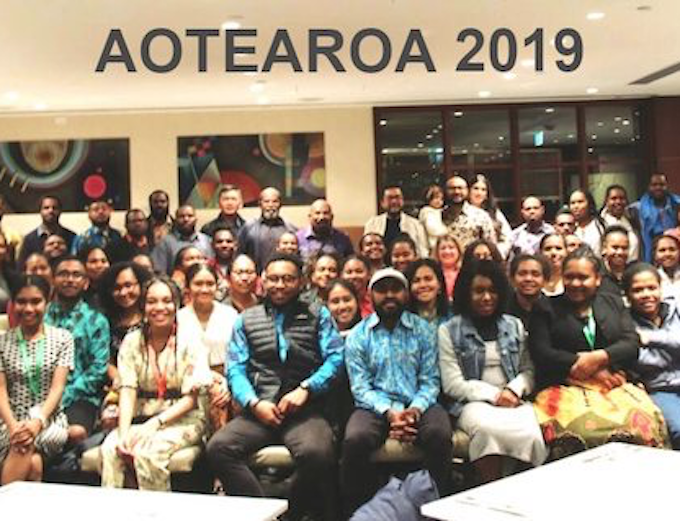
Some of the Papuan students in Aotearoa New Zealand pictured with Papua provincial Governor Lukas Enembe
Some West Papuan students in Aotearoa New Zealand pictured with Papua Provincial Governor Lukas Enembe (rear centre in purple shirt) during his visit in 2019. Image: APR

Carving up Indonesia’s Papua province

Widodo says move from two to five provinces is to aid development, skeptics see blow at indigenous people’s power

By JOHN MCBETH AUGUST 19, 2022

The five administrative divisions of Indonesian Papua. Central Papua is aqua. Highland Papua is blue. South Papua is forest green. Papua province (what’s left of the giant province from which those three were separated) is lavender. West Papua, unchanged territorially, is pea green. Map: Wikipedia

The Indonesian Government’s decision to carve up the sprawling province of Papua into four has been widely seen by its detractors as a strategic move to divide and conquer the rebellious indigenous population living mostly along the central mountain chain.

But the leading proponent of the move, President Joko Widodo, who has probably paid more attention to Papua than any previous leader, has always insisted it is aimed at speeding up development, delivering better public services to a vast region where poverty is commonplace.

Despite a last-minute intervention by the Papuan People’s Council (MRP), which threatened widespread demonstrations, the three new provinces – South Papua, Central Papua and Highland Papua – were finally declared on June 30.

MRP chairman Timotius Murib claimed the move was made without proper consultation and would bring more non-indigenous Papuans into local government posts, already a festering sore point among highland community leaders.

The three new provinces have 20 districts in total – four of them in South Papua, where Merauke is the administrative center, and eight each in Central Papua and Highland Papua. The rump Papua province retains nine districts spread out along the northern coast.

The fifth province of Indonesian Papua is the pre-existing West Papua, which remains territorially intact. It contains 1.1 million people and draws economic benefits from British petroleum company BP’s Tangguh liquefied natural gas (LNG) facility in the so-called Bird’s Head region.

Controversial changes to Papua’s 2001 Special Autonomy Law last year cleared the way for the recent division, which appears to cut across the seven tribal Papuan areas that Widodo formally recognized in a 2020 presidential instruction.

At 323,370 square kilometers, Papua province was by far Indonesia’s largest, roughly the size of Norway and with a populace of barely 4.3 million. About half those people are migrants from other islands who have settled mostly in lowland areas.

According to the Bureau of Statistics, the pre-division Papua province’s income last year was 14.7 trillion rupiah, or US$991.5 million, placing it fifth behind Jakarta (Rp72.18 trillion), West Java (Rp41.47 trillion), East Java (Rp31.2 trillion) and Central Java (Rp26.7 trillion).

Revenues are boosted by the presence of Freeport Indonesia’s Grasberg copper and gold mine in Central Papua, a new province stretching from the city of Nabire 200 kms across the Central Highlands to Freeport’s logistics center of Timika (pop: 142,000) on the south coast.

Although the best estimates suggest Freeport’s contribution may be as high as Rp12-13 trillion, there appears to be little to show for it – or for the $$8 billion the province has received in additional special autonomy allocations from the central government since 2002.

Critics blame that on corruption and the result of a concentration of power in the hands of bureaucrats and politicians in Jayapura, the capital and largest city (pop:363,000) located in the far northeast corner of the province bordering Papua New Guinea.

As a land bridge linking the north and south coasts, Central Papua stands to be the economic engine of the region, home not only to Freeport but also to the promising Wabu gold deposit and a long-planned hydro-electric project on the Urumuka River flowing out of Lake Enaratoli. 

Construction workers still have to finish a 23km stretch of the road linking Timika and the new province capital of Nabire (pop: 170,000), sitting on the 4,325km Trans-Papua Highway connecting Sorong in the west to Merauke in the southeast.

Another of Widodo’s pet infrastructure projects, which will open up the highlands for the first time, the final 183 kms of the pioneering highway are expected to be completed by 2024, although not all of it will have been paved by then.

Why the government chose Nabire as the capital has been the subject of conjecture. In any case the choice angered local Amungme and Kamoro tribal leaders. Freeport reportedly lobbied against the tribals’ choice, Timika, worried it would have to deal with the daily demands of a more powerful local government.

There were more compelling political reasons as well, mostly stemming from the past dominance of ailing provincial governor Lukas Enembe, 55, a loyalist of ex-president and Democrat Party leader Susilo Bambang Yudhoyono whose term ends later this year.

Enembe, the first highlander elected to the post, shunned Widodo’s early visits to Papua, but appears to have been brought into line in 2018 by corruption allegations involving Papuan student scholarships, in addition to charges that he interfered in district elections.  

Analysts say the ruling Indonesian Democrat Party for Struggle (PDI-P) and the second-ranked Golkar Party pushed hard for Nabire as part of an overall effort to end the Democrat Party’s hold on the province ahead of the 2024 legislative elections.

Breaking up the province into three power centers will have the effect of diluting the domination of Enembe’s majority Dani tribe and weakening the authority of Timika-based Mimika district chief Eltinus Omaleng, who steps down in late 2023. 

An Amungme, Omaleng has his eyes on the governorship of Central Papua, but political sources say Jakarta favors former Papua police chief Paulus Waterpauw, 58, now apparently learning the ropes as temporary governor of West Papua.

The trusted 58-year-old intelligence officer served as provincial police commander from 2014 to 2015, then was brought back in 2019-2021 to deal with the fallout from riots that engulfed the province after a racial incident in the East Java city of Surabaya. 

A hardline Golkar loyalist, Waterpauw is a Christian member of the small Kamoro tribe from West Papua’s Fak-Fak district, more than half of whose inhabitants are Muslim. That’s unusual for Indonesian Papua. About 62% of the West Papua population is Christian and the figure in pre-division Papua province was 70%. 

———Article is from Asia times.com/2208————————

Dialogue a dignified solution to the Papuan conflict

Peacebuilding in Papua – News Desk

15 August 2022

Dialogue
Illustration of Nduga children living in refugee camps in Muliama District, Jayawijaya due to armed conflict in the central highlands of Papua. – Jubi/Yuliana Lantipo

Jayapura, Jubi – Researcher from the National Research and Innovation Agency (BRIN) Cahyo Pamungkas said that in order to resolve with dignity the prolonged conflict in Papua, the solution was no other than through dialogue, not even the regional expansion into new provinces.

This was conveyed by Cahyo as a speaker in the Indonesia Leaders Talk online discussion “Let’s Love Papua” organized by the Prosperous Justice Party on Friday, August 12, 2022.

Even though the central government carried out Papua expansion with the argument to improve development and equal distribution of public services for the Papuan people, Cahyo said Papuan human resources were not ready for it. Study shows that the average length of

Papuans going to school was up until grade 2 to grade 5 of elementary school.

“If we look at conflict areas, such as in Nduga, Intan Jaya, the average length of schooling is only up to grade 3 of elementary school. How do we want the expansion of a province when the level of education is like that?” he said.

According to him, the number of new provinces in Papua did not guarantee that the conflict in Papua would end. Conflicts can only be resolved through peaceful dialogue between the central government in Jakarta and Papua.

“Dialogue doesn’t kill anyone. Conflicts can only be resolved through dialogue,” he said.;

Papuan human rights activist Frederika Korain added in the forum the importance of evaluating the 20-year implementation of Law No. 21/2001 on Papua’s Special Autonomy (Otsus). According to Korain, through a dialogue forum, all problems that occur in Papua can be discussed openly between the central government and the Papuan people.

“Otsus in Papua has been running for 20 years but why is the human development index of Papua) is still low? Why are Papuans increasingly marginalized? Why is militarism on the rise in Papua? We, the Papuan people, hope that there will be an open forum, where both parties sit down and evaluate the process that has taken place before, and then formulate together how Papua will go forward,” said Korain.

Meanwhile, Executive Director of Lokataru Haris Azhar said Papua did not need regional expansion, as there was no guarantee that it would resolve the conflict in Papua. So far, Haris said, Papua was oftentimes only seen as a living space for oligarchs to massively exploit Papua’s natural resources.

Haris said that currently, Papua needed leaders who were emotionally and culturally understanding and able to move people to resolve conflicts in Papua. (*)

https://imasdk.googleapis.com/js/core/bridge3.525.0_en.html#goog_99383718

Yamin Kogoya: West Papua’s colonial fate – UN ‘New York Agreement’

Yamin Kogoya: West Papua’s colonial fate – UN ‘New York Agreement’ 

By APR editor –  August 15, 2022

COMMENTARY: By Yamin Kogoya

West Papua … The only appropriate and adequate justice left for Papuans is to be given back their sovereignty. Image: Free West Papua/Twitter

Sixty years ago today — on 15 August 1962 — the fate of a newly born nation-state West Papua was stolen by men in New York. The infamous event is known as “The New Agreement”, a deal between the Netherlands and Indonesia over West Papua’s sovereignty.

A different fate had been intended for the people of West Papua in early 1961 when they elected their national Council from whom the Dutch were asking guidance for the transfer of administration back to Papuan hands.

Shockingly, the threat of colonialism came from America several months later when a journalist advocating liberty denounced a secret Washington proposal to betray America’s Pacific War ally Papua to an Asian colonial power.

The “special” nature of the US proposal had the opposite intent than that of the international law. The International Trusteeship System, Chapter XII of the United Nations Charter is meant protect a people’s right of independence and have the UN prepare annual reports about their welfare and progress towards independence for each territory the United Nations has become responsible for, including those invaded and subjugated by UN troops.

West Papua is both.

Instead of protection and annual reports, the United Nations by omission of duty is enabling Indonesian impunity for military campaigns of terror and administrative suspension of all human rights.

West Papuans have suffered hundreds of thousands of extrajudicial deaths, disappearances and looting of many hundreds of billions of dollars throughout the UN appointed administration by Indonesia.

Weekly stories of horror hidden from international news media by an ongoing Indonesian declaration that Papua is a quarantine zone requiring special permission for NGOs and journalists to enter.The Council’s response was to present to the Dutch a flag and manifesto of independence asking all the peoples of West Papua to unite as one people under their new Morning Star flag.

On 1 December 1961, the Dutch raised the Morning Star flag, and for more than 60 years the people have united as one raising their Morning Star flag.

But declassified American records reveal horrific deceptions. A group inside the White House had begun secret negotiations with the Republic of Indonesia around a proposal for an illegal use of the International Trusteeship System, or to quote the US, “a special United Nations trusteeship of West New Guinea” that irrespective of Papua’s objections would then ask Indonesia to assume control.

Fiscal and geopolitical deceptions
Every principle written into the UN’s charter, the Rules of Procedure of the Trusteeship Council, and even Indonesia’s own New York Agreement have been violated by the ongoing Indonesian conduct, international mining and United Nations omission of lawful conduct.

These events proceeded against the backdrop of a global movement calling for decolonialisation that rippled across Asia, Africa and the Pacific, with the West and the Communist bloc supporting or opposing one another to gain influence in these movements.

The newly independent nation of Indonesia, which had been under Dutch rule for more than 300 years, declared independence on 17 August 1945. Sukarno was the man of this era, leading the outburst of a long-awaited human desire for freedom and equality.

In the same era, wars broke out in Korea and Vietnam; the world endured the Cuban missile crisis as forces of the West and the Communist bloc continued to clash and reshape the destiny of these new nation-states.

Leading up to the final recognition of their new republic in December 1949, Indonesians experienced another brutal, protracted war with the Dutch. The Netherlands side wanted to reclaim their past colonial glory, and the Indonesian side wanted to removed Dutch occupation and authority from their nation.

Indonesia’s founding fathers, Sukarno and Suharto, were significant men of their era, with ambitions to match — ambitions that led to the massacre of millions of alleged Indonesian Chinese communists in the mid-1960s; the same ambition that placed the Papuan people on the path they are on now, carved by blood, tears, trauma, war, killing, rape, exploitation, betrayal, and being cheated at every turn by the world’s highest institutions.

Many nations around the world had to face difficult choices, with emerging leaders of all types avoiding the cause of their own imagined nation-state. This was a most turbulent era of development and globalisation.

Arguably, most conflicts around the world today stem from unresolved grievances brought about by this turbulence and divisive historical events.

West Papua’s extended conflicts for the last 60 years are a direct result of being mishandled by Western forces who sought to take Papua’s independence for themselves.

As of today, Indonesians (and those unaware of West Papua’s legal status under international law) think that this is a domestic issue, a narrative which Jakarta elites insist on propagandising to the world.

The truth is that West Papua remains an unresolved issue with international implications. More specifically, the UN still has the responsibility to correct their sixty-year-old mistake.

The UN breached its own charter
At least in principle, all 111 articles of the UN Charter are aimed at promoting peace, dignity, and equality. One of the key elements of the charter (in relation to decolonisation) is its declaration that colonial territories would be considered non-self-governing territories. The United Nations’ responsibility was to provide a “full measure of self-government” to those nations colonised by foreign powers. West Papua’s story as a new nation began within these international frameworks.

West Papua was already listed under the UN’s decolonisation system as a non-self-governing territory before 1962 and the Dutch were preparing Papuans for full independence in accordance with the UN charter guidelines. The public has been deceived by trivialising this agreement and downplaying it as simply two powers — Netherlands and Indonesia — fighting over West Papuan territory.

The UN, as a caretaker of this trust, had a responsibility to provide a measure for Papuans to achieve independence. The UN instead handed (abandoned) this trust to Indonesia, who then abused that international trust by invading West Papua in May 1963. This scandalous historical error has brought unprecedented cataclysm to Papuans to date.

The Indonesian perspective
Most Indonesians have been fooled by their government to think that West Papua’s fate was decided during a referendum, known as “Pepera” or “Act of Free Choice” in 1969, which Papuans now refer to as the “Act of No Choice”. Indonesians assume that Indonesian occupancy is good for West Papua, but this is not true: they are unaware that Indonesia is illegally occupying West Papua and their government is in breach of many international laws.

It seems that the Western powers have no issue turning a blind eye when one of their endorsed global players are breaking their laws.

During the period of July to September 1969, the Act of Free Choice was carried out by the Indonesian government. The UN was there but did not act or speak against it. This referendum was one of the items stipulated in the New York Agreement seven years earlier.

About 2025 Papuan elders among the one million Papuans who were handpicked at gunpoint and forced to say “yes” to remain with Indonesia. The UN acted as a bystander, unwilling to interfere with the tyranny taking place before them.

What we seem to forget is the fact that before the referendum in 1969, Indonesia had already launched a large-scale martial and administrative operation throughout West Papua, instilling fear and setting the stage for the rubber stamp referendum to proceed.

What happened in 1969 was a tragedy and a farce of human autonomy. The UN and international community betrayed West Papua on the world’s stage.

The New York Agreement
Andrew Johnson and Julian King, Australian researchers who specialised in this case, have argued that West Papua is still a non-self-governing territory, and that Indonesia has no legal or moral right to claim sovereignty over West Papua. These researchers insist that West Papua is still a non-self-governing territory, and Indonesia is only there temporarily as an administrator — they have no legal basis to introduce any law or policy towards West Papua.

In their ground-breaking seminal work West Papua Exposed: An Abandoned Non-Self-Governing or Trust Territory, Johnson and King conclude that:

EITHER AS A NON-SELF-GOVERNING TERRITORY OR A TRUST TERRITORY, THE LEGAL RIGHTS OF THE PEOPLE OF WEST PAPUA HAVE BEEN DENIED WITH EVERY UN MEMBER RESPONSIBLE AND LEGALLY BOUND TO UPHOLD THE CHARTER IN ORDER TO CORRECT THIS BREACH OF INTERNATIONAL LAW.

No Papuan was invited or included during the agreement. This act itself speaks volumes – the complete denial of Papuans’ intrinsic worth as human beings to have any input into their fate is the basis for all kinds of violence, abuse, torture and mistreatment towards Papuan people.

This is the first violation and the most egregious because the Indonesian government’s draconian policies towards Papuans have consistently exhibited and reinforced this prejudiced behaviour over the past 60 years. Indonesians do not treat Papuans as equal human beings, therefore, what Papuans think, desire and feel doesn’t matter.

It was the right move for the UN to accept West Papua as a Trust Territory. However, the UN abandoned this sacred trust to Indonesia a year later, even though Indonesia’s behaviour prior to, during, and after this agreement had already been in breach of many UN charters and principles.

For example, Chapters 11 (XI), 12 (XII), and 13 (XIII) of the UN Charter governing decolonisationand Papua’s right to self-determination, as specified in the New York Agreement’s Articles 18 (XVII), 19 (XIX), 20 (XX), 21 (XXI), and 22 (XXII) have not been followed.

Additionally, the UN’s failure to uphold its principles and its silence on its disastrous mistake constitutes a serious breach of international law.

Secret documents
Declassified documents from the United States, Australia, and the United Nations reveal irrefutable evidence of what went wrong behind the scenes prior to, during, and after the Netherlands-Indonesia agreement.

The idea of exploiting the UN Trusteeship system to transfer the sovereignty of West Papua to Indonesia was already proposed in 1959 by the US embassy in Jakarta.

Now-declassified document titled “A proposal for Settlement of the West New Guinea Dispute”, dated on May 26, 1959, stated:

OUR POSITION OF NEUTRALITY HAS SERVED ITS PURPOSE. IT IS TIME WE DEVELOPED A FORMULA TO REMOVE THIS MAJOR IRRITANT TO INDONESIAN RELATIONS WITH THE WEST.

In the US minds, the formula was exploiting the UN’s mechanisms to give West Papua sovereignty to Indonesia.

A year later on 3 March 1961, the US embassy wrote:

UNLESS NEW GUINEA QUESTION CAN BE PROMPTLY REMOVED AS SOURCE OF SOVIET STRENGTH AND US WEAKNESS, AS INCIPIENT CAUSE OF WAR AND AS PLATFORM FOR VARIETY OF UNHEALTHFUL ISMS WITHIN INDONESIA, OUR BEST EFFORTS IN ANY OTHER DIRECTION WILL FAIL TO ACHIEVE OUR OBJECTIVES HERE.

According to King and Johnson, the 1962 New York Agreement story has been a deception for 60 years; the agreement was not drafted after the Indonesian invasion in 1962. The agreement was proposed by an American lawyer in May 1959, modified in 1960, proposed to Indonesia in March 1961, and executed in 1962.

West Papua is not sold or traded under the Agreement. It is an agreement between UN members to share the responsibility for the welfare of West Papuan people (trusteeship), and it asks the UN to be the “administrator” (occupying force) in 1962. When the United Nations backed the agreement, Pakistani troops were appointed to administer West Papua in 1962, followed by Indonesian troops in 1963.

As it turns out, armies of secret dealers in UN uniforms were behind the scenes setting agendas, proposing solutions, and implementing them without consequences.

It appears then that the New York Agreement itself, the terms of reference upon which the UN General Assembly voted on the agreement, the UN’s role from 1962 to 1963, the final Act of Free Choice in 1969, and the UN General Assembly vote on the Act of Free Choice’s outcome were all facades — a treacherous performance fit for a tragic drama.

A carefully orchestrated plan was devised to sacrifice West Papua to Indonesia by manipulating the UN’s system by the United States — the leader of the free democratic world and the tyrant flexing its vast military power.

The fight to reclaim stolen sovereignty lives on
Papua played an important role in reshaping geopolitical arrangements between the West and the communist bloc, and it will continue to do so if this issue remains unresolved.

The future in which West Papua will play a critical role has arrived. The US and its allies will have to face China or any other power or ideological forces that are challenging the liberal world order.

The responses, criticisms, or reactions arising from nations around the world — whether it be on the issues of covid-19, the Ukraine war, Taiwan, Solomon Islands-China security deals, or any other global issue — suggest that the grand narrative of the West as the saviour of mankind pushed by the US is being questioned and rejected.

Another new grand narrative is now emerging, and that is China.

West Papua at a crossroads
What role will West Papua play in the current geopolitical tussle between the West and China is impossible to predict. This is something that must be dealt with by regional and international communities. West Papua’s issues do not dominate the headlines like Ukraine, Solomon Islands, or Taiwan, but they have their own significance in reshaping regional and global geopolitical arrangements.

The world of Papuans 60 years ago was different from now. More than half of a country abused, tortured and mistreated under Indonesia occupation is driving Papuans to become a minority in their own homeland. It has also strengthened their will to live and fight, and most Papuan youth are equipped with knowledge of the crimes against their people and what they can do to bring about justice and facilitate change.

Papuan resistance groups are increasingly becoming anti-Western, believing that the West is exploiting them while supplying arms to the Indonesian military. West Papuan students across Indonesia often wear revolutionary hats or t-shirts displaying socialist and communist revolutionary leaders such as Fidel Castro, Lenin, Che Guevara, and Ho-Chi Mi — they are well-versed in Leftist literatures.

The attitude of the general population in West Papua is also changing. Where previous generations have had a strong connection with the West due to shared experiences of World War II and influence by Western missionaries, young people are now questioning everything about the current state of affairs and asking why they are in this predicament.

Papua’s governor also praised Russia for its generous sponsorship of Papuans to study in the country. The Governor is currently building Russian and Papuan museums to strengthen this relationship and honour Russian anthropologist Nicholai Nicholaievich Mikluho Maklai, who advocated for the rights of New Guinea People 150 years ago.

The West Papua National Liberation Army (TPNPB)
The armed wing of the Free Papua Movement (OPM), the West Papua National Liberation Army (TPNPB), has also been changing its armed resistance strategy against Indonesian occupation.

They are shooting and killing anyone they consider a traitor or an invader, an attitude never seen before. It is dangerous because of not only their drastic approach, but the retaliation from heavily armed Indonesian security forces, who are aggressively shooting, burning, rampaging, and bombing anyone they consider to be OPM.

The TPNPB and Indonesian security forces have been at war for many years, and Jakarta has responded with heavy handed security measures by sending thousands of soldiers to hunt down the alleged perpetrators.

Recently, this has intensified, resulting in the displacement of thousands of Indigenous Papuans.

West Papua civilians could be subjected to an unprecedented mass atrocity if (or when) this situation escalates. According to a report published by the United States Holocaust Memorial Museum, structural factors behind conflict in the region are showing signs of events that could trigger mass atrocities against civilians.

As reported by the UCA News, Gadjah Mada University researchers in Yogyakarta reported 348 violent acts in Papua between 2010 and March of this year. There were at least 464 deaths, including 320 civilians, and 1654 injuries, mostly civilians.

There are far more human tragedies unfolding in West Papua each day than what this figure represents. Unfortunately, Jakarta has blocked independent journalists from entering the region, making it difficult to verify these claims.

International voices for human rights investigation
In March 2022, UN experts from the Office of the Human Rights High Commissioner published a report highlighting serious violations and abuses against Papuans.

In addition, Jakarta has not granted a request for a visit by the UN High Commissioner to the region made by the UN Human Rights Council.

Despite the Tuvalu resolution of the Pacific Island Forum in 2019 and another resolution from African Caribbean and Pacific nations requesting Jakarta for a UN visit, the request has not yet yielded results.

On August 3, ABC Radio Australia hosted Benny Wenda, the UK-based exiled West Papua independence leader, to discuss the current situation in his homeland.

According to Wenda, the plight of West Papua to determine its own fate is clouded by the current geopolitical intrigues between the West and China. The status of West Papua is an unresolved international issue that has been swept under the carpet.

Even though the 52nd Pacific Islands Forum (PIF) meeting of heads of state and government held in Suva, Fiji from 11 to 14 July 2022 left West Papua out of the forum’s agenda, Wenda expressed optimism that West Papua would not be forgotten at the next meeting.

Indonesia and West Papua at a crossroads again
Although West Papua has been buried deep within diplomacy for 60 years, it remains the most important issue affecting Jakarta’s relations with China and the US, as well as the way big powers deal with the independent Indigenous nation states across Oceania.

Above all, geopolitical war via chequebook diplomacy, media, or forming military and trade alliances and deals in the Pacific has become a real issue that we all must face.

The peaceful blue Pacific (Oceania), which Australia and New Zealand consider their “backyard” could become a new Middle East.

In response to this fear, the White House invited Pacific leaders to dinner later this year with Joe Biden.

At the outset, West Papua issues might seem insignificant, irrelevant, or forgotten to the world, but in reality, it is one of the most significant issues influencing how Jakarta’s engage with the world and how the world engages with Jakarta.

Once again, Jakarta is caught in the middle between great powers, and they do not have the same leverage to play the same games as their ancestors did so many years ago. Jakarta elites need to recognise that they stole something so precious that belonged to Papuan people, and this must be returned to the rightful owner.

The only appropriate and adequate justice left for Papuans is to be given back their sovereignty. This is the only way for Papua to heal and have decades of violence against them reconciled.

Yamin Kogoya is a West Papuan academic who has a Master of Applied Anthropology and Participatory Development from the Australian National University and who contributes to Asia Pacific Report. From the Lani tribe in the Papuan Highlands, he is currently living in Brisbane, Queensland, Australia.

——————————————

Papuan scribe bags Indonesia’s press freedom award  


Victor Mambor, co-founder of tabloid Jubi, is often targeted for reporting on human rights issues

 By Ryan Dagur Published: August 09, 2022 09:37 AM GMT 

Victor Mambor, a native Papuan journalist has won Indonesia’s press freedom award. (Photo: Facebook)

A native Papuan journalist known for reporting on human rights issues has been awarded the press freedom award by an Indonesian journalists’ organization.

Victor Mambor, the co-founder of tabloid Jubi, the largest media in Papua, was presented the Udin Award on the 28th anniversary of the Alliance of Independent Journalists (AJI) on Aug. 7.

The award is named after the pen name used by Fuad Muhammad Syafruddin, a journalist of the Yogyakarta-based Bernas Daily who died after being attacked by two unknown assailants on August 16, 1996.

Mambor hoped the award would remind the public that “intimidation, criminal, physical, verbal and digital violence against journalists is still happening” and the media in Papua is fighting daily for its freedom to report.

“If we believe that the press is the fourth pillar of democracy, then we should encourage better press freedom in the land of Papua so that democracy will do better too,” he said.

AJI said that Mambor has consistently raised human rights violations in Papua through his journalism since 1996. He has written in Indonesian and international media, and also co-founded the tabloid Jubi.

“With Jubi, Victor brings more voices from Papua, in the midst of the dominance of information that is biased, unilateral and discriminates against Papua,” AJI said.

Due to his experience, Mambor is also known as a mentor for young journalists in the easternmost region.

In June, he conducted training in journalism for seminarians in the three dioceses of Papua as part of a program organized by the Franciscan Secretariat for Justice, Peace and Integrity of Creation.

Yuli Langowuyo, executive director of the Franciscan Secretariat for Justice, Peace and Integrity of Creation, said Mambor is very deserving of the award because of his dedication and consistency as a journalist.

She further lauded him for sparing his knowledge and time with the grassroots community during the training of seminarians.

“Even though his work as a journalist, especially in Papua, brings danger to himself and his family, we do not see him resigning from his journalism work,” she told UCA News.

Bambang Muryanto, one of the award’s jury said, it is not easy for a journalist like Mambor to maintain professionalism and independence in conflict-torn Papua.

“His own safety and that of his family is at stake. The remoteness of his location also poses several challenges in presenting a comprehensive picture,” he said.

Mambor has been intimidated on several occasions for his reporting.

The UN Human Rights Council in September 2021 called him a humanitarian and a rights activist who experienced frequent acts of violence and intimidation.

“Threats are certainly like daily food for him and other journalists in armed conflict areas,” Muryanto said.

Papua has seen conflict since becoming a part of Indonesia in 1969 with continued resistance by armed pro-independence groups.

The province is ranked 33 among the country’s 34 provinces as per the Press Freedom Index released by Indonesia’s Press Council in January.

The Indonesian government restricts foreign journalists from visiting the region.

Proposal for active TNI officers to hold civil posts seen as revival of TNI’s dual function

Kompas.com – August 8, 2022

Achmad Nasrudin Yahya, Jakarta — A proposal by Coordinating Minister for Maritime Affairs and Investment Luhut Binsar Pandjaitan that active TNI (Indonesian military) officers be allowed to occupy positions in state ministries and institutions is seen as an effort to revive the TNI’s dual socio-political function (dwifungsi).

Indonesian Legal Aid Foundation (YLBHI) Chairperson Muhammad Isnur believes that this effort is in line with government policy moves which have shown signs of reviving the New Order (Orba) regime of former president Suharto.

“Up until now, there have been many policies by the Jokowi [President Joko Widodo] regime which show signs of reviving the authoritarianism of the New Order regime”, said Isnur in a press release on Monday August 8.

Isnur gave several examples of the symptoms of the New Order under President Widodo’s administration. One of these is efforts to militarise civilians through the Reserve Component (Komcad) system for state civil servants (ASN).

This system is embodied in Minister for Administrative and Bureaucratic Reform (Menpan-RB) Circular Number 27/2021 on the Role of ASN Officials as a Reserve Component in Supporting National Defense Efforts.

“On the other hand, resolving past human rights violations as well as resolving the Papua conflict which involves the TNI has yet to show any clarity”, said Isnur.

Isnur also asserted that Panjaitan’s proposal to revise Law Number

34/2004 on the TNI is in line with growing signs of authoritarianism.

According to Isnur, this discourse poses a serious threat to democracy as a fruit of reformasi — the political reform process that began in 1998.

“Not only that, LBP’s (Panjaitan’s) statement as a state official is a form or abuse of power and negates the constitution”, he asserted.

Earlier, Panjaitan proposed revision to the TNI law so active TNI officers could hold positions in government ministries and institutions.

“[Revising] the TNI Law is actually one of the things that has been needed since I was the Menko Polhukam [coordinating minister for security], that TNI [officers] be assigned to [government] ministries and institutions at the request of the institution and the president’s agreement”, said Panjaitan during Retired Army Generals Association

(PPAD) national meeting on Friday August 5.

According to Panjaitan, if this is realised, there will no longer be any senior Army officers filling unnecessary posts so the Army’s performance will be more efficient.

These senior Army officers, said the retired general, will also no longer need to compete over posts because they can follow a carrier outside of military institutions.

“Actually the TNI can could later play a simpler role, and not all TNI officers will have to become KSADs [Army chiefs of staff], they may well not be KSAD but be in a ministry”, said Panjaitan.

Panjaitan added that the stipulations which he is proposing are already valid for active Indonesian police officers who can be assigned to government ministries and institutions.

“So I hope that the TNI in this can along with the Kemhan [Defense Ministry] be able to insert an article such as this into revisions to the TNI Law”, he said.

[Translated by James Balowski. The original title of the article was “Luhut Ingin Revisi UU TNI agar Perwira Aktif Jabat di Kementerian,

YLBHI: Gejala Rezim Orba Kembali”.]

Source:

https://nasional.kompas.com/read/2022/08/08/13074571/luhut-ingin-revisi-uu-tni-agar-perwira-aktif-jabat-di-kementerian-ylbhi

—————————————————————

Graft agency’s poor image because it has been attacked from inside and

out: Observer

r

Kompas.com – August 9, 2022

Syakirun Niam, Jakarta — Gajah Mada University Faculty of Law Anti-Corruption Studies Centre (Pukat UGM) researcher Zaenur Rohman says that the corruption Eradication Commission’s (KPK) performance has progressively worsened because the institution has been attacked from inside and out.

According to Rohman, the decline in the KPK’s image was intentionally designed right from the start. One of the most important moments which influenced the KPK’s performance was when the revisions to the KPK Law were enacted in 2019.

Rohman conveyed this in response to a Kompas Research and Development

(Litbang) survey that found that the KPK’s image was the worse it has been in the last five years.

“The key moment was the revisions to the KPK Law through Law Number 19/2019″, said Rohman when contacted by Kompas.com on Tuesday August 9.

Rohman said that these revisions resulted in the KPK losing much of its strategic powers needed to eradicate corruption.

According to Rohman, these revisions were an effort to weaken the KPK from the outside. The revisions to the law were carried out by the House of Representatives (DPR) and the government.

Meanwhile the effort to weaken the KPK from inside was when several controversial figures were selected to become the KPK’s new commissioners, one of which was Firli Bahuri, who was subsequently chosen to become the head of the KPK.

“Right from the start Firli Bahuri had a record of ethical issues because he had committed ethical violations when he held the position of deputy of operations at the KPK, but instead he was in fact selected [as a commissioner] then become the chairperson”, said Rohman.

Continuously beset by problems

According to the UGM law expert, it is because of these two issues that the KPK has continued to be beset by problems which have caused the institution’s image in the eyes of the public to decline.

The revisions to the KPK Law also gave rise to an internal struggle within the KPK with Bahuri and the KPK leadership dismissing the commission’s best investigators and other KPK employees who were deemed to have failed a national perspectives test (tes wawasan kebangsaan, TWK).

“Those who formulated the revisions already knew what the KPK would be like in the future”, said Rohman.

“What was the consequence? The consequence was that the KPK’s performance in preventing and prosecution worsened. What’s the evidence?

There aren’t any strategic cases, the corruption perception index has also worsened”, he said.

A Litbang Kompas survey conducted in July revealed that the KPK’s image had declined to a figure of just 57 percent, the lowest in the last five years.

In addition to this, the survey revealed that the public’s trust that the KPK is lead by people who are free of corruption has begun to fade.

“As many as 62.6 percent of respondents no longer believe that the KPK is headed by people who are free from corruption”, said Litbang Kompas researcher Rangga Eka Sakti as quoted by the Kompas Daily newspaper on Monday August 8.

[Translated by James Balowski. The original title of the article was “Citra Baik KPK Rendah, Pengamat: Diserang dari Luar dan Dalam”.]

Source:

https://nasional.kompas.com/read/2022/08/09/18190591/citra-baik-kpk-rendah-pengamat-diserang-dari-luar-dan-dalam

—————————————————————

INDOLEFT News service

If you are not already subscribing to this news service, you can do so by sending a blank e-mail to <subscribe-indoleft@riseup.list.net> and you will be automatically added to the list.

To view the archive of Indoleft postings since 2003 visit:

<https://www.indoleft.org>.

Follow us on Facebook:

<http://www.facebook.com/asiapacificsolidaritynet>

—————————————————————