Jakarta. The Indonesian Military has established five new infantry battalions to be deployed in conflict-prone areas of Papua, Armed Forces Commander General Agus Subiyanto announced on WednesdayThe primary mission of these battalions is to maintain security and support the government’s development efforts in the eastern region of Indonesia.“We have inaugurated five battalions to be stationed in vulnerable areas of Papua. Their goal is to assist the government in accelerating development and improving the prosperity of the Papuan people,” Agus said during a press briefing in Jakarta.These ground forces will help secure major government projects, such as the food security program covering over 1,000 hectares of crops in Merauke Regency, and key road construction projects across Papua.
The newly established units are:
Ksatria Yuddha Kentsuwri 801st Infantry Battalion for Keerom Regency,
Wimane Mambe Jaya 802nd Infantry Battalion for Sarmi Regency,
Nduka Adyatma Yuddha 803rd Infantry Battalion for Boven Digoel Regency,
Dharma Bhakti Asasta Yudha 804th Infantry Battalion for Merauke Regency, and
Ksatria Satya Waninggap 805th Infantry Battalion for Sorong Regency.
In recent years, Papua has seen an escalation in insurgent activity, with sporadic attacks on both civilian and military targets. The Free Papua Movement (OPM) has been responsible for abductions and killings, particularly targeting construction workers involved in key infrastructure projects aimed at improving connectivity in the region.
A notable incident involved the abduction of New Zealand pilot Philip Mark Mehrtens, who was held hostage by an OPM rebel group for nearly 20 months before being released last month.
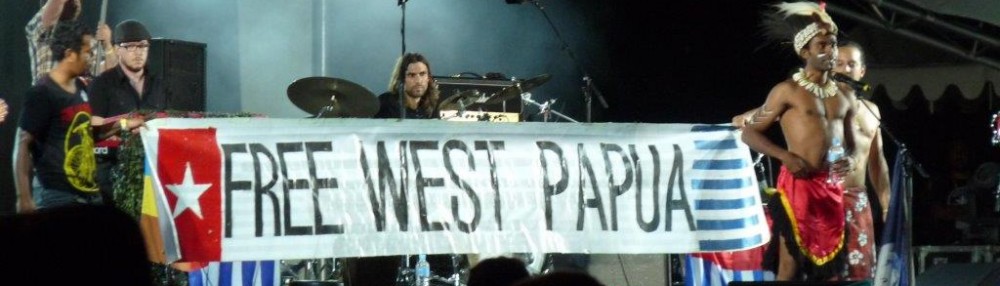
West Papuan independence advocate Octo Mote is in Aotearoa to win support for independence for West Papua, which has been ruled by Indonesia for over 60 years.
Mote is the vice-president of the United Liberation Movement for West Papua (ULMWP), and is being hosted in New Zealand by the Green Party, which Mote said had always been a hero for West Papua.
ULMWP president Benny Wenda has alleged more than 500,000 Papuans have been killed since the occupation, and millions of acres of ancestral forests, rivers and mountains have been destroyed or polluted for “corporate profit”.
The struggle for West Papuans
“Being born a West Papuan, you are already an enemy of the nation,” Mote said.
“The greatest challenge we are facing right now is we are facing the colonial power who live next to us.”
If West Papuans spoke up about what was happening, they were considered separatists, Mote said, regardless of whether they were journalists, intellectuals, public servants or even high-ranking Indonesian generals.
“When our students on the ground speak of justice, they’re beaten up, put in jail and [they – Indonesians] kill so many of them,” Mote said.
Mote is a former journalist and said, while he was working, he witnessed Indonesian forces openly fire at students who were peacefully demonstrating their rights.
“We are in a very dangerous situation right now. When our people try to defend their land, the Indonesian government ignores them and they just take the land without recognising we are landowners,” he said.
The ecocide of West Papua
The ecology in West Papua was being damaged by mining, deforestation, and oil and gas extraction. Mote said Indonesia wanted to “wipe them from the land and control their natural resources”.
He said he was trying to educate the world that defending West Papua meant defending the world, especially small islands in the Pacific.
West Papua is the western half of the island of New Guinea, bordering the independent nation of Papua New Guinea. New Guinea has the third-largest rainforest after the Amazon and Congo and is crucial for climate change mitigation as they sequester and store carbon.
Mote said the continued deforestation of New Guinea, which West Papuan leaders were trying to stop, would greatly impact the small island countries in the Pacific, which were among the most vulnerable to climate change.
Mote also said their customary council in West Papua had already considered the impacts of climate change on small island nations and, given West Papua’s abundance of land, they said by having sovereignty they would be able to both protect the land and support Pacific Islanders who needed to migrate from their home islands.
In 2021 West Papuan leaders pledged to make ecocide a serious crime and this week Vanuatu, Fiji and Samoa submitted a court proposal to the International Criminal Court to recognise ecocide as a crime.
Support from local Indonesians
Mote said there were Indonesians who supported the indigenous rights movement for West Papuans. He said there were both NGOs and a Papuan Peace Network founded by West Papuan peace campaigner Neles Tebay.
“There is a movement growing among the academics and among the well-educated people who have read the realities, among those who are also victims of the capital investors, especially in Indonesia when they introduced the omnibus law.”
The omnibus law was passed in 2020 as part of the president’s goals to increase investment and industrialisation in Indonesia. The law was protested because of concerns it would be harmful for workers due to changes in working conditions, and the environment because it would allow for increased deforestation.
He said there was an “awakening” especially in the younger generations who were more open-minded and connected to the world, who could see it both as a humanitarian and an environmental issue.
The ‘transfer’ of West Papua to Indonesia
“The Dutch [traded] us like a cow,” Mote said.
The former Dutch colony was passed over to Indonesia in 1963 but ULMWP calls it an invasion.
From 1957, the Soviet Union had been supplying arms to Indonesia and, during that period, the Indonesian Communist Party had become the largest political party in the country.
The US engineered a meeting between both countries, which resulted in the New York Agreement, giving control of West Papua to the UN in 1962 and then Indonesia a year later.
The New York Agreement stipulated that the population of West Papua were entitled to an act of self-determination.
The ‘act of no choice’
This decolonisation agreement was titled the 1969 Act of Free Choice, which is referred to as “the act of no choice” by pro-independence activists.
Mote said they witnessed, “how the UN allowed Indonesia to cut us into pieces, and they didn’t say anything when Indonesia manipulated our right for self-determination.”
The manipulation Mote refers to is for the Act of Free Choice. Instead of a national referendum, the Indonesian military hand-picked 1,025 West Papuan “representatives” to vote on behalf of the 816,000 people. The representatives were allegedly threatened, bribed and some were held at gunpoint to ensure a unanimous vote.
Leaders of the West Papuan independence movement assert that this wasn’t a real opportunity to exercise self-determination as it was manipulated. However, it was accepted by the UN.
Pacific support at UN General Assembly
Mote has came to Aotearoa after the 53rd Pacific Island Leaders Forum meeting in Tonga and has come to discuss plans over the next five years. Mote hopes to gain support to take what he calls the “slow-motion genocide” of West Papua back to the UN General Assembly.
“In that meeting we formulated how we can help really push self-determination as the main issue in the Pacific Islands,” Mote said.
Mote said there was focus on self-determination of West Papua, Kanaky/New Caledonia and Tahiti. He also said the focus was on what he described as the current colonisation issue with capitalists and global powers having vested interests in the Pacific region.
The movement got it to the UN General Assembly in 2018, so Mote said it was achievable. In 2018 Pacific solidarity was shown as the Republic of the Marshall Islands, Tuvalu and the Republic of Vanuatu all spoke out in support of West Papua.
They affirmed the need for the matter to be returned to the United Nations, and the Solomon Islands voiced its concerns over human rights abuses and violations.
What needs to be done
He said in the next five years Pacific nations needed to firstly make the Indonesian government accountable for its actions in West Papua. He also said President Joko Widodo should be held accountable for his involvement.
Mote said New Zealand was the strongest Pacific nation that would be able to push for the human rights and environmental issues happening, especially as he alleged Australia always backed Indonesian policies.
He said he was looking to New Zealand to speak up about atrocities taking place in West Papua and was particularly looking for support from the Greens, Labour and Te Pāti Māori for political support.
The coalition government announced a plan of action on July 30 this year, which set a new goal of $6 billion in annual two-way trade with Indonesia by 2029.
“New Zealand is strongly committed to our partnership with Indonesia,” Foreign Affairs Minister Winston said then.
“There is much more we can and should be doing together.”
“I have to yell out to the world. Because if I do not, we are weakening. The indigenous will be wiped out”, says one West Papuan highlander fighting for independence.
“I have to yell out to the world. Because if I do not, we are weakening. The indigenous will be wiped out”, says one West Papuan highlander fighting for independence (ABC News In-depth,2020). The Papua conflict has been ongoing for far too long. According to Lembaga Ilmu Pengetahuan Indonesia (LIPI) (2011), it all started in 1969 when, under the New York Agreement on Papua, the Dutch agreed to transfer Papua or Dutch New Guinea to Indonesia subject to a referendum. It was argued that the 1969 Act of Free Choice (AFC) or Penentuan Pendapat Rakyat (Pepera) had indicated foul play that was done by the Indonesian government, violating the “one man, one vote” content of the agreement. This then created a sort of discontentment among the Papuans and the Indonesian government. It all started as a protest for a redo. However, rather than being resolved, the conflict only grew from there.
Human rights violations committed by the Indonesian government and state security forces towards the Papuans, and especially the West Papuans, aren’t getting the scrutiny they deserve. The Categories of violations include the right to life, the right to freedom of expression, and the right not to be tortured. Even now, in a notable-aware society, the list of controversial cases is not ending. In 2022, the list of human rights violations in Papua increased from the years before. Most cases are related to the suppression of freedom of expression and the rejection of oil palm plantations. Civilian casualties were more than 300 people, including women and children! Worse, 34 of these horrific cases involve the authorities and state officials, and even 4 are armed conflicts involving the military and the Tentara Pembebasan Nasional Papua Barat-Organisasi Papua Merdeka (TPNPB). (Laia, 2023)
It doesn’t stop there. Recently, #AllEyesOnPapua has been trending throughout all social media platforms as a nod to the #AllEyesOnRafah campaign. The Papua campaign brings awareness to the tribal forests by clear-cutting inside oil palm concessions. The four companies in Boven Digoel and Sorong are planning to overlap and destroy indigenous tribes’ land by establishing an area twice the size of Indonesia’s capital, Jakarta, plantations. This is indeed an act of cruelty! What’s even crueler is that the concessions form a project called the Tanah Merah mega plantation, which sits on an immense block of primary rainforest twice the size of New York City. This project is run by several companies owned by unknown investors, hiding behind anonymously held firms in the Middle East. This means foreigners. Foreigners with corporate secrecy, which Indonesia’s corrupted bureaucracy played a part in. Yayasan Penguatan Partisipasi, Inisiatif, dan Kemitraan Masyarakat Sipil Indonesia (YAPPIKA) stated that the Papuans consider the government and state authorities to be supportive of capital owners and foreign companies, compared to the indigenous and native Papuans(Gradiyanto, 2021). They argue using production being controlled by said foreigners. The question Papuans wished the government would answer is, “Where should we go?”. (Jong, 2024)
Even in their own homes, they are unsafe and unsatisfied. Papuan political and economic unrest has arisen due to controversy over social infrastructure development. This writer argues that the failure of development programs, especially in the fields of education, health, and community empowerment in Papua, creates dissatisfaction with the Indonesian government. Even as essential as access to markets is limited, thereby limiting the development of agricultural products (Raweyai, 2001). Furthermore, more than 244.000 children at the Sekolah Dasar level, more than 224.000 at the Sekolah Menengah Pertama level, and more than 151 thousand at the Sekolah Menengah Atas level did not attend school, and the shortage of more than 20 thousand teachers throughout Papua (Hutasoit, 2023) are educational issues that need addressing. Unsurprisingly, Papua is the poorest province in Indonesia, with a low human development index (Pahlevi, 2023).
And as an Indonesian writer, it is profoundly saddening to witness such complex atrocities happening in the nation. It’s saddening to witness a fellow Indonesian feel exploited and say, “I feel like all they want from us is our riches, our land. But not us” (ABC News In-depth, 2020). The Papuans felt they were victims of injustice and wished for independence from Indonesia. Their wish is then fought by themselves, forming the Organisasi Papua Merdeka (OPM) or the Free Papua Movement. The Tentara Nasional Indonesia (TNI) returned to using OPM as an umbrella name for the terrorist separatist and armed criminal groups of Papua. According to the Kepala Pusat Penerangan TNI Mayor Jenderal Nugraha Gumilar, the change of terms is for society to be made aware that the OPM are soldiers and combatants who have the right to become victims in armed conflict (Yunus, 2024). It must be highlighted that, indeed, the OPM is not a peaceful or non-violent movement. In 2023, OPM formally stated that it was responsible for the burning of school buildings and shooting down planes in Bintang Mountains, Papua (BBC, 2023).
Some argue that the Papua conflict is a problem of violence, terrorism, separatism, or even criminals. However, if this is merely a problem of violence, this only means a problem of intentional use of physical force or power against another person that either results in injury, death, or psychological harm (UNHRC, n.d.). And if it is merely a problem of violence, what differentiates it from the acts of violence done in other areas? In Yogyakarta, there are many cases of violence done by a group of Klitih (Nurhadi, 2021). As the state’s capital, Jakarta has seen quite a lot of violence. And so, this writer does not think of the Papua conflict as a problem of violence.
This writer believes that the root problem of the Papua conflict is inequity and injustice. Therefore, this policy brief aims to eliminate violence and bring justice and equity. Peace does not mean no disputes, but at least with peace, long overdue justice is finally served. A few efforts have been made to resolve the Papua conflict and build the pathway to peace, one of which is through the making of Undang-Undang Otonomi Khusus Papua dan Pembentukan Daerah Otonom Baru (DOB) as a state law:
“This law regulates the addition and amendment of several articles in Law Number 21 of 2001 as amended by Law Number 35 of 2008. The authority of Papua Province includes authority in all fields of government, except for authority in the fields of foreign policy, defense and security, monetary and fiscal, religion, and justice as well as certain authorities in other fields determined in accordance with the provisions of laws and regulations. The regional government of Papua Province consists of the Regional Government of Papua Province and the Papuan People’s Representative Council (DPRP). The DPRP consists of members elected in general elections and appointed from the indigenous Papuan element.” (BPK, 2021)
However, this is not enough. This writer argues that through recent cases, it is evident that the conflict has not been resolved and has not calmed, even with the policy of special autonomy. Therefore, through this policy brief, this writer would like to propose recommendations to the Indonesian government to transform or resolve the Papua conflict.
Since the beginning, Sukarno’s policy regarding Papua has been clear, namely, incorporating the territory into Indonesian territory, as with the adjacent former Dutch lands. This then creates a bond between people, known as nationalism. According to Britannica (2019), nationalism is an ideology based on the premise that the individual’s loyalty and devotion to the nation-state surpass other individual or group interests. In simple terms, nationalism means an individual’s love for a particular nation-state. However, nationalism could not be the only answer to such a complex conflict. Nationalism only works if Papua is treated in equity as the other areas of the nation. Nationalism only works if Papuans are considered part of the nation, not only Papuan land but also Papuan people!
The Papua conflict is cultural as much as it is political. Therefore, this writer urges the government to carry out a dialogue. To do so, the primary stakeholders need to be identified. Rather than hold a regular discussion between two parties, this writer believes that by involving experts who can provide comparative examples or options of solutions. As the involved parties are the Indonesian government and Papua as a province, the two are unable to think clearly and objectively, thus unable to think outside the box. It would be better if the two invited professionals could present new ideas with tangible evidence in a dialogue. For example, ask a professional and expert in land disputes to provide a menu of solutions by saying, “Oh, in Mexico, they divide the land into two!” or “In Japan, they made skyscrapers to move the indigenous!”. Given a menu of solutions, the two parties can choose from a selection. This writer also believes it would be ideal if the state or government here works as a participant rather than a facilitator, which means there needs to be another independent dialogue facilitator to ensure objectivity and fairness in the discussion.
For all human rights violations and cases of violence that occur between the TNI, OPM, and even Papuans, perpetrators must go through all the processes of law in conflict resolution. And official supervision from the Indonesian government must be maintained to prevent repetition.
These approaches must be done continuously and, indeed, until solutions by Papuan needs are met. As it is understood, the root cause of the conflict is inequity, so to truly resolve the dispute, Papuan problems need to be treated and paid the same as the other Indonesian provinces. Even so, Papuan issues are not one for all. The mountains of Papua must have conditions that are different from those of the coastal Papua, so various problems must be addressed. Hence, this writer recommends that the Indonesian government change its standards, especially in making state laws. Instead of equality, highlighting equity is much more critical. Asymmetrical standards and regulations customized to each area of the nation will make everyone feel involved. That is when true nationalism takes place.
The Papua conflict is complex, involving almost every aspect of life, including culture. Cases of human rights violations, indigenous people’s eviction, and inequity pushed the Papuans to fight for freedom, thus creating the Organisasi Papua Merdeka. To transform and resolve the conflict between the Papuan organization and the Indonesian government, this writer recommends a well-structured dialogue, prevention of repetition, and a fight for equity rather than merely continuing the special autonomy policy.
A nation without nationalism is merely a territory with people. However, nationalism could only work if a nation truly treats all of its people and territory in equity.
Jasmine Naurah
Sabrina Jasmine Naurah Sabrina is undergoing her undergraduate studies at Universitas Gadjah Mada. Jasmine is a lifelong learner of global politics and international relations. She is incredibly passionate about film and literature. She is, therefore, dedicated to further exploring and expressing opinions through writing. —————————————————————
Responding to the shooting of Yan Christian Warinussy, a senior lawyer and human rights defender in the province of West Papua, Amnesty International Indonesia’s executive director Usman Hamid said:
“This heinous act is not only a violation of Yan Christian Warinussy’s right to bodily integrity but also an alarming attack on the principles of justice and human rights in Papua.
“Yan Christian Warinussy has long been a steadfast defender of human rights in Papua, tirelessly working to ensure justice and equality for all. His advocacy has been instrumental in bringing to light numerous human rights violations and in providing legal assistance to those most vulnerable.
“This attack is a reprehensible attempt to silence a courageous voice and to instil fear in those who fight for justice.
“We call on the authorities to promptly conduct an effective, thorough and impartial investigation into this attack and to bring the perpetrators to justice in fair trials.
“The government must take immediate and decisive action to protect human rights defenders and to ensure that perpetrators who have committed such acts of violence are brought to justice.”
Background
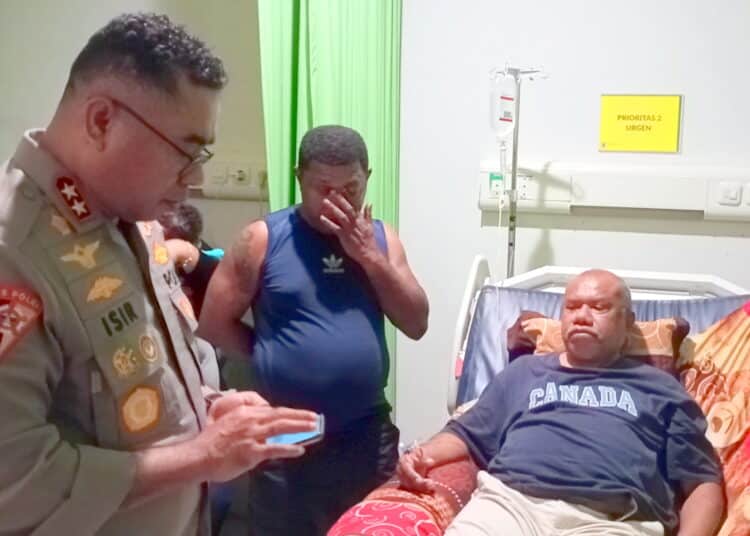
Yan Christian Warinussy, a senior lawyer and human rights activist in Papua, was shot by an unidentified person in Manokwari, West Papua province on Wednesday 17 July.
According to his driver, cited by some local media, the shooting occurred after Warinussy had just withdrawn money from an ATM kiosk on the roadside. Previously he attended a corruption trial involving some local state auditors at the Manokwari anti-corruption court.
He survived and was taken to hospital to get medical treatment. The doctor managed to remove an air rifle bullet projectile from his chest. Local police said they were investigating and attempting to find the suspected shooter.
Warinussy is known as a lawyer and human rights defender in Papua because of his dedication to advocating for the rights of the Papuan people. He leads the Research Institute for Legal Aid Assessment and Development (LP3BH) in Manokwari.
He has received various national and international awards for his human rights work, including the John Humphrey Freedom Award in 2005. This award recognized his efforts in exposing gross human rights violations in West Papua and defending the rights of the marginalized, despite facing repeated intimidation and threats. (*)
The Asian Human Rights Commission (AHRC) supports Indonesian civil society organisations to promote the eradication of torture. The organisations consist of the Sekretariat RFP (Aliansi Masyarakat Sipil untuk Reformasi Kepolisian), the LBH Masyarakat (LBHM), the Yayasan Lembaga Bantuan Hukum Indonesia (YLBHI) and the Komisi untuk Orang Hilang dan Korban Tindak Kekerasan (KontraS).
June 26 is an important moment for the international community to commemorate the United Nations International Day in Support of Victims of Torture. This warning began with the formation of the Convention against Torture and Other Cruel, Inhuman or Degrading Treatment or Punishment (Convention against Torture [CAT]) which came into force on 26 June 1987 for all Member Countries. The enactment of the CAT is the main instrument in the struggle to prevent the practice of torture and to respect human dignity.
Indonesia is one of the Member States that has ratified the CAT through Law Number 5 of 1998, exactly 25 years ago on 28 September 1998. However, the practice of torture and cruel punishments still occurs in the law enforcement cycle in Indonesia. Based on the findings of the YLBHI and LBH Jakarta, from 2013-2022, there were at least 58 victims of torture by members of the Police, 25 of whom were victims of wrongful arrest or wrongful conviction and six who were children. From these findings, all the actors or perpetrators were members of the Police. In 2022-2023, the YLBHI and LBH recorded 46 cases of torture with a total of 294 victims. Meanwhile, during 2020-2023, there were 24 victims of extrajudicial killings in detention handled by the legal aid offices. These extrajudicial killings all occurred by means of torture, most of which were carried out by members of the Police.
Apart from that, from the documentation carried out by the LBHM in three Detention Centres (Rutan) in the DKI Jakarta area in the January-May 2024 period, there were 35 (three women and 32 men) out of a total of 204 detainees who admitted to being tortured. As many as 15 of the 35 detainees who admitted to having experienced torture were suspected of being involved in narcotics cases, and the remaining 20 were suspected of committing general crimes (as regulated in the Criminal Code). The torture cases occurred during the Police investigation stage. This data is a small part of the darkness of the criminal justice system, especially at the Police level, which has minimal supervision and intervention from the civil society.
Meanwhile, the Commission for the Disappeared and Victims of Violence (KontraS) throughout the June 2023 – May 2024 period also documented 60 cases of torture and cruel punishment related practices spread across Indonesia. During this period, KontraS again noted that the Police was an institution that was consistently the dominant actor in various cases of torture which occurred with 40 cases, followed by the Indonesian National Army (Army, Navy and Air Force) with 14 events; and the Warden or Correctional Institution Officer with six cases. The increasing number of torture cases based on KontraS monitoring data from the previous year (2023) shows that the culture of violence in various State institutions is still a problem that must be resolved thoroughly. This ongoing practice is caused by the absence of an adequate legal system and legal culture to prevent and eliminate all forms of torture related practices.
The Government’s steps in ratifying the CAT were not accompanied by the establishment of more rigid regulations at the national level. In fact, to date, Indonesia has not yet ratified the Optional Protocol to the CAT which actually shows the Government’s compromised attitude and disregard for the act of torture itself.
On the other hand, it took more than 20 years to accommodate acts of torture as a criminal offense in Law Number 1 of 2023 concerning the Criminal Code (New Criminal Code).
Articles 529 and 530 actually contain elements of acts of torture that are almost similar to the CAT. However, the threat of punishment given to officials who commit acts of torture is not rational enough. Article 529 carries a maximum prison sentence of four years, while Article 530 is a maximum of seven years. This is very different when compared to criminal acts of abuse – where acts are carried out by ordinary civilians – with variations in prison sentences from six months to 15 years, and can even be made worse by qualifying certain actions (Articles 466 to 471 of the New Criminal Code).
Apart from that, there are also many other power related practices that are equivalent to torture but may be excluded from these torture related Articles. One example is the death penalty which is part of a type of punishment that degrades human dignity. Based on data from the Institute for Criminal Justice Reform (ICJR), as of 19 October 2023, there were at least 509 people on death row in Indonesia. The majority of the cases on death row were for narcotics, namely 351 people (69%). Apart from being a type of punishment that demeans human dignity, the waiting line phenomenon is also a form of torture that causes great psychological suffering because they continue to live in endless terror over the threat of death which could occur at any time.
Regulations in Indonesia still have a number of problems in the formal or procedural legal aspects of the criminal justice system, especially at the Police level. The freedom to carry out detention for 60 days opens up room for torture. A new torture test mechanism can be proposed after coercive measures are taken when someone has the status of a suspect or defendant. As the starting point for the operation of the criminal justice system, the Police actually has enormous authority without optimal supervision. Internal and external monitoring institutions (Propam and the National Police Commission [Kompolnas]) often become tools of impunity for perpetrators of precision related jargon.
This condition is exacerbated by the discourse to revise Law Number 2 of 2002 concerning the Police of the Republic of Indonesia (RUU Polri), the substance of which actually expands the authority of the Police in invading human rights without clear control and supervision. Torture and cruel punishment should not be underestimated. The Government needs to take serious steps to prevent repeated acts of torture and create a law enforcement climate that relies on human rights based principles.
Based on the above, we encourage the Government and the law enforcement officials to:
The Government and the House of Representative (DPR RI) must immediately ratify the Optional Protocol to the CAT;
The Government and the DPR RI must immediately revise or amend the Criminal Procedure Code, specifically regarding control and testing mechanisms for the authority of law enforcement officials, as well as for the reparation for victims of acts of torture;
The Government and the DPR RI must immediately stop discussing the National Police Bill which threatens democracy and human rights. The revision of the Police Law of the Republic of Indonesia should be carried out comprehensively, not carried out behind closed doors and ignoring the meaningful participation of citizens. The Bill needs to be directed at institutional and system reform that ensures that the National Police becomes a professional, transparent and accountable institution through a humanist approach, rather than strengthening the character of militarism with large powers of repression but without supervision;
In order to effectively prevent the practice of torture, institutions that are the dominant perpetrators, such as the National Police, the National Military (TNI), correctional institutions and prison guards, must improve and develop preventive and anticipatory steps in order to reduce the number of torture cases in their respective institutions. These various institutions can build intensive collaboration with various external supervisory institutions to encourage public accountability;
There must be an improvement in the supervision and law enforcement system that is impartial, transparent and fair to perpetrators of torture, whether in the National Police, the TNI, correctional institutions or other institutions so that there is no impunity for the perpetrators and the practice of torture does not continue to be repeated.
# # #
The Asian Human Rights Commission (AHRC) works towards the radical rethinking and fundamental redesigning of justice institutions in order to protect and promote human rights in Asia. Established in 1984, the Hong Kong based organisation is a Laureate of the Right Livelihood Award, 2014.
TEMPO.CO, Jakarta – The West Papua National Liberation Army-Free Papua Organization or TPNPB-OPM highlighted the expulsion of people being treated at the Paniai Regional General Hospital (RUSD), Central Papua. The civil forces—later called the armed criminal group or KKB—said that the authorities used hospital facilities as a place of refuge.
“Because they were afraid of facing TPNPB, the Indonesian National Army used the Pania Regional General Hospital (RSUD) as a ‘human shield’ to protect themselves from TPNPB attacks,” said the spokesperson for the TPNPB-OPM National Command Headquarters Management, Sebby Sambom, in a written statement after -patient expulsion, Sunday, May 26 2024.
TPNPB-OPM quoted testimony from health workers regarding this incident, urging the patient to leave the treatment room. In this testimony, the hospital official stated that, for mutual safety, the Paniai Regional Hospital was temporarily closed in view of the dynamics of the Paniai situation. “Especially around the Paniai Regional Hospital, it has been used as a military base,” said a Paniai Regional Hospital officer, as quoted by Sebby.
The testimony explained that hospital employees were very traumatized by the situation in Paniai. He asked for prayers from the public so that the situation at Paniai Regional Hospital returns to normal activities. He said that the presence of the apparatus would have an impact on the safety of all hospital crew and patients. “We are afraid that wherever there are security forces, that will be the target of security disturbances,” he said.
“We feel that the targets were doctors, nurses, all RSUD employees, and more specifically patients who were being treated,” read the written testimony. According to Paniai Regional Hospital officials, the hospital is not a military base. The hospital environment is a base for sick people.
In his testimony, he stated that doctors and nurses obeyed the basic calling in accordance with the vision and mission of Paniai Regional Hospital. He stated that the TNI had violated the service code of ethics, especially violating humanitarian law. “In conclusion, the officer said, ‘This world still exists because righteous people still exist,'” said Sebby.
TPNPB-OPM Headquarters stated that on May 25 2024, a patient reported information from the Paniai Regional Hospital that the 3rd floor of the Regional Hospital in Enarotali, Paniai, was occupied and filled with TNI. “The patients at the Paniai Regional Hospital were told to go home because the TNI had occupied the Regional Hospital as a TNI defense headquarters to face the TPNPB-OPM,” said TPNPB-OPM.
TPNPB-OPM assessed that the hospital occupation had occurred in Intan Jaya. The patient’s healing house was used as the TNI-Polri headquarters. “So patients are forced to go home and sick people are afraid to come for treatment at the hospital,” said Sebby.
Paniai Resort Police Chief, Adjunct Senior Commissioner Abdus Syukur Felani, denied there was any expulsion of patients from the hospital. He said that the news was not true. He asked the public not to easily believe information whose source is unclear.
“It is not true that there is an expulsion of patients, in fact the presence of the TNI-Polri is to provide a sense of security to both patients and health workers,” said Abdus in a written statement on Sunday, May 26 2024. He said that the TNI-Polri secured the RSUD because it was a vital object that needed to be secured. to provide a sense of security to the community.
According to him, closing the door to the Emergency Room at Paniai Hospital is a precautionary measure. The hospital staff closed the emergency room door. The reason is that the door lock is broken. “To prevent theft from occurring in the room, RSUD officers closed it,” said Abdus.
Jayapura, Papua (ANTARA) – The Jayapura/1701 Military Command (Kodim) is building a comfortable public toilet in Naira Village, located 133 km from Jayapura, Papua Province’s capital, to help locals lead a clean and healthy lifestyle, a military officer stated.
Building the public toilet in Naira Village, which administratively belongs to Airu Sub-district in Jayapura District, is part of the 120th TNI Manunggal Masuk Desa (TMMD) Community Service Program, according to the Indonesian Military (TNI) press statement published here, Monday (May 20).
The TMMD Program is the continuation of ABRI Masuk Desa (AMD), which is TNI’s community service program, introduced and routinely carried out during the leadership era of Indonesia’s second president, Suharto.
The availability of the public toilet would hopefully help villagers improve their quality of life amid a lack of basic sanitation facilities in the village, 120th TMMD Task Force commander, Major Afandi, stated.
Apart from building the comfortable public toilet, the TMMD personnel also launched a public awareness campaign to help the villagers get familiarized with a clean and healthy lifestyle, he remarked.
The public awareness campaign was carried out by collaborating with those from the district’s health office and other government agencies, he added.
As reported earlier, Indonesian soldiers in Papua are required to multitask amid the government’s incessant efforts to bridge the regional development gap between Papua and other provinces.
Soldiers deployed in the Papua region are required to be responsive in seeking solutions to problems and challenges faced by Papuan communities in their daily lives.
They are also expected to play the role of problem solvers for local communities amid their central task to defend the country’s territorial integrity and guard the safety of Indonesians.
The geopolitical and geostrategic position of Papua, which shares land and sea borders with Papua New Guinea, occupies a significance in matters of Indonesia’s sovereignty and territorial integrity.
Over the past few years, soldiers stationed in the region have been facing security threats posed by armed Papuan separatist groups operating in several districts.
Despite the security-related challenges, soldiers have actively engaged in community service activities, highlighting their commitment to supporting local populations.
Several personnel of the Indonesia-PNG Border Security Task Force, for instance, have been assisting locals through community services, such as voluntary teaching, mobile libraries, and street cleanup programs.
Elisa Sekenyap, Jayapura — A peaceful demonstration by Papuan students in Balinese provincial capital of Denpasar on Wednesday May 1 to commemorate the day Papua was annexed into the Unitary State of the Republic of Indonesia (NKRI) has been blocked and repressed by police.
Earlier, according to the notification letter submitted to police, the protesters planned to gather at the Renon Field eastern parking area then hold a long-march to the location of the action at the American Consulate in Denpasar.
The plan however was not realised because officers from the Bali regional police (Polda) and the Denpasar city municipal police
(Polresta) rushed to intercept the protesters, who were then forced to disperse at exactly 12 noon.
Chronology of incident
Field coordinator Derimon Kepno said that the Papuan students had been gathering at the eastern parking area since 6.30 am after moving off from the Papua dormitory and several other locations in the city.
“At 8.50 am the protesters began a long-march towards the action point at the American Consulate in Denpasar. At 9.15 am they were intercepted and repressed by police.”
“At that time we were hemmed in and forced to disperse. The live recording on Facebook was also suddenly cut, because the network was interrupted. The Bali Polda and Denpasar Polresta deployed around 480 personnel just to stop the mass action, but we also insisted on going to the American Consulate, because before the action we had already sent a letter notifying [police about] the action”, explained Kepno.
At that moment, said Kepno, representatives from the Legal Aid Foundation (LBH) and Papua Student Alliance (AMP) met with the authorities to hold negotiations, but they reached a dead end and police remained determined to disperse the protesters.
“At 10.20 am the Bali LBH and AMP representatives negotiated with the police, but the police did not respond well and the police instead forbade the demonstrators from taking the protest to the action point at the American Consulate. Next we had a second negotiation but the authorities only gave us time for an action until 12 noon”.
“At 11.15 am the crowd was surrounded and the space [allowed] for the action was isolated so in the end comrades decided to change the method of action. So they put up posters on the side of the road so that the public could see them, because previously we were isolated.”
“Finally at 12.15 pm, comrades read out a statement. When we read out our statement, Brimob [paramilitary Mobile Brigade], Dalmas [crowd control unit] and a police water canon arrived at the location of the action. We knew that this was a way of upsetting our psychology, so we remained calm and read our statement”, he concluded.
Papuan student’s statement
AMP General Chairperson Jeeno Dogomo, as the person responsible for the action, said that Indonesia’s position in the land of Papua over the last 61 years is illegal.
Dogomo said this started on May 1, 1963, because the United States, the United Nations, the Netherlands and Indonesia had an interest in the land of Papua. “The handover of West Papua to Indonesia was without the knowledge of the Papuan people, therefore we declare this illegal”, asserted Dogomo.
He said that the annexation of the Papua region into the NKRI was carried out through a series of military operations in the context of thwarting the state of West Papua that was declared on December 1, 1961.
The declaration of the state of West Papua was organised by the representative political institution of the Papuan nation, namely Nieuw Guinea Raad (the New Guinea Council, NGR) with the approval of the Dutch royal government, which at that time occupied the Papua region in accordance with UN Resolution Number 1514.
However nineteen days later Indonesia’s founding president Sukarno issued the Trikora (the Triple Commands of the People) declaration at the Yogyakarta Northern Square which called for: (1) Disbanding the Dutch-made puppet state (2) Raising the red-and-white flag throughout the Land of Papua and (3) A national mobilisation to seize West Irian (as Papua was then called).
“Today’s situation is that the Papuan people are facing a situation of systematic and structured repression, intimidation and murder by the state after special autonomy was imposed in 2001. As a result, a prolonged conflict continues to occur where the TNI [Indonesian military] and Polri [national police] indiscriminately accuse civilians [of being separatists]”, he said.
Therefore, said Dogomo, they reject Indonesia’s presence in the land of Papua over the last 61 years and make the following demands.
– For 61 years Indonesia’s position in Papua has been illegal.
– Fully investigate the perpetrators of the torture of three civilians in Puncak regency, Papua.
– Audit Freeport’s assets and provide severance pay to its workers.
– Audit mine reserves and environmental damage.
– Withdraw all organic and non-organic TNI and Polri from the land of West Papua.
– Stop engineering conflicts throughout West Papua.
– Provide access to foreign journalists and provide information throughout West Papua.
– Investigate, arrest, prosecute and imprison human rights violators during Freeport McMoran’s presence in West Papua.
– Provide the right to self-determination a democratic solution for the West Papuan people.
Notes
Although it is widely held that West Papua declared independence from Indonesia on December 1, 1961, this actually marks the date when the Morning Star flag was first raised alongside the Dutch flag in an officially sanctioned ceremony in Jayapura, then called Hollandia. The first declaration of independence actually took place on July 1, 1971 when the Free Papua Organisation (OPM) unilaterally proclaimed West Papua as an independent democratic republic.
Operation Trikora was an Indonesian military operation aimed at harassing and forcing the Dutch out of Netherlands New Guinea (West
Papua) in 1961-62 rather than one intended to suppress a nascent independence movement.
[Translated by James Balowski. Abridged slightly due to repetition. The original title of the article was “Aparat Hadang dan Represi Aksi Demo Damai Mahasiswa Papua di Bali”.]
These tactical and technical steps were taken in an effort to comprehensively handle the capital city of Intan Jaya after the TPNPB-OPM attack
May 3, 2024 in Political, Legal and Security Affairs
0
Author: Alexander Loen – Editor: Alberth Yomo
Jayapura, Jubi – A total of 20 Cartenz Peace Operation Task Force personnel were sent to Intan Jaya Regency, Central Papua Province following the attack on the Homeyo Police Station on April 30 2024 which resulted in the death of a teenager named Alexsander Parapak. Not only that, this Task Force will also investigate the burning of the Inpres Pogapa Elementary School building on Wednesday 1 May 2024, and the attempted attack on Koramil 1705-05/Homeyo on 2 May 2024 by an armed group suspected of being the West Papua National Liberation Army Free Papua Organization or TPNPB -OPM. This was conveyed by the Head of the Papua Regional Police, Inspector General Mathius Fakhiri in Jayapura City, Friday (5/5/2024).
“We hope today can be calmer. I am also trying today to be able to add additional personnel assistance and our helicopter can land safely because yesterday it couldn’t come in. “So today we are adding strength to take action,” said Fakhiri.
Fakhiri said that if additional personnel had arrived at Intan Jaya, his party would take tactical and technical steps in comprehensive handling of Sugapa, the capital of Intan Jaya. With the hope that in the future there will be no more disturbances.
“Our helicopter is under maintenance and the other is in Boven Digoel. Our personnel have also been shifted there. “When we arrive there, we will immediately take security measures together with the Intan Jaya Police,” he stressed.
Police Chief Fakhiri admitted that he had received reports that in Intan Jaya there had been disturbances in security and order (kamtibmas) such as shootings. Government services will certainly be disrupted and paralyzed. However, he asked the government to continue providing services to the community.
“The only survivors are Polri and TNI personnel and the task force assigned there. “Meanwhile, other civil servants chose to leave to protect themselves,” he said.
Commander of the Joint Regional Defense Command (Kogabwilhan) III, Lieutenant General TNI Richard T.H. Tampubolon said the joint TNI-Polri apparatus had succeeded in cracking down on the TPNPB-OPM movement in Intan Jaya. “TPNPB has disturbed security and tried to control the Homeyo area for three days in a row, causing fear among the local community, some people even fled to protect themselves,” said Richard.
According to Richard, the armed disturbances and arson carried out by TPNPB also paralyzed community activities in the area. “Today the TNI-Polri security forces have succeeded in carrying out an action against the TPNPB group in the Homeyo District area,” he stressed.
Richard said the joint TNI-Polri apparatus assigned to Intan Jaya involved the Habema TNI Operations Command (KOOPS TNI) unit and the Nanggala Damai Cartenz Task Force. The results obtained from this operation are that the Homeyo District is gradually recovering from TPNPB’s sporadic actions.
He assessed that control of security is very meaningful for the smooth and conducive situation in the lives of local people in carrying out their daily lives and activities. “The firm crackdown operation against OPM in the Homeyo District area is an effort to create regional security that will support all processes of accelerating Papua’s development,” he said.
Komnas TPNPB spokesperson Sebby Sambom in a written release said that TPNPB Region VIII Intan Jaya troops managed to shoot 4 members of the Indonesian military and burn down an elementary school building on May 1 2024. “TPNPB-OPM Kodap VIII Intan Jaya Brigadier General Undius Kogoya is responsible for the deaths of 4 “TNI-Polri members and an empty back car,” said Sambom.
According to Sambom, the shooting incident occurred at 12.05 WIT afternoon in Enarotali Regency, precisely in Bibida Village. The incident started when members of the TNI-Polri entered without permission so we shot them. We hope that we don’t blame the people of Enarotali.
“We are also ready to carry out operations in Enarotali, Deiyai, Dogiyai and Nabire districts, these 4 areas are the TPNPB-OPM operational areas. “We convey this because Prabowo Subianto and top Indonesian military officials have agreed to discuss law enforcement, so before sending TNI-Polri troops, prepare the coffins of your members’ bodies and then send them,” he stressed. (*)
ASEAN BEAT | SECURITY | SOUTHEAST ASIA Indonesian Imperialism Is Alive – And Brutal – in West Papua In the restive eastern province, Cold War realpolitik continues to reverberate.
David Hutt By David Hutt April 26, 2024 Indonesian Imperialism Is Alive – And Brutal – in West Papua Supporters of the independence of the West Papua shout slogans during a rally commemorating the 59th anniversary of the failed efforts by Papuan tribal chiefs to declare independence from Dutch colonial rule in 1961, in Jakarta, Indonesia, Tuesday, Dec. 1, 2020.
Credit: AP Photo/Achmad Ibrahim Last month, videos emerged of 13 soldiers from an elite Indonesian battalion in West Java torturing a Papuan man, Definus Kogoya. According to Human Rights Watch, Kogoya “had his hands tied behind him and been placed inside a drum filled with water. The soldiers taunted Kogoya with racist slurs, kicking and hitting him. In another video, a man used a bayonet to cut his back. The water turned red.” The military, while apologizing for the incident, insisted that Kogoya was a member of the West Papua National Liberation Army and that he and two comrades – one of whom “died when he jumped from a military vehicle after arrest” – had burned down a clinic. Later, the police released the two alive men without charge.
At least 10 Papuan teenagers were killed by Indonesia’s military last September alone, while the implications of the 2019 Papuan uprising, the largest pro-independence mobilization in decades, are still being felt. Douglas Gerrard produced an excellent article on the conflict (“Indonesia Is Stepping Up Its Repression of West Papua’s Freedom Movement”) last year.
When the rest of Indonesia won independence in the 1950s, West Papua remained part of Dutch New Guinea. Jakarta wanted the entire territory. Sukarno’s first foreign minister demanded that Jakarta and its forces “get them down from the trees,” a racist notion of West Papuans that aped the racism of the European colonizers and which continues today. In the 1950s, Indonesian troops led some incursions into the Dutch colonial holdout but they were rebuffed, in part because Washington was unsure of which side to take, not least because Sukarno was still flirting with the communists.
But by the end of the 1950s, as the Cold War became more intense and Indonesia was seen as a country that had to become an ally, by hook or crook, the Americans made it known to the Dutch that they could no longer count on U.S. support for the status quo. Knowing that its empire would soon end and motivated to maintain some influence in Southeast Asia once it did, the Dutch cautiously favored independence for the West Papuans and supported the formation in 1961 of the New Guinea Council, which drafted a manifesto for Independence and Self-Government and declared the territory Papua Barat – “West Papua.”
Still, Washington wouldn’t support the effort. Instead, it orchestrated talks that led to the August 1962 New York Agreement. Jakarta gained control of West Papua (renamed West Irian), and after a brief transitional period overseen by the U.N., things were supposed to climax in (and Indonesia was obligated to hold) a referendum on self-determination.
Starting in July 1969, U.N. officials oversaw the so-called “Act of Free Choice,” an Orwellian term if there ever was one. The U.N. claimed it would be a fair election conducted under international scrutiny and by international norms. And all adults from West Papua were supposed to have a vote, per the U.N.’s rules. However, that wasn’t the case. Jakarta upped its attacks on West Papuan separatists, especially after Suharto became dictator in 1965. Having already decimated much of the separatist movement, Jakarta then handpicked 1,022 West Papuans to vote on behalf of the region’s 800,000 people in the plebiscite, despite committing to a universal ballot. Naturally, they voted unanimously in favor of integration with Indonesia.
In July 2004, on the 35th anniversary of this Act of Free Choice, the U.S. National Security Archive released declassified documents on U.S. policy deliberations, which I quote liberally from below. The violation of the Act of Free Choice was obvious long before the 1,000 or so Jakarta patsies were led forcibly into the polling booths. In 1968, U.S. embassy officials visiting the region noted that “Indonesia could not win an open election.” The U.S. ambassador, Marshall Green, fretted at the time that U.N. officials might “hold out for free and direct elections,” while Green stressed that all U.S. and Western officials should make known to their U.N. counterparts the “political realities,” meaning that Washington needed the vote to go Jakarta’s way because it was a committed anti-communist ally at the time.
By October 1968, months before the election, the U.S. Embassy wrote back to Washington in relief that U.N. officials had conceded “that it would be inconceivable from the point of view of the interest of the U.N., as well as the [Government of Indonesia], that a result other than the continuance of West Irian within Indonesian sovereignty should emerge.” Even still, Green’s successor as U.S. ambassador, Frank Galbraith, noted in 1969, the year of the “referendum,” that “possibly 85 to 90%” of the West Papuan population “are in sympathy with the Free Papua cause.”
Nonetheless, Nixon and Kissinger visited Jakarta in July 1969 while the referendum was underway. Kissinger instructed his boss, “You should not raise this issue” of West Papua, and advised that “we should avoid any U.S. identification with” the matter of independence or integration. This was from a man who described Suharto as a “moderate military man … committed to progress and reform.” (Or was that said by U.S. officials of Prabowo today?) In any case, Indonesia’s control over the region was accepted by the international community, West Papua became a formal part of Indonesia, and six years later Kissinger masterminded, shadowing another U.S. president, America’s support for Indonesia’s colonization and occupation of Timor-Leste.
Why do I write all this? For starters, it’s a story often forgotten. How many people have heard of West Irian or West Papua or know that there remains a separatist movement? And there remains the notion that Indonesian imperialism ended in the 1990s with the death of the Suharto regime. That’s true for Timor-Leste, though Indonesians traipsed off only through pools of blood. Indonesia’s imperialism is also back in the news as Prabowo Subianto, the incoming Indonesian president, is accused of war crimes during his time in occupied Timor-Leste as head of the Kopassus special forces. As I argued some months ago, it’s not always healthy to pick at history’s healing wounds, and Indonesia’s relations with Timor-Leste, despite its barbaric past, had been healing for several years. But it’s quite another thing for the majority of Indonesians to elect an alleged war criminal, which must surely re-open those wounds.
But, also, this history serves as a reminder that American foreign policy is at its most heinous and brutally hypocritical when it wants to appease dictators and tyrants for a greater cause. A few months ago, after the death of Henry Kissinger, I was asked by a newspaper to write an obituary. A family emergency meant I hadn’t the time. But, for research and pleasure, which aren’t mutually exclusive, I did re-read a number of biographies, including Niall Ferguson’s sonorous first volume “Kissinger: 1923-1968: The Idealist,” and its polar opposite, Christopher Hitchens’ “The Trial of Henry Kissinger,” a short pamphlet that dedicates a chapter to how Washington (and Kissinger) sold out East Timorese independence and permitted an Indonesian invasion in order to appease Suharto and to keep stoking anti-communism in Southeast Asia. Hitchens had no space, though, for West Papua. Yet he did write: “Those who willed the means and wished the ends are not absolved from guilt by the refusal of reality to match their schemes.”
Realpolitik didn’t die with Kissinger last November. It is found – although not to the same extremity as in the 1960s and 1970s – in U.S. policy in Southeast Asia today. It’s quite obvious that Washington doesn’t just tolerate but provokes the worst excesses of the Communist Party of Vietnam because of China’s hostilities with Hanoi. Equally, Washington is now seeking to make friends with Phnom Penh because it has realized that it cannot condemn Cambodian authoritarianism at the same time as deterring Cambodia’s friendship with Beijing, so support for Cambodian democracy has been ditched. Elsewhere, all effort is now on rivaling China. Liberation and liberty, not least in Myanmar, are the casualties.
Contributing Author
David Hutt is a journalist and commentator. He is a research fellow at the Central European Institute of Asian Studies (CEIAS), and a columnist at The Diplomat and Radio Free Asia.


 Australia West Papua Association Adelaide