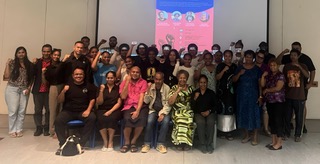
Summary notes on speakers at World Habitat Day at Yitpi Yartapuultiku Port Adelaide, 6 October 2025

STRONG FOCUS ON COP, CLIMATE and UNIFIED STRENGTH OF INDIGENOUS PEOPLES

This event was organised by The Australian West Papua Association (SA) (AWPA) supported by Conservation Council of SA and Pacific Islands Council of SA PICSA

The Free Family Event was a community fair – a number of organisations had stalls and presences including:

  • Asian Australians for Climate Solutions
  • AWPA – environment and political info
  • XRSA – flyers, free badges, write climate solutions on our whiteboard – about 8 XR members assisted
  • Face painting
  • Kid’s activities – focusing on tree kangaroos
  • Fijian and Papua New guinea dancers – organised by Tukini Tavui (Fiji) CEO PICSA
  • Hindmarsh Greens
  • Fusion Party
  • Sea Shepherd
  • Food trucks

 Channel 9 came to film the dancers

The evening event had about 120 people attending (including more XR members and friends joining) – a good showing in the auditorium. Uncle Moogy welcomed us to country with stories about water sources and connections across country through groundwater.

Chairing the session: Koteka Wenda … the advertised chair was not available but young West Papuan activist-in-exile Koteka Wenda stood in: setting a unifying and gracious tone of welcome, and speaking of her own upbringing and connection to country.

Speakers: all were intensely political and focused on indigenous justice and justice for country. There was a strong focus on the Pacific peoples and on COP31, and the wider interests of millions of first nations peoples.

Arabella Douglas – from Currie Country South-East Queensland/ northern NSW .

Topics:

  • Recent appeals to the International Court of Justice on compensation for climate damage, and on recognition of Palestine.
  • Strong interest by (so-called) Pacific nations in Aust bid to hold COP31 in Adelaide,
  • The stance of Pacific nations in leading the approach on climate.
  • History of the greater land mass of SAHUL (New Guinea and Australia were once joined and still share bird and animal and plant species, long history of connection and trading,
  • Severe impact of climate – and moves to create unified climate solutions: examples: plant mangroves as sea-protection, and to close down the many extractive industries
  • Impacts of climate risk on indigenous people here – opportunities to join with Pacifika peoples. Examples of injustice – poor management of northern rivers.
  • Drawbacks – Fed monies received for Native Title compensations and restitutions have conditions so that they cannot be used to sue the Fed Govt.
  • Opportunities for appeals to the ICJ (Int Court of Justice) over climate crisis impacts as a violation of human rights. Want to get problems such as Algal Bloom and damage to Murray-Darling basin onto the COP agenda.
  • Opportunity for Australia to have a seat on the UN Security Council (although the 5 permanent-seat nations have rights of veto)

Note on ICJ: https://www.crikey.com.au/2025/07/30/international-court-justice-australia-pabai-pabai-torrest-strait-climate-change/

  1. Uncles Pabai and Paul of Torres Strait raised a case in the Aust courts, alleging the government had failed to meaningfully address climate change.
  2. Students from the University of the South Pacific took a case to the ICJ in 2019 to advise on the obligations of governments to address climate change under international law

Ali (Kenny) Mirin – West Papuan writer and advocate … topics:

  • West Papua is arguably the world’s most biodiverse and most threatened region
  • Illegal logging, multi-national corporations, military protection … impacts for people: restrict access to forests and food sources – + hunting, medicine
  • Destruction of place-identification markers such as large trees – these mark boundaries between tribes and overstepping boundaries leads to inter-tribal conflicts – there are no written records – instead a story-telling system and a land-place/moiety system
  • Major corp: MIFEE (Merauke Integrated Food and Energy Estate)  – land grab … https://www.etan.org/news/2011/mifee.htm  world’s largest deforestation for sugar cane .. clearing of native mangrove, sago, paperbark, wetland destruction, incursion of roads, multi species of frogs, high elevations, fragmented habitats … add climate impacts increased temp and rainfall.
  • 50,000 – 60,000 internally displaced people due to Indonesian Military
  • Media censorship and communication difficulties – PNG has more than 800 languages.

Rowena – Samoan woman   now living in Adelaide … topics

  • Pacifika peoples have contributed least to climate change but have the most serious impacts – example – nuclear waste dump flooded by rising sea levels
  • Repressions with all the usual methods – forbidden to use language, students confined to dormitories.
  • Climate justice is indistinguishable from land justice.
  • The Australian government claims to protect pacific “family” but at the same time rewards and supports “those who would destroy us”.
  • Habitat protection needed
  • Solution to climate catastrophe is to Speak the Truth
  • People in Aust do not know where Samoa is
  • People in the Pacific do not know where Adelaide is “is it near Perth?” … but they know it when you say “It’s the place with the Santos HQ”.

Tiani Adamson (Wildlife Conservationist and Young South Australian of the Year 2024)

  • Tiani came from the northern Cape York peninsula – her people were forcibly relocated to Darwin. She is now based in Adelaide.
  • Focuses research on islands – 5% of landmass, > 20% of biodiversity, extreme speciation due to isolation, but vulnerability to introduced ferals.
  • Island and indigenous decision making is more community based, long term and not based on a 4 year election cycle.
  • Australian native food businesses are less than 5% owned by indigenous people
  • Need to nourish land and sea  – and at the same time each other.

AWPA Statement – Indonesian military kill 15 West Papuans, the majority civilians during military operation

During the military operation the security forces  conducted house to house searches and opened fire in an  indiscriminate fashion resulting in 15 deaths. According to community sources  soldiers buried most of the bodies  with some still to be found. 

      Human Rights Monitor

Joe Collins of AWPA said, “as with previous military operations  local people fled in fear of their lives. In this case up to 145 residents fled from Soanggama, Janamba, and Kulapa. There are now over 100,000 displaced people in West Papua. Many are malnourished and children are missing out on their education”.

The security forces claimed that  the dead were  members of the West Papua National Liberation Army (TPNPB) and they were killed  in a firefight.

However, TPNPB Spokesperson Sebby Sambom  reported only  three of the dead were  TPNPB members. 

Local church leaders and civil society groups also disputed the official narrative. The Intan Jaya Conflict Mediation Team stated that not all 15 victims were affiliated with the TPNPB, identifying at least nine civilians, including a deaf man and a housewife who died while fleeing. 

The Head of the Intan Jaya Conflict Mediation Team, Yoakim Mujizau, said  that his team had visited Soanggama Village and identified the victims and gathered information from residents who witnessed the incident. The team also received information from members of the Indonesian National Armed Forces (TNI) stationed there.

The latest information is that all the victims have been buried by the Task Force in different locations. Two victims were buried in Soanggama Hamlet in front of the Protestant Church. Six people were buried in Dusandigi Hamlet, Soanggama Village, and one woman was buried in Jembatan Hamlet, on the Wuisiga River.

Meanwhile, the bodies of the other six victims have not yet been found.

“The security forces are still unwilling to provide information. Where are the shooting victims? And where are they buried? So we are still investigating the whereabouts of the bodies, and we have not yet identified them,” he said.

Collins said, “we have statements from the Indonesia  military  saying it reclaimed/ liberated  a village from the TPNPB when  the only liberation that needs to be done is the liberation of West Papuans from the oppression of the Indonesian security forces”.

Joe Collins said,” we have a massacre of Papuan civilians on our doorstep and there is no comment from Canberra on the incident. No concern about the ongoing human rights abuses, the military operations or the death of civilians in the territory”. 

All Canberra does “is to train and exercise with the Indonesian military. Sign a  defence treaty  with PNG and build up bases for US forces in the north. All to prepare for some imaginary invasion from China. Australia has always been concerned about stability in the region to our north, but the West Papua issue is the one issue that could cause the very instability the Canberra fears.

The West Papuan issue is not going away. Time for Canberra to become involved and put pressure on Jakarta to control its military in West Papua, as a first small step.

Ends

Sources

Jubi, Human Rights Monitor and Civil society reports 

Arbitrary arrests and restriction of peaceful assembly in Jayapura

15 October 2025 / 2 minutes of reading

On 23 September 2025, police officers from the Jayapura Police arbitrarily detained thirteen members of the West Papua National Committee (KNPB) in the Sentani area while they were distributing leaflets to announce an upcoming peaceful demonstration marking International Farmers’ Day (24 September 2025). According to local reports, at 10:08 am, police officers stopped the activists at the old Sentani Market (Pasar Lama) and detained them after 20 minutes of tense negotiations. The police seized the leaflets and transported the KNPB activists to the local police station for questioning. They were allowed to leave later that day.

In the afternoon, around 3:30 pm, KNPB members in Abepura and Kamkey, Jayapura City, continued distributing the same leaflets at strategic public points. The police again intervened, seizing the leaflets and detaining several individuals in police vehicles. In response, other KNPB members and residents marched to the Abepura Police Station to protest the arbitrary detention and demand an explanation.

Human rights analysis

This incident demonstrates a continuing pattern of repression of peaceful political expression in West Papua. The arrests of non-violent activists for merely distributing informational materials represent a violation of the rights to freedom of expression, peaceful assembly, and association, as guaranteed under Articles 19 and 21 of the International Covenant on Civil and Political Rights (ICCPR), to which Indonesia is a State Party. The use of police force to silence non-violent activists highlights the shrinking democratic space in West Papua and perpetuates an atmosphere of fear among civil society organisations. The events underscore the urgent need for systemic reform of policing practices in West Papua to prevent and reduce human rights violations.

Detailed Case Data
Location: CGJ4+W2W, Jln.mahkal;),;Pasar Lama, Hinekombe, Kec. Sentani, Kabupaten Jayapura, Papua 99352, Indonesia (-2.567648, 140.5050644) pasar Lama Sentani (Old Sentani Market)
Region: Indonesia, Papua, Jayapura Regency, Sentani
Total number of victims: 13

#Number of VictimsName, DetailsGenderAgeGroup AffiliationViolations
1.13 

maleunknown Activist, Indigenous Peoples

Period of incident: 23/09/2025 – 23/09/2025
Perpetrator: , POLRES

Perpetrator details: Polres and Polresta Jayapura

Issues: indigenous peoples

Indigenous community faces criminalization and land seizures as Merauke Food Estate Project advances

16 October 2025 / 4 minutes of reading

The Indonesian government’s ambitious National Strategic Project (PSN) in Merauke has entered a critical phase marked by escalating conflict between indigenous landowners and corporations backed by state authority, with customary land seizures now accompanied by police criminalization of community members resisting plantation development on their ancestral territories. On 29 September 2025, Coordinating Minister for Food Zulkifli Hasan announced plans to convert 481,000 hectares of Papuan forest in Wanam, Merauke Regency, for rice, oil palm, sugarcane, and cassava production, alongside renewable energy facilities, including bioethanol and biodiesel processing industries. The government claims the forest area has already been “released” from protected status, with Minister of Agrarian Affairs, Nusron Wahid, stating the land “does not belong to the community because it was previously state forest,” allocating 263,000 hectares for rice fields in Wanam, 41,000 hectares in Merauke City, 146,000 hectares for oil palm, and 1,140 hectares for ports and settlements. This massive land conversion contradicts the lived reality of indigenous Yei communities like the Kwipalo clan, whose ancestral territories are being forcibly seized by PT Murni Nusantara Mandiri (MNM). The company is part of the PT Global Papua Abadi consortium holding a 52,700-hectare concession for sugar cane plantation development.

The conflict reached a new level on 15 September 2025, when Mr Vincen Kwipalo and his relatives physically stopped PT MNM employees operating excavators and bulldozers clearing their customary forest to build road access through Kwipalo clan territory in Jagebob District. Following this confrontation, PT MNM used one of its employees to file a police report against Mr Kwipalo at the Merauke Resort Police Station. Following the police report, Mr Kwipalo was summoned for clarification on 2 October 2025. On 17 September 2025, Mr Kwipalo and three relatives erected traditional barriers named “Sasi“ using tree trunks across the cleared land, painting them orange and posting warning signs reading “No entry to the Kwipalo customary area,” to protect the 2,308 hectares of ancestral land threatened by corporate encroachment. As of August 2025, PT MNM had already cleared 4,912 hectares of the concession area, with periodic monitoring by Pusaka Bentala Rakyat Foundation documenting ongoing deforestation.

The Kwipalo clan’s resistance reflects systematic violations of indigenous land rights under Indonesian law, particularly Article 43(3) of Law No. 2/2021, requiring that provision of customary and individual land “for any purpose” must be “carried out through deliberation with the customary law community and residents concerned to reach an agreement on the transfer of required land and compensation.”

The Kwipalo Clan has manifested its rejection through multiple channels: planting red crosses on customary territory as traditional symbols of prohibition, openly declaring rejection through the national media, staging demonstrations in both Merauke and Jakarta, and filing an ongoing lawsuit with Indonesia’s Constitutional Court challenging the project’s legality. His position is reinforced by Article 21 of Merauke Regency Regulation No. 5/2013. The article obligates the South Papua Governor and Merauke Regent to immediately order PT. MNM to stop the criminal act of seizing and embezzling the customary land of the Kwipalo clan and protect Mr. Vinsen Kwipalo from the threat of criminalisation. State institutions, including the police, have become enforcement mechanisms for corporate land acquisition. Ín addition, the military has established the 817th Territorial Development Infantry Battalion within PT MNM’s concession area on Kwipalo customary land in July 2025, without clan permission or consent. The developments support growing concerns of deliberate militarization for the purpose of securing corporate business interests.

The Merauke PSN represents a broader pattern documented across Indonesia, where National Strategic Projects systematically dispossess indigenous communities under the legal framework established by the Job Creation Law. Civil society organizations argue that the law provides “facilitation and acceleration” mechanisms that bypass normal consultation and compensation requirements. The case parallels the displacement of 75 families from Soa Village in Tanah Miring District by PT Global Papua Abadi for road and bridge construction, and other conflicts at other PSN sites, including Rempang Island (Riau Islands), Indonesian Green Industrial Zone (North Kalimantan), and the National Capital (East Kalimantan), where communities face forced evictions for development projects. Greenpeace Indonesia Forest Campaigner, Mrs Sekar Banjaran Aji, notedthat “PSN Merauke has deprived indigenous peoples of their rights, destroyed natural forests, and threatened the biodiversity of the landscape,” while emphasizing that “the involvement of the army and police in the project has also caused terror among the community and indigenous Papuans.” 

Indonesia’s National Human Rights Commission has documented violations in PSN Merauke activities. Yet the government continues advancing the project as part of President Prabowo Subianto’s vision referenced at the UN General Assembly, positioning Indonesia as a “candidate for the world’s food barn.” The Papua Law Enforcement and Human Rights Coalition has called on the President to “immediately revoke the National Strategic Project policy that legalizes PT. MNM’s seizure and misappropriation of the customary land of the Kwipalo clan. The criminalization of Mr Vincen Kwipalo represents an “early example” of tactics that will be deployed against indigenous land rights holders resisting investment projects throughout the South Papua Province and in other PSN sites across Indonesia.

Mr Vinsen Kwipalo stops PT MNM excavators from destroying the Kwipalo clan’s customary forest, 17 September 2025

Mr Vinsen Kwipalo and supporters in front of the Merauke District Police Station, 2 October 2025

Detailed Case Data
Location: Jagebob, Merauke Regency, South Papua, Indonesia (-7.9103659, 140.7624493)Kwipalo customary land in Jagebob District
Region: Indonesia, South Papua, Merauke, Jagebob
Total number of victims: dozens

#Number of VictimsName, DetailsGenderAgeGroup AffiliationViolations
1.Vincent Kipalo

maleelderly Human Rights Defender (HRD), Indigenous Peoples
2.dozens 

mixedunknown Indigenous Peoples

Period of incident: 15/09/2025 – 15/10/2025
Perpetrator: Private Company, Government
Issues: business, human rights and FPIC, human rights defenders, indigenous peoples

Rising militarism 

In the wake of looting and rioting in late August, President Prabowo Subianto deployed more than 75,000 Indonesian Military (TNI) soldiers to secure areas in and around Jakarta.

Editorial board (The Jakarta Post) Jakarta Fri, September 19, 2025 

Political developments in the past few weeks have not been very kind to the concept of civilian supremacy in the country. In the wake of looting and rioting that took place in late August, President Prabowo Subianto agreed to the deployment of more than 75,000 soldiers from the Indonesian Military (TNI) to secure areas within and around Jakarta.  It could have been a bigger display of military might, as security authorities proposed the deployment of more than 100,000 troops in the city. The troops’ deployment may have been the largest in the capital city since 1998, when soldiers in armored vehicles patrolled the streets following civil unrest that ended with the resignation of then-president Soeharto. 

Also in response to the unrest in August, President Prabowo sacked coordinating minister for political and security affairs Budi Gunawan after serving only 10 months in office, convinced that the former police general had failed to coordinate a proper response to handle the protests and street violence.

To replace Budi, on Wednesday President Prabowo inaugurated Djamari Chaniago, his senior at the military academy who in the late 1990s served as commander of the Army Strategic Reserves Command (Kostrad). 

The appointment of Djamari is only the latest in a series of decisions allowing both active and retired military generals to take charge of civilian institutions.  In May this year, then-finance minister Sri Mulyani Indrawati appointed Djaka Budhi Utama, a retired lieutenant general who was once found guilty of kidnapping human rights activists, as head of the Customs and Excise Directorate General.  Later in July, another Army officer Maj. Gen. Ahmad Rizal Ramdhani was appointed as president director of the State Logistics Agency (Bulog), in charge of one of the most crucial agencies involved in food security.

Other than packing civilian institutions with military generals, President Prabowo has also designed policies that allow military officers to have leading positions in their execution. In the food security program, the plan is to have thousands of soldiers deployed in the country’s remote regions to work on lands that will produce rice and other staple foods.  Currently, TNI soldiers are taking leading roles in a forestry task force that is expected to seize lands illegally occupied or used by palm oil companies.  Plans are also afoot to expand the military presence outside of Java, including the deployment of the Army’s Special Forces (Kopassus) to far-flung regions. 

This certainly looks like an aberration in a civilian-led democracy like Indonesia. But the reality today is that this expansion of the military’s role in politics could find its legal justification in the revised TNI Law, which was passed without much fanfare in March this year.


The revised law increases the number of state institutions to which military officers can be appointed without having to retire early from the service from 10 to 14. The new legislation also expands the TNI’s non-combat operations and extends sitting officers’ retirement age. When the Constitutional Court (MK) read its ruling on Wednesday to uphold the legality of the revised TNI Law, the court’s judges were up against insurmountable odds.  It was difficult for them to turn the tide in a political atmosphere that was already welcoming the increased presence of the military in civilian affairs. And with soldiers still patrolling the streets as the court was hearing the case, it was as if the panel of judges was staring down the barrel.

But it is unfair to pin our hopes on the court to save this nation from rising militarism. 

 The job of ensuring civilian supremacy should be in the hands of politicians both in the executive and legislative branches of the government, it is they who should devise rules mandating that the primary role of the military is national defense.

Out of touch: Why an increase in politicians’ allowances triggered mass protests

On Monday 25 August, protestors took to the streets outside the House of Representatives (DPR) building in Jakarta under the banner of ‘dissolve the DPR’ (bubarkan DPR). These demonstrations were sparked by anger following an announcement by Deputy House Speaker Adies Kadir that national lawmakers would receive a new monthly housing allowance of Rp50million (approximately AUD4,700). These protests have continued through the week.

Turning violent with protestor throwing Molotov Cocktails, police have responded with tear gas, water cannons and tactical vehicles. That an online taxi motorcycle driver in close proximity to the protests was brutally killed by being run over by a police tactical vehicle has only fuelled public discontent.

The rationale for the new allowance was that legislators in the current term [2024-2029] were not receiving government housing, unlike in previous years, and were therefore entitled to compensation. This was further justified by the fact that many legislators are not from Jakarta and have to pay for accommodation when they are in town. The previously existing DPR housing complex where they received free accommodation was decommissioned in 2024 due to quality complaints from residents.

The allowance announcement led to outrage for many reasons. First, the amount of Rp50 million was seen as outrageously high—much more than what ‘ordinary Indonesians’ earn—and a poor use of taxpayers’ money. This was further exacerbated by a viral moment in which Kadir gave a nonsensical calculation for how the Rp50million amount had been determined, defended it as being insufficient to find suitable accommodation in the vicinity of the legislative complex. He claimed that around Rp78million would be required every month and so legislators would still be out-of-pocket.

While a charitable interpretation would be that Kadir misspoke, the fact that his calculations were wildly incorrect led to ridicule and undermined the rationale of the allowance. Responding to pressure, Deputy House Speaker Sufmi Dasco Ahmad clarified on 26 August 2025 that the allowance would only be applicable for one year, from October 2024-October 2025, and that it could only to be used for housing, dismissing claims that it was a salary increase. However, this explanation has done little to address the underlying concerns that prompted public anger in the first place.

So, what do these protests say about current attitudes towards politicians, their work and their lifestyles in Indonesia? Following on from the recent One Piece flag phenomenon, the critiques that have unfolded reflect much deeper issues regarding Indonesians’ perceptions of politicians. Not only are they seen as out of touch with the concerns of everyday people but also the decisions they make about government spending are made without transparency and accountability.

The housing allowance: is it justified?

One reason the new Rp50 million (AUD4,700) monthly housing allowance was such a shock to Indonesians is that it stands in stark contrast to the minimum wage rate (Upah Minimum Regional, UMR) for Jakarta, which currently sits at Rp5,396,791 (approximately AUD500) per month. As the minimum wage is government-sanctioned, the fact that another government body came out so publicly with wildly different calculations for housing, let alone other costs associated with surviving in Jakarta, hit a raw nerve.

Online media forum Kok Bisa compared the buying power of politicians and ordinary citizens. It found that on a politician’s wage it would take 2 years and 1 month to afford a house, whereas it would take 38 years and 7 months for someone on minimum wage to do the same. Furthermore, politicians do not personally pay tax on their earnings, as the state covers it for them.

There have also been calls for more transparency on how the DPR decided on the allowance amount in the first place. Defending the decision, House Speaker Puan Maharani said that the determination was thoroughly evaluated and took into account ‘the conditions and prices in Jakarta.’ A cursory scan of property websites in Indonesia such as rumah123 and lamudi.co.id, list a wide range of accommodation available for rent around the Senayan area which surrounds the legislative complex. Yes, the area is central and highly desirable, but fully-furnished 2-bedroom apartments can still be found for under Rp10 million per month. Considerably larger houses at the low-end of the price spectrum can be found for Rp20 million per month.

Of course, there are other neighbourhoods close by that offer comparable options at significantly lower prices. The previous accommodation for DPR members was in Kalibata, a neighbourhood around 10 kilometres away from the DPR offices. This does beg the question of how legislators landed on the allowance sum of Rp50million per month in the first place, and whether politicians’ entitlements are too high.

Indonesia Corruption Watch (ICW) and the Indonesian Institute have framed the debate in terms of what politicians already earn, highlighting that their compensation is already generous and their accommodation should not be further subsidised with public funds. In the aftermath of the announcement, several politicians have made public their earnings. Puan Maharani and Dasco Ahmad have both stated that their take home pay is around Rp100 million per month (AUD9,381), including base wages, allowances and higher duty benefits.

But the Indonesian Forum for Budget Transparency (Forum Indonesia untuk Transparansi Anggaran (Fitra) has claimed it to be closer to Rp230million (AUD21,578). For reference, the Central Statistics Agency (Badan Pusat Statistik, BPS), put the average monthly salary for managers in Jakarta at Rp14,329,826 (AUD1,341) (August 2024).

Other discourses that have emerged include comparing Indonesian politicians salaries to other countries around the world, including other ASEAN countries and many European states like Sweden. In a more local example, DPR salaries have been contrasted with those of teachers (particularly non-formal teachers or guru honorer), who receive between Rp1-2million (AUD93,81-187,64) per month—although there are reports of them receiving much less, particularly in rural areas.

Politicians out of touch

With politicians’ salaries way above average pay rates in Jakarta, politicians have been accused of being unworthy of such high salaries and out of touch with the concerns of everyday Indonesians.

Netizens have flocked to social media to complain, including by posting comedic videos about how much they survive on in Jakarta. Some link their complaints to recent viral videos of politicians dancing (berjoget) and singing during legislative sessions, while another netizen compiled images of politicians asleep during debates. The underlying message is clear—what are you actually doing to earn your keep?

The public response of some politicians has added further fuel to the fire. Accused of being out of touch, KBR.ID have called the situation an ‘empathy test‘ for politicians, which several seem to have failed. Project Multatuli compiled a list of quotes which exemplified the haughty retorts of politicians.

In some choice examples, PDI-P member Deddy Sitorus was quoted as saying that comparing legislators to becak drivers or workers is a ‘logical fallacy’, while Nasdem member Ahmad Sitori stated that people calling for the dissolution of the DPR ‘are the dumbest people in the world.’ Nasdem member Nafa Urbach refuted criticism of the housing allowance, arguing that due to traffic her commute to the DPR from outer suburb Bintaro was ‘’extreme” (luar biasa) so she needed the allowance to live closer to work. Kompas, in a sly lampooning of this argument, calculated that by taking public transportation and walking she could be at work within 35 minutes.

Online discourse criticising the decision has drawn much from ideas about the appropriate use of public funds and that, as taxpayers, Indonesians should have a say in how politicians are compensated. Much has been made about Indonesia’s economic situation which led to drastic cross-sectoral funding cuts earlier in 2025, including to the education and health budgets, and regional fund transfers. In an economic context where the government has been forced to take drastic measures and promote ‘efficiency’ within the national budget, a high additional allowance for lawmakers seems like a poor use of already limited funds.

Attempts to silence criticism have further angered the public. Reminiscent of the political debate surrounding flying the One Piece flag on Indonesia’s national day, the Deputy Minister for Communication and Digital, Angga Raka Prabowo, called on social media platforms TikTok and Meta to assist with deplatforming ‘provocative content.’ In their attempts to mediate online channels, places where citizens can post their political complaints and critique government policies, politicians have only intensified the perception they believe that they should be above criticism.

Questioning the position of politicians

The protests and commentary on the housing allowance, both online and offline, reflect a revived spotlight on debate about the role of politicians and public expectations of them.

While the announcement of the housing allowance provided an impetus for outrage, the issues subsequently discussed are reflective of a much deeper dissatisfaction with the way the government is run. These August 2025 protests are part of a more recent history of protests stemming from the Dark Indonesia (Indonesia Gelap) movement, which aimed to highlight a plethora political complaints.

One of the fundamental reasons that the housing allowance has triggered anger is related to public perceptions of politicians and their role as representatives of citizens’ interests. Arguments that since politicians’ salaries are funded by public money, they should be beholden to the public fuels these complaints.

Indonesians are used to politicians falling short of expectations, evidenced by the high number of politicians embroiled in the corruption scandals flooding national news. But the housing allowance was particularly jarring because people could directly compare it to what they earn themselves.

This has opened the floodgates for a more intense focus on politicians’ salaries and, more importantly, whether they are worthy of them. Here, the argument is that if politicians do not understand what it is like to live as an ordinary person in Indonesia, how can they possibly represent ordinary people’s interests?

These complaints are not new. They reflect a long-existing divide between political elites and everyone else within Indonesian society. But with increasing social media commentary and debate, Indonesians are better able to connect across grievances and mobilise, both online and offline. The call for accountability and increasingly vocal demands that politicians answer to the public are reflective of an rising sense of dissatisfaction with the status quo, which, if not resolved, might lead to an ever-rising number of protests in the future.Analysis, Policies, Politics

West Papuan journalists call for Pacific solidarity  

August 20, 2025 _  Ema Ganivatu

IN exile but unbroken, three West Papuan journalists are in Fiji calling on the Pacific to stand with them against Indonesia’s ongoing media blackout and human rights abuses.

Their visit is part of a broader effort to forge solidarity with Pacific neighbours, through media partnerships, university collaborations, and joint advocacy for human rights and self-determination.

Speaking after the screening of their latest documentary film “Pepera 1969: A Democratic Integration” at the University of the South Pacific, the team including Victor Mambor, co-founder of Jubi Media Papua, Yuliana Lantipo, senior journalist and editor, and Dandhy Laksono, Jakarta-based investigative filmmaker shared their personal experiences of reporting from inside one of the most heavily militarised and censored regions in the Pacific.

“We are here to build bridges with our brothers and sisters in the Pacific,” said Mambor.

“There is no hope from the Asian side,” added Laksono. “That’s why we are here, to reach out to the Pacific. We need new audiences, new support, and new understanding.”

The team urged Pacific people to push for greater awareness of the West Papuan situation and to challenge the dominant narratives propagated by the Indonesian government.

“Don’t just listen to what Jakarta says,” said Mambor. “Speak to Papuans. Listen to our stories. Raise our voices.”

“We want to bring West Papua back to the Pacific — not just geographically, but politically, culturally, and emotionally.”

Mambor described the continued targeting of Jubi Media staff, including attacks on their office and vehicles, as part of an escalating crackdown under Indonesia’s new President.

“Two of our operational cars were destroyed. Our journalists are constantly intimidated. Yet we continue to report the truth.”

The situation for press freedom in West Papua is dire. Foreign journalists are barred entry, internet access is often restricted during periods of unrest, and local reporters — especially Indigenous one’s risk arrest or violence for covering politically sensitive stories.

“If you report on deforestation or culture, maybe it’s allowed. But if you report on human rights or the military, there is no tolerance,” said Laksono.

Laksono, who is not Papuan himself but has long worked to expose injustices in the region, added:
“Much of Indonesia has been indoctrinated through school textbooks and media into believing a false history. Our film tries to change that by offering the truth, especially about the so-called Act of Free Choicein 1969, which was neither free nor a genuine act of self-determination.”

Journalist Yuliana Lantipo spoke of the daily trauma faced by communities caught between the Indonesian military and the West Papua National Liberation Army.

“Every day we receive reports: killings, displacement, families fleeing villages, children out of school, no access to health care. Women and children are the most affected,” she said.

As one of the few Indigenous female journalists reporting from conflict zones, Lantipo also highlighted how her identity both enables and complicates her work.

“Sometimes, as a woman, I can access conflict areas more easily, especially when traveling with elders or family members. But Indigenous male journalists, especially those with dreadlocks or visible Papuan identity, are often turned away or arrested.”

Despite the personal risks, Lantipo and her colleagues remain committed to their role.

“People need us to speak the truth. That is our responsibility. That is our profession.”

Jubi Media Papua

Founded in 2001 by West Papuan civil society, Jubi Media has become one of the most trusted and independent sources of information from the territory. With more than 30 reporters and 50 staff, the media house has built a reputation for fearless journalism.

Jubi means ‘to speak the truth’,” said Mambor. “We created a special section just to tell Pacific stories — to remind our people that we are not alone, and to reconnect West Papua with our Pacific identity.”

Who is clearing Indonesia’s forests — and why?

  • Most tropical countries are experiencing record-high deforestation rates, but in Indonesia, forest loss is slowing.
  • But nearly half of the forest cleared in 2024 can’t be linked to an identifiable driver, raising red flags about speculative land clearing, regulatory blind spots and delayed environmental harm.
  • Land is often cleared but not immediately used; research shows that nearly half of deforested lands in Indonesia remain idle for more than five years.
  • Experts say these trends signal regulatory failure, as the government issues permits widely and concession holders face few consequences for clearing forest and abandoning the land, creating a cycle of destruction without accountability.

JAKARTA — While most tropical countries experienced record-high deforestation rates in 2024, Indonesia’s forest loss is slowing, bucking a global trend.

But beneath the headline figures lies a troubling mystery: Nearly half of the forest cleared last year can’t be linked to any identifiable driver, raising red flags about speculative land clearing, regulatory blind spots and delayed environmental harm.

This uncertainty complicates supply chain accountability under laws like the EU Deforestation Regulation, and raises questions about who’s really clearing Indonesia’s forests — and why.

In 2024, Indonesia lost 242,000 hectares (598,000 acres) of primary forest, down 14% from 279,000 hectares (689,000 acres) in 2023, according to an analysis by TheTreeMap, a technology consultancy behind the Nusantara Atlas forest monitoring platform.

Annual Deforestation in Indonesia (2001-2024). Image courtesy of TheTreeMap.

TheTreeMap used satellite and time-series imagery to attribute deforestation to known drivers. They are logging (18%), industrial oil palm (13%), pulpwood/timber plantations (6%), mining (5%), food estate projects (3%) and fires (2.3%).

Together, these drivers explain just 47.3% of Indonesia’s 2024 primary forest loss — leaving the majority unattributed, which experts say reflects both data limitations and deeper governance failures.

What explains this gap in attribution? A likely reason is that land is cleared but not immediately used.

A study published in 2024 in the journal Proceedings of the National Academy of Sciences (PNAS) found that nearly half of all deforested land in Indonesia remained idle for at least five years — meaning it wasn’t converted to plantations, agriculture or any observable land use.

These areas are often eventually converted to agriculture — usually oil palm — but the long delay obscures who cleared the land and why, TheTreeMap noted.

There are many examples of these across Indonesia, said Timer Manurung, the director of the environmental NGO Auriga Nusantara.

In Riau and Bengkulu provinces on the island of Sumatra, for example, natural forests in some selective logging concessions have been cleared, and yet the permit owners seem to have abandoned the concessions.

As a result, oil palm investors moved in years later and began planting, Timer said.

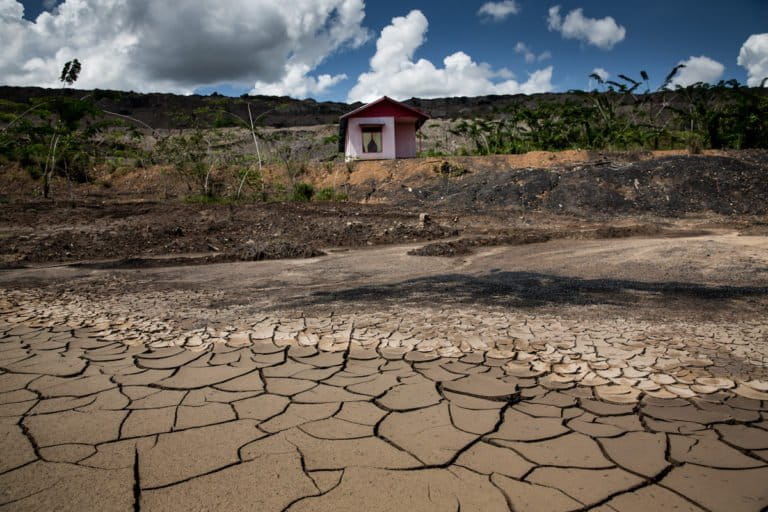
A lone house is left standing at an abandoned village after a nearby mining concession degrades the surrounding environment. Image by Kemal Jufri/Greenpeace.

The deeper roots of idle land

While nearly half of Indonesia’s primary forest loss in 2024 remains unexplained, experts say this absence of clear attribution is not simply a data gap — it may be a warning sign of deeper governance issues.

One leading explanation is speculative clearing, when companies clear forests without immediately converting the land to plantations or infrastructure. According to Arief Wijaya, managing director of World Resources Institute (WRI) Indonesia, this pattern has persisted since the 1990s, when companies obtained forestry or plantation permits, extracted valuable timber and left the land idle. In many cases, this was deliberate: either a lack of capital to proceed or part of a long-term land banking strategy.

These behaviors point to regulatory failure, as the issue of abandoned land is closely tied to the “reckless issuance of permits” by the government, said Boy Jerry Even Sembiring, the director of the Riau chapter of the country’s largest green group, Walhi.

Concession holders face few consequences for clearing forest and abandoning the land, creating a cycle of destruction without accountability. The result is a patchwork of degraded forestland, legal ambiguity and lost oversight — fertile ground for future land conflict, encroachment, opportunistic development and fires.

In an effort to address this, Indonesia’s Ministry of Forestry earlier this year revoked 18 inactive forestry concessions covering more than 526,000 hectares (1.3 million acres). Minister Raja Juli Antoni framed the move as part of a broader push to reclaim unproductive concessions and reassert state control over idle forestland.

But Arief warned that the recent revocations barely scratch the surface.

“If we look at the broader picture, this land speculation has been happening for over 30 years,” he told Mongabay.

Without a systematic approach to identify, map and resolve the status of idle lands, the problem will persist — quietly fueling environmental degradation, sparking community conflict and undermining efforts to clean up supply chains, Arief said.

Once land is cleared and left idle, communities often move in and begin farming, sometimes triggering future land disputes, especially when the land is later contested by concession holders or targeted for development, he added.

Idle land is also prone to fires, activists say.

Boy of Walhi Riau said abandoned lands consistently burn during the dry season.

“After being cleared, they [idle lands] often burn, yet there’s no proper accountability or follow-up review process for these incidents,” he said.

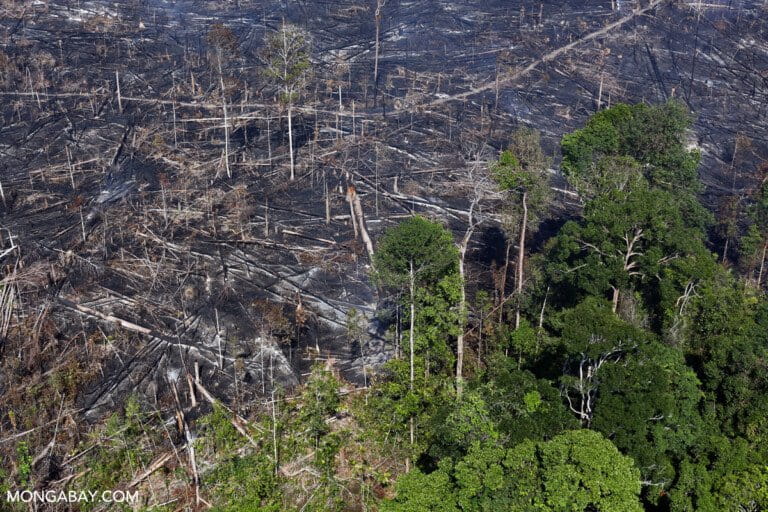
Burning within Tesso Nilo National Park.
Between 2001 and 2021, Indonesia lost more than 28 million hectares (69 million acres) of forest. However, since peaking in 2016, forest loss in Indonesia has continued to decline. Image by Rhett A. Butler/Mongabay.

Turning idle land into opportunity

Therefore, Arief called on the government to come up with a targeted and comprehensive strategy.

The first order of action is to map where the idle lands are and identify their owners and jurisdictions. If during the mapping it turns out that communities have already controlled the land and conflicts have emerged, then the government needs to resolve the conflicts first, Arief said.

After that, the government and other stakeholders should develop a plan for how to use these lands — whether through rehabilitation, community use or reallocation, he said.

One option is to mandate the rehabilitation of the idle lands, if they are located within concessions.

Yuliusman, the director of Walhi South Sumatra, said concession owners need to be held responsible for the land they control, including when these lands are cleared and burned.

That’s why the government needs to make land ownership data available to the public so landowners can be held accountable, he said.

Another option is to grant communities rights to manage these idle lands through the social forestry scheme.

The program, initiated by President Prabowo Subianto’s predecessor, former President Joko Widodo, is one of the largest socioenvironmental experiments of its kind, aiming to reallocate 12.7 million hectares (31.4 million acres) of state forest to local communities and give them the legal standing to manage their forests.

By granting social forestry permits to communities with a clear business plan, the government could empower small farmers while bolstering food security at the same time, Arief said.

This aligns with the platform of Prabowo, who has prioritized achieving both food and energy self-sufficiency as cornerstones of his administration, he added.

Since his election campaign in late 2023 and early 2024, Prabowo has emphasized the need for Indonesia to achieve sovereignty in these critical sectors to bolster economic resilience and national security.

In December 2024, Minister Raja Juli announced the government had identified 20 million hectares (50 million acres) of forest area for potential conversion into “food and energy estates.”

The announcement raised concerns over new deforestation, especially if the areas include intact forests. But Arief said the plan could be positive — if those hectares are truly idle lands that have already been cleared and remain unproductive.

“If we already know there are 20 million hectares of low-productivity land, and we have a food security program, then we can map which crops are suitable — maybe some areas for rice paddies, others for water conservation, others for energy,” he said. “That’s where we need a road map.”

Recognizing the rights of communities to manage their lands could also help prevent fires, according to Rod Taylor, the global director of WRI’s forests program.

“I think some of the success in Indonesia [in mitigating fires] can be put down to really good collaboration between companies and communities, to not only prepare for big fires and a lot of enforcement of no burning laws, but also really fast response mechanism to spot and take action against fires before they can spread too far,” he said.

Having a road map that puts community rights at the forefront is also critical to resolving lingering land conflicts, said Timer of Auriga Nusantara.

It’s also necessary to address Indonesia’s deep-rooted structural injustice in land ownership. Today, 68% of the country’s land is controlled by just 1% of the population, as the state prioritizes concessions to large corporations over community land rights.

These large-scale infrastructure and resource extraction projects have pushed marginalized groups such as farmers, Indigenous communities and fisherfolk off of their lands.

Between 2015 and 2024, more than 3,200 agrarian conflicts broke out across 7.4 million hectares of land (18.3 million acres) — affecting 1.8 million households.

Timer warned against using the existence of idle land as a pretext to expand industrial agriculture, which he said would only deepen Indonesia’s land conflicts.

“We must avoid justifying the planting of monoculture commodities on deforested land in the name of ‘what’s already happened,’” he said. “If these areas must be converted, then they should be turned into social forestry zones — and owned by local communities, not corporations.”

Citation:

Parker, D., Tosiani, A., Yazid, M., Sari, I. L., Kartika, T., Kustiyo, … Hansen, M. C. (2024). Land in limbo: Nearly one third of Indonesia’s cleared old-growth forests left idle. Proceedings of the National Academy of Sciences, 121(28). doi:10.1073/pnas.2318029121

Banner image: Peatlands destruction in Riau, 2014. While Indonesia has in the past been a major carbon emitter due to land-use change, deforestation, forest fires and peatland destruction, the recent decline in deforestation is seen as a positive sign. Image by Rhett A. Butler/Mongabay.

The World’s Largest Deforestation Project

Douglas Gerrard

Share on BlueskyShare on FacebookEmailPrint

In the West Papuan regency of Merauke, close to the border with Papua New Guinea, Indonesia is rapidly clearing land in the world’s largest ever deforestation project: three million hectares for sugarcane and rice production. Within three years, Indonesia plans to convert an expanse of forest roughly the size of Belgium into profitable monoculture. The ambition and destructiveness of the development distinguish it from previous mining or agribusiness initiatives in West Papua, which has been under Indonesian occupation since the 1960s. 

At a ground-breaking ceremony in June 2024, Indonesia’s then president, Joko Widodo, described Merauke as Indonesia’s future ‘food barn’. He also touted the potential of converting sugarcane into bioethanol fuel. (On the Raja Ampat islands meanwhile, Papuan activists are fighting plans to exploit nickel reserves for electric vehicle batteries.)

Since formalising its control of West Papua in a fraudulent 1969 referendum, Indonesia has carried out genocidal military assaults – up to a quarter of West Papuans have been killed under occupation – and ‘transmigration’ settlement programmes that have reduced the Indigenous population to a minority. 

In the nine months since he took office, Indonesia’s new president, Prabowo Subianto, has both restarted the transmigration programme and accelarated deforestation in West Papua. Widodo designated Merauke a ‘National Strategic Project’ (PSN), giving the state eminent domain powers to expel civilians. Fifty thousand Indigenous Papuans face displacement over the project’s lifespan; already, people are finding vast tracts of their customary land have been closed to them, with wooden stakes signalling the expropriation by the Indonesian military.

The human costs of the PSN, while severe, are eclipsed by its possible environmental consequences. The destruction of Merauke is set to release over 780 million additional tons of CO2 into the atmosphere, more than doubling Indonesia’s yearly emissions and leading to irreversible ecosystem collapse in one of the world’s most biodiverse regions. Officials have pressed on with the development while trying to conceal its impact. The energy minister, Bahlil Lahadalia, in charge of parcelling out land to developers, has claimed there is ‘no forest in the middle of Merauke … only eucalyptus, swamps and savannahs’. But though the sago and paperbark mangroves that cover much of the Merauke landscape may appear sparse from above, they store up to 381 tons of carbon per hectare – a higher concentration than the Amazon rainforest. 

The PSN is not Indonesia’s first attempt to convert Merauke into profitable farmland. In the 2010s, huge swathes of the rainforest were razed to make way for a palm oil mega-project, the Merauke Integrated Food and Energy Estate (MIFEE). It has been described by one researcher as effecting an ‘ecologically-induced genocide’ of the Marind tribe, whose gardens and hunting grounds also extend into the territory now threatened by the PSN. As their forest recedes, the Marind are forced to rely on remittances from the corporations that have seized their land. Rice and instant noodles are replacing traditional sago cultivation. 

In her book In the Shadow of the Palms, Sophie Chao describes the warping effects that MIFEE has had on both the environment and the Marind worldview. Before palm oil arrived, the forest provided a rich network of relationships between people, plants and animals. Under the monocrop regime, everything is ‘abu-abu’ – grey, uncertain. In a new documentaryabout Merauke, a Yei tribesman describes the transformation of his land in similarly alienated terms: ‘Before, when I went there [to the forest], I could catch deer, pigs, fish … Now it’s like I’m half dead.’

MIFEE was intended not only to boost Indonesia’s food security, but also to make it a net exporter of rice and palm oil – to ‘feed Indonesia, then the world’. The profit motive is harder to identify in the Merauke PSN. Its advocates have instead emphasised national self-sufficiency, partly in response to the precarity of global supply chains exposed by the Covid pandemic. Even a staunch rightwinger like Prabowo can sound like an anti-colonial nationalist when discussing the project: ‘How can a country be independent if it cannot feed its people?’ he asked in 2023, when he was defence minister. 

During Indonesia’s three decades of dictatorship under Suharto (Prabowo’s father-in-law), more than a third of its national revenue came from West Papua, much of it from the world’s largest gold mine, which was operated until 2017 by the US company Freeport McMoran. But while the Freeport mine primarily enriched foreign and domestic elites, the Merauke PSN is designed to insulate ordinary Indonesians from food and energy shocks – caused by a climate crisis that the PSN will drastically worsen. Both ventures aimed to secure the future of the regime, though in different ways. West Papua has gone from being Indonesia’s gold mine to its larder.

Where private interests are involved in the PSN, the principal beneficiaries are not foreign corporations but politically connected Indonesian entrepreneurs. Co-ordinating the project is the palm oil magnate Andi Syamsuddin Arsyad, also known as Haji Isam (or the ‘new poster boy of Indonesia’s oligarchy’). Isam owns the Jhonlin Group, which has bought two thousand excavators from a Chinese company to begin the deforestation. His cousin, Amran Sulaiman, is the agriculture minister. 

The military role in the development of the PSN goes far beyond their normal land-grabbing and security remit. Following a large recruitment drive in Java, more than three thousand additional troops have been deployed to Merauke, where they are directly engaged in felling and crop cultivation. Instagram posts show fresh-faced soldiers playing at farmers, ineptly watering crops or operating Isam’s excavators. 

Sulaiman has insisted that ‘the military support is there because of a lack of manpower’ – but while most of the soldiers deployed to Merauke may be new recruits, photographs have also surfaced of some sporting the insignia of Yonif Raiders, an elite combat unit notorious among West Papuans for their brutality. In August 2022, a troop of Raiders murdered four Papuan villagers and dumped their dismembered bodies in a local river. Such atrocities are commonplace in the West Papuan highlands, where the armed resistance movement is strongest and international scrutiny all but non-existent. 

Merauke is a lowlands region, which may be one reason the PSN hasn’t yet been met with violence from its opponents. Nonetheless, resistance has been immediate and widespread: there have been mass protests throughout West Papua, while a coalition of NGOs and Indigenous groups has drawn the UN’s attention to the project. A UN fact-finding mission has long been a demand of the United Liberation Movement for West Papua (ULMWP), a proto-governmental organisation uniting the three most significant independence factions, operating under the stewardship of the exiled leader Benny Wenda (I have worked with them). 

While the forces arrayed against the ULMWP are forbidding – not least a decades-long ban on foreign media that has kept West Papua from international attention – the climate crisis gives their liberation struggle a global dimension. The New Guinea rainforest is the world’s third largest, after the Amazon and the Congo. Uniquely, tribal struggles for land rights in West Papua form part of a wider revolutionary movement that seeks to replace military-corporate domination with Indigenous sovereignty and a ‘green state’. Wenda has urged environmental activists to ‘accept climate catastrophe or fight for a free West Papua’. Merauke will determine their choice. 

West Papua political representatives put on notice following arrests 

Andrew Mathieson – August 8, 2025 National indigenous times

Indonesian forces in West Papua have arrested 42 Papuan liberation activists, including a prominent 74-year-old tribal chief, during an independence separatist meeting.

Police detained all of the activists, who spent one night in jail before they were placed under house arrest for the next eight months, to curb the opportunities of further assembly together.

Tribal chief John Wenggi was arrested at his Waropen residence in the Papua province of Indonesia during the political meeting.

Wenggi was reportedly later beaten in custody, according to West Papua sources.

He was returned to his own residence last week for house arrest and is said to currently be on an intravenous (IV) drip from his injuries sustained in custody.

United Liberation Movement for West Papua leader and chairman, Benny Wenda, denounced the arrests on Wednesday, specifically taking aim at the alleged targeted beating of Mr Wenggi.

The arrests follows ongoing reports of violent clashes between the Indonesian military and West Papua civilians.

“On behalf of the people of West Papua (independence movement), I condemn the arrest of the 42 United Liberation Movement for West Papua representatives last week by the Indonesian police,” Mr Wenda said.

“Indonesia has proven once again that fundamental human rights do not exist in West Papua.

“What possible justification is there for this vicious repression?

“Under international law, the United Liberation Movement for West Papua has the right to assembly and to peacefully advocate for democracy in our own land.

“This was a private political meeting held in the home of a widely-respected West Papuan Elder.

“I call on international non-government organisations and solidarity groups to pressure your governments to condemn these arrests and to call for the release of all remaining Papuan political prisoners.”

Indonesia’s latest crackdown on the West Papuan political movement is seen as a further response to the United Liberation Movement for West Papua’s Legislative Council’s first plenary session – a deliberative assembly to mark the region’s unrecognised provisional government – a month earlier in July.

Indonesia, in the same week of the arrests, released six unnamed West Papuan political prisoners on Friday after they were granted clemency among 1,778 other inmates following an earlier announcement from the nation’s President, Prabowo Subianto, to pardon approximately 44,000 detainees fighting against the state.

West Papua’s historic meeting of more than 2000 members had been inaugurated to its Legislative Council across West Papua’s six customary, historic regions – as opposed to the six different provinces the Indonesian administration imposed on West Papua.

Those moves have sparked Indonesian House of Representative MP Oleh Soleh to deliver a warning that a “new wave of repression” would target West Papua while also calling the United Liberation Movement for West Papua nothing more than a “political criminal group”.

“These groups that disrupt the Unitary State of the Republic of Indonesia, groups that will disrupt unity, must be resolved immediately and effectively without problems or casualties because this is a burning fire,” Mr Soleah said.

“If this continues, it will certainly be dangerous.”

Mr Wenda said the words are a clear threat to all “peaceful activities” of the United Liberation Movement for West Papua-backed provisional government.

The United Liberation Movement for West Papua chairman, who lives in exile in the United Kingdom, has urged West Papuans to protect other high-profile independence leaders on the ground, naming West Papua Prime Minister Edison Waromi and West Papua Legislative Council Chair Buchtar Tabuni as crucial in its struggle towards independence.

“I call on our allied legal, political, and solidarity groups to do all they can to protect United Liberation Movement for West Papua representatives from arrest and/or imprisonment,” Mr Wenda said.

“They are at serious risk as Indonesia intensifies its crackdown.”

West Papua’s head of state, President Jacob Rumbiak, is reportedly exiled in Australia.

Mr Wenda has reportedly told Indonesia the United Liberation Movement for West Papua is the legitimate representatives of West Papuans to act on behalf of its Indigenous peoples.

“The strategy that has been formulated in the Indonesian parliament and by the Indonesian police is now coming to fruition,” he said.

“But in their desperation to destroy United Liberation Movement for West Papua’s peaceful mission for liberation, Indonesia shows just how weak their hold on West Papua truly is.

“The United Liberation Movement for West Papua now has roots in every city, every town, and village throughout West Papua.

“We are a government-in-waiting and are ready to engage with the world.

“Indonesia is terrified of our growing strength.

“Indonesia must realise that no number of arrests will crush the West Papuan desire for independence.”

Despite Mr Wenda adding “we are already prisoners in our land“, in concession to Indonesia, the United Liberation Movement for West Papua is inviting President Prabowo to meet to discuss an internationally mediated referendum on independence.

“Ultimately, this is the only true path to a peaceful resolution in West Papua,” he said.

——————————————-