IDP Update January 2026:  Humanitarian crisis deteriorates as Indigenous communities bear brunt of expanding security operations

Human Rights NewsReports / IndonesiaWest Papua / 7 January 2026 

Between November and December 2025, human rights defenders and local media covered new internal displacements in West Papua due to new security force raids and the ongoing expansion of military infrastructure in the central highlands. As of 1 January 2026, more than 105,878 civilians across multiple regencies remained internally displaced due to military operations and armed conflict (see table below). The vast majority of the internally displaced persons (IDPs) are indigenous peoples, as security force operations exclusively target areas that indigenous Papuans mainly inhabit. Incidents triggering new internal displacements reportedly occurred in the regencies Mimika, Nduga, Lanny Jaya, Intan Jaya, and Yahukimo.

On 21 November 2025, the Papuan Church Council, in collaboration with the STT Walter Post Jayapura Centre for Social and Pastoral Human Rights Studies, organised a Literacy and Resilience Festival titled “Caring for Memories Through Words” in Jayapura City. The event provided a platform for IDP representatives to share their experiences and brought together civil society stakeholders to document and raise awareness about the humanitarian crisis. The testimonies at the festival illustrated both the challenges faced by displaced populations and grassroots resilience efforts.

The humanitarian conditions across all displacement sites remain uniformly dire, characterised by acute shortages of food, medicine, clean water, and shelter. IDPs sheltering in forests face particularly harsh conditions with minimal humanitarian access, while those in evacuation camps struggle with severe overcrowding, inadequate resources, and the complete cessation of daily activities. The situation is further complicated by restricted humanitarian access due to security force controls and challenging geographical conditions. The militarisation of health access in conflict zones across West Papua has created fear and hesitation in seeking medical care, with fatal consequences for vulnerable populations.

This crisis reveals a systematic pattern of military operations that disproportionately affect civilian populations and violate principles of distinction between combatants and non-combatants. The long-term nature of these displacements, with some populations like those in Pegunungan Bintang displaced since 2021 and over 10,000 Nduga IDPs living in Jayawijaya since December 2019, indicates an entrenched humanitarian emergency requiring sustained attention. The IDPs refuse to return until military forces withdraw from their villages.

Mimika

On 31 October 2025, Indonesian military forces entered Jila District, Mimika Regency, and opened fire on villages without prior warning, despite no reported armed conflict with the TPNPB at the time. The operation reportedly resulted in the internal displacement of approximately 1,500 civilians. Some fled to Timika City while others remained sheltering in forests around Jila District without government assistance or humanitarian access. Restricted internet access in the area hampered the documentation of the situation.

The crisis escalated significantly on 10 December 2025, as military forces reportedly conducted aerial bombardments in Amuagom Village at approximately 5:00 a.m. The attack destroyed civilian homes, livestock, and property, with ammunition casings found in yards and bullet holes penetrating house walls. Hundreds of IDPs fled dozens of kilometres to the Jila District centre without adequate food or water. A dozen residents fled to Puncak and Puncak Jaya Regencies. Military operations reportedly continued on 11 December, expanding to ten villages with additional troops and helicopters deployed.

IDPs fleeing the Jila District after military operations began on 31 October 2025, without prior incident or notice

Full update

https://humanrightsmonitor.org/reports/idp-update-january-2026-humanitarian-crisis-deteriorates-as-indigenous-communities-bear-brunt-of-expanding-security-operations

Formation of Three Battalions in Papua Deemed to Have Potential to Lead to Human Rights Violations

January 9, 2026 in Politics, Law, and Security Reading Time: 3 mins read

0

Author: Larius Kogoya – Editor: Arjuna Pademme

Jayapura, Jubi – Reinhart Kmur, a Legal Aid Volunteer from the Papua Legal Aid Institute (LBH Papua), stated that the formation of three new TNI battalions in three regencies in Papua has the potential to lead to human rights violations.

He stated that this concern arose because the policy for resolving conflicts in Papua has always prioritized a security approach.

According to Reinhart Kmur, based on information gathered by his office, the TNI has officially formed three new battalions in three regencies in Papua: Biak Numfor Regency, Supiori Regency, and Waropen Regency.

He said, these three battalions are new units of the Territorial Development Battalion (TP) which are prepared to carry out duties in Papua in supporting food security, infrastructure development, public health, and economic empowerment to improve welfare and security in Papua.

The presence of these three battalions has the potential to create violence and perpetuate human rights violations in Papua, because the amount of violence [perpetrated by security forces] in Papua is always directly proportional to the continued implementation of a security and armed approach through military operations,” Reinhart Kmur told Jubi in Jayapura, Papua, Thursday (January 8, 2026) via text message.

Reinhart Kmur stated that, using his authority as stipulated in Article 100 of Law Number 39 of 1999 concerning Human Rights, he strongly condemned the addition of three new battalions to Papua Province.

“Adding military personnel to Papua will only lead to human rights violations and add to the long list of human rights violations,” he said.

Kmur stated that the formation of the battalion would make the public fearful of the presence of TNI personnel. The presence of the new battalion would certainly be accompanied by the mobilization of military personnel.

“[This situation] is very dangerous amidst the TNI’s institutional problems, namely its professionalism and human rights violations,” he said.

He stated that the formation of the new battalion under the pretext of supporting food security programs, infrastructure development, economic empowerment, and other issues clearly violates the TNI’s primary duties and functions as stipulated in law.

Previously, the Kankain Karkara Byak Cultural Institute (KKB), along with tribal chiefs (Mananwir Bar Wamurem, Manfasfas Bar Wamurem, and Manfun Kawsa Byak), declared their rejection of the deployment of Indonesian National Armed Forces (TNI) soldiers from Battalion Yonif TP 858, Yonif TP 859, and Yonif TP 860 in the Byak customary territory of Biak Numfor Regency and Supiori Regency, Papua.

This statement was conveyed by the Kankain Karkara Byak Cultural Institute and the tribal chiefs, who claim to represent the entire Byak indigenous community, through the Chairman of the Byak Tribal Customary Council, Apolos Sroyer, to Jubi via telephone on Tuesday (January 6, 2026).

Apolos Sroyer stated that personnel from the 858th, 859th, and 860th Infantry Battalions (TP Yonif TP Yonif TP 858, TP Yonif TP 859, and TP Yonif TP 860) were stationed in Biak Numfor, Supiori Regency, from November 29-30, 2025. The military personnel arrived in Biak aboard a Navy ship.

“The presence of these TNI Battalion personnel surprised the public. Approximately 1,700 personnel from the three battalions were deployed to Biak,” said Apolos Sroyer.

According to Apolos Sroyer, the TNI personnel were divided into several locations. The 858th Infantry Battalion was stationed in the Wamure customary area of ​​East Biak, while the 859th and 860th Infantry Battalions were stationed in Supiori Regency.

“The presence of these TNI personnel is very worrying and has seriously disrupted the activities of indigenous communities in Biak Numfor and Supiori Regencies, which are part of the Byak customary territory,” he said.

He said that, in general, the community was unaware of the deployment of military personnel in these locations. Only certain community members held limited meetings and closed-door meetings with the TNI, then released hundreds of thousands of hectares of land for the construction of TNI posts or headquarters. (*)

————————————

Indonesia calls in military to help clear forests at rapid pace

Indonesia is clearing forests at a rapid pace with military assistance in one of its most biodiverse regions for a state-backed agricultural project, even as recent fatal floods have illustrated the dangers of deforestation.

Some soldiers have posted videos on TikTok posing with excavators and regular patrols © reinharddengo/TikTok

Billed as a project to ensure the fourth-most populous nation’s food and energy security, Indonesia is planning to cultivate rice and sugar on 3mn hectares in the eastern province of Papua. The area covers a mix of primary forests, grasslands, woodlands and wetlands.

It will ultimately be five times the size of London and bring irreversible environmental consequences, worsen greenhouse gas emissions and reverse the south-east Asian country’s progress over the past decade in slowing deforestation for palm oil production.

A former general is overseeing the project, and five battalions have been placed in Papua to support the government’s food security initiatives in the province.

Residents and local activists say soldiers are involved in the clearing of forests and eviction of residents, in addition to providing security. Some soldiers have posted videos on TikTok posing with excavators and regular patrols.

Military posts have also been set up near food estate developments, according to the residents and satellite imagery analysed by the Financial Times. 

“Since the clearing of the forest, the military has been actively involved,” said Ariston Moiwen, a resident in the South Papua town of Merauke, whose family land has been taken over for rice cultivation. “The military operates the heavy equipment too,” said Ariston, who still lives nearby.

Between May 2024 and November 2025, more than 40,000 hectares of land were cleared, according to an FT analysis of satellite imagery.

While a fraction of the total being razed, the pace has been swift. Most of the land cleared so far is being prepared for sugarcane, which will also be used to produce bioethanol.

“It’s hard to justify this project from any perspective . . . environmental, climate and the wellbeing of local communities,” said Glenn Hurowitz, chief executive of environmental group Mighty Earth.

The so-called food estate project stands in sharp contrast to the climate pledges that President Prabowo Subianto has made to achieve net zero emissions before 2060, and his public comments in the aftermath of floods in recent weeks that claimed more than 1,000 lives in Sumatra.

Environmentalists, scientists and even government officials say the loss of forests for mining and palm oil production and resulting soil degradation on Sumatra island exacerbated the flooding and deadly landslides.

Prabowo vowed action after touring the devastated areas, threatening fines for companies in breach of permits. “Climate change, global warming and environmental damage. These are issues we must confront,” he said. “We must truly prevent the cutting down of trees and the destruction of forests.”

But late last year, he said claims about deforestation should not deter the expansion of palm oil plantations. “I think in the future, we also need to plant more palm oil. Oil palms are trees, right? They have leaves, right? So why are we being accused [of deforestation]?”

The government has already revoked the “forest area” status for hundreds of thousands of hectares in Papua to allow the protected areas to be converted to agricultural development, conceived under former President Joko Widodo.

Natural ecosystems in Papua had previously remained largely intact because of its remoteness and the presence of indigenous communities.

But that is now under threat, with another part of Papua also being developed for contentious nickel mining.

Indonesia is the world’s fifth-largest emitter, based on CO₂ emissions, of about 660mn tonnes from fuel combustion, according to the International Energy Agency.

A government-sanctioned feasibility study dated July 2024, seen by the FT, estimated emissions of 315mn tonnes from the land clearing, but independent groups have forecast more than double that amount.

The study, conducted by Indonesian inspection group Sucofindo, also acknowledges that the rice fields will overlap with protected forests, wildlife sanctuaries and nature reserves. Papua is home to rare birds, tree kangaroos and other endemic species.

It says the development will result in increased temperatures, disruption to water systems and soil degradation. Sucofindo did not respond to a request for comment on its report. Indonesia has said it planned reforestation over 12mn hectares to mitigate possible negative impacts from the food estates.

A former military general, Prabowo has made food and energy security one of his priorities.

But campaigners say Indonesia does not need to sacrifice its nature to expand food production. “The major agricultural industries in Indonesia have shown that it is possible to expand by focusing on productivity improvements and their expansion on degraded lands, instead of bulldozing intact rainforest,” said Hurowitz.

Deforestation in Indonesia for rice terraces develops at rapid pace

A map of land with a map of land

Description automatically generated

The development also involves a massive infrastructure effort: a 135km road, a seaside port and a new airport. About 59km of the road has been completed as of November after construction began in July 2024.  

The project is being led by two Indonesian companies. The Jhonlin Group, a coal miner and palm oil producer, is developing the rice fields and ordered 2,000 excavators from China to be used for the Papua project.

The Merauke Sugar Group is leading the sugarcane cultivation. The companies did not respond to requests for comment.

US chocolate maker Hershey has suspended both companies from its suppliers list because of their involvement in the Papua project, according to a grievance log published on its website. 

Blood, silence and history: questioning Indonesia’s 1965 narrative

Duncan Graham

 December 11, 2025 

As Indonesia prepares to release a new official national history, an Australian historian’s account of the 1965–66 mass killings threatens to reopen a long-suppressed debate about power, violence, and memory.Indonesia’s reputation for tolerance is about to be tested by an Australian academic. Queensland historian Greg Poulgrain says he isn’t seeking fame or notoriety, just “telling the truth”, but fears his name will be trashed and research shredded. That’s if the Indonesian government responds furiously to a foreigner challenging the official account of frenzied killings as “one of the darkest turning points in Indonesia’s modern history.”

The Indonesian government-approved version of the past six decades has a surprise Moscow-engineered Communist plot to take over the Republic. This was thwarted by the military and courageous General Soeharto, who was then rewarded with the presidency, a position he held for 32 years.

The US Central Intelligence Agency claimed: “The (1965-66 anti-Communist) massacres in Indonesia rank as one of the worst mass murders of the 20th century.”

In 1966, Australian PM Harold Holt callously quipped: “With 500,000 to one million Communist sympathisers knocked off, I think it’s safe to say a reorientation has taken place.”

This month Jakarta plans to launch a new official history of the world’s fourth largest nation by population (285 million) with 88 per cent Sunni Muslims.

US and UK-educated former journalist Fadli Zon is Indonesia’s Minister for Culture. He’s ordered the writing of his nation’s history in ten volumes by more than a hundred academics pounding laptops. The section dealing with the 1965 crisis should be on the streets before 2025 departs.

Also to be released this month by Kompas, the nation’s premier publisher, is Poulgrain’s Blood and Silence – the Hidden Tragedy 1965.

His account has the plot known ahead of time by Soeharto, who launched the genocide backed by Washington. He’s just been awarded National Hero status by his former son-in-law, current President Prabowo Subianto.

Nations tack together myths about themselves that become so embedded they morph into truths and resist scrutiny.

Ours is that we’re tough Ozzies, big on mateship and giving all a go, sturdy upholders of the Anzac spirit, larrikins who value independence.

Indonesia’s pride is a nation of friendly folk, humble and helpful, accepting those who follow different gods, values and opinions.

That’s the opposite of the ghastly reality that still stains memories and stirs fears of a repeat in the land next door, once red with the blood of executions. This writer has been shown bunkers on riverbanks, allegedly mass graves from the 60s, undisturbed lest they release vengeful ghosts.

The excuse for the slaughter is that the wee folk were impetuously aroused to slitting neighbours’ and relatives’ throats because the godless Communists were about to overthrow the government and ban Islam. They didn’t need encouragement.

Poulgrain’s account doesn’t follow that script. He has US capitalists and right-wing politicians in cahoots with Muslim big business, determined to rip out the land rights movement rooted in Marxism, not through legislation and debate but violence.

During his 20-year reign, founding President Soekarno had grown close to the Partai Komunis Indonesia and away from the West and foreign corporations. His home-grown ideology was Nasakom, a contrived blend of nationalism, Islam and Communism. No reference to the military.

Nasakom remained illusory,” writes Poulgrain. “Soekarno’s political opponents took every opportunity to label him as a Communist, though (President) John Kennedy knew this was untrue.

“This worried the PKI’s fierce rivals, the Indonesian Army, whose power waned as the PKI grew.”

The story of Asia’s largest genocide is one that few Australians know and many Indonesians don’t want told. On the last day of September 1965, Indonesians woke to news that six generals had been seized from their homes by soldiers, shot, and their bodies dumped in a well at an air force base after being castrated and their eyes gouged by naked dancing women.

This was an embellishment to pique outrage – autopsies found no traces of torture and mutilation. Nor were there any nudies.

The killers were alleged to be Communists, and the mastermind was supposed to be Moscow. Russia and China were rivals seeking the support of the Partai Komunis Indonesia, then the world’s largest Communist party outside the Sino-Soviet Bloc.

That afternoon, the public was reassured by radio that the government of the first President Soekarno was intact, though the military was in charge through a ‘Revolutionary Council’.

This was led by General Soeharto, who later became the second president and held his job for 32 years. During this time, he and his family allegedly amassed US $35 billion of public money through widespread corruption.

In 1965, he ordered the nation cleansed of the ungodly PKI, so the military broke out its armouries for the killing squads. Modern weapons weren’t always necessary, as scythes and other farm tools were used to murder villagers the Army had labelled Reds. They helpfully distributed lists of those doomed to die.

Poulgrain quotes a distressed Soekarno saying: “Those people instigating the anti-PKI massacres, namely, the Army and the CIA, ought to be brought to trial.” That didn’t happen. Soekarno’s power was waning, and Soeharto’s narrative of a spontaneous and unstoppable grass-roots uprising prevailed.

Poulgrain’s research has Soeharto well prepared ahead of the coup. “At no time during his two decades in the military (prior to 1965) did Soeharto acquire a reputation of being anti-PKI … (he was) more concerned with business than politics.”

Poulgrain claims the unarmed Communists allegedly threatening the State were in reality “landless rice-farmers (petani) whose very existence depended on getting some land to grow rice. They comprised the bulk of PKI membership … supporting legal land reform in the hope of securing a small patch to grow their own food.

“On the other side were Muslim landlords for whom land reform was seen as a threat to their livelihood, wealth and status, their very existence.

“Most petani had no land at all … 60 to 70 per cent were pursuing subsistence-based agriculture.”

Sixty years on, land reform and inequality remain weeping wounds. In the 2024 presidential election campaign, The Jakarta Post commented: “Economic inequality, notably in income and wealth ownership, should have been discussed vigorously because of its connection to economic instability and political unrest.

“(There’s a) correlation between economic inequality and slow economic income disparity; last year was the worst in the last five years … remaining among the highest in Asia.”

If this gulf isn’t bridged, sociologists fear another volcano of violence could erupt.

G30S remains a compulsory annual national holiday with all flags at half-mast, including those on residents’ gates.

There are sickening dioramas in a special Jakarta museum celebrating the horrors, influencing school kids on compulsory visits. There’s a huge statue of the six murdered generals looking formidable. Doubts voiced by outsiders get ridiculed with the easy slur that critics are Fellow Travellers.

Poulgrain’s 122-page book is based on years of research and interviews held with key participants in Indonesia and overseas for his PhD in the last century, when many witnesses were alive. He writes:

“Australia’s biggest contribution to the Army’s anti-communist campaign was broadcasting and supporting Indonesian Army propaganda.

“The Army seized control of virtually all of Indonesia’s media after the attempted coup. It began an aggressive and pervasive anti-PKI campaign, spreading dangerous disinformation to discredit and dehumanise the Communists.  The party and its principles are still banned.

“Radio Australia fed the Indonesian population an Indonesian Army-approved political narrative that Ambassador Mick Shann said ‘should [be thumped] into Indonesians’ as much as possible.”

Those words are the advice of Australia’s then leading diplomat in Jakarta.

The first edition of Blood and Silence will be in English. Whether Kompas will be forced to abandon its promise to publish in Indonesian will be a test of the nation’s tolerance for dissenting views, a pillar of democracy.The views expressed in this article may or may not reflect those of Pearls and Irritations.

Duncan Graham

Duncan Graham has been a journalist for more than 40 years in print, radio and TV. He is the author of People Next Door (UWA Press). He is now writing for the English language media in Indonesia from within Indonesia. Duncan Graham has an MPhil degree, a Walkley Award, two Human Rights Commission awards and other prizes for his radio, TV and print journalism in Australia. He lives in East Java.

——————————————————————————
Indonesian police face pressure to implement Constitutional Court ruling banning officers from civilian posts

Human Rights News / Indonesia / 21 November 2025 

Indonesia’s Constitutional Court has issued a landmark ruling prohibiting active police officers from holding civilian government positions. Still, the implementation of the decision has sparked controversial discussions as thousands of police officers remain in posts across ministries and state agencies.

Constitutional Court Decision Number 114/PUU-XXIII/2025, delivered on 13 November 2025, struck down provisions that had allowed active members of the Indonesian National Police (INP) to occupy civilian positions through assignments from the National Police Chief. The ruling mandates that police officers must resign or retire before taking up positions outside the police structure.

Thousands of police officers in civilian roles

The scale of police placement in civilian positions has expanded dramatically in recent years. According to official data, 4,351 police officers held positions outside the National Police in 2025, including 1,184 officers at senior ranks. This represents a significant increase from 2,822 officers in 2024 and 3,424 in 2023.

High-ranking officers occupy prominent positions across government, including secretary-general positions at multiple ministries, inspector-general posts, and leadership of agencies such as the National Counterterrorism Agency. In March 2025 alone, the National Police Chief issued six telegrams assigning 25 high-ranking and mid-ranking officers to various ministries and institutions.

Conflicting government responses

The implementation of the ruling has been complicated by contradictory statements from government officials. Minister of Law Supratman Andi Agtas stated that officers already serving in civilian posts would not be required to resign, arguing the ruling applies only to future appointments. Meanwhile, Minister of Administrative Reform and Bureaucratic Reform Rini Widyantini emphasizedthat the government must respect the decision and that officers “must resign or retire.”

As of late November, only one officer had been withdrawn from a civilian position. National Police Chief General, Listyo Sigit Prabowo, recalled Inspector General Raden Prabowo Argo Yuwono from the Ministry of Cooperatives and Small and Medium Enterprises on 20 November 2025, describing it as demonstrating commitment to the ruling.

Concerns over selective compliance

Constitutional law experts and civil society observers have demanded to fully implement the decision. Currently, the government appears to be “cherry picking” which Constitutional Court decisions to follow, implementing only those that serve its interests while ignoring rulings with significant public importance.

Observers note that Constitutional Court decisions are final and binding, taking immediate effect. Police analyst Bambang Rukminto warned that continued delay represents an unconstitutional practice and undermines the rule of law. The placement of officers in civilian roles has continued year after year due to weak oversight by Parliament’s Commission III, which handles law enforcement matters.

Rights and governance implications

The Constitutional Court’s decision followed a petition from advocate Syamsul Jahidin and student Christian Adrianus Sihite, who argued that the practice violated citizens’ constitutional rights to fair access to employment. With approximately 7.46 million job seekers in Indonesia as of August 2025, civilian positions occupied by active police officers reduce opportunities for qualified civilians to obtain government posts.

The practice of positioning active police officers in prominent civilian positions creates significant conflicts of interest. Civil observers argue that the placement serves as a tool of political control, allowing those in power to extend influence across government agencies while compromising police independence. They warned that official non-compliance with court rulings undermines legal culture and public respect for the law. Without mechanisms to enforce compliance with Constitutional Court decisions, the independence and accountability of Indonesia’s judiciary are at stake.

Path forward uncertain

The National Police has formed a working group to review the Constitutional Court decision, but no timeline has been announced for withdrawing officers from civilian positions. Some officials have suggested that certain agencies with law enforcement functions, such as the National Narcotics Agency and National Counterterrorism Agency, may still require police personnel.

Parliament’s Commission III has established a working committee on police reform that will provide recommendations for revising the Police Law to align with the Constitutional Court ruling. However, critics note that the same parliamentary body failed to exercise adequate oversight as the practice expanded over the past decade.

As debate continues, civil society groups emphasize that the Constitutional Court’s ruling represents an opportunity to restore the police force to its constitutional mandate of protecting and serving the community while ensuring fair access to public employment for all citizens.

IPWP Statement: West Papua at COP30

As COP30 begins in Belém, Brazil, we the undersigned express our profound concern over the intensifying deforestation currently occurring in West Papua, Indonesia. 

West Papua has been under Indonesian control since a controversial 1969 process, “the Act of Free Choice”, which saw 1026 West Papuans vote for integration into Indonesia under conditions of intimidation and violence. In 2019, the Act of Free Choice was described by the UK Government as “utterly flawed”. The number of West Papuans killed since Indonesian rule began has been estimated at between 100,000 and 540,000, while a state-backed ‘transmigration’ policy which has relocated more than 800,000 Indonesians to West Papua has likely made the indigenous population a minority.

Indonesian governance in West Papua is characterised by corruption, violation of Indigenous land rights, and widespread deforestation. 71% of the decrease in West Papua’s forest cover has occurred since 2011. Given that the territory contains over half of the world’s third largest rainforest, protecting this unique environment is critical to the preservation of a habitable planet. West Papua is also home to a number of extremely destructive industrial projects. Since 1988, US company Freeport McMoran has operated the world’s largest and most toxic gold mine in the Mimika Regency, which dumps over 200,000 tonnes of toxic tailings into the local Aikwa river system daily. 

More recent deforestation in West Papua has concentrated in agribusiness initiatives as well as mining. In 2024, a government-designated National Strategic Project (PSN) was launched in the southeastern Regency of Merauke, dedicated to sugarcane and rice production. Spanning more than three million hectares in total, the Merauke PSN has been described by conservation news service Mongabay as the largest deforestation project in human history. Upon completion, the PSN will release 782.45 million additional tonnes of CO2, more than doubling Indonesia’s existing yearly CO2 emissions. Much of the Merauke landscape is covered by Melaleuca paperbark trees, which store up to 381 tons of carbon per hectare. This makes the Merauke rainforest a denser CO2 sink than the Amazon rainforest.

As is often the case in West Papua, the Merauke mega-project appears to have been launched without consultation with indigenous West Papuans, deepening an already widespread sense of disenfranchisement and marginalisation. Industrial policy in West Papua is marked by a consistent violation of Free, Prior, and Informed Consent (FPIC). In another example of this trend, a 2018 investigation into the Tanah Merah mega-plantation in Boven Digoel revealed that all seven of the permits for oil palm concessions had been falsified.

We observe that industrial development is one of the major drivers of violence and internal displacement in West Papua. According to data compiled by human rights defenders on the ground, a total of 102,966 West Papuans were currently displaced as of October 2025. 

This interplay between deforestation and displacement is perhaps clearest in Intan Jaya Regency, where an area of forest the size of Jakarta is currently being cleared for the development of the Wabu Block gold mine. A 2022 Amnesty International report described construction at Wabu Block as having resulted in a ‘clear escalation’ in militarisation, including beatings, restrictions on free movement, extrajudicial killings, and a greatly increased number of military checkpoints. 

Intan Jaya has been a site of intense conflict and multiple human rights abuses in 2025, as construction on the Wabu Block has accelerated. On October 15th, fifteen civilians were massacred during an Indonesian military raid on Soanggama Village. A similar atrocity was committed in May 2025, when up to fifteen West Papuans were killed or disappeared in Sugapa district. The victims of this massacre included a minor, a 75-year-old, and two women, one of whom was buried by Indonesian soldiers in a shallow grave. In March, a series of aerial military bombardments destroyed a number of villages in Intan Jaya, prompting hundreds of civilians to flee.

We express our deep concern that Indonesia’s programme of deforestation in West Papua, is incompatible with UN’s sustainable development goals, as well as the Tropical Forest Forever Facility set to be launched at COP30. 

We urge leaders at COP to protect the natural environment of the unique rainforest of West Papua. Specifically, we urge leaders to support the Green State Vision developed by the United Liberation Movement for West Papua (ULMWP) for an environmentally just and sustainable West Papua. 

Alex Sobel, MP, UK, Labour Party, IPWP Chair
Carles Puigdemont, MEP, Catalonia (Spanish State), Junts, IPWP Vice-Chair
Gorka Elejabarrieta, Senator, Basque Country (Spanish State), EH Bildu, IPWP Vice-Chair

Matthew Wale MP, Leader of the Opposition, Solomon Islands, IPWP Vice-Chair
Lord Lexden OBE, UK, Conservative
Rt. Reverend Lord Harries of Pentregarth, UK, Crossbench
Maggie Chapman MSP, Scotland (UK), Scottish Greens
Ross Greer MSP, Scotland (UK), Scottish Greens 
Jeremy Corbyn, MP, UK, Your Party

Baroness Nathalie Bennett of Manor Castle, UK, Green Party
Nadia Whittome, MP, UK, Labour Party

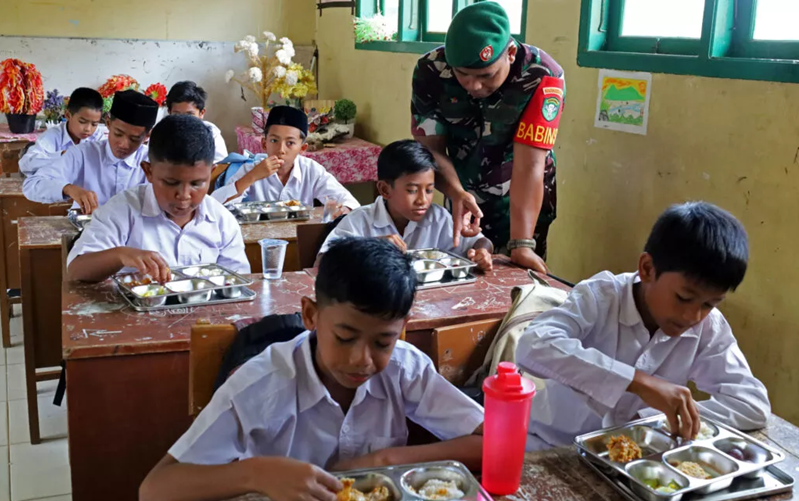
Fatal free lunch

November 20, 2025

Indonesia’s free meals for kids program has left thousands of youngsters with food poisoning, and returned the country to the bad old days of military influence.

“All power flows from the barrel of a gun,” said Mao Zedong. His aphorism may have been right a century ago in China, but not in modern Indonesia. In the nation next door, power comes subtly via unarmed brigadiers in boardrooms. The riflemen are there, but out of sight.

Professional corporations with genuine jobs to fill normally advertise for the best certified and experienced applicants to stay innovative and competitive. Patronage appointments kill such management essentials.

Meat and veggie buyers, cooks, hygiene inspectors, nutritionists, quality controllers, agricultural advisors – there are scores of positions with Makan Bergizi Gratis (MBG) the free meals for kiddies’ programme.

The venture is to stop stunting through malnutrition – a most worthwhile goal – so standards should be high.

They’re not. Much of the work is being done by young guys hired to kill but employed to care. No surprise that more than 10,000 children have reportedly been gripped by food poisoning,

Dirty kitchens, food left to the flies, delivery delays, and hands and workbenches unwashed – the list is extensive and the blame clear: kitchens are no place for enlistees.

Video grabs of screaming students on classroom floors, fouled by vomit and diarrhoea, have ensured widespread coverage and demands that the program be shut until fixed.

That won’t happen, because the initiator of this stench is President Prabowo Subianto, 74, who swept into power last year on the promise of free tucker. It remains his flagship policy, and to stall would show defeat – difficult for an ageing authoritarian who knows he knows best.

The goal is 75 million meals a week through 1,400 kitchens by the end of this year – the cost A$10 billion.

Next year, the budget is expected to blow out threefold. Economists fear health and education money boxes will get raided and services suffer, though not the military, which is on an international weapons-buying spree.

By 2027, the MBG could gallop past A$27 billion, overtaking the defence allocation of A$18 billion.

It shows what goes wrong when a voter-grabbing policy first scribbled on a restaurant receipt isn’t backed by thought-throughs on infrastructure and planning. The public gets fed up with delays in implementing promised change – but here’s a good reason why patience is prudent.

When Prabowo won the election last year and flaunted his pledge, the applause was worthy of a footy win, though players knew there were too few cooks and bottle washers and a dearth of commercial kitchens.

The solution? Conscript the army.

Soldiers who joined for adventure, a uniform, a haircut and the chance to shoot dissidents in Papua found themselves scrubbing food trays.

Corruption has reportedly flooded the fractured system as a tsunami of unchecked government cash swirls around the dishes of cold soup and burned rice. The service is a continuous rush; no time for audits.

The policy of employing the military in civic affairs was refined by the Republic’s second president, former army general Soeharto. When he was overthrown in 1998 by students preaching democracy, dwifungsi (two functions) was also ditched. Now it’s back with Prabowo, also a former general and Soeharto’s former son-in-law.

There are already ten departments and industries where the military rules. They’ve also seized 3.7 million hectares of private palm-oil plantations and handed them to a state-owned company.

The Kuala Lumpur-based youth NGO World Order Lab voiced its concerns: “Partisan loyalty has increasingly dictated appointments, often sidelining professional qualifications in leadership. This is no accident but a calculated strategy of power consolidation, which signals that loyalty and political stability outweigh technocratic competence.

Patronage appointments undermine the crucial link between responsibility and expertise, leaving critical programs in the hands of those unprepared to manage them.”

The military is getting bigger, spreading wider and digging deeper. Orwell’s Big Brother was a wimp when measured against the Indonesian military’s ambitions.

Expect uniforms everywhere. Regional commands will be doubled to cover most of the archipelago’s 38 provinces. One hundred ’territorial development’ battalions will deploy units in 7,285 kecamatan (districts) within five years.

This isn’t secret stuff – the Defence Ministry published a full-page explanatory ad in the Kompas newspaper. The headline read Bukan Lagi Sekadar Militer: Pertahanan Rakyat Gaya Indonesia (No longer just the military: Indonesian-style people’s defence). No need for a catchy title – it’s an order.

It listed plans to enlarge battalions specialising in health and agriculture between now and 2030, claiming these have expanded and transformed “people’s defence based on prosperity and cross-sector collaboration”. The reasoning here is impenetrable.

The ad was published  “to counter public perception that these actions represent militarisation.” The public’s perception has been clear – so have the commentators.

Veteran Bloomberg Asian affairs columnist Karishma Vaswani warned: “The military’s increased influence (is) potentially enabling human rights violations and corruption.

“(The Kompas ad) was an attempt to normalise the presence of soldiers and generals in everyday life, potentially giving them the kind of influence they had during the Soeharto era…. an outsized role in politics and governance.

“A rejuvenation of the military’s power will reinforce (Prabowo’s) image as a leader who cannot rule without the assistance of the army.”

The Tentara Nasional Indonesia (TNI – Indonesian armed forces) has embedded itself in the national legend for almost eight decades, starting with guerrilla heroes routing the returning Dutch colonialists in the late 1940s.

Through its untouchable status, the TNI has boosted incomes and officers’ salaries by running foundations, factories and co-ops. Men in khaki moved off parade grounds onto the boards of banks, insurance companies, and even big retailers.

Soldiers are supposedly prohibited from business activities, though this is widely overlooked. The TNI is proposing a law change so Army wives can run village kiosks, though the real reason is to legitimise jobs for officers in civil businesses.

Perceptive readers of Pearls and Irritations would have foreseen that Indonesia was sliding into the black pit of military control when a story was published of MPs in fatigues at a post-election boot camp.

The few who still uphold democracy were dismayed; others saw it as a chance for selfies of giggling pols flashing thumbs-up. They should have been down.

The views expressed in this article may or may not reflect those of Pearls and Irritations.

Duncan Graham

Duncan Graham has been a journalist for more than 40 years in print, radio and TV. He is the author of People Next Door (UWA Press). He is now writing for the English language media in Indonesia from within Indonesia. Duncan Graham has an MPhil degree, a Walkley Award, two Human Rights Commission awards and other prizes for his radio, TV and print journalism in Australia. He lives in East Java.

President Wenda: December 1st a celebration of West Papuan unity

NOVEMBER 4, 2025

On behalf of the ULMWP, I declare this December 1st to be a celebration of West Papuan unity.

In that spirit, I acknowledge and welcome the statement of support for me as President of West Papua from West Papua National Liberation Army (TPNPB) spokesperson Sebby Sambom and Chief of Staff Terianus Satto. This is a major step forward for our movement and I thank Sebby and Terianus for their important message. We know our enemy always seeks to divide us. We must all move toward the same mission: one people, one soul.

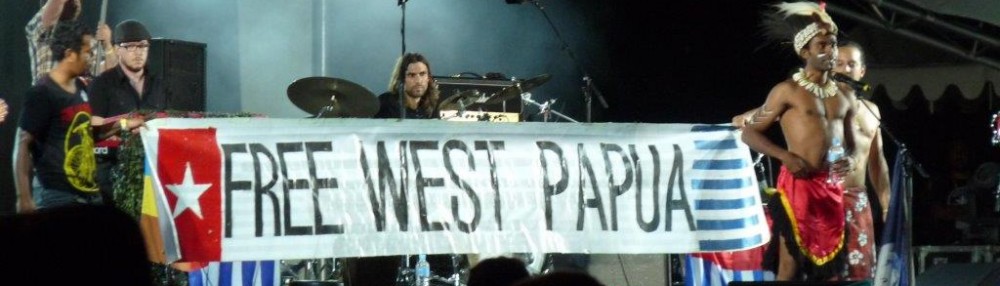
This December 1st I call on all West Papuans, wherever you are, to honour the Morning Star by wearing its colours on your clothes. We must show the Indonesian colonisers that the spirit of the struggle is as much a part of West Papua as the clothes we wear.  

Every December 1st, West Papuans celebrate our Independence Day in 1961, when our nation announced itself to the world as the first liberated Melanesian state. In a ceremony witnessed by six countries, including the UK, France, the Netherlands, and our neighbour Papua New Guinea, the New Guinea Council raised the Morning Star and sang our national anthem for the first time. Our freedom may have been stolen from us by Indonesia’s invasion two year later, but we still honour 1961 as our national day.  

The situation on the ground is worse than it has been since 2019. Every day brings a new massacre, a new killing, a new incident of torture or rape. In the past three months, we have seen the murder of fifteen Papuans in Intan Jaya, the relentless bombardment of the Star Mountain, the killing of children and mothers, and riots triggered by racist abuse of Papuan students in Yalimo. 

At the same time, Indonesia’s war criminal President Prabowo is continuing with the destruction of the Papuan rainforest. The National Strategic Project (PSN) in Merauke is the biggest plantation in human history: it is a planet killer.  

These events show how urgent the need for unity among West Papuans is. We know that all West Papuans support Merdeka, whether in the bush, the village, the refugee camps or the cities. But we cannot have any hope of saving our people or protecting our forest if we don’t stand together. I therefore urge my people, continue to rally behind the ULMWP. This is your government and your constitution. We have thousands of representatives across our land. 

We know our enemy will exploit any division between us. By unifying, we honour our ancestors and all those who have fought against Indonesian colonial rule. They joined the struggle because they believed that one day, the Morning Star would fly freely in every village and town across West Papua.  

To our supporters around the world, please raise the Morning Star on November 1st. Our national flag is illegal in our own country. If we raise it, paint it on our faces, or shout for freedom in the streets, we can be imprisoned for twenty-five years. We can also be shot dead, as 18-year-old Obert Mirip was in July. This is why we need our allies to fly the flag for us. 

Benny Wenda
President 
ULMWP

Indonesian President Prabowo visits Australia. Will PM Albanese raise West Papua?

AWPA Statement 11 November  2025

Indonesian President Prabowo visits Australia. Will PM Albanese raise West Papua?

Barring any last minute changes, the Indonesian President Prabowo Subianto, will visit Australia on Wednesday 12 November. His first visit to Australia since taking office. His last visit was in August 2024 as Defence Minister.

 2024 visit  (Photo Jakarta Post) President-elect Prabowo Subianto meets with Australia’s Prime Minister Anthony Albanese at Parliament House in Canberra, Australia, August 20, 2024. (Reuters/AAP Image/Mick Tsikas )

Joe Collins of AWPA said, “we are going to hear the usual statements about how our relationship/friendship with Indonesian is one of our most important”.

From PM Albanese media release (11 November 2025)

“Australia and Indonesia share a deep trust and unbreakable bond as neighbours, partners and friends. Together we are committed to working for a secure, stable and prosperous Indo‑Pacific.

“I look forward to building on our previous discussions about how we can develop the strength and depth of our bilateral relationship.”

https://www.pm.gov.au/media/visit-australia-president-republic-indonesia


Collins said, “Although improving trade will be the number one topic in the talks, we can be sure the usual issues of defence ties, terrorism and security in the region will also be on the agenda”.

“The one issue that won’t be discussed will be the human rights situation in West Papua”.

There will be no mention of the massacre of 15 West Papuans  on the 15 October 2025 during  a security force operation in Soanggama Village in the Intan Jaya Regency, Central Papua. During the military operation the security forces conducted house to house searches and opened fire in an indiscriminate fashion resulting in 15 deaths. The massacre was condemned by civil society, church groups throughout the region 

and by Sen Lida Thorpe (Victoria). 

https://www.aph.gov.au/Parliamentary_Business/Hansard/Hansard_Display?bid=chamber/hansards/28876/&sid=0126

There will be no mention that there are more than 102,966 Internally displaced people in West Papua due to Indonesian security force operations or that there are ongoing human rights abuses committed by the security forces in the terrority.

No mention of the fact that the TNI arrest and torture  West Papuans”.  No mention of the fact that there are regular crackdowns on peaceful demonstrations with West Papuan activists arrested and intimidated” 

And

no mention of the fact that Prabowo  was  dismissed from the Indonesian army in 1998 for kidnapping student activists or that he  has  been accused  of involvement in  human rights abuses in East Timor  and West Papua, accusations that Prabowo has denied.


Joe Collins said, “we have been told in replies to our letters (to DFAT) that the Australia Government does raise the human rights situation in West Papua with Indonesia, however, we have yet to see any public statements from the Government on the issue. 

As West Papuan National Flag day approaches, 1st December, supporters around the world will be raising the unfree flag of West Papua in a show of solidarity with the West Papuan people. A reminder to governments and in particular to the Australia Government the issue is not going away.

How UN betrayal of West Papua led to genocide, step by step

by Julie Wark 24th October 2025

The United Nations has recently come under attack from the Trump Administration and, much as it goes against the grain, it’s difficult to argue with real-estate-developer-cum-ambassador-representative for UN Management and Reform [sic], Jeff Bartos:

“Over 80 years, the UN has grown bloated, unfocused, too often ineffective, and sometimes even part of the problem. The UN’s failure to deliver on its core mandates is alarming and undeniable.”

Yet the problem isn’t really the UN. One notable symptom of its malaise is the Security Council and its five veto-playing permanent members — the US, UK, France, China and Russia — representing the world system that assist and cover up for their allies who commit human rights violations, war crimes and genocide, and that also outsource such crimes. But lèse-humanité is the crime par excellence of the international system. It’s a basic principle of colonial “development”. So what follows isn’t about kicking the UN when it’s down, but about how the rulers of this system use any institution, democratic or otherwise, to achieve their own diabolical and white supremacist ends.

I’m sorry — in more ways than one — that this article is long.

It’s long because the list of UN (when I refer to the UN, I’m basically referring to the world system) offences against the people of West Papua is hideously long. Sadly, my list is by no means complete because there’s lots of “classified” material I don’t know about and many, many secrets, but I hope it gives a glimpse of how the international system works when it wants to get whole encumbering peoples out of its way.

I’m taking it as given that Indonesia is committing genocide in West Papua. It’s done stealthily but there’s plenty of evidence (for example, see here, here, and here) for it. However, the facts show that, in this six-decade-plus crime against humanity, Indonesia has been the tool of other interests, that the role of the United Nations (by which I mean some of its dominant powers and personalities) has been particularly egregious, and this is surely one of the reasons why the West Papua genocide has continued sub rosa, deliberately silenced, for more than 60 years. There are many aspects of the UN betrayal because they belong to big-power politics and they’re convoluted because of the secrecy that surrounds them.

This isn’t about an isolated instance of genocidal violence. It fits into a world system where white supremacist brutality, going back at least to the period of early modern European overseas expansion from the 15th century, the so-called Age of Discovery (a quintessentially Eurocentric concept), turned into a “scientifically-based” system with the Enlightenment and didn’t end with decolonisation. I’d suggest, after reading documents from the time when West Papua was gifted to Indonesia, that the latter was less the West’s darling than a mere instrument unscrupulously used to favour the economic and geopolitical interests of white supremacy and its destructive notions of “progress and development”. It’s not only the various Indonesian regimes that are responsible for mass murder in West Papua, but also and especially their enablers in the international political system represented by the UN and the big powers.

I can only partially list the crimes committed against West Papua (and, here, I’m indebted to painstaking research by Julian McKinlay King, John Saltford, Greg Poulgrain, and others). But even an incomplete list gives an idea of the magnitude of this lèse-humanité, this core crime of international law. I’m not interested in “speaking truth to power” because I agree with Pankaj Mishra that this is a naïve exercise. Those in power know and control the truth. I studied politics and am not an expert in international law so I hope I don’t misinterpret some aspects of it. In any case, the hard facts are enraging for any decent human being. Experts in international law are often too invested in, or too occupied with, other aspects of the corrupt system to inquire into the evidence of Indonesia’s daily genocidal actions in West Papua, and too demoralised to try to stop them through the shoddy institutions at their disposal. Yet any non-expert person who cares to look at the documents can see quite plainly that, in the last almost 65 years of West Papua’s history, the UN has played a shameful role, not only allowing this to happen but deliberately colluding with it. The very forum that has the power to stop the genocide is complicit in it.

It was only recently that the UN finally acknowledged that Israel is committing genocide in Palestine, and I can’t help wondering whether all this fudging about the word is somehow related with fear of disclosure of the UN’s active role in abetting and silencing the West Papua genocide. I list 43 aspects of this below.

For the full article please see below.

The article in CounterPunch does list 43 separate paragraphs which are a real work of research and worthwhile reading editors note

Republished from CounterPunch, 24 October 2025

The views expressed in this article may or may not reflect those of Pearls and Irritations.