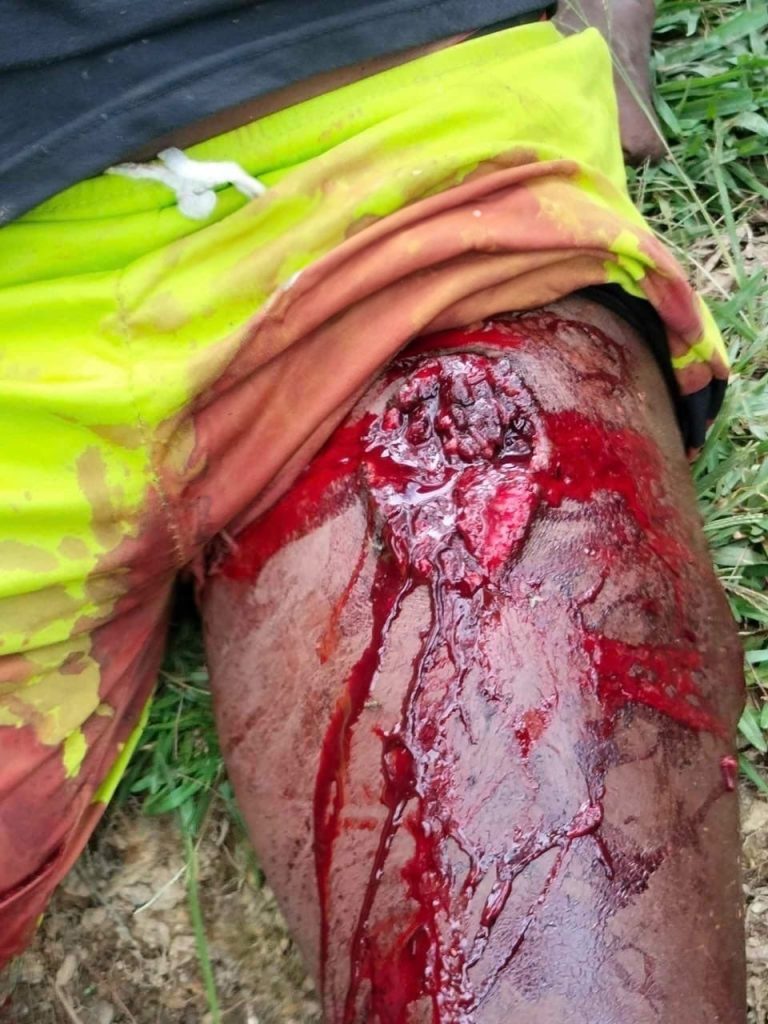
Sabrina Asril, Jakarta — The Indonesian Legal Aid Foundation (YLBHI) has condemned the arrest of nine palm oil farmers in the area of the new capital city Nusantara (IKN) who were opposing the construction of the VVIP Airport in North Penajam Paser, East Kalimantan, on Monday February 26.
“The YLBHI condemns the actions of the East Kalimantan regional police who carried out the inhuman and arbitrary arrests, because it was done without showing an arrest warrant and did not clearly notify them of the reason they were arrested”, said YLBHI Chairperson Muhammad Isnur said in a written statement on Monday.
Isnur said that the arrests can be categorised as a systematic act against communities defending their right to life. According to Isnur, the arrest of nine farmers by the police as a case of using the law to coerce the community.
“The police for the umpteenth time have used this method, in securing national strategic projects (PSN)”, said Isnur.
Isnur said that the same thing had happened at the Rempang Eco-City project in the Riau Islands and in the case of a land dispute in Seruyan, Central Kalimantan.
“The actions of the East Kalimantan regional police violated the law and human rights, where any person who is arrested has the right to be told the reason why they were arrested and the police are required to show an arrest warrant”, said Isnur.
Earlier, nine members of the Saloloang farmers group in North Penajam Paser (PPU) were arrested by the police on Saturday evening, February 24. The arrests were related a land dispute between a group of farmers and the IKN VVIP Airport national strategic project.
East Kalimantan regional police public relations head Senior Commissioner Artanto said that the nine farmers were arrested because it was said that they had threatened the IKN VVIP Airport construction project.
Artanto explained that on Friday February 23, a group of people approached VVIP project workers and threatened them so they would stop working.
The next day, on Saturday at around 8.30 am, the group returned to stop the construction of the VVIP Airport. The incident occurred on the northern side of Zone 2 when they brought Mandau (a kind of sword made in Borneo) and the operators immediately stopped work.
“On the basis of the incident, field supervisors at the location of the planned VVIP Airport made an official police report with the PPU regional police on that day as well”, Artanto said on Monday.
[Translated by James Balowski. The original title of the article was “YLBHI Kecam Penangkapan 9 Petani Sawit di Wilayah IKN”.]
A leaked document circulating on the Internet detailing the reasons behind the dismissal of presidential candidate Prabowo Subianto from military service on Aug. 21, 1998, has cast doubts on the former general’s suitability to serve as president, if elected on July 9.The document, which was a scanned copy of the official letter signed by members of the Indonesian Military’s (TNI) Officer’s Honorary Council (DKP) tasked with hearing the cases of Prabowo’s complicity in the kidnapping of pro-democracy activists in 1998, revealed that the former Army’s Special Forces (Kopassus) commander was also fired from his position due to insubordination.Signatories in the document include then Lt. Gen. Susilo Bambang Yudhoyono, the current President; then Army chief of staff Gen. Soebagyo Hadi Siswoyo; Lt. Gen. Fachrul Razi; and Lt. Gen. Agum Gumelar.If the authenticity of the document is verified, it could deal a blow to Prabowo’s credibility as a military man and presidential candidate.The document states Prabowo, as Kopassus commander, overstepped his authority by ordering the Mawar and Melati units to ‘arrest and detain’ the activists of the radical People’s Democratic Party (PRD).Mawar and Melati are military units under the command of Kopassus, which answer to the commander of the TNI.However, the document reveals the Mawar unit did not act on its own initiative, like Prabowo’s campaign team have repeatedly claimed.The document suggests the Mawar unit carried out the kidnappings after Prabowo reassured them that it ‘had been reported’ and that the operation was based on ‘a direct order from on high’, when in fact a report was never made by Prabowo to then Indonesian Armed Forces (or ABRI, as the TNI was then known) commander Gen. Wiranto.The kidnapping was only reported in April 1998 after pressure from then head of the Armed Forces Intelligence Body (BIA) Maj. Gen. Zacky Anwar Makarim.The document, which was uploaded on the website indonesia-2014.com, is the first document made public that details how Prabowo was dismissed from the military.The document states the DKP not only dismissed Prabowo on charges of human rights violations in relation to the abductions, but also on a number of other actions that demonstrated his insubordination and disregard for the military code.Among the other charges brought against him in the DKP hearing were that Prabowo had carried out or had taken over several operations that were under the authority of the ABRI commander, including the involvement of military forces in East Timor (now Timor Leste) and Aceh; the release of hostages in Wamena in then-Irian Jaya; and Kopassus’ involvement in securing president Soeharto’s visit to Vancouver, Canada in 1997, shortly before the strongman was ousted from power.In conclusion, the DKP said Prabowo had disgraced and disregarded the military system and committed a criminal offense.In response to the circulating document, the leader of the Prabowo-Hatta Rajasa election campaign team, Mahfud MD, reiterated that Prabowo was honorably discharged from the military.’Pak Prabowo did receive his marching orders, but take note that he was discharged with respect,’ Mahfud told reporters at Polonia House in East Jakarta.’There is no problem with this document circulating, I want to emphasize it [the dismissal] was done with respect. It would only be a problem if he were dishonorably discharged,’ the former Constitutional Court chief justice said. (tjs)
Jakarta — Scores of civil society organisations have expressed their opposition to President Joko “Jokowi” Widodo’s decision to award Defense Minister Prabowo Subianto with an honorary rank of four-star general.
The Coalition believes that the policy is a transactional electoral political move and that Widodo wants to annul Prabowo’s involvement in past gross human rights violations.
“With regard to this decision, the Civil Society Coalition condemns giving an honorary promotion in rank (HOR) of four-star general to Prabowo Subianto. This is not right, but also injures the feelings of the victims and betrays the 1998 reformasi [process]”, said the groups in a written statement on Wednesday February 28.
The Coalition is making five recommendations. First, that Widodo cancel giving the honorary rank to Prabowo.
Second, that the National Human Rights Commission (Komnas HAM) must seriously investigate the cases of crimes and gross human rights violations committed by Prabowo. Third, the Attorney General must conduct a criminal investigation into and prosecute cases of gross human rights violations in 1997-98.
“The government, in this case the president and his officials, must pursue the DPR’s [House of Representatives] 2009 recommendations, namely forming an ad hoc Human Rights Court, finding the 13 abduction victims that are still missing, rehabilitating and providing compensation to the families of the missing victims and ratifying the Convention Against Enforced Disappearances”, said the Coalition.
Fifth, the TNI-Polri (Indonesian military-Indonesian police) must maintain neutrality and not be involved in political activities.
The opposition to Prabowo’s honorary rank was conveyed by 22 organisations. They are the Commission for Missing Persons and Victims of Violence (Kontras), Indonesian Human Rights Watch (Imparsial), the Indonesian Association of the Families of Missing Persons (IKOHI), Asia Justice and Rights (AJAR), the Indonesian Legal Aid Foundation (YLBHI) and the Community Legal Aid Institute (LBHM).
Then the Institute for Public Research and Advocacy (ELSAM), the Human Rights Working Group (HRWG), the Indonesian Legal Aid and Human Rights Association (PBHI), Centra Initiative, the Lokataru Foundation for Human Rights, Amnesty International Indonesia, Public Virtue, the Setara Institute for Peace and Democracy and Migrant Care.
The Institute for Ecosoc Rights, Greenpeace Indonesia, the Public Interest Lawyers Network (Pil-NET Indonesia), Kontras Surabaya, the Banten Legal Aid Foundation for Justice (LBH Keadilan), the Institute for Legal Development and Human Rights (LPSHAM) and the Kontras Federation.
President Widodo has denied that awarding Prabowo with an honorary rank of four-star general is a reciprocal move and a form of transactional politics.
“Yeah, if was transactional politics we would have given it to him before the elections”, said Widodo after attending a TNI-Polri leadership meeting in Cilangkap, East Jakarta, on Wednesday February 28.
“This is after the elections, right, so there wouldn’t be any suspicions like that”, he added.
Widodo explained that giving the honorary rank to Prabowo was a proposal from the TNI commander which did not come out of the blue but rather through various processes. (dhf/pmg)
Notes
In 1997-98 as many as 23 pro-democracy activists were abducted by members of the Army’s Special Forces (Kopassus). After extended periods of detention — in many cases the victims were severely tortured — most were released although 13 remain missing and are presumed dead. Former Kopassus commander Lieutenant General Prabowo Subianto, who was at the time President Suharto’s son-in-law, has admitted to ordering the abductions but claims they were all released alive and well. He was subsequently dismissed from the military over the abductions but has never been tried in court.
[Translated by James Balowski. The original title of the article was “Ramai-ramai Tolak Pangkat Jenderal Kehormatan Prabowo”.]
Indonesia’s president-elect, Prabowo Subianto, has form. As the son-in-law of the former dictator, Suharto, he rose quickly through the ranks of the military to become head of the greatly feared Indonesian special forces, Kopassus. To put it bluntly, in 1983 he was involved in one of the biggest massacres in Indonesian-occupied Timor-Leste, in Kraras in the south of the country. His soldiers killed up to 300 men, women and children in the biggest mass killing in Timor-Leste’s 24-year war with Indonesia. He was also involved in the killing of the first president of Timor-Leste, Nicolau Lobato, whose body was taken by Indonesian forces and never recovered.
Prabowo was finally thrown out of the army in 1998 following the detention and disappearances that year of pro-democracy Indonesian activists in Jakarta, who were protesting against Suharto and calling for his overthrow. Thirteen of the activists disappeared and were never seen again, presumed killed by Kopassus troops who were under his command. Prabowo was given a travel ban to the United States, where he had previously trained in counterinsurgency with US special forces at Fort Benning and Fort Bragg, and to Australia. He has always denied his involvement in kidnapping, torture and killings, and has never been charged in relation to any of the allegations against him and his men.
Prabowo orchestrated the strategy of separating those fighting for independence and the population. In Timor-Leste, Aceh and West Papua, troops under his command carried out countless casual human rights abuses.
Coopting former resistance fighters into his own control was one of the lessons he learnt in America and he put it into effect firstly in Timor-Leste. He created auxiliaries called Hansips and later two notorious Indonesian-led but Timorese-staffed battalions, 744 and 745. Both were among the most brutal towards their own people. They killed civilians, students, nuns, priests and journalists, right up until the final Indonesian withdrawal in 1999. Prabowo orchestrated the strategy of separating those fighting for independence and the population. In Timor-Leste, Aceh and West Papua, troops under his command carried out countless casual human rights abuses.
Some acts, such as the prominent killing of West Papuan leader Chief Theys Eluay in 2001, were blamed on his subordinates, who were given brief and sometimes-ignored convictions and jail terms.
Prabowo rose quickly in the military. By the age of 32, he was a major. He was untouchable and powerful. When I spoke to Indonesian human rights workers, student activists, independence supporters, members of Timor-Leste resistance fighters Falintil in the mountains, or their civilian supporters in Fretilin and CNRT, Prabowo’s name always came up.
I remember talking to Munir, an Indonesian human rights leader who had come to Timor-Leste after the fall of Suharto in May 1998 to document the abuses of the Indonesian military there. In August 1998, he told me about Prabowo’s role in recruiting and organising the Indonesian-led and funded militias that were starting to form back then in Timor-Leste. Munir was later killed by a poisoned cup of orange juice on a Garuda flight to Singapore as he tried to flee Indonesia after reporting on Indonesian military abuses in Aceh. Kopassus was blamed.
In many ways August, September and October in 1998 were extraordinary times in Timor-Leste. The Indonesian military, unsure if it was allowed to shoot demonstrators as it used to under Suharto, stood aside as Timorese students mounted louder and more heavily attended rallies in the capital Dili and in regional centres such as Manatuto and Baucau.
The lid was off and they came in their thousands, chanting, singing and waving pro-independence flags. Apart from the occasional killing, the Indonesian military seemed to tolerate the speeches and calls for independence, but they were always there watching, taking photos and video, identifying those who spoke out. They always had guns and you never knew if that day was the day they would start shooting.
As the protests continued, I joined the students on a trip to Lacluta in the remote south-east of the island. The trip down there felt like a day off – sitting in an open-backed truck. The group sitting on the roof would sing the solo verse and the others the chorus. The villagers couldn’t believe their defiance. We got to Viqueque.
There had been trouble in the area: houses burnt, a few men killed by a new group of Indonesian soldiers. When we arrived for the rally the next day it was mostly the students from Dili and a few old people. Horrible things had happened in this area. On August 8, 1983, Indonesian soldiers from Battalion 501, who later trained in Australia, entered the town of Kraras and began rounding up the men. They killed them all in a group and threw their bodies in a swamp. They killed the children by swinging them against walls or stabbing them with knives. There had been 3000 people living in this village and only about 1300 escaped. The killings in that area went on until September.
Later, when the militia violence was in full swing, I went up into the mountains to interview the Falintil commander Falur Rate Laek. Things had cracked down and it involved lots of planning. There was a long drive and a long mountain walk in monsoonal rain, trying to be quiet to avoid Indonesian military patrols. It was hard and nerve-racking. In this sparse mountain camp of tarps with bush thrown over the top, the guerillas spoke in whispers. I had done this before and knew what to expect. The threat of being captured with them was ever-present. They were taking a risk to speak and I was taking a risk going up there.
Ostensibly I was there to interview Falur Rate Laek about the recent killings in the village of Alas. The Indonesian soldiers and militia had killed at least 50 men the previous November. I had walked there too and been run out of town by armed Indonesians troops and militia, who shot at me and my guide as we scrambled up the muddy hill to get out of that place.
I got Falur’s version of the killings, which his men had witnessed. After endless coffee and cigarettes in the night, our talk turned to Prabowo. I knew Falur had once been in the Indonesian army and had deserted back to Falintil. I asked him why. He told me he had been forced to join the Indonesian military in 1980 and deserted in 1983. He told me it was because of what he had seen in Kraras.
He wanted to talk and, with the rain pelting down on the branch-covered tarp, he spoke in a low voice. He told me he had never talked to a Western journalist about this before.
He told me he was forced to witness the killing of his own people in Kraras in 1983 – when the entire male population, including children, were killed by the Indonesian military. After that, he rejoined the guerillas in the bush. He told me the troops who carried out the killings were under the command of then Captain Prabowo Subianto, who was head of Koppasandha, later to become Kopassus, in the district at the time. Prabowo may not have been there on the day – but it was his men who carried out the killings.
Prabowo is now president-elect of Indonesia. Lieutenant General Falur Rate Laek is now commander of the Timor-Leste Defence Force.
John Martinkus first wrote for The Saturday Paper in October 2015.
This article was first published in the print edition of The Saturday Paper on March 2, 2024 as “Chasing Prabowo in Timor-Leste”.
Jayapura, Jubi – The Bishop of Jayapura, Mgr. Yanuarius Theofilus Matopai You, has expressed concerns over the deployment of Indonesian Military (TNI) and Police personnel from outside Papua to the region, stating that it instills fear and discomfort among the local residents. Bishop Yanuarius made these remarks during a discussion titled “Quo Vadis Papua Land of Peace?” organized by the Secretariat for Justice, Peace, and the Integrity of Creation of the Franciscan Papua in Jayapura City on Monday, January 29, 2024.
“The excessive deployment of security forces causes the community to live in fear,” he said.
Bishop Yanuarius argued that the deployment of security forces to Papua, under the pretext of maintaining sovereignty, has significant implications for the lives of civilians. According to him, the people of Papua are already traumatized by the presence of the TNI and police.
“The deployment of forces is making security in Papua increasingly non-conducive. Papua is not a military emergency area. Yet the people have to leave their villages, gardens, and businesses and go elsewhere. Their lives are very difficult, and it continues,” he said.
Bishop Yanuarius emphasized that the central government should create space for dialogue. Dialogue is a wise step to discuss and find solutions to the conflicts in Papua.
“If the dialogue space is not opened, we will continue like this. What have we done wrong? What sins have we committed that the central government and the president allow us to live in this situation?” the Bishop questioned.
A report from the Democracy Alliance for Papua (AlDP) in 2023 noted that at least 10,250 TNI soldiers and 1,416 police from outside Papua were sent and stationed in the region. These thousands of security personnel are involved in various tasks, including the Cartenz Peace Operation, border security operations between Indonesia and Papua New Guinea, territorial community operations, public order, security operations for PT Freeport Indonesia, and Susi Air pilot rescue.
The Director of the Secretariat for Justice, Peace, and the Integrity of Creation of the Franciscan Papua, Alexandro Rangga OFM, emphasized the need for all parties to honestly discuss the issues in Papua. This is crucial for those with interests in Papua to take sincere actions to realize a peaceful Papua.
“We need to talk honestly about our home [Papua],” said Alexandro on Monday.
Alexandro stressed the importance of advocating for a peaceful Papua as conflicts persist in the region. He expressed concern that armed conflicts could escalate and trigger dangerous horizontal conflicts or conflicts between residents.
“If not, the slogan Papua Tanah Damai (Papua Land of Peace) that started 22 years ago will remain just a slogan. Those experiencing the lack of peace in Papua are the people themselves, regardless of the decisions made by political elites. The pressure on the people is increasing, and it is dangerous because every reaction to anarchic actions has a comprehensive effect in Papua,” he added. (*)
Jayapura — The Papuan people and the West Papua National Committee
(KNPB) in the Meepago area have welcomed the acquittal of Haris Azhar and Fatia Maulidiyanti who were found not guilty by the East Jakarta District Court on Monday January 8.
Azhar and Maulidiyanti are human rights activists who were found not guilty in a case of defamation brought against them by Coordinating Minister for Maritime Affairs (Menko Marves) and Investment Luhut Binsar Pandjaitan.
The case began when Azhar and Maulidiyanti appeared in a YouTube podcast titled “There is Lord Luhut behind the Economic Relations-Military Operations in Intan Jaya!! There are also State Intelligence Agency Generals!! NgeHAMtam”.
“Myself along with the Papuan people in Meepago and Dogiaya, we welcome the news of the release of Haris and Fatia by the [East] Jakarta District Court which today decided to free them. We welcome this and we say this is a victory for the Papuan people, that what Haris and Fatia fought for in the conflict in Papua was something that was true”.
“Therefore this truth will continue to win anywhere and the people are together with Haris and Fatia”, said KNPB international spokesperson Victor Yeimo on Monday in South Kamu, Dogiya regency, Central Papua province.
“We convey to the government of the Republic of Indonesia, especially to Luhut Binsar Pandjaitan (Menko Marves). Stop the military businesses in Papua, especially in the Wabu Block. We convey that the people of Meepago, the people of Intan Jaya, Dogiaya and Deiyai firmly reject the Wabu Block project being developed in Papua, especially in Intan Jaya”.
Yeimo said that the Papuan people have suffered since the gold-and-copper mine PT Freeport was established in Papua.
“We, the people of Papua, have experienced suffering along with the presence of PT Freeport. Don’t let there be any more companies in the Wabu Block with military businesses that conduct massive exploitation of Meepago land”.
“We, the people of Meepago, firmly reject military projects, projects of the Oligarchic elite from Jakarta. We [stand] together with Haris and Fatia. The truth will always win out!”, Yeimo concluded.
[Translated by James Balowski. The original title of the article was “Vonis Bebas Haris dan Fatia Disambut Rakyat Meepago dan KNPB, Victor:
Jayapura, Jubi – In 2023, according to ELSHAM Papua’s Director, Rev. Matheus Adadikam, there were numerous instances of arbitrary arrests conducted by the Indonesian Military (TNI) and Police across various regions in Papua. These incidents occurred in Boven Digoel in January; in Wamena in February; in Puncak Regency in March; and in Nduga in April.
Additionally, there were internal displacements in Paro, Nduga in February following the Susi Air pilot’s abduction, the West Papua National Liberation Army’s (TPNPB) shootings in Ilaga in March, and civilian property looting allegedly by the TNI in the Kuyawage area in April.
Adadikam stated to Jubi on the eve of the new year that there were still numerous armed clashes and sweeps throughout 2023 that claimed the lives of civilians.
Reflecting on the human rights situation in Papua, he mentioned that ELSHAM Papua observed a continuous stream of events violating human rights in the region, including persistent conflict without resolution, the perpetuation of militaristic policies, favoritism towards capitalist investors, and practices of impunity.
“Moreover, the criminalization of activists, stifling of expression, extrajudicial killings, internal displacements, racist rhetoric, and animosity persisted, highlighting the ongoing human rights issues in Papua,” said Adadikam.
ELSHAM Papua viewed the promises made by President Jokowi regarding the resolution of past human rights violations in Papua in December 2014 and the establishment of the Human Rights Violation Settlement Team in 2022 and 2023, as merely gestures, and an insincere one.
Adadikam noted that these initiatives seemed more like attempts to improve Indonesia’s global image after scrutiny by the UN Human Rights Council, rather than genuine efforts to address human rights violations.
Considering the persistent conflict, ELSHAM Papua stressed the necessity for the state to earnestly work towards resolving ongoing conflicts in Papua, urging an end to militaristic approaches and the excessive use of force against civilians in conflict zones.
Furthermore, Adadikam highlighted the need for the state to ensure civilian safety in Papua and specifically appealed for the release of the Susi Air pilot, held captive since February 2023, as a humanitarian gesture. (*)
Jayapura — West Papua National Committee (KNPB) international spokesperson Victor Yeimo says that the Jayapura immigration office has banned him from overseas travel (dicekal) and refuses to issue him a passport.
Yeimo conveyed this to Suara Papua after receiving an online travel ban notification from the Immigration Intelligence and Enforcement
(Inteldakim) Section on Thursday December 8 at 9.49 am.
According to Yeimo, this is because of a travel ban that had been issued by the national police (Polri) on December 25, 2021.
He says that the ban is a violation of his human rights because he has been released from prison and is no longer linked to any criminal cases.
“I think that the immigration department should not restrict my rights as a citizen to have a passport as an overseas travel document”, said Yeimo.
Yeimo said that when he was at the immigration office he explained that he was no longer linked to any cases, however immigration officials suggested that he first ask the police to revoke his travel ban on the Cekal Online website.
Thus as a follow up, he said, he will ask for legal assistance to write to the Papua regional police chief and the Papua Justice and Human Rights regional office to ask that the overseas travel ban be revoked immediately because it has the potential to restrict his rights as a citizen.
Yeimo is a KNPB activist and political prisoner who was convicted of makar (treason, rebellion, subversion), and was only released from the Abepura Correctional Institution in Jayapura on Saturday September 23.
He was charged with makar because he was deemed to have organised demonstrations that took place in Jayapura city in 2019 on August 19 and
29 protesting racist slurs directed against Papuan students at the Kemasan III Papua student dormitory in Surabaya, East Java, on August 16, 2019.
On November 10 Yeimo was given the Voltaire Empty Chair award by the Australian organisation Liberty Victoria for his perseverance in defending human rights in Papua.
[Translated by James Balowski. The original title of the article was “Victor Yeimo Dicekal dan Paspornya Tidak Diterbitkan”.]
Jayapura, Jubi – Frits Ramandey, the Head of the Papua Office of the National Commission on Human Rights (Komnas HAM Papua), revealed that his office received 65 complaints concerning alleged human rights abuses in Papua from January to December 2023. This announcement came during the 75th World Human Rights Day commemoration in Jayapura, Papua Province, on Sunday, December 10, 2023.
Ramandey stated that out of the 65 complaints, 43 were related to alleged violations of civil and political Rights, predominantly involving armed violence.
“Meanwhile, the remaining 23 complaints were related to suspected violations of economic, social, and cultural Rights,” he added.
He further disclosed that as a consequence of the reported violence, 40 people died, 41 were injured, one was held captive, and one person went missing. These victims consisted of civilians (59), health workers (5), members of the West Papua National Liberation Army or TPNPB (10), Indonesian Military (TNI) soldiers (5), and police personnel (3).
“We are deeply concerned about the continuous string of violence. Our condolences go out to the victims,” he expressed.
Ramandey emphasized that the ongoing and repeated violence indicated flaws in handling the situation in Papua. He highlighted the significance of the Humanitarian Pause appeal made by several national figures in Jakarta on November 9, 2023, aimed at easing armed conflicts and improving the situation in Papua. Efforts to ease armed conflicts are essential for managing refugees and initiating peaceful dialogues in Papua to halt violence.
“Otherwise, the cycle of violence will only escalate,” he warned.
Komnas HAM Papua urged the TNI and police as well as the TPNPB to cease armed violence and seek legal and humanitarian approaches to resolve issues in Papua. They also called upon the provincial and municipal governments in Papua to prioritize human rights issues and create a violence-free living environment.
Additionally, Komnas HAM Papua stressed the importance of considering the rights of indigenous communities in the development of the newly formed province resulting from the division of Papua Province, in line with human rights values and principles. (*)
4) Komnas HAM Papua voices concern over freedom suppression in Papua
News Desk – Freedom Of Expression In The Land Of Papua
14 December 2023
Jayapura, Jubi – Frits Ramandey, the Head of the Papua Office of the National Commission on Human Rights (Komnas HAM Papua), highlighted the consistent stifling of citizens’ freedoms by the state through police authorities in Papua. Speaking during the 75th World Human Rights Day commemoration in Jayapura on Sunday, December 10, 2023, Ramandey stressed that the values of freedom, equality, and justice for all in Papua are yet to be fully realized.
He emphasized that the freedom of expression and public opinion in Papua has consistently been and suppressed by the police, creating limited space for citizens to voice their aspirations.
“Human rights values must be respected, protected, and fulfilled by the state,” he stated.
Additionally, a report titled “Dong Penjarakan Tong Pu Suara dan Pikiran” (They Suppressed My Thoughts) by Pusaka Bentala Rakyat in 2022 documented 26 alleged cases of freedom of expression violations in Papua. These incidents led to three fatalities and 72 injuries, with 361 individuals arbitrarily detained. Among those arrested, 26 faced legal proceedings, and 18 were charged with subversion, facing potential life imprisonment.
Also speaking in the same event, Onan Kobogau, the Chair of the Student Executive Board of Timika University, reported that the Mimika Police forcefully disbanded the commemoration of World Human Rights Day in Timika, detaining 41 individuals. Kobogau and four others sustained injuries from police using firearm butts.
Jubi tried to obtain a response from the Mimika Police Chief Adj. Sr. Comr. I Gede Putra regarding the disbandment of the World Human Rights Day commemoration in Timika but to no avail as of Sunday. (*)
The U.S. State Department named two Indonesians – including a candidate for the House of Representatives in next year’s election – among its international list of “perpetrators of human rights abuses” on Friday.
The list, released to mark the 75th Anniversary of the Universal Declaration of Human Rights on Dec. 10, named Hartomo, a former military officer who is seeking office in the Feb. 14 election, and Terbit Rencana Perangin-Angin, a former regent of Langkat in North Sumatra province.
Hartomo, who goes by one name, “is being designated for his involvement in gross violations of human rights, namely extrajudicial killing,” the State Department said.
He held the highest rank, lieutenant colonel, of a group of soldiers accused of killing Theys Eluay, chairman of the Papua Presidium Council, in November 2001, according to media reports.
A member of former President Susilo Bambang Yudhoyono’s Democratic Party, Hartomo is seeking to represent Central Java in the legislature.
Lt. Col. Hartomo (left), Capt. Rionardo, 1st Sgt. Asrisal and Pvt. Achmad Zulfahmi hear the indictment against them at the Surabaya Military Court in Indonesia, Jan. 3, 2003. [AFP]
Terbit Rencana “is being designated for his involvement in gross violations of human rights, namely the forced labor of boys and men,” the news release said.
The iron-barred rooms were discovered four months earlier when the Corruption Eradication Agency searched the house and found 27 people inside the cells. Terbit Rencana, who was arrested at that time, said his residence housed drug addicts who were undergoing rehabilitation.
Police said 656 people had been held in the two cages since 2010.
Promoting Accountability in Support of the 75th Anniversary of the Universal Declaration of Human Rights FACT SHEET
OFFICE OF THE SPOKESPERSON
DECEMBER 8, 2023
On Human Rights Day and the 75th Anniversary of the Universal Declaration of Human Rights, the Department of State, in coordination with the Departments of the Treasury and Homeland Security, is taking actions to promote accountability for perpetrators of human rights abuses. State is taking steps to impose visa restrictions on four individuals pursuant to Section 7031(c) of the Annual Appropriations Act, 11 individuals pursuant to Section 212(a)(3)(C) of the Immigration and Nationality Act, designating one People’s Republic of China (PRC) individual pursuant to the Uyghur Human Rights Policy Act (UHRPA), and designating two ISIS-DRC leaders pursuant to Executive Order (E.O.) 13224, as amended. On Human Rights Day and the 75th Anniversary of the Universal Declaration of Human Rights, the Department of State, in coordination with the Departments of the Treasury and Homeland Security, is taking actions to promote accountability for perpetrators of human rights abuses. State is taking steps to impose visa restrictions on four individuals pursuant to Section 7031(c) of the Annual Appropriations Act, 11 individuals pursuant to Section 212(a)(3)(C) of the Immigration and Nationality Act, designating one People’s Republic of China (PRC) individual pursuant to the Uyghur Human Rights Policy Act (UHRPA), and designating two ISIS-DRC leaders pursuant to Executive Order (E.O.) 13224, as amended. Treasury is designating 20 individuals pursuant to E.O. 13818, which builds upon and implements the Global Magnitsky Human Rights Accountability Act, as well as E.O. 13667, E.O. 13413 as amended by E.O. 13671, and E.O. 13664. These actions also implement the Presidential Memorandum on Promoting Accountability for Conflict-Related Sexual Violence. Homeland Security is also adding three PRC-based companies to the Uyghur Forced Labor Protection Act (UFLPA) Entity list.
….
Indonesia
State is designating two individuals pursuant to Section 7031(c).
Terbit Rencana Pergangin-Angin, Former Regent of Langkat, Indonesia. He is being designated for his involvement in gross violations of human rights, namely the forced labor of boys and men.
Hartomo, Former Official of the Indonesian National Armed Forces. He is being designated for his involvement in gross violations of human rights, namely extrajudicial killing.
———————– — etanetanetanetanetanetanetanetanetanetanetanetan Support ETAN. Donate now: https://www.paypal.com/paypalme/etan009 John M. Miller etan@igc.orgCoordinator, East Timor and Indonesia Action Network (ETAN)PO Box 1663, NY, NY 10035-1663 USAPhone: (917)690-4391 www.etan.orgTwitter/Instagram: @etan009 Send a blank e-mail message to info@etan.org to for information on other ETAN electronic resources on East Timor and Indonesia etanetanetanetanetanetanetanetanetanetanetanetan