Unknown's avatar

About AWPA Adelaide administrator

AWPA Adelaide site manager

Kanaky ( New Caledonia ) to vote on Independence in 2018

Islands Business Magazine Published in 2018 March

by Nic Maclellan


‘At the dawn of a new day’

FLNKS Congress calls for “full sovereignty”

AS New Caledonia’s FLNKS independence movement met in congress last month near the northern town of Poum, the theme highlighted the importance of the coming year: “Yet Tim Men Ta Yabwat” (At the dawn of a new day). After decades of campaigning, a decision on New Caledonia’s political status is looming.

The exact date is still to be announced, but New Caledonia’s referendum on self-determination must be held before the end of the year, after a 20-year transition established by the 1998 Noumea Accord. Opponents of independence believe that they will win the vote and retain their current status within the French Republic. After generations of settlement and migration, the indigenous Kanak people are a minority in their own country, so mobilising independence supporters in the lead up to the referendum is all the more important. The 36th Congress of the Front de Libération Nationale Kanak et Socialiste (FLNKS) met at Arama on 3-4 February.

The meeting provided a crucial opportunity for delegates and activists to build common understanding on issues that have long been debated within the broad independence coalition. For many years, there have been internal tensions over leadership, how to negotiate with conservative pro-French parties and the best path for a transition to a new political status. But with only months remaining until the referendum, there is a need to promote unity amongst the four political parties that comprise the FLNKS: Union Calédonienne (UC); Parti de Libération Kanak (Palika); Rassemblement Démocratique Océanien (RDO); and Union Progressiste Mélanésien (UPM). The first President of the FLNKS, JeanMarie Tjibaou, was assassinated in 1989 and the position was later filled by Palika’s Paul Neaoutyine and UC’s Roch Wamytan. But since 2001, the independence coalition has been unable to agree on a President.

To avoid potentially divisive debates over leadership, the Arama Congress decided to leave the position vacant and instead appointed UC President Daniel Goa as its official spokesperson within New Caledonia, the region and internationally. Debating the path forward As the largest and oldest member of the independence movement, UC has long called for the adoption of full, sovereign political independence.

The other FLNKS members have been more open to variations of political status. Palika President Paul Neaoutyine has declared his party is open to discussing “l’indépendance avec partenariat” (independence with partnership), which would establish New Caledonia as an independent nation but with an ongoing relationship with France. Despite these differences, the FLNKS congress “reaffirmed its objective to have the country accede to full sovereignty in the referendum scheduled for this year 2018.”

If New Caledonia’s Congress cannot agree on a date for the referendum by May this year, the French State must hold the referendum at least six months before next Congressional elections in May 2019. For this reason, everyone is gearing up for a referendum in late October or November, preparing for a public campaign in the months before the vote. One of the central concerns for independence supporters has been to meet the legal requirement that potential referendum voters must be registered on the general electoral roll.

The Congress called on independence activists appointed to the Special Administrative Committees which register voters “to maintain the greatest possible vigilance during the forthcoming work to update the special lists and especially those for the referendum.” The United Nations Special Committee on Decolonisation is expected to send a mission to New Caledonia this month, to monitor the work of these Special Administrative Committees, as they finalise the voting roll that will be released publically in August. The FLNKS Congress reaffirmed its call for automatic registration of all indigenous Kanaks of voting age, echoing a central concern of the Rassemblement des indépendantistes et nationalistes (RIN).

The RIN is a loose network outside the FLNKS that includes more radical proindependence groups like the Parti Travailliste (PT), Dynamique Unitaire Sud (DUS), the USTKE trade union confederation and individual activists. UC President Daniel Goa has floated the idea of re-incorporating all pro-independence forces – including political parties, trade unions and churches – within the FLNKS. However this idea was not accepted by Palika and UPM at the Arama congress. Instead, the congress resolution called on “independence supporters, progressives and nationalists to support the planned accession to full sovereignty and to re-join the structures created by the FLNKS to undertake a campaign at local level.”

This aims to reinforce the “Comités Nationalistes et Citoyens” (CNC), a network of local action groups in tribes and towns across the country. The CNC were created in 2016 as a structure for independence supporters to campaign together at the grassroots, regardless of political affiliation. Young people share their vision This spirit of cooperation was evident amongst young Kanaks at the Arama meeting. A key feature of the congress was the strong presence and coordination of young people, who have not been involved in longstanding political jousting amongst their elders, often dating back to the 1970s. Each of the FLNKS member parties has a separate youth wing, but younger delegates caucused together and issued a joint statement from the congress.

The youth declaration called for “a sovereign Kanaky-New-Caledonia, as a multicultural, secular, democratic and united republic.” The united youth network will organise a series of cultural and sporting events during 2018, so that “young New Caledonians, whoever they may be, can join the movement for national unity so our country can access full sovereignty.” New Caledonian leaders across the political spectrum will meet with French Prime Minister Edouard Philippe and other representatives in March for the next Committee of Signatories to the Noumea Accord.

This meeting, one of the last before the referendum, will address outstanding issues over the referendum process, as well as the transfer of the remaining “Article 27” powers from Paris to Noumea (including control of the university, TV and radio, as well as the ADRAF land reform agency currently managed by the French State). To continue the momentum towards the vote, the FLNKS will hold a national convention in April.

This meeting will see the formal launch of the independence movement’s campaign, in the lead up to a scheduled visit by French President Emmanuel Macron. Since last year, the FLNKS has been developing a proposal for “a sovereign Kanaky-New-Caledonia,” with ideas for economic, political and cultural reform that will be the centrepiece of the referendum campaign. Beyond its mobilisation on the ground, the FLNKS congress resolutions highlighted the importance of international solidarity, including the “historic and ongoing support of the Melanesian Spearhead Group,” support from the Non-Aligned Movement as well as churches, NGOs and trade unions (a notable omission from the list is the Pacific Islands Forum, given the rapprochement between France and key Forum member states like Australia). To mobilise international support during 2018, the FLNKS will soon name overseas representatives as official spokespeople in Europe and the Pacific islands.

The movement will also send a team to build support for independence and sovereignty in French Polynesia and Wallis and Futuna (key constituencies, given the large Tahitian and Wallisian populations living in New Caledonia). Soon after the congress, FLNKS delegates travelled to Port Moresby for the MSG summit. As a signal to the host government, the Arama congress “reaffirmed its unshakeable support for the United Liberation Movement of West Papua (ULMWP) in its combat for human rights and the right to self-determination in West Papua.” The FLNKS congress also resolved to support nationalist movements in Corsica, Catalonia and French Polynesia – signalling their support for allies in the debate over autonomy, decentralisation and independence that is raging around the globe, from Spain to Indonesia and Papua New Guinea, from old Caledonia to New Caledonia.
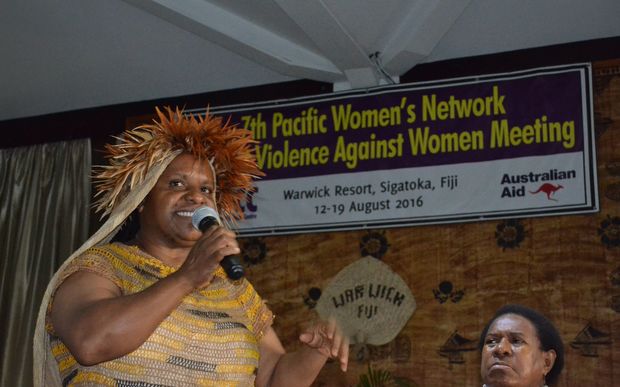
4 out of 10 West Papuan women found to have been subjected to Indonesian state violence

4 out of 10 West Papuan women found to have been subjected to Indonesian state violence

October 19, 2017

Research by the Papuan Women’s Working Group together with the Asia Justice Rights (AJAR) has revealed shocking levels of Indonesian state violence being committed towards West Papuan women. Of the representative 170 indigenous West Papuan women surveyed between 2013 and 2017, 64 of them (4 out of 10) had been subject to violence committed by Indonesian state authorities.

Some of the violence the West Papuan women testified experiencing included: Shootings, torture, sexual violence, arbitrary detention, husbands/family members lost or killed, husbands/family members detained, and property which was stolen or damaged.

When releasing the research results on 18th October, Selviana Yolanda, from AJAR stated that util now, there has been no consistent effort from the Indonesian state and civil society to restore and empower victims of state violence and human rights abuses. In fact, Selviana said, they now have no access to health and other public services because they have been labeled as part of the Free West Papua movement. She added that in one village in Wamena, a group of widows whose husbands were killed during the 1977-1978 massacres were forced to live together in very isolated conditions. According to Selviana, the unresolved continuing impact over the years has left West Papuan women who are the victims of violence; marginalized from all walks of life, sick and living in poor conditions. They lost their wealth and livelihoods due to the conflict.

“Women who suffered torture, sexual violence we find from the 70s or 80s whose children were shot, tortured and so on are still alive; but living in discrimination because there is a stigma attached to them”. She added, “So for us the violence is not over.”

Systematic Indonesian state violence against women in West Papua has continued unabated ever since Indonesia invaded West Papua in 1963. In a public report to the U.N. Commission on Human Rights in 1999, the Special Rapporteur on Violence Against Women concluded that the Indonesian security forces used rape “as an instrument of torture and intimidation” in West Papua, and “torture of women detained by the Indonesian security forces was widespread”.

For more information on violence against women in West Papua, please read this very informative article in the Guardian. 

Indonesia seizes illegally logged wood from Papua


http://www.tampabay.com/indonesia-seizes-illegally-logged-wood-from-papua-ap_worldcf9cf9ff573e4ef5ab6fec4b56cecd0e

2) Indonesia seizes illegally logged wood from Papua

Published: March 9, 2018


JAKARTA, Indonesia (AP) — Indonesian authorities foiled the shipment of 21 containers of prized ironwood from Papua, highlighting what environmentalists say is a rampant illegal trade in the country’s easternmost region.

The Forestry and Environment Ministry’s law enforcement agency said the wood from the Kaimana tropical forest was processed and ready for shipment to Surabaya when seized. The city has a major port and is a center of Indonesia’s wood furniture manufacturing and export industry on the island of Java.

Greenpeace Indonesia said the confiscation, which was made Tuesday and announced Thursday, is small compared with long-standing smuggling from Papua where no “big actors” have been prosecuted. The region has Indonesia’s largest remaining tropical forests and is seen by logging and palm oil companies as a new frontier for exploitation after the stripping of most of Java, Sumatra and Borneo of natural forests.

Indonesia was admitted in 2016 to an EU arrangement that makes it easier for Indonesian wood producers to export to the bloc if they’ve been certified by Indonesia’s new Timber Verification and Legality System, known by its local acronym SVLK.

Some environmental and civil society groups have said the system, meant to provide certainty about the origin of wood, could easily become a conduit for illegal timber from a country where tropical forests have been cut down at an epic rate.

The ministry said investigations by police and its staff in Papua revealed a scheme for transporting and processing the wood and then shipping it once the desired quantity had been accumulated in warehouses at a West Papua port. Apparently falsified documents were to be used for the transport of the illegal wood.

It said police have arrested a suspect, who is a director of one of the companies involved, who could face up to 15 years in prison and a fine of up to $140,000.

Ironwood is prized for its beauty and strength and is used as flooring and in joinery.

Greenpeace Indonesia forests campaigner Charles Tawaru said weak supervision is one factor why the illegal timber trade continues to flourish in Papua and a significant amount of wood is shipped out without verification.

On the ground, oversight through the timber verification and legality system had weakened because of the absorption of the district forestry service into the larger provincial apparatus, he said.

Earlier this week, the U.K. ambassador to Indonesia, Moazzam Malik, said the SVLK system had provided a major boost for Indonesian wood exporters.

“The SVLK standard that Indonesia created, actually with an enormous U.K. investment over a 15-year timeframe, is something that’s given Indonesian wood exporters access to the European market on a no restrictions basis,” Malik said at a Jakarta Foreign Correspondents Club event.

“A world first, really a very major boost and that industry is responding really well,” he said.

—————————————————————

Solomon Islands Deputy Prime minister seeks apology

http://www.solomonstarnews.com/index.php/news/national/item/20179-dpm-says-fiji-should-apologise


06 March 2018


DPM says Fiji should apologise


Deputy Prime Minister Manasseh Sogavare says Fijian PM Frank Bainimarama should apologise to MSG member countries.


Deputy Prime Minister (DPM) Manasseh Sogavare says Fiji Prime Minister (PM) should apologise to the member countries of the Melanesian Spearhead Group (MSG) for admitting Indonesia as an associate member.


Speaking on the floor of parliament yesterday, DPM says Fiji PM Frank Bainimarama should apologise to the MSG member countries for admitting Indonesia as an associate member which was totally un-procedural.


“There was no consensus in the admission of Indonesia by member countries.”


He said Fiji PM solely made the decision to admit Indonesia into MSG and forced the member countries to endorse it.


But DPM revealed that when it comes to the application for membership by the United Liberation Movement for West Papua (ULMWP) into MSG, Fiji PM talks about the strict criteria to be followed to become a member.


“Which continue to be a difficulty for ULMWP to become a full member of MSG,” said the DPM.


Sogavare said the application by ULMWP is consistent with that of the Socialist National Liberation Front (FLINKS) of New Caledonia when they apply for membership.


DPM was speaking during the question and answer session in Parliament when Member of Parliament (MP) for Aoke/Langalanga Matthew Wale asked PM Rick Hou to answer the questions related to his apology MSG member countries for the sour relationship over the past years.


He said, MSG is a purely political body to free Melanesia from colonisation but this is not the case today as their interests have been shifted from its fundamental purpose that establish the organisation.


Mr Sogavare said, if MSG stands on the very purpose and the founding principles upheld by the MSG leaders who started the organisation there should not be any difficulty in admitting ULMWP full membership.


He said ULMWP is a political entity representing the indigenous people of West Papua who a Melanesians, so there is no problem to admit them full membership in MSG.


Arguing that MSG has been shift from its original purpose to protects the rights and freedom of Melanesia from colonialism.


“Close association of Fiji with Indonesia is sabotaging the work of MSG and their membership in MSG is not political but economic interest.”


He concluded that Fiji and Papua New Guinea strongly allied with Indonesia therefore their relationship continues to sabotage the work of MSG to uphold its purpose.


By AATAI JOHN LAUNGI


etanetanetanetanetanetanetanetanetanetanetanetanetanetanetan

A Written Submission to the 37th Regular Session of the United Nations Human Rights Council by the Asian Legal Resource Centre

A Written Submission to the 37th Regular Session of the United Nations Human Rights Council by the Asian Legal Resource Centre

INDONESIA: Impunity strengthened while past human rights abuses remain forgotten

The Asian Legal Resource Centre (ALRC) wishes to inform the UN Human Rights Council (UNHRC) of the lack of seriousness of President JokoWidodo’s government in resolving past human rights abuses. This is contrary to the Nawa Cita, President Widodo’s vision and mission, which clearly states that he will ensure prosecution of past human rights abuses cases, and it also has a breakdown into a National Medium-Term Development Plan (RPJMN 2014-2019), which states that the government will ensure protection of its citizens. The RPJMN also clearly states that human rights cases are one of the government’s priorities.

Since the April 2016 national symposium discussing the 1965-1966 massacre, there has been no further effort made by the government to deal with past abuses. At the same time, several retired army generals allegedly involved in past human rights abuses have been appointed as cabinet members by President Widodo. Retired Army General Wiranto for instance, allegedly involved in crimes against humanity in East Timor during the 1999 referendum, and in the Trisakti and Semanggi student shootings of 1998-1999, has been appointed as Coordinator Minister of Politic, Law and Security (Menkopolhukam). Retired Army General Ryamizard Ryacudu, former army chief, has been appointed as Defense Minister. He is allegedly involved in the murder of prominent Papuan activist Mr. Theys Hiyo Elluay. Furthermore, while Army Chief in 2003, Ryacudu led the implementation of martial law by the Indonesian Armed Forces in Aceh Province, which caused various human rights violations.

Retired Army General Hendro Priyono meanwhile, has a very close relationship with President Widodo, having played a strategic role in supporting Widodo during the presidential election. Priyono is alleged to have been involved in the Talangsari massacre as well as the murder of human rights activist Munir Said Thalib.

Since 2003, seven cases of past human rights abuses submitted by the National Commission on Human Rights (Komnas HAM) to the Attorney General (AG) for further investigation, as regulated by Law No 26 of 2000 on Human Rights Court, are sitting in the AG’s office with no further investigation undertaken. These seven cases are: 1# Student shootings in Trisakti and Semanggi 1998-1999; 2# Enforced disappearances of student activists 1997-1998; 3# May tragedy 13-15 May 1998; 4# Talangsari massacre 6-7 February 1989; 5# 1965-1966 massacre; 6# Mysterious shooting 1981-1983; 7# Wasior and Wamena Papua 2001-2003. Continue reading →

60 Years of diplomatic relations with Indonesia: black marks on the record card

GUEST BLOG: Maire Leadbeater – 60 Years of diplomatic relations with Indonesia: black marks on the record card

By   /   February 27, 2018  /   No Comments

TDB recommends Voyager – Unlimited internet @home as fast as you can getThe Ministry of Foreign Affairs has a snazzy theme to promote the 60th anniversary of the establishment of diplomatic relations with Indonesia: ‘60 years as friends for good’.

The Ministry of Foreign Affairs has a snazzy theme to promote the 60th anniversary of the establishment of diplomatic relations with Indonesia: ‘60 years as friends for good’.

I’m all for friendship with the Indonesian people, but the diplomatic relationship has been badly marred over the years by our complicity and silence in the face of a long list of human rights crimes.  The 24 year Indonesian occupation of East Timor is a well-known example, but there are other egregious examples including  the matter of the 1965 massacres, when the ‘New Order’ regime set about killing half a million people accused of  ‘communist sympathies’.  New Zealand officials were well-informed about the scale and arbitrary nature of killings,  but they welcomed Suharto’s rise to power and one diplomat told a  1967 parliamentary committee that the transfer of power had been ‘surprisingly peaceful’.   At that time New Zealand’s diplomatic representation in Jakarta was upgraded from a Legation to a full Embassy.

New Zealand’s diplomatic relations with Indonesia began in 1958 when Dr A. Y. Helmi, Indonesia’s Canberra based Ambassador,  was accredited to New Zealand, and in 1961 New Zealand’s Colombo Plan office in Jakarta was upgraded to a Consulate General.   Back then there was a strong focus on New Zealand aid – especially educational and technical training support.

One of the first clouds on the horizon came in 1960.   The future of Netherlands New Guinea, as it was at the time, was at a crossroads. The Dutch were preparing the territory for eventual independence, but Indonesia was insisting that it should be incorporated into the Indonesian Republic.  The other half of the New Guinea island –today’s Papua New-Guinea- was administered by Australia under UN mandate.  New Zealand’s Prime Minister, Walter Nash, put forward a proposal that the two halves of the New Guinea Island should be placed under joint trusteeship and prepared for eventual independence as one country.  Nash put forward his initiative in The Hague in May 1960 and this prompted a trip across the Tasman by Dr Helmi.  Declassified reports show that Dr Helmi’s attempt to sway Mr Nash from his position wasn’t successful. Nash said that the people of New Guinea might need more time to get ready, but one day, like people everywhere, they would want to be independent.

Nash underestimated the forces against him – the United States and Australia had come to the conclusion that Indonesia mattered more to them than the people of West Papua,  and were quietly letting the Dutch know that they would be on their own should Indonesia carry out its threats of force.  But he was on the right track and over the years Papuan leaders have often upheld the idea of one united country: ‘from Sorong to Samarai’.

Unfortunately, New Zealand soon fell into line, burying its qualms about the way the 1962 US brokered ‘New York agreement’ handed the territory to Indonesia on a plate.   Our Ambassador observed part of the subsequent 1969 so-called ‘Act of Free Choice’, and described a stage-managed process, but his critical report did not prompt any action.  During the UN debate that followed, New Zealand stayed silent, leaving it to newly independent African nations to speak up for the West Papuan people .

New Zealand acquiesced to Indonesia’s 1975 invasion of East Timor and helped Indonesia to cover up subsequent crimes even as the death toll approached  200,000. Three New Zealanders died in East Timor at the hands of the Indonesian military or militia during the Indonesian occupation:  photo-journalist Gary Cunningham in 1975, human rights activist Kamal Bamadhaj in 1991 and peacekeeper Leonard Manning in 2000.  Notwithstanding, New Zealand has worked hard to develop and maintain a close bilateral relationship with Indonesia – and because the military is so influential in Indonesian affairs that has included defence ties.  Military training ties were suspended in 1999 after the cataclysmic violence in East Timor but resumed again in 2007 in the absence of any indication that the military had changed its spots or been held accountable for its crimes in East Timor.

Sadly, this is very much an ongoing issue as New Zealand says as little as possible about Indonesia’s ongoing crime of ‘slow genocide’ in West Papua.  In January it emerged that dozens of children of  the  Asmat tribe had died of measles exacerbated by widespread malnutrition. The Asmat,  famed for their elaborate carving and wood sculptures, struggle to preserve their way of life and diet against the predations of forestry, palm oil plantations and mining. Yet they live, metaphorically speaking,   in the shadow of the Freeport  McMoran gold and copper mine, Indonesia’s largest taxpayer.

The Papuans are calling for their right to self-determination to be respected but for successive New Zealand governments that is an ‘s’ word, never to be uttered for fear of offending Indonesia.   Sixty years yes, for good – hardly.


Maire Leadbeater is one of NZs leading human rights activists. Currently her focus is the human rights abuses in West Papua.

ULMWP Can Pass Muster: Foreign Minister

ULMWP Can Pass Muster: Foreign Minister

http://dailypost.vu/news/ulmwp-can-pass-muster-foreign-minister/article_bf4c30a1-de70-561e-bd14-9f38b1d1e54d.html


In a brief message yesterday, Vanuatu Foreign Minister Ralph Regenvanu responded to an Indonesian spokesman’s claims by Indonesia’s First Secretary for Political Affairs in Australia that West Papua’s ‘game is up’.

Radio New Zealand reported earlier this week that Mr Sade Bimantara said that the “United Liberation Movement for West Papua’s bid to be a full member of the Melanesian Spearhead group has reached a dead end.”

In the interview with RNZI’s Johnny Blades, Mr Bimantara opined “I don’t think they qualify to be a full member of the MSG. They are not a state, and as opposed to Kanaks, they are not on the C24 (UN) Decolonisation Committee, they are not on the list, West Papua. And also the separatist group does not obtain full support from all the West Papuans. And West Papua and Papua is also politically free, so there’s no reason for the MSG to accept them as full members.”

This was disputed yesterday by Vanuatu’s Foreign Minister. In an email exchange with the Daily Post, Mr Regenvanu wrote, “Well, that’s for the MSG Leaders to decide once the application is presented to them.

“Technically, the ULMWP can meet the new criteria just agreed upon.”

The issue, he wrote, would not be decided by the technicalities outlined by Indonesia’s spokesman. “The question is only whether a political compromise can be achieved by the MSG Leaders before the next Summit at which the application for membership will be considered.”

“Vanuatu is working on achieving this political compromise,” he concluded.

Mr Regenvanu has been an outspoken supporter of West Papuan Independence movement. One of his last acts as Lands Minister before he took up the Foreign Affairs portfolio was to facilitate a grant of land to provide the United Liberation Movement for West Papua a permanent headquarters in Port Vila.

A ULMWP statement following the announcement of Mr Regenvanu’s appointment to the portfolio said that it “is certainly a very effective state policy closely linked to the direction of the effective support of… Vanuatu for the West Papuan independence struggle.”


INDONESIA: Environment activists in Tumpang Pitu sentenced to 10-month imprisonment

ASIAN HUMAN RIGHTS COMMISSION – URGENT APPEALS PROGRAMME

Urgent Appeal Case: AHRC-UAU-001-2018

8 February 2018

[RE: AHRC-UAC-101-2017: Mining operations in Tumpang Pitu result in environmental damage and fabricated charges; AHRC-UAU-006-2017: Tumpang Pitu villager in mining operations is the victim of a fabricated case]
———————————————————————
INDONESIA: Environment activists in Tumpang Pitu sentenced to 10-month imprisonment

ISSUES: Environmental damages, fair trial, impunity, remedy, due process of law, Rule of Law, fabricated case, human rights defenders
———————————————————————

Dear Friends,

The Asian Human Rights Commission (AHRC) has received updated information regarding the Banyuwangi district court’s sentence of Mr. Heri Budiawan alias Budi Pego, an environment activist, to 10-months imprisonment. In addition, three other activists as well as community members also have been named as suspects, and an investigation is still going on. Budi Pego along with the local community of Sumberagung village conducted advocacy efforts to stop the mining operation in Tumpang Pitu, Banyuwangi regency, East Java province. They called for the protection of the environment, but were criminally charged with crimes against the State. Budi and the other three activists /community members were falsely accused of putting and circulating the Communism logo (hammer and sickle) on their anti-mining banners.

UPDATED INFORMATION:

On Tuesday, 23 January 2018, the judges of Banyuwangi district court sentenced Mr. Heri Budiawan (also known as Budi Pego) on the charges of spreading Communist ideology. The judges sentenced him to 10-month imprisonment, a much lower sentence than the prosecutor’s petition of seven years.

The case began on 4 March 2017, when Budi Pego and the local community of Sumberagung village, Pesanggrahan sub-district organized a peaceful protest, displaying banners of “reject mining” against the Bumi Suksesindo Company (PT. Bumi Suksesindo/PT BSI) in Tumpang Pitu, Banyuwangi regency. Budi Pego and the local community displayed the banners along the road of Pulau Merah until the Pesanggrahan sub-district office. Suddenly, at 12 p.m., five unknown persons carrying cameras approached the community members, and gave two banners to them. The unknown persons requested the community to display these two banners as well, and then took some pictures of them.

According to some witnesses, it is impossible for Budi Pego or the locals to put the Communist hammer and sickle logo on the banners, as the police officers guarding the protest would immediately have arrested them. This did not occur.

Moreover, the public prosecutor was not able to present the two Communist banners as evidence during the trial process in Banyuwangi district court. The judges have ignored this lack of evidence and merely considered the expert testimony presented by the public prosecutors, while ignoring the expert testimony presented by the public defenders. The expert presented by the public defenders stated that the hammer and sickle in the banner shown in the court through video is not enough and cannot be included as a proper evidence without the two original banners. The expert added that the local community involved in the peaceful anti-mining protest had not said a single word about Communism or Marxism.

Besides Mr. Budi Pego, in total there are three more local environment activists who have been named as suspects: Mr. Cipto Andreas, Mr. Trimanto and Ms. Dwiratnasari. The police charged them using article 107a of Law No 27 of 1999 on the revision of the Criminal Law related to crimes against the State. In Article 107 a, it states that “Anyone who publicly violates the law with oral, written and/or through any media, disseminates or teaches Communism/Marxism-Leninism in any kind of forms is punishable by a maximum of 12 (twelve) years imprisonment.”

ADDITIONAL INFORMATION:

Communism is still used as a tool to restrict or even criminally charge human rights defenders who critique and advocate against the government policy not in favor of human rights and rule of law. Last year the AHRC also noted human rights violations committed by anti communist mobs against human rights groups, for instance forced dissolution and brutal attack against public discussion organized by the Indonesian Legal Aid Foundation, Jakarta Legal Aid and association of victims and family of victims 1965-1966 massacre (AHRC-UAC-130-2017). We also documented and reported harassment and forced dissolution of movie screenings and workshops organized by civil society in some provinces of Indonesia such as West Java, Yogyakarta and East Java province.

SUGGESTED ACTION:

Please write to the authorities listed below. Ask them to ensure that all criminal charges against Mr. Heri Budiawan, known as Budi Pego, an environment activist and a villager of Sumber Agung village, Banyuwangi, East Java Province, must be evaluated by the High Court of East Java province and the Supreme Court under fair trial principles. We also urge the police to stop any criminal charges against three other environment activists and also local community members, considering that under Indonesian law number 32 of 1999 on Environmental Protection, article 66 states, “Everybody struggling for a right to proper and healthy environment may not be charged with criminal or civil offense.” Furthermore, the government must immediately conduct legal audit upon the mining company operated in Tumpang Pitu, and the audit must be transparent, accountable and accessible for public (in particular local community) and media. Local community’s input and information about environmental damages due to mining operation in Tumpang Pitu must also be considered by the government.

The AHRC will write a separate letter to the UN Special Rapporteur on the Independence of Judges and Lawyers and the Independent Expert on the issue of human rights obligations relating to the enjoyment of a safe, clean, healthy and sustainable environment, calling for their intervention into this matter. Continue reading →

Jokowi to send critics to monitor condition in Asmat

Jokowi to send critics to monitor condition in Asmat Illustration. Residents are waiting for queue when they seek treatment at a community health center in Bayiwpinam village, Akat District, Asmat District, Papua. (ANTARA/M Agung Rajasa) ()


Situbondo, E Java (ANTARA News) – President Joko Widodo (Jokowi) has expressed his wish to send students to monitor the condition in Asmat, in the eastern province of Papua, after they criticized him over the situation.

“Perhaps, later, I will send the chairmen and members of Student Executive Board (BEM) from the top state University of Indonesia (UI) to Asmat,” he said, after attending an event in Salafiyah Safi`iyah Islamic boarding school in Sukorejo, Situbondo, East Java, on Saturday.

The chief of BEM of UI, Zaadit Taqwa, raised a yellow book to warn Jokowi over the recent spread of measles and malnutrition, which have claimed lives in Asmat, after the president gave a speech at an event to mark the university`s anniversary on Friday.

“Let them check the situation there for themselves and the big problems that we are facing in regions, especially Papua,” Jokowi noted.

He added that he had no problem with the student`s action. “Such a dynamic is common. He is a young activist. It is something common. I think it is good that there is someone to remind us,” he remarked.

BEM UI has demanded three things from the president. The first is related to the malnutrition problem in Papua, the second is connected to the idea of naming active police officers as acting governors, and the third is about the student organization, which is considered to limit students` movement.

Jokowi has sent a team to help measles patients, conduct vaccination programs, and prepare measures to deal with the post-outbreak condition. More than 71 children have died due to the measles outbreak in Asmat.

The president has also offered to relocate the people of Asmat to enable them to have better access to health facilities.

Reported by Desca Lidya Natalia
(H-YH/INE)
EDITED BY INE/a014
(T.SYS/B/KR-BSR/A014) 

We will lose everything : A Report on a Human Rights Fact Finding Mission to West Papua


Pictures from AWPA (SA) inc’s West Papua Public Forum 2nd November 2017


Dr Jim Elmslie  , Academic specialist  on West Papua with Rex Rumakiek , Executive member of the United Liberation Movement for West Papua who spoke at the Forum .

Rex discussed the presentation of a petition signed by 1.8 million West Papuans to the United Nations in September 2017  also spoke about the campaign to get more countries to sign up in support of West Papua and the call to have a democratic vote of Papuans about self determination.


Rosemary McKay , Chairing the Forum


Crowd scene from the Forum


Felix Patrikeef , Associate Professor , University of Adelaide and the Australian Institute of International Affairs , S.A. Branch, talking to the meeting


Peter Arndt, Executive officer , Catholic Justice & Peace Commission of Brisbane

Below is a link  to the report Peter and Sister Susan Connelly prepared about Human Rights abuses in West Papua when they visited recently . It is only 24 pages long but contains very hard hitting and valuable information .

we-will-lose-everything-may-2016(1)